Each year, dozens of groups apply to Miami-Dade County Public Schools, hoping to open a charter school.
If they want their plans approved, they'd better think ahead. They have to fill out the same application as charters elsewhere in the state. They also need to show the district:
These questions aren't all required in state law, but asking them has helped Miami-Dade minimize the number of charters that shut down within months of opening — a problem that plagues other large, charter-heavy districts in South Florida.
A recent review by the National Association of Charter School Authorizers said the Miami-Dade's system for reviewing charter applications helps "ensure it approves proposals with a high likelihood of success."
The country's fourth-largest school district is home to the fifth-largest number of charter school students. Tiffanie Pauline leads the district's charter school office, which is tasked with overseeing nearly 130 charter schools. While she's been working with state and national groups to promote better oversight, she says Florida's law could be changed to give districts clearer authority to stop unqualified schools.
Florida charter school applications are public records. That means groups sometimes plagiarize applications that have from other groups that have gotten approved. The state might need stronger laws to help weed out copycat applications, Pauline says.
Below are questions and answers submitted by email, edited for length and clarity. In a future post, we'll look at some changes she'd like to see in the state's charter school laws.
What does the volume of charter school applications look like in a typical year? How do you manage it?
Miami-Dade County Public Schools (MDCPS) receives the most applications across the state, and in many cases, more than most authorizers across the nation.
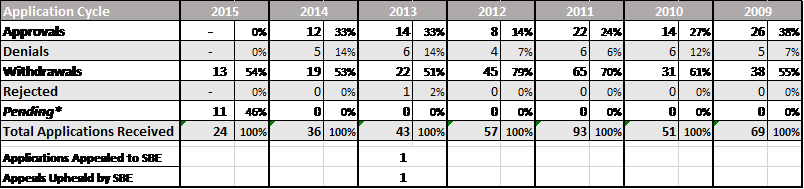 On average, MDCPS receives about 53 applications each year. It is our philosophy to scrutinize charter schools heavily on the front end, meaning during application review, to better ensure that quality charter schools open in our district. It is much more difficult to close down a bad charter school [after it opens]. It also impacts students and disrupts instruction.
Does Miami-Dade interview all charter applicants? What other steps does the district take to assess the quality of groups that apply to open charter schools?
Our application process actually starts with an orientation meeting for any interested applicants, which is held usually in May and/or July. This orientation clearly explains the District’s application process and sets clear expectations for anyone submitting an application to MDCPS.
The actual application review process consists of a two-level review. [We review each school's technical plans. Then a committee of senior staff from district departments – curriculum and instruction, school operations, facilities – reviews the school’s plans and recommends whether the school board should approve or deny the plan]. Our process is fair and transparent, yet rigorous.
MDCPS feels strongly that a face-to-face interview, by staff members closest to the work, is essential.
Do districts in Florida have the ability to deny charters based on their ability to run a school?
I believe that the interview, which is a national and state best practice, is a great way to evaluate an applicant’s capacity.
In an environment where one can contract with an experienced consultant to craft an application or simply present a public records request to districts for successful applications for review, the interview provides a great venue to determine if the applicant has the wherewithal to implement their proposed educational program.
The interviews … sometimes last over an hour. In many cases, applicants that lack capacity actually withdraw their application from consideration during the interview, which speaks directly to the rigor and value of our process.
How does the district find the authority to reject charter applicants that might appear on the surface to comply with the law, but whose qualifications or track records raise red flags?
I am of the opinion that currently there does not exist statutory authority to reject an applicant on capacity [to run a school] ONLY.
However, we are moving in the right direction with the new addendum to the state’s model application that requires the applicant to disclose historical information of the proposed operators and management company.
I am hopeful that future legislation will be crafted to support inclusion of applicants' [ability to run a school] in the review of a charter application, and to use lack of capacity as a basis for denial.
In Florida the performance of charter schools varies. Studies by CREDO and recent NAEP results suggest that in Miami-Dade they generally have a positive impact on student achievement. In other communities charter performance is mixed, and in others it's dismal. To what extent do authorizers share the credit or blame for the performance of charters in their communities?
Charter schools operate independently from district schools; therefore, I do not think it is appropriate for authorizers to share the credit nor blame. In Florida, the statutory role of the authorizer is one of compliance, oversight, and general technical assistance.
However, one may want to examine — specifically, in Miami-Dade — of the schools that are performing well, how many of them are replicating the curriculum, processes and practices of the district.

