By Lloyd Dunkelberger
News Service of Florida
TALLAHASSEE — State colleges could face higher costs after a new law revamped the dual-enrollment program for students at private high schools who take courses at public colleges and universities.
Dual enrollment is an increasingly popular program that allows students from grades six through 12 to take post-secondary courses that help them complete high school as well as get a head start on college degrees.
More than 60,000 students are using the program to attend state and community colleges and state universities.
During the 2015-2016 academic year, 56,245 dual-enrollment students attended Florida’s 28 state and community colleges, an increase of 12.5 percent over the 2011-2012 year, according to the state Department of Education.
In 2015-2016, 5,842 dual-enrollment students attended Florida’s 12 universities, according to the state Board of Governors.
The program is popular, in part, because dual-enrollment students pay no tuition and the costs of textbooks are covered. (more…)
The response to a school shooting at Marjory Stoneman Douglas High School overshadowed many other education issues before the Florida Legislature this year.
Appropriately so.
It's also an election year, which brings an earlier start to the legislative session and can limit policymaking bandwidth. But that didn't stop lawmakers from creating multiple new programs and pushing several long-standing school choice priorities over the finish line.
Here's a breakdown of what passed and what didn't, as far as educational choice is concerned. For comparison, it's worth looking at the agenda before the session started.
Hope scholarships
Victims of bullying or violence will have the ability to seek a transfer to another public school, or a scholarship to attend a private school. HB 7055
Charter schools
Charter schools that hope to open similar schools in new locations will be able to replicate twice per year, rather than just once, if they hope to open in areas that aren't served by persistently low-performing schools. Districts that want to shut down charter schools will have to appear before the state Division of Administrative Hearings. HB 7055
Reading scholarships (more…)
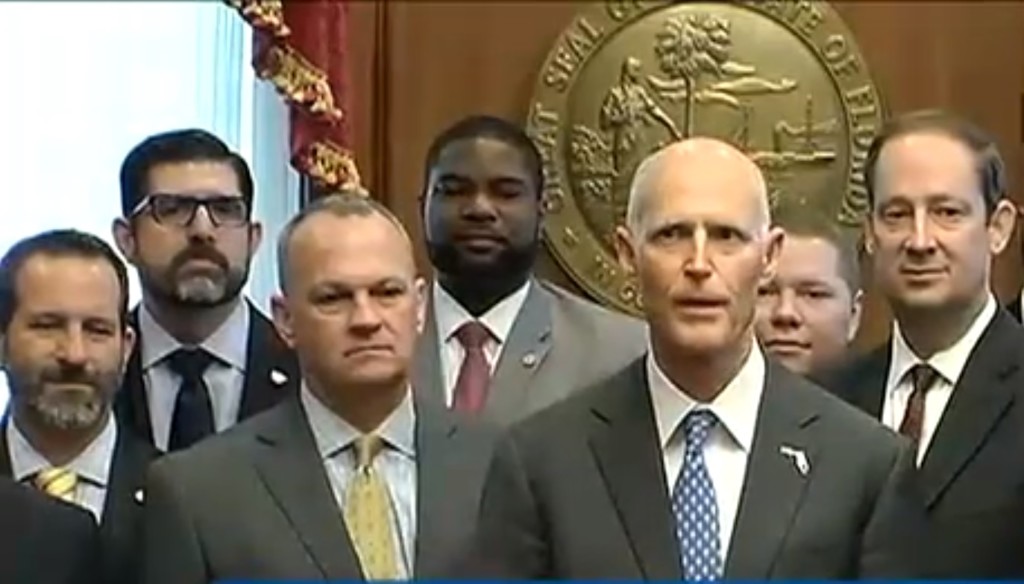
Legislative leaders joined Gov. Rick Scott for a bill singing ceremony in his office.
Florida will soon have a new school choice option for victims of bullying and violence. Parents will have access to new tools to help struggling readers. School districts will have to appear before administrative law judges before shutting down charter schools. Districts will be able to place top principals in charge of multiple schools under "innovation zones." And some rough edges of a contentious education law passed last year will get smoother.
Gov. Rick Scott this afternoon signed HB 7055, the most wide-ranging education bill of this year's legislative session.
The statewide teachers union had called on the governor to veto the bill. Contentious teachers union certification provisions drew the ire of the Florida Education Association and other labor groups.
House Speaker Richard Corcoran appeared alongside the governor for a signing ceremony at the state capitol, where Scott also approved higher education legislation sought by Senate President Joe Negron. (more…)
Bills expanding a state initiative to help students learn at their own pace fell by the wayside late in Florida's legislative session.
The House approved its version of the "mastery-based learning" bill. But Sen. Jeff Brandes, R-St. Petersburg, was stymied in multiple attempts to advance the proposal in the Senate.
In a last-ditch effort, Rep. Heather Fitzenhagen, R-Fort Myers, attached a version of the proposal to SB 88 — a bill creating a high school financial literacy course. The amendment also would have made the financial literacy course optional, watering down a longtime priority of Senate Education Chairman Dorothy Hukill, R-Port Orange. (more…)
The nation's largest education savings program could continue to grow under a deal reached late Wednesday by Florida's House and Senate budget chiefs.
The agreement would add another $25 million for Gardiner Scholarships for children with special needs. The funding would help the program meet rising demand.
This school year, for the first time, demand from parents exhausted the supply of funding for the scholarships. There are approximately 1,300 students on Step Up For Students’ wait list* for the scholarships. Thousands more have expressed interest.
The spending plan agreed to by Sen. Rob Bradley, R-Fleming Island and Rep. Carlos Trujillo, R-Miami would bring total funding for the program to approximately $128.3 million. (more…)
The most wide-ranging education bill of this year's session in the Florida Legislature is headed to Gov. Rick Scott.
One Democrat and 19 Republicans backed HB 7055 in a contentious 20-17 Senate vote, with four Republicans joining 13 Democrats in opposition.
The House gave the bill final approval hours later.
Opponents put up resistance. They tried unsuccessfully to remove a contentious teachers union certification proposal.
The bill also provoked the usual debates about charter schools and private school choice. Rep. Lori Berman, D-Lantana, attempted to strip a provision that would allow companies to receive up to $57.5 million in tax credits on corporate leases. The tax credits would encourage contributions to two state scholarship programs*.
"We shouldn't continue to chip away at general revenue and give it to scholarship programs," Berman said.
But House Republicans made expanding school choice an election-year priority. They rebuffed Berman's proposal and approved the bill on a 74-39 vote.
The bill includes the Hope Scholarship proposal, championed by Speaker Richard Corcoran. It would offer new private school scholarship and public school transfer options to victims of bullying and violence. A standalone version of that legislation won bipartisan support in the House earlier in the day.
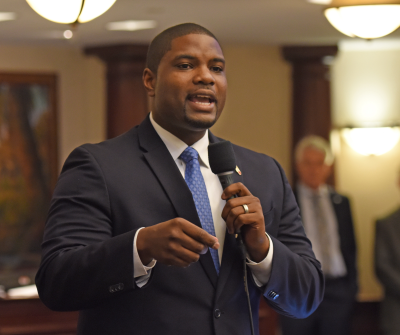
Rep. Byron Donalds, R-Naples
The Florida House today gave bipartisan approval to legislation creating a new school choice program for victims of bullying and violence.
The Hope Scholarship proposal stirred passions on both sides. Supporters and opponents recounted their own experiences with bullies growing up.
The program would allow victims to transfer to another public school, or qualify for a scholarship to attend a private school. The scholarships would be funded by car buyers who choose to support the program. They could receive a credit of up to $105 on the sales taxes they would pay on a vehicle. Scholarship funding organizations, including Step Up For Students, which publishes this blog, would help administer the program.
Rep. Jennifer Sullivan, R-Mount Dora, relayed a message from a student who recently served as a page at the state capitol. The student described relentless bullying, which didn't stop even after she transferred to another public school. She finally found refuge after her parents sent her to a private school. (more…)
Two education-related bills are expected to overshadow the rest over the next few days in Tallahassee: The Legislature's response to last month's shooting at Marjory Stoneman Douglas High School in Broward County, and final votes on the wide-ranging HB 7055.
But below the radar, there are a few other issues worth watching going into the legislative session's final week.
Pieces of HB 7055 (more…)
Today, the Florida Senate is expected to vote on the biggest education bill of this year’s legislative session.
A contentious teachers union certification proposal might overshadow the rest of HB 7055.
But the bill also contains a wide range of provisions related to charter schools and educational choice. Here’s a rundown of what the Senate's proposed rewrite would do.
Charter schools
High-performing charter schools would be able to replicate — meaning, open a similar school in a new location — twice a year, rather than just once. Last year, HB 7069 allowed high-performing charters to replicate more than once if they opened new schools in the vicinity of a persistently struggling public school.
In addition, the bill would place new legal standards on school boards that want to close charters. They would only be able to shut down charters for "material" violations of state law, rather than any law violations. School districts could still to shutter charters for financial problems, or for failing to meet academic goals. But they would have to appear before the state Division of Administrative Hearings before closing a charter school. This issue was the subject of some debate on the Senate floor.
District freedoms
Florida's principal autonomy pilot program would be a pilot no more. It would be open to any school district in the state.
And principals granted autonomy through the program could manage entire networks of schools, known as "innovation zones." The networks would operate within their districts and be exempt from many state education regulations. These schools would not be overseen by independent boards beyond the reach of their school district, as previous versions of the legislation contemplated.
School facilities (more…)
After some convoluted procedural maneuvers, a Florida Senate panel approved its version of the biggest education measure of this year's legislative session.
But the debate over House bill 7055, and efforts to revise it, is far from over.
The Senate Education Committee unanimously backed a rewrite of the legislation proposed by Chairwoman Dorothy Hukill, R-Port Orange.
The committee also approved new changes, including, most consequentially, amendments by Sen. Perry Thurston, D-Fort Lauderdale, to remove contentious collective-bargaining changes vehemently opposed by teachers unions and beef up school security in the wake of last week's mass shooting in Broward County. (more…)

