
Fuentes
Politicians eager to gain or retain the trust of Hispanic voters should focus on education and put particular emphasis on expanding school choice, suggests Julio Fuentes, president of the Hispanic Council for Reform and Educational Options, in an op-ed in today's South Florida Sun Sentinel. Here's a snippet:
We know that education reform and school choice are top issues for Latinos, second only to jobs and the economy, based on the HCREO/AFC poll released this past summer of voters in five key battleground states including Florida. The poll found that education is a top-tier issue for battleground voters and Latinos – even more important than immigration, in some cases. The poll found that Latino voters in Florida, Arizona, New Mexico, Nevada, and New Jersey are more likely than voters overall to cite improving education and increasing education options as core priorities.
Both presidential candidates stressed on election night that those in office must now work jointly and in a non-partisan way to address the great civil justice issues of our time. These issues include immigration, reducing the gap in quality educational opportunities for minorities, expanding school choice options so that all students regardless of zip code or socioeconomic background have a chance to excel. According to national data from the Pew Hispanic Center, only about 13 percent of Hispanic 25- to 29-year-olds complete at least a bachelor's degree, compared with 39 percent for whites in the same age group and 53 percent for Asians. This gap cannot persist.
(Full disclosure: Fuentes is a member of the board of directors for Step Up For Students, which co-hosts this blog.)
Editor’s note: Washington state is one of only nine states that don’t have charter schools. But voters can change that in November if they approve Initiative 1240, which will allow up to 40 charters statewide over five years. Chris Eide, who heads a Seattle-based ed reform group called Teachers United, tells redefinED in this emailed Q&A that it’s the students who struggle the most who will benefit if voters say yes.
 This is the fourth time Washington voters will go to the polls to vote on charter schools. They said no the first three times. Why will this time be different?
The last time voters looked at the option of charter schools in our state was eight years ago. Over that time, we have been unable to significantly address the needs of our struggling students. Moreover, the families of those students are often without high-quality options that can adapt to and address the needs of their children. Additionally, over the past eight years, high-performing charter schools across the country have demonstrated success for struggling students. Families in 41 other states have this option now, and Washington voters are faced with an easy decision to help struggling students.
Why does Washington state need charter schools?
Like other states, Washington has had a difficult time addressing the needs of struggling students. In some schools, nearly 40 percent of students are dropping out and far too many who do graduate are not prepared for college or their career. Public charter schools would be an option that will allow those students and families to attend a school that might better address their needs. If we hope to have more of our students graduating high school prepared for life after K-12, we are going to need all of the high-quality options that we can get.
You pointed out in a recent Seattle Times column that Initiative 1240 will only allow high-performing charters. How is that defined? And why did you stress that distinction? (more…)
Beyond the boos for his vow to undo President Obama's health care overhaul, Republican president Mitt Romney stressed school choice in his speech to the NAACP today, talking up charter schools and suggesting Obama’s ties to teachers unions hampered his efforts to help disadvantaged kids.
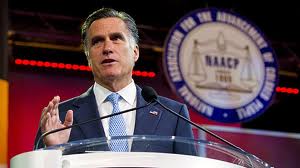 “If equal opportunity in America were an accomplished fact, black families could send their sons and daughters to public schools that truly offer the hope of a better life,” he said, according to his prepared remarks. “Instead, for generations, the African-American community has been waiting and waiting for that promise to be kept. Today, black children are 17 percent of students nationwide – but they are 42 percent of the students in our worst-performing schools.”
“Our society,” he continued, “sends them into mediocre schools and expects them to perform with excellence, and that is not fair. Frederick Douglass observed that, “It is easier to build strong children than to repair broken men.” Yet, instead of preparing these children for life, too many schools set them up for failure. Everyone in this room knows that we owe them better than that.”
Media coverage of today's event in Houston is focusing heavily on the negative reaction Romney received for his plans to scuttle "Obamacare." The Republican candidate got a more polite response to his education positions.
Romney noted his support for charter schools as governor of Massachusetts, despite opposition from teachers unions and Democratic lawmakers.He also pitched his plan to allow federal education funding to follow the student to the school of the parents’ choosing, including private schools “where permitted.”
The dig at Obama's education agenda came without mentioning the president’s name. (more…)

