 Tax initiatives: About a third of Florida residents face increased taxes if voters in seven counties approve initiatives Tuesday to raise money for their school districts. Officials in those districts say the state put them in the position of asking for voter help by underfunding mandates for school security. "The legislative mandates were substantially unfunded," says Alberto Carvalho, superintendent of the Miami-Dade County School District. "It has put significant fiscal pressure on the district." Bloomberg. In Miami-Dade, a four-year property tax hike would generate an extra $232 million a year, and 88 percent of the money generated would go for teacher raises. In Palm Beach County, a four-year increase in property taxes would bring in about $150 million more a year, and the district has pledged 50 percent of it to improve teacher pay. Miami Herald. Palm Beach Post.
Post-hurricane schedule: The Bay County School District's plan to make up the three-plus weeks of class time students lost to Hurricane Michael is approved by the Florida Department of Education. The district's schools will be 10 to 14 minutes longer every day and schools will be in session on four days that had been set aside as holidays or teacher work days. Already scheduled time off over Thanksgiving, Christmas and spring break will not change. Half the district's schools reopen today, and the district's goal is to have the rest open by Nov. 13. Panama City News Herald. New bus stop schedules are issued for Bay County students, many of whom may be attending a different school starting today. The district is also handing out reflective items for students who will now be going home in the dark. WMBB. Panama City News Herald. School officials in Calhoun and Jackson counties had to get creative to reopen schools last week. WFSU. Eighty Florida students displaced by the hurricane are attending southeastern Alabama schools. Associated Press. Gov. Rick Scott is asking the Florida Department of Education to send additional funds to districts so schools damaged by the hurricane can be rebuilt to withstand storms. Gradebook. (more…)

We can’t have honest dialogue about the what needs to be fixed in Florida's education system without an appreciation for the signs that academic outcomes are trending upward.
The recent Education Week report that ranked Florida public schools No. 4 in the nation in academic achievement was well-deserved recognition for this state’s underappreciated schools. It arrived in the thick of an election season where public education has been front-burner. And, given the less-than-glowing reputation of Florida’s education system, it bore all the markings of a flying pig. Florida No. 4 in academics?! Stop the presses!
Yet in a state with 21 million people, only one media outlet covered it.
On the flip side: Last week, another report found Florida to be the fifth-worst state to be a teacher. This report wasn’t compiled by seasoned, knowledgeable education journalists, like those who work at Education Week. Rather, it was crafted by WalletHub.
To date, eight news outlets have covered the WalletHub report, including three papers that editorialized about it.
For the sake of argument, let’s say the ranking methodologies from EdWeek and WalletHub are equally rigorous. Let’s agree we’re all guilty of confirmation bias. Even then, I have to ask my reporter friends: Does this seem right?
I’m a journalist by training. I had my first byline when I was 18. I worked at newspapers my entire adult life before I joined Step Up For Students (which publishes this blog) six years ago. For eight of those years, I covered education at the biggest paper in Florida, during a period of particularly heady change.
So don’t count me as another media grump. But I struggle with the degree to which news coverage in Florida seems to be missing powerful indicators of progress in public education. And I fear that the absence of such reporting has contributed to a warped public debate.
We can’t have honest dialogue about funding, testing, teacher pay, vouchers, charter schools, accountability – any of it – without an appreciation for the signs that academic outcomes are trending upward.
Consider another example. (more…)
Florida public schools now rank No. 4 in academic achievement, behind only Massachusetts, New Jersey and Virginia, according to the latest annual “Quality Counts” report from Education Week, released this week. Though it’s not noted in the report, Florida has a far higher rate of low-income students than any state in the Top 10, with roughly 60 percent of its students eligible for free- and reduced-price lunch.
The latest ranking is Florida’s highest ever. But it shouldn’t come as a surprise.
In fact, it punctuates a decade-long run.
Since 2009, Florida has, by Education Week’s analysis, finished at No. 7, No. 7, No. 6, No. 12, No. 12, No. 7, No. 7, No. 11, No. 11 and now No. 4. (The rankings stayed the same in some consecutive years because Education Week waited on national test scores, released every other year, to re-calculate.)
Education Week bases its analysis on a combination of common indicators: high school graduation rates; results on college-caliber Advanced Placement exams; and reading and math scores on the National Assessment of Educational Progress, considered the gold standard of standardized tests. It factors in proficiency and progress.
In a less tribal world, yet more good news about the relative performance of Florida public schools would finally knock the dunce cap off the state’s reputation, and spur more scrutiny of those trying to keep it there. The track record there isn’t encouraging.
Florida’s vision of education reform has been in the state and national spotlight for 20 years and remains “controversial” despite the rising trend lines. State policy makers have consistently emphasized a dual approach: Tough regulatory accountability measures like school grades. And an expansion of school choice options like charter schools and private school scholarships.
The latest news will come as a surprise to many parents – if they hear it – given the still oft-repeated myth that Florida schools are sub-par.
Twenty years ago, Florida’s education system was anemic, according to the most common indicators, with barely half its students graduating. But today, Florida’s public schools have never performed better, according to the same indicators. In some respects, they are among the best in the nation.
For example, Florida students rank No. 1, No. 1, No. 3 and No. 8 on the four core NAEP tests, once adjusted for demographics, according to the left-leaning Urban Institute. After the latest round of NAEP scores were released last spring, showing Florida had made the biggest gains in the nation, a top official at the National Center for Education Statistics told reporters, “Something very good is happening in Florida, obviously.”
Obviously.
How odd, then, that some who define themselves as public school defenders continue to double down on the notion that Florida public schools are being decimated – and to blame school choice for a decimation that so clearly isn’t happening.
How odd, too, that they so easily get away with it.
A few months ago, the latest results from the National Assessment of Educational Progress – the gold standard of standardized tests – showed Florida, again, made a national splash. This time, it notched the biggest gains in America.
Florida now ranks No. 1, No. 1, No. 3 and No. 8 on the four core tests on The Nation's Report Card, after adjusting for demographics.
You’d think the biggest gains in America would prompt applause from school boards, superintendents, teacher unions, and allied lawmakers. But no. In Florida, good news about public schools is increasingly ignored by public school groups; media coverage is mostly crickets (recent exception here); and alternative facts seed conspiracy theories.
No wonder, then, that plenty of candidates for political office are again vying to see who can flog the system the most. One gubernatorial candidate says “we are experiencing a true state of education emergency,” citing a single, obscure (at least in education circles) ranking, based on an especially crude set of indicators. Another says “Florida’s education reform has been a failure” while citing no evidence at all.
Deny and distort. Refuse to acknowledge progress. Demonize anybody who does. This is what “debate” over Florida education has come to.
Measures like NAEP scores continue to show the system is not only better than ever, but, in some ways, among the best in America. Yet to many, it’s still Flori-duh.
The tragic result is Florida teachers don’t get credit they deserve. And every day Floridians have no idea their public schools are on the rise.
Consider:
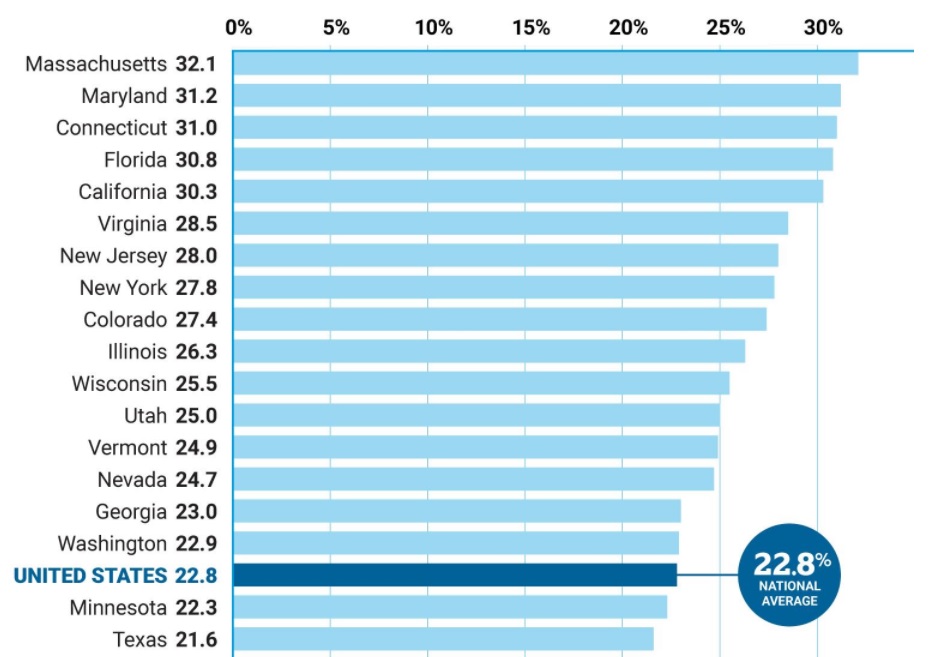
Florida ranks no. 4 in the country for its percentage of high school students who have scored 3 or higher on at least one AP exam. Source: College Board.
Florida remains a leader in pushing high school students toward college credit.
The Sunshine State keeps its no. 4 ranking in the latest report on Advanced Placement courses from the College Board. Only Maryland, Connecticut and Massachusetts had a larger percentage of students pass at least one AP course. And only Massachusetts has made faster improvements over the last 10 years. (more…)
Charter district: The Jefferson County School Board agrees to turn over operations of the district's struggling schools to the charter school company Somerset Academy. The proposed deal will be taken to the Florida Board of Education today for approval. If the deal is approved, Jefferson would become the first charter district in the state. In its application, Somerset said it will operate an elementary, middle and high school on a single campus led by a single principal, bring in a rigorous curriculum, including Advanced Placement classes, pay teachers 7 percent more than they can get in surrounding counties, pay competitive benefits, and work to bring students attending the alternative school back into the traditional schools. redefinED. WFSU.
Testing debate: The debate over the state's standardized testing intensifies at a Senate Education Committee meeting Tuesday. Supporters of former Gov. Jeb Bush are backing a moderate revision of the current system, while others want more significant changes, including fewer tests. Sen. Wilton Simpson, R-Trilby, who is leading the committee in the medical absence of Chairwoman Dorothy Hukill, R-Port Orange, said no decision has been made on what direction the bills will take, and that Hukill will make that call. News Service of Florida.
Help for home-schoolers: Students who are home-schooled would have greater access to college classes and career education courses offered by school districts in a bill approved by the House PreK-12 Innovation Subcommittee. Districts also would be required to accept home-education registrations as long as parents and their children meet the state's requirements. redefinED.
Religious expression bill: The Florida Senate moves the so-called "religious expression" bill to a third and final reading. If approved, the bill would be sent to the House, which has a slightly different version. The bill would give students more freedom to express religious thoughts in public schools. Gradebook. News Service of Florida. (more…)
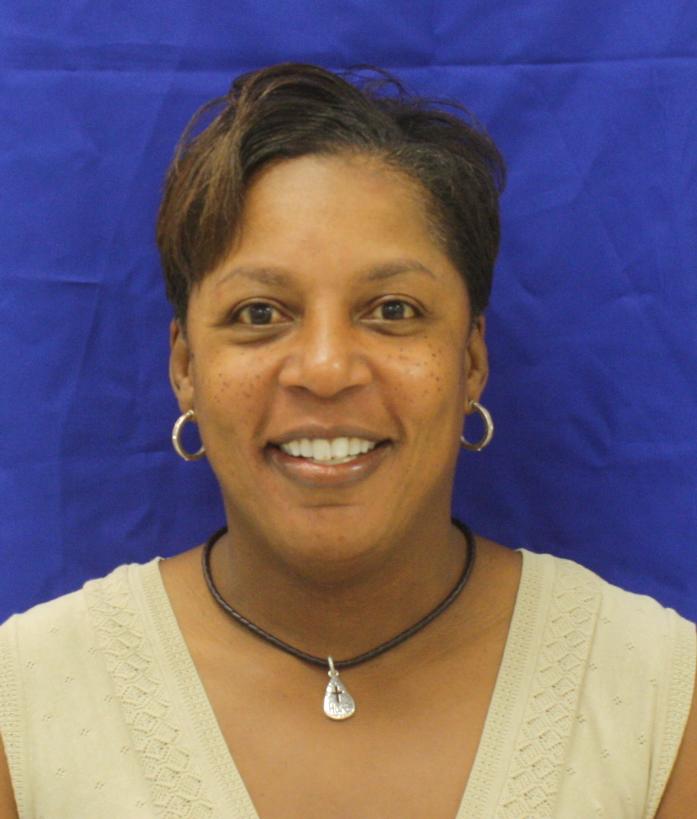
Julie Lueallen, principal at East Ridge High School
Growing up in a single-parent, low-income household in the late 1970s, Julie Lueallen had fewer opportunities to excel in education.
Now, she's the principal of East Ridge High School, one of the highest-performing schools in south Lake County, Fla.
Growing up, she said, she was an average student who had potential. Her teachers did not steer her into honor courses, which at the time were the only classes available for students to receive more rigorous coursework that would prepare them for college.
“It was all in your grades,” she said. “Nobody even talked about opening that world to me. They counseled kids, but not the kind of kid like me.”
Lueallen, a product of nearby Tavares High School, said she had some excellent teachers. But she might never have gotten onto a college-preparatory track without an advocate who knew the school system well and argued on her behalf: her mother.
“If my mom was not pushing I wouldn’t have gotten into honors courses,” she said. “Having a parent that is savvy in a high school curriculum. That is important.”
Now, as a principal, she advocates for all students to take advantage of the opportunities she and her mother had to fight for. Her school has emerged as a leader in Florida's effort to push more into Advanced Placement courses and toward college credits.
According to a new report from the College Board, the nonprofit that administers the AP program, Florida ranks fourth in the nation in the percentage of graduating seniors who have passed at least one AP exam, which can lead to credit for an entry-level college course. Over the past decade, low-income children of color have driven most of the state's improvements.
Beginning in the 1990s, Florida leaders decided to open AP courses to more low-income, black and Hispanic students. The College Board, which administers AP exams, has adopted an equity and access policy, which states: (more…)
Testing bills: The Florida Senate Education Committee meets Tuesday to consider seven bills that could change Florida's testing-based accounting system. Among the ideas being discussed: moving the testing to the final three weeks of the school year, ending the requirement to fail any third-grader who doesn't pass the reading test and doesn't have an exemption, and changing the rules on reporting test results. Gradebook. Lawmakers are pushing for tougher passing standards on the Florida Standards Assessments exams. Orlando Sentinel.
Bright Futures: Escalating eligibility standards for Bright Futures scholarships, tied to higher SAT and ACT scores, are shutting out an increasing number of students from Miami-Dade schools with large populations of low-income and minority students. At Hialeah High School, for example, almost 20 percent of students qualified for Bright Futures in 2011. By 2015, it was 8 percent. “I think the challenge with Bright Futures is that it doesn’t take into account the students who need us the most, the low-income students, the students who haven’t had the benefit of the best schools, whose parents don’t know the system and what needs to be done to get those high scores on the test,” says Lenore Rodicio, the executive vice president and provost for Miami Dade College. Miami Herald.
Vitti looks to Detroit: Duval County School Superintendent Nikolai Vitti is one of three finalists for the superintendent's job at the Detroit Public Schools Community District. Vitti, a native of Detroit, took the job in Duval in 2012 with a mandate to change the culture and direction of the 128,000-student district. His tenure has been marked with progress in some areas, such as graduation rates, cutting into the achievement gap and creating more school choice, but also with rocky relationships with some school board members. Detroit, which once had 224,000 students, is down to 47,000, and there are more students in charter schools than in district schools. Florida Times-Union. Florida Politics. WJAX.
Budget improves slightly: State economists think Florida will have about $300 million more revenue than expected for next year's budget, but legislators don't think it will have much of an impact. The proposed budget is more than $82 billion. Senate President Joe Negron, R-Stuart, says he's happy for the forecast improvement, but says cuts are still inevitable. Naples Daily News. News Service of Florida. Florida House Speaker Richard Corcoran, R-Land O'Lakes, defends the House's budget priorities during a talk at the Panhandle Tiger Bay Club. He says cuts in education spending shouldn't affect K-12 schools, but will have an impact on higher education. Pensacola News Journal. (more…)
Bright Futures: The Senate passes a higher education bill that would allocate $151 million to restore Bright Futures funding to 100 percent and allow recipients to use the scholarships for summer classes. Also in the bill are a scholarship program for migrant workers and their children and an expansion of benefits to National Merit Scholars. Miami Herald. Sunshine State News. Politico Florida. News Service of Florida. The bill is a top priority for Senate President Joe Negron, R-Stuart, but he somehow missed the vote even though he was present in the chamber. He said he intended to vote after the roll call, but it was locked down before he could. Miami Herald.
Education budget cuts: Rep. Manny Diaz, Jr., R-Hialeah, says he will release details next week on a pair of House education budget-cutting exercises. One of the plans trims higher education and K-12 spending by $232.7 million, while the other cuts $485 million. Diaz says specific cuts under the plans may or may not be part of the House's final education budget. Politico Florida.
Guns in schools: Two Republican senators from Miami-Dade can control gun bill votes on the Senate Judiciary Committee, and one of them has publicly stated she opposes the guns in school zones proposal. Sen. Anitere Flores, R-Miami, also opposes several other gun-related bills, but says that doesn't mean she would oppose any gun bill. Sen. René García, R-Hialeah, says he can't support any gun bill that doesn't include a mental health component. Miami Herald. Sarasota Herald-Tribune.
AP test improvements: Florida is fourth among U.S. states in the percentage of graduating seniors who passed at least one Advanced Placement exam, and more than half the growth came from low-income students, according to the Florida Department of Education. The percentage of low-income graduating seniors in Florida who passed an AP exam went up 500 percent from 2006 to 2016. redefinED. (more…)
Florida continues to be a national leader on college-caliber Advanced Placement exams, fueled by the success of growing numbers of low-income students.
The Sunshine State ranks No. 4 in the nation in the percentage of graduating seniors who have passed at least one AP exam, according to 2016 data released in a new report from the College Board, the nonprofit that administers the AP program.
At 29.5 percent, Florida outpaces the national average of 21.9 percent and trails only Massachusetts, Maryland and Connecticut, states with far fewer low-income students and far better academic reputations.
AP exams are standardized tests that correspond with dozens of college-caliber high school courses. They are widely viewed as a good gauge of a student’s college readiness and, in some credible quarters, as a good indicator of a state’s educational quality.
The latest results aren’t a fluke. The percentage of graduating seniors passing AP exams in Florida shot up 11 percentage points between 2006 and 2016, putting the state No. 3 in progress over that span. In raw numbers, 47,242 graduating seniors from the class of 2016 had passed at least one, nearly double the number from a decade ago.
Florida’s outcomes are even more impressive given its demographics. Florida has the highest rate of students eligible for free- and reduced-price lunch among states in the AP Top 10, and in most cases, a far higher rate. No state has a bigger differential between the relative poverty of its student body and its overall performance on AP exams. (See chart at the bottom of the post.)
Additional AP numbers from the Florida Department of Education show low-income students are leading the charge. The percentage of low-income graduating seniors who passed an AP exam climbed more than 500 percent between 2006 and 2016, and that group made up more than 60 percent of the total growth in AP-passing graduates, according to DOE figures.
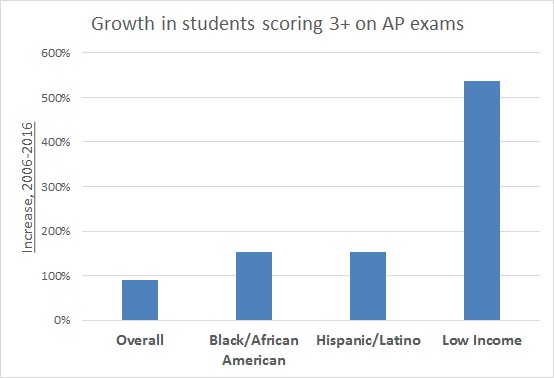
The number of low-income Florida students who passed at least one AP exam grew by more than 500 percent between 2006 and 2016. Source: Florida Department of Education data.

