Arizonans have a pet peeve involving people from “back East” who judge us before they understand us. The Washington Post jumped into this with both feet by publishing a story with the headline Public schools are closing as Arizona’s school voucher program soars.
The story, which prominently features the long-troubled Roosevelt Elementary School District’s decision to close five schools, has multiple problems. The paragraphs below will document one of the main problems. Before moving to that, the reader should note that multiple people made efforts by both email and phone to alert the Post reporter to these data during the research process, including the sharing of many of the links to the same state data sources that will be used below.
Arizona K-12 choice is complex with multiple types of choice operating simultaneously and interacting with each other: the nation’s largest state charter school sector, multiple private choice programs, and (the granddaddy of them all) district open enrollment. No one should fault anyone for failing to appreciate the complexity of a situation from afar, but ignoring data to formulate a fundamentally misleading narrative is another matter.
Just to set the stage, under the Arizona education formula, spending follows the child. From the perspective of a school district, it makes little financial difference as to whether a child transfers to another district, enrolls in a charter, takes an ESA, or moves to California -- you either have enrollment to get funded, or you do not. Because districts also generate local funding with enrollment, they are (by a wide margin) the best-funded K-12 system in the state on a per-pupil basis on average.
The Arizona Department of Education tracks public school students by district of residence and by public district or charter school of attendance. The 2025 report includes a tab called “District by Attendance,” and it reveals that of the total public-school students residing with the boundary of Roosevelt Elementary and attending a Roosevelt Elementary district school amounts to 6,551 students. The same report reveals that 5,764 students live within the boundaries of Roosevelt but attend charter schools. Finally, the open enrollment report documents that 2,741 students live within the boundaries of Roosevelt but attend other district schools through open enrollment.
Separate reports from the Arizona Department of Education document ESA use by school district. The most recent quarterly report currently available finds that 803 students reside within the borders of Roosevelt Elementary and are enrolled in the ESA program (see page 22). If we stopped the story there, the conclusion that the fiscal impact on Roosevelt Elementary from other school districts was more than three times larger than that of the ESA program would appear unavoidable. “Public schools are closing as a majority of families choose other public schools” does not seem quite as exciting but would be far more accurate.
But we should not stop the story there. Another report from the Arizona Department of Education tracks not only which districts ESA students reside in, but also what school they previously attended. Page 17 of this report reveals that the number of students residing in Roosevelt Elementary district and which previously attended a Roosevelt Elementary school stood at 129. Put it all together, and the picture looks like this:

School boards don’t close five schools in a 6,551-student district because of the loss of 129 students. Enrollment in Roosevelt Elementary began to decline years before the ESA program existed. “Public schools are closing as Arizona voucher enrollment soars” is akin to “Sun rises as rooster crows” as it pertains to Roosevelt Elementary. If the ESA program did not exist, we have every reason to believe that a large majority of ESA students would employ other choice programs.
The fault lies not in Roosevelt’s stars, but in itself -- a large majority of the community it serves prefers schools other than the ones they are operating. Statewide Arizona school districts spend an estimated billion dollars annually on underutilized and vacant school buildings -- funds they could be spending on teacher salaries and academic recovery, and which also happens to approximately equal the budget of the ESA program, which 90,000 Arizona students use for K-12 education.
The Roosevelt school board has decided to focus their efforts, and good luck to them. The unstated thesis of the Washington Post’s narrative, however, is that readers should sympathize with the interests of Roosevelt employees rather than with those of the Roosevelt families exercising agency in the education of their children. This is the greatest misdirection of all. We fund schools first for the benefit of children, not the adults working in the schools.
This is all an all-too-common sort of thing in K-12 journalism these days, and it is hardly unique to Arizona. Florida, for example, has no shortage of hugely exaggerated claims regarding the impact of choice on school districts. Author Amanda Ripley, interviewed for a book she wrote on deep problems of journalism, noted the “strange and insular world of journalism prizes,” which encourage simplistic “us versus them” stories. “This adversarial model that we’ve got going in education, journalism, and politics no longer serves us. There’s a good guy and a bad guy, and everything’s super clear; it just breaks down. And we keep awarding prizes in that model. But 99 percent of stories are not that clear-cut,” Ripley noted.
What is clear-cut: Roosevelt Elementary may have 99 problems, but losing 129 kids to the ESA program ranks far from being one.
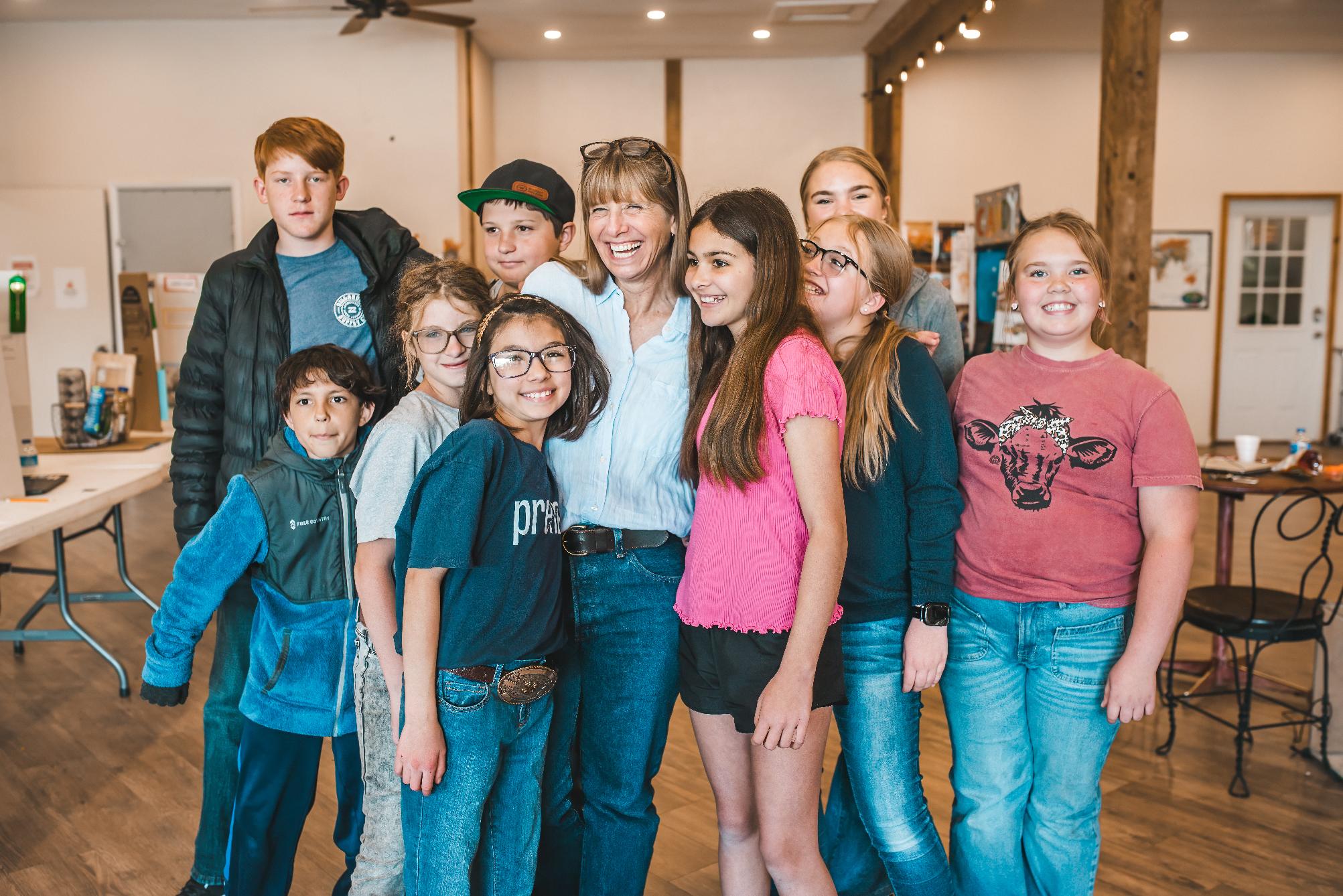
Denise Lever with her students at Baker Creek Academy, a tutoring center in Eagar, Arizona. Photo provided by Denise Lever
Nothing can stop Denise Lever. Not a raging wildfire and certainly not a state fire marshal’s effort to shut down her tutoring center by trying to impose regulations that could have forced her to spend $70,000 on building upgrades.
As one of the nation’s few female wildland firefighters in the late 1980s, Lever survived the hazing that came with being a woman in a male-dominated profession by proving herself and never backing down.
For example, take this story: Lever’s team had been dispatched to a California fire. Roads were closed, and the crew had to climb up a cliff to get into position. Loaded down with their gear, they pulled together and worked through the night.
“It was absolutely brutal,” Lever recalled. “It was hot. It was windy. Our hands were cut up from moving brush, and we lost gloves in the middle of the night, and we couldn’t find them on the fire line because of the debris.
As morning broke and a cold Pacific Ocean breeze stung their faces, the team huddled together in space blankets and reflected on their victory.

Denise Lever, center, during her days as a wildland firefighter. Photo provided by Denise Lever
“The camaraderie and the sense of accomplishment, they’re irreplaceable,” Lever said.
Lever’s days of battling blazes ended when she got married and became a homeschool mom to three kids, but her trailblazing spirit stayed with her when she became an education entrepreneur.
In 2020, she opened Baker Creek Academy, a tutoring center/microschool to support homeschool families in Eagar, Arizona, just west of the New Mexico state line. The center operates four days a week for five hours per day and serves about 50 students, who attend on different days at various times. Baker Creek provides a host of supplemental services, primarily to homeschooled students, from one-on-one tutoring to limited classroom instruction and group projects to field trips. Students and parents can customize the services that best fit their needs. Baker Creek doesn’t keep attendance records because, Lever said, parents are the ones in charge.
After completing her city’s approval process, Baker Creek began operating in a historic commercial building once occupied by a church, shared with three other independent microschools.
One day, out of the blue, an official at the Arizona Office of the State Fire Marshal left Lever a voice mail message. He wanted to inspect her “school.”
“And I said, ‘No, not really, because we're not a school,’” she said.
As an experienced firefighter, Lever recognized a school designation for what it was: the potential kiss of death for her tutoring center.
Being labeled a school triggers a list of code restrictions intended for campuses that serve hundreds or sometimes thousands of students and often include sports fields, playgrounds, auditoriums, cafeterias, gymnasiums, classrooms, and offices.
On the line are often tens of thousands of dollars in mandated building changes, which are not required for other commercial buildings, such as dance studios and karate dojos.
Levers wasted no time. She contacted the Stand Together Edupreneur Resource Center, which offers guidance, but not legal advice, about regulatory issues. The representative encouraged Lever to contact the Institute for Justice, a national public interest law firm that specializes in education choice litigation and zoning issues.
IJ Senior Attorney Erica Smith Ewing sent a letter to the state’s fire inspector questioning the basis for the inspection.
“Ms. Lever successfully completed a local fire safety inspection in 2023 and has been operating successfully with no problems,” the letter said. “Your request to inspect her property was unexpected. Could you please explain why you wish to inspect her property? We do not currently represent Ms. Lever, and we hope that formal representation will be unnecessary.”
Lever said she faced the possibility of having to spend tens of thousands of dollars upgrading doors and electrical systems. Because the building was smaller than 10,000 square feet, she avoided the order to install a sprinkler system, which can cost $100,000.
However, the timing couldn’t have been worse.
“If the state was going to require some of these upgrades, that was just not going to be possible for (our landlord) to renew our lease,” she said, adding that she used the building to host summer programs and annual meetings for other microschool leaders who use her consulting services.
Lever also wondered why similar businesses weren’t targeted -- for example, a dance studio across the street that taught school-age students and operated similar hours to Baker Creek.
“Because she offered dance instead of math tutoring, her program was considered a trade, and our program was going to be shut down and treated like an education facility simply because we offered more of an academic program,” Lever said.
State officials performed the inspection, but finally backed down, offering only that the situation was a result of “confusion” and the Lever’s business wasn’t under their jurisdiction.
“Forcing Denise to follow regulations designed for sprawling, traditional schools would be both arbitrary and unconstitutional,” Ewing said. “More and more, we are seeing state and local governments hampering small, innovative microschools by forcing them into fire, zoning, and building regulations that never anticipated microschools and that make no sense being applied to what microschools do.”
In Georgia, local officials tried to force a microschool to comply with unnecessary inspections and building upgrades, in violation of state law protecting microschools. They backed down after a letter from IJ. And in Sarasota, Florida, Alison Rini, founder of Star Lab, nearly closed her doors this spring when the city interpreted the fire code to require she install a $100,000 fire sprinkler system, despite operating from a one-room building with multiple exits. Only after a donor provided a generous gift was she able to stay open.
“Teachers shouldn’t need lawyers to teach,” said IJ Attorney Mike Greenberg. “Bureaucrats shouldn’t use outdated and ill-fitting regulations to stifle parents and students from choosing the innovative education options that best suit their needs.”
Lever said the state’s decision to back off sets a precedent that will help other microschools across Arizona.
“I was definitely willing to go forth with the lawsuit,” she said. “At this point, though, we’re going to take our win. We’re going to publicize it so the other microschools will know what their options are.”
I received some interesting responses to last week’s post where I showed some math on how few votes it could have swung control of the Arizona State Senate in the 2024 elections and noted that one of the Arizona political parties having proposed eliminating five popular choice programs may have helped Republicans expand their previous narrow majority. One response focused on a relative who voted for Kamala Harris for president but only voted for state legislative Republicans because her grandchildren participate in the Empowerment Scholarship Program. I had not even considered grandparents and relatives (other than parents) of students participating in choice programs, but they are indeed out there and are registered to vote.
Another response noted that the potential coalition against private choice was much larger than that in favor of private choice in Arizona, given that far more students attend school districts than participate in choice programs. The latter part of this is of course true, but I noted that both absolute and per pupil spending in Arizona school districts stands at or close to all-time highs, making it a fairly latent constituency. Notwithstanding a whole lot of windy rhetoric, no one is proposing to eliminate district schools in Arizona (or anywhere else).
Supporters of private choice programs, on the other hand, have watched as Gov. Katie Hobbs proposed eliminating the programs that they rely upon, making them more of an active constituency. I had a couple of readers inquire as to why I did not include charter school students and families. To my knowledge no one has proposed eliminating Arizona charter schools, so I view them as a mostly latent constituency, at least until someone is reckless enough to threaten their existence.
I put together the chart below based on a few different sources of information. Some numbers are from 2025; the tax credit numbers are from the state’s 2023 report. The tax credit donor numbers only count donations, rather than the number of members of the families who made the donation. There is certainly some double counting going on with the original and switcher credits, as many people claim both. The parent figure is an estimate that assumes 1.5 parents per ESA student in 2025 and does not consider the possibility of other relatives. The below list is by no means exhaustive, or even close to it. Also included are the number of swing votes each losing candidate would have needed to win in the swing Arizona Senate races.
Here goes:
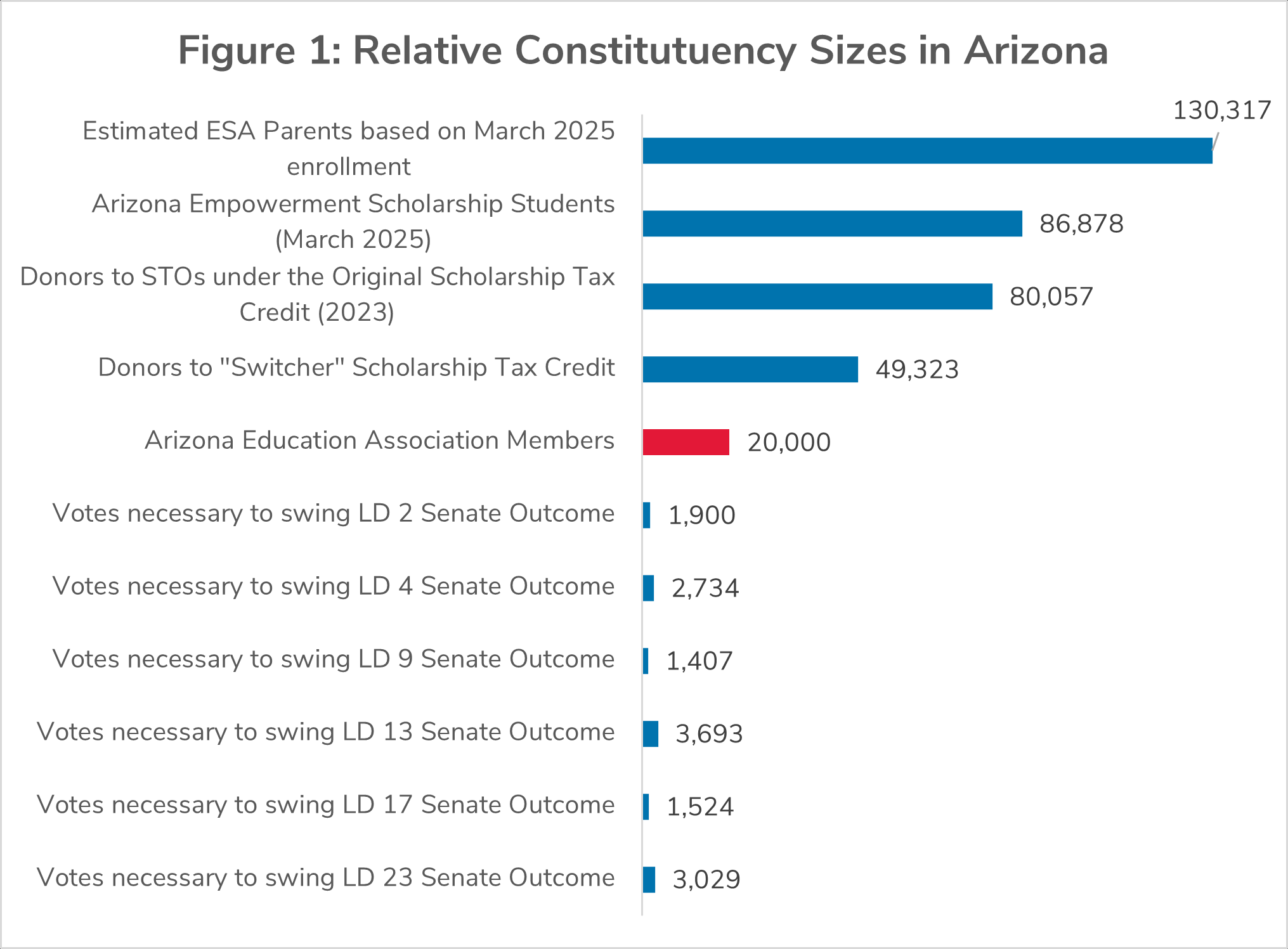
By November 2026, these numbers are going to look even less forgiving than they do now. There are a whole lot of registered Democrats in those larger numbers. It might not be a great idea to give them an incentive to split their tickets to vote in their kids’ interests in legislative races.
By the way, did I mention that the margin of victory in Arizona’s 2022 governor’s race was 17,117 votes and, in the attorney general race, the margin was 280 votes?
Arizona’s politics might be described as “Chaotic Purple,” but 2024 elections proved quite red at the state legislative level, with Republicans making gains in both the Arizona Senate and House. It may be the case that some of those gains happened because of the unrelenting level of hostility to school choice on the part of the nominated candidates of the Arizona Democratic Party for state legislature. Surveys show that school choice remains broadly popular among Arizona Democrats, Independents and Republicans. Democratic candidates and officeholders, however, have been much more likely to represent the views of public school-affiliated lobbyists and activists than those of their own voters and (crucially) the independent voters needed to secure electoral victory. Hostility to school choice may have cost Arizona Democrats legislative majorities in 2024, and the likelihood of this will only increase in the years ahead.
The 2018 elections might best illustrate Arizona’s Chaotic Purple tendencies, as Republican Gov. Doug Ducey won re-election by a thumping margin even as Democrat Kirsten Sinema won the race for a seat in the U.S. Senate. “Ducey-Sinema voting” did not end in 2018. In 2020, Arizona voters narrowly went for Joe Biden and in 2022 elected Democrat Katie Hobbs governor, but in both instances kept Republican legislative majorities intact. In 2024, the same electorate swung back to Donald Trump over Joe Biden in the presidential race and expanded Republican legislative majorities but also elected Democratic candidate Rueben Gallego to the U.S. Senate. Arizona was a hotly contested swing state in 2024, and Arizona Democrats privately expressed confidence regarding their chances for capturing majorities in the state legislature.
Arizona Democrats have not always been hostile to school choice. Gov. Janet Napolitano, for example, signed two voucher laws as a part of a budget deal. Arizona’s current governor has espoused an unrelenting hostility to school choice, having called for the repeal of Arizona scholarship tax credit programs and “reforms” to the Arizona Empowerment Scholarship Account program that would effectively eliminate the program. Not to be outdone, Arizona legislators have also filed “reform” and “accountability” proposals on choice programs which, if not actually drafted by Arizona’s NEA affiliate, looked remarkably similar to something they would draft if given the chance.
Arizona has five private choice programs: four scholarship tax credits and the Empowerment Scholarship Account. Well over 100,000 students participated in these programs by November 2024. Some of them were eligible to vote in 2024. Arizona taxpayers made 80,057 scholarship tax credit donations in 2023 under the original tax credit program, and another 49,323 donations under the “switcher” credit. Thousands of Arizonans volunteer and/or work at a private school. A broader universe of therapists and tutoring firms also participate as eligible vendors in the ESA program. The unrelenting hostility of many Democrats to the interests of their children, students and schools would be hard pressed not to notice. Did this hostility cost Democrats at the ballot box?
Perhaps so.
The Arizona Senate has 30 seats, and most of these races are not close, going for either the Republican or the Democrat candidate by a wide margin. The races are close and decide which party will be in the majority. The closest state Senate races in 2024 occurred in Legislative Districts 2, 4, 9, 13, 17 and 23. Republicans won four of these six close races, prevailing by margins of 3,767, 5,465, 7,383 and 3,045 votes, respectively.
For example, Arizona Legislative District 4 featured Republican Carine Werner defeating Democrat Christine Marsh by 5,465 votes. A swing of 2,733 votes would have changed the outcome of the election. Data compiled on Legislative Districts by the Common Sense Institute of Arizona found that 3,399 students were attending private schools in 2021-22 in Legislative District 4. The 2021-22 school year, however, was before the Arizona Empowerment Scholarship Account became universally eligible to all Arizona K-12 students.
The Common Sense Institute Arizona research found private school enrollment increased by 31% between the 2019-20 school year and 2021-22 school year. If we take the conservative assumption of a similar increase by the fall of 2024, it would create an estimate of 4,452 private school students in Legislative District 4 by November 2024. If you assume 1.5 parents for each private school student, you reach a potential voting block of 6,679. Assume further that the 4,452 private school students didn’t get there without corresponding private school staff members, add in the assumption that LD 4 had a proportionate share of Arizona’s 100,000 plus scholarship tax credit donors, and you reach an unavoidable conclusion: pledging to revoke private choice programs may have been a very costly political decision. In Arizona Legislative District 4, not only the Senate race but both House races went to candidates supportive of K-12 choice.

We will never know for certain whether K-12 choice hostility tipped electoral balances in 2024. However, we do know that it will be more likely to happen in 2026 legislative races than it was in 2024 based upon the continued growth in Arizona choice programs. Continuing to threaten the thousands of families relying upon choice programs looks to have been a bad bet in 2024 and a worse bet going forward. Both ESA families and scholarship tax credit donors each separately outnumber members of the National Education Association affiliate by more than four to one. Math is hard, and it is even less forgiving.

Imagine the major metro area near you if students were free to attend the fanciest school district in the leafiest local suburb. Can Dallas kids enroll in Highland Park? Can Columbus students transfer through open enrollment into Grandview Heights? Will Smith portrayed a kid from a tough background who got to go to school in Bel Air, but how often does this happen in real life? If you mentally put the over/under on the number of students getting the chance to do this at 1, take the under. Thousands of Phoenix students however attend school in Scottsdale. Sadly, a recent report from the Brookings Institution exemplifies the sort of short-sighted thinking that prevents these kinds of opportunities from materializing in other states.
The Brookings Institution recently published a report on the Arizona Empowerment Scholarship Account Program that was long on unsupported claims and short on context. Brookings decided not to engage in nuance in titling its study Arizona’s ‘Universal’ Education Savings Account Has Become a Handout for the Wealthy.
The study can be briefly summarized with two maps from the report: on the left is a ZIP code map of the Phoenix area by the rate of ESA participation (darker=more), and on the right the same zip code map by family income (darker=higher average). The maps look kind of similar. Is Arizona’s ESA program an instrument of plutocracy?
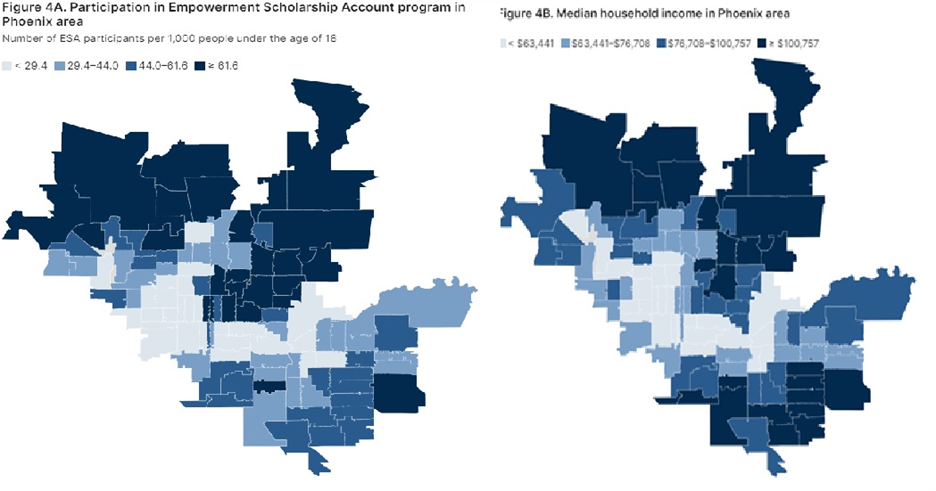
In a word, no. Quite the opposite.
Arizona has four other private choice programs besides the ESA program- all scholarship tax credits. Two of these programs are means-tested for the exclusive use of middle and low-income families. One of the other credits requires scholarship granting organizations to consider income in making awards, and the final credit is for children with disabilities- a fair number of whom will also be from families of modest incomes. These tax-credit programs raised over $264 million for scholarships in 2023, (see below) and higher income families do not qualify for many of these dollars.
Lower-income families desiring to attend private schools often prefer the tuition tax credit program over the ESA program. Meanwhile, higher income families are not eligible for much of the scholarship tax credit funding. Under Arizona law, you cannot participate in both programs.
All the ZIP codes in the Brookings analysis, including those with higher-than-average incomes, have public schools operating in them. The statewide average total district spending per pupil on school is almost twice as high as the ESA program. Higher income Arizonans pay their taxes and are entitled to attend school districts like everyone else, but they are also entitled to participate in the Empowerment Scholarship Account if they desire. If the ESA program is a “give away to the rich” then what pray tell is the Scottsdale Unified School District?
Speaking of Scottsdale Unified, it stands as a shining example of why choice programs should be universal. Scottsdale Unified publishes an ongoing demographic report and publishes the number of out of district open enrollment students served. This graphic is from that report:

The average home price in Scottsdale Arizona stands at $893,000, but 21% of Scottsdale Unified’s enrollment came from out of district through open enrollment. The reason 4,667 students can attend Scottsdale Unified without having a family purchase a $893,000 home is because 9,000 students living in Scottsdale Unified go to school elsewhere- charter schools, other districts through open enrollment, private schools.
Universal choice programs- including the Arizona ESA program but also including charter schools and district open enrollment-help create open enrollment opportunities. A virtuous cycle worked through Arizona schooling as educators supplied high demand school models, nearly all school districts began accepting open enrollment transfers. When a large majority of Phoenix students could attend Scottsdale Unified schools, it had the effect of closing low-demand charter schools.
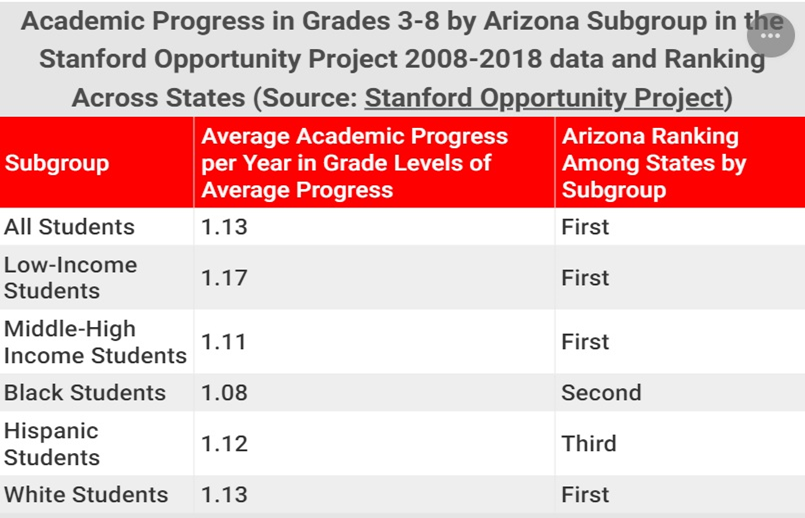
During the last period in which all six state-level NAEP exams were available, fourth and eighth grade math, reading and science, (2009 to 2015) Arizona students alone made statistically significant gains on all six exams. The Stanford Educational Opportunity Project linked state tests in grades 3-8 across the country for the 2008-2019 period. Arizona’s low-income students have the fastest rate of academic achievement growth in the nation. Counterintuitively, universal choice has worked wonders for low-income students.

The Brookings study is neither the first nor will likely be the last example of folks back east lacking context about Arizona choice. Arizona created two universal choice programs in 1994 (charters and open enrollment) then a mix of universal and means-tested scholarship tax credits and finally the ESA program. Critics predicted doom every step of the way and continue to this day.

A portion of the early adopters of the ESA program, excluded from fully participating in other programs, chose to participate in ESA. Understood in context, you have no reason to feel alarmed and every reason to follow suit in your state- especially if you are concerned about poor students.
Arizona Gov. Katie Hobbs, who fruitlessly called for a repeal of Arizona’s Empowerment Scholarship Account during her first year in office, is following up with a plan in her second year that would throw tens of thousands of students out of the program while strongly discouraging private schools from enrolling ESA students. The plan transparently aims to limit the ability of parents to participate in the program and to discourage private schools from participating. It is unfortunate to see someone who benefited from choice both as a child and as a parent attempt to reduce such opportunities for others.
Arizona lawmakers have been expanding K-12 options for parents since 1994, when they created the nation’s most robust charter school law and statewide district open enrollment. Lawmakers followed this with the nation’s first scholarship tax credit program to assist families with private school expenses in 1997 (expanded several times subsequently). They followed this by creating the ESA program in 2011 and making it available to all Arizona students in 2022.
By 2017, analysts found that nearly half of the Phoenix area K-8 students attended a school other than their zoned district option and that district open enrollment was the largest form of choice. District schools gain and lose students through open enrollment, and the financial impact of their comings and goings is indistinguishable from other forms of choice: the money follows the child.
Despite the blindingly obvious benefits of this system (we will get to that below), Governor Hobbs has aligned herself politically with choice opponents rather than with choice beneficiaries. This is unfortunate, as Governor Hobbs has been a choice beneficiary personally. Governor Hobbs attended private schools as a student and sent her own child to an Arizona charter school. In both cases she made decisions which, in the distorted world view of choice opponents, “drained” her local district school of funding.
Those with a better grasp on reality might, however, note that the Hobbs family paid their public-school taxes like everyone else and sought out the best available education for their child. This seems to have worked out well, as their child is now the governor of Arizona.
Likewise, I am very confident that Governor Hobbs’ decision to enroll her child in a charter school resulted in a high-quality education, as your author had a child graduate from the same charter school. The children of a number of prominent Democrats in addition to Governor Hobbs — one or more Phoenix mayors, gubernatorial nominees, even a teacher union President — also overcame any aversion to “draining” districts when it came to the education of their own children.
If we apply the “judge a tree by its fruit” standard to Arizona school choice, it passes with flying colors. We can peer into the state-level NAEP data all the way back to 1990. Arizona was a very different place then, and K-12 student demographics were much more like those of Idaho today, but overall performance was much lower on average. Arizona’s average performance improved during a massive demographic transition into a majority-minority student body because all the major subgroups improved their performance.
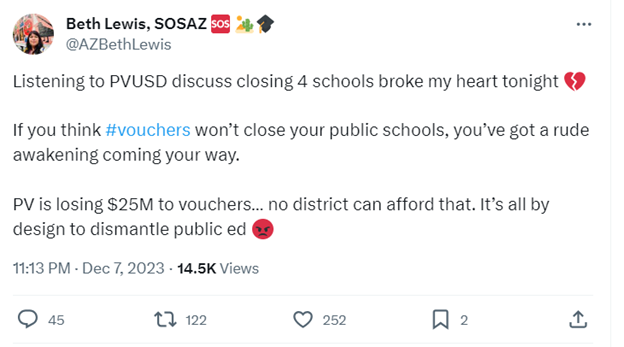
Americans started a Baby Bust in 2008 (on behalf of Gen-Xers-welcome you to the club youngsters!) In addition, the public school system seems determined to do their best imitation of Side-Show Bob marching over rakes since 2020, prompting a great many American families to make other schooling plans. Peak school district enrollment clearly lies in the past. In the states having created or expanded private choice policies, advocates should be prepared to have attempts made to scapegoat choice programs for district school closures. For example, last week in Arizona:
The Arizona Department of Education put out open enrollment reports by districts in 2022 and reported where residents of the Paradise Valley Unified School District attended school. In addition, the Department reported ESA enrollment by quarter, so the final quarter of 2022 is included below.

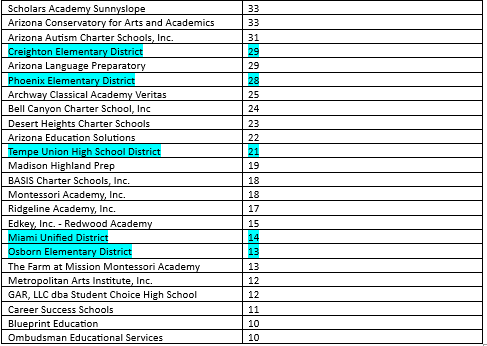
Scottsdale Unified, which borders Paradise Valley Unified, is the biggest “drainer” of students residing within the boundaries of Paradise Valley Unified, if you are misguided enough to see students as indentured peons. If however you view students as human beings with agency and dignity, you might look at the above table and think “wow- that’s a lot of diversity, variety and pluralism!”
2022 was before the universal ESA expansion fully took effect, and the 2023 ESA report has 2,712 residents of Paradise Valley Unified School District enrolled in ESA. As you might discern from the above table, these students had tons of options on where to go to school other than their local district. Moreover, if we add up the total number of kids attending other school districts (marked in light blue) from 2022 and compare it to the number of 2023 ESA students, the numbers look like this:
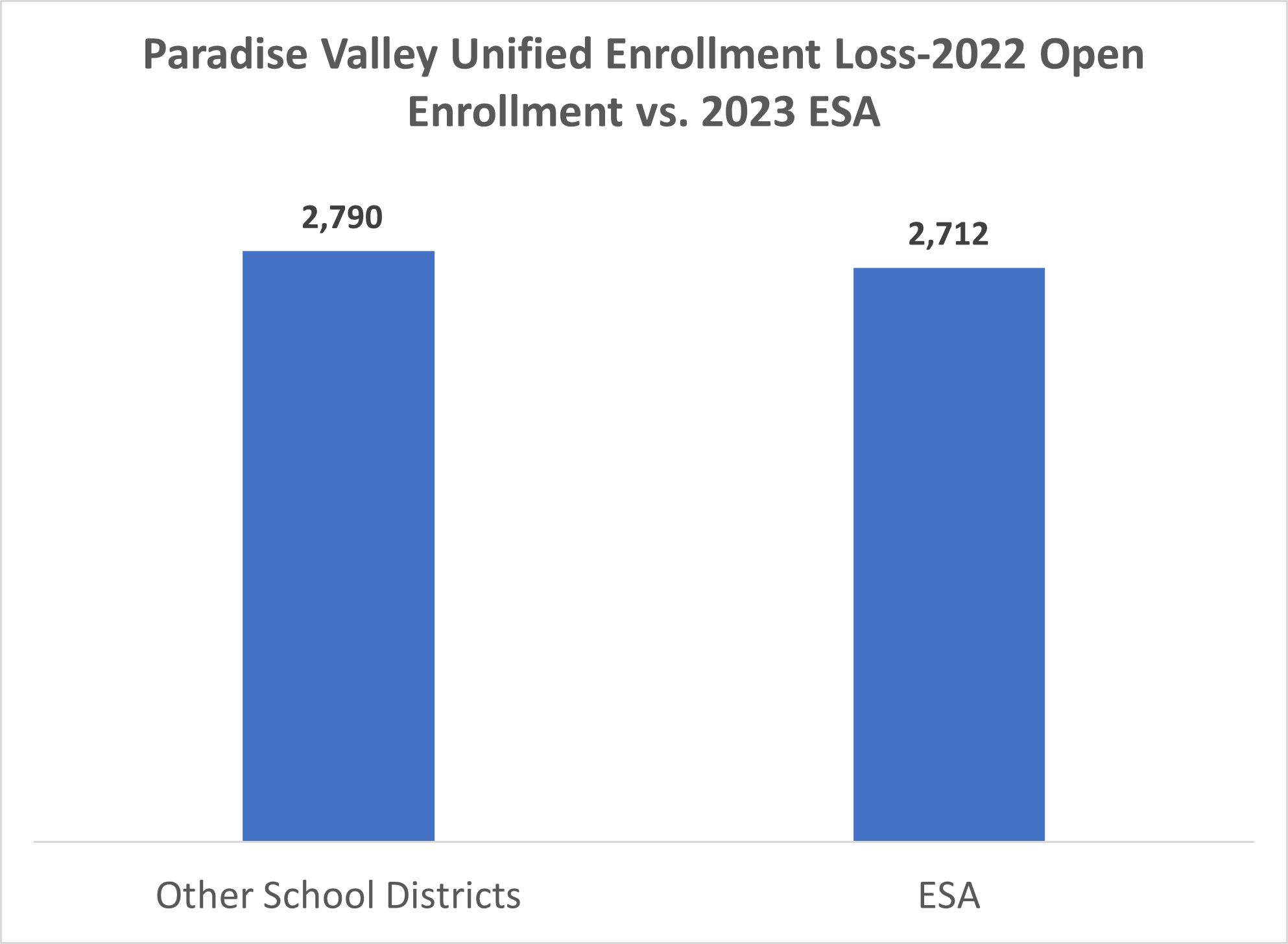
Note that Paradise Valley has been losing students to other districts for decades, whereas the ESA program is a relative newcomer. Right about now you might be asking yourself “Self, why don’t choice opponents ever complain about open enrollment?” I can’t be certain, but it might have something to do with the fact that kids transferring between unionized districts doesn’t bother them overly much, but that would be speculation on my part.
In any case, Arizona is 15 years and counting into a Baby Bust, and the state has millions of square feet in unused or underutilized district school space. School closures seem inevitable, raising the question who should decide? Arizona families should carry on voting with their feet on which schools endure, which replicate or expand, and which to close.
 Last week saw some excitement in Arizona political circles as the Arizona Department of Education estimated 2024 Empowerment Scholarship Enrollment at 100,000 students. Sadly, “some excitement” translated into absurd fear mongering predictions of financial ruin for Arizona.
Allegedly, We.Are.All.GONNA.DIEEEEEEEE!!!!!!
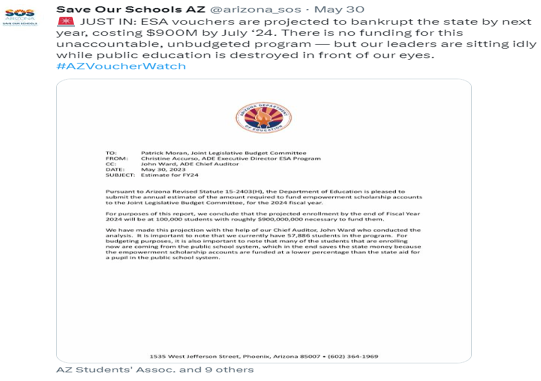
If Arizona choice opponents had done a bit of math, they might have spared themselves from having to breathe into a paper bag. I can, however, be of some assistance: $900,000,000 divided by 100,000 students is an average of $9,000 per student.
How much do taxpayers put per pupil into district and charter schools? Arizona’s Joint Legislative Budget Committee has an answer from fiscal year 2021:
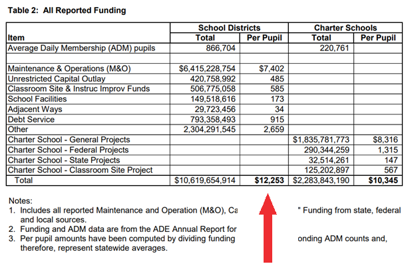
JLBC also has a statewide estimate for fiscal year 2023 of an average of $13,306 per student. In the reverberations of the Arizona anti-choice echo chamber, you’ll hear people desperately trying to claim that it doesn’t matter that $13,306 > $9,000 because of different pots of money (local, state and federal) because reasons.
Reasons that cannot be coherently articulated, but reasons.
 This belief is quite odd given that all the pots are filled up by the same taxpayers, who all pay local, state and federal taxes. Ergo, while the taxpayer may magnanimously pay more for students to attend district or charter schools at their option, it’s not like they have any reason to oppose children opting for the Empowerment Scholarship Account if that floats their particular boat.
My Texas public school math training informs me that the average ESA students uses approximately 32% fewer taxpayer resources per pupil than the average Arizona student. For you incurable skeptics, consider the budget of Mesa Unified:
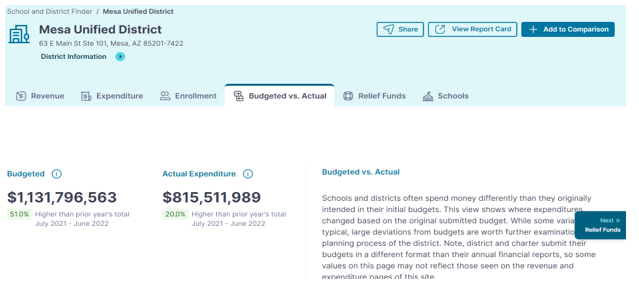
Mesa Unified had 54,000 students, was budgeted for $1.1 billion and change, actually spent $815 million and change. The memo that caused Arizona choice opponents to panic estimated 100,000 students at a cost of $900 million. So … ESA has far more students but fewer taxpayer dollars. If ESA is going to bankrupt Arizona, Mesa Unified is going to send Grand Canyon State taxpayers to a debtor’s prison.
Is the growth of the ESA program going to “destroy public education?” Hardly.
Arizona lawmakers have been listening to such non-stop predictions of doom since passing charter school and open-enrollment legislation in 1994. Since then, they have created a scholarship tax credit program (1997), expanded it multiple times, and created the Empowerment Scholarship Account program (2011) and expanded it multiple times. Lo and behold, Arizona’s spending per pupil in districts is currently at an all-time high, and this happened in academic growth:
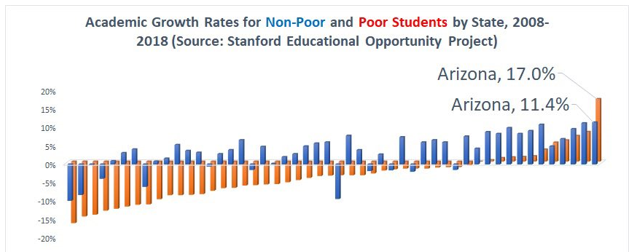
Please, sir, can I have some more “destruction?”


In the stunning fantastic Disney+ Star Wars series Andor, the shadowy Luthen Rael finally reveals something about himself by telling a subordinate about what he was sacrificing. In response he gave the above speech which you can watch the amazing Stellen Skarsgaard deliver here. Luthen makes clear that far from being an arm-chair general, he fully expects to die for his rebellion.
Others, however, expect to receive deference without putting anything at risk. On Feb. 15, during a hearing in the Arizona legislature over a curriculum bill, an Arizona public school teacher said the quiet part out loud:
I have a master’s degree, and when I got certified I was told I had to have a master’s degree to be an Arizona certified teacher. We all have advanced degrees. What do the parents have? Are we vetting the backgrounds of our parents? Are we allowing the parents to choose the curriculum and the books that our children are going to read? I think that it is a mistake and I’m just speaking from the heart. The one line that I love is that ‘we must remember that the purpose of public education is not teach only what parents want their children to be taught, but what society needs them to be taught.’
Where to start? First off there is no requirement to get a master’s degree to become a certified teacher in Arizona. This is a good thing as research has found that while having an effective teacher is a big deal in terms of student outcomes, having a teacher with a master’s degree, not so much.
I think that having earned a couple of advanced degrees doesn’t qualify me for much, but it does qualify me to say that some of the biggest out of touch with reality nitwits of all time hold advanced degrees. Decades ago, William F. Buckley once stated he’d rather be governed by the first 100 names in the Boston phone book than the faculty of Harvard University. I couldn’t agree more.
The intervening years can only have strengthened this conviction to anyone paying even a small amount of attention, especially in education. “Experts” with “advanced degrees” after all trained generations of teachers to employ catastrophically flawed methods of reading instruction. Multiple teachers are quoted in Emily Hanford’s Sold a Story podcast explaining that they had made a terrible mistake deferring to “experts.”
“Are we allowing the parents to choose the curriculum and the books that our children are going to read?” the speaker asked rhetorically. One literacy-crisis-mass-produced-by-idiots-with-advanced-degrees later, I’m inclined to say “why yes, actually, that sounds like a splendid idea. Hand me the dice.” A few times in my career I’ve needed to explain to a highly credentialed younger colleague that a graduate degree does not entitle one to deference. If your training was worth what you paid for it, then you need to show us rather than tell us about it.
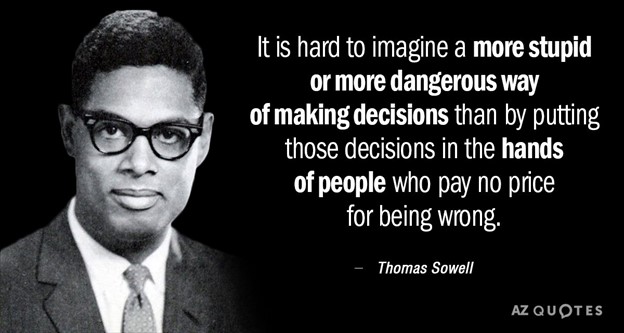
What do the parents have? The testifying teacher likely will be paid and receive a pension whether students learn the knowledge and habits needed for success in life or not. The parents, on the other hand, have something very important - a great deal to lose. They have skin in the game- their family’s future. I’d also wager that they have a great deal more common sense per capita.
What do our highly degreed “betters” lose when they mismanage the curriculum of public schools? Nothing. What do parents sacrifice? Everything.

Oklahoma Attorney General John M. O’Connor released an advisory opinion on Dec. 1, which concluded in essence that enforcement of Oklahoma’s statutory prohibition on religious charter schools was likely unconstitutional given a series of rulings by the United States Supreme Court. Nicole Garnett made a similar case in a policy brief for the Manhattan Institute in 2020. Describing the legal issues as “complex” would be to grossly understate the matter. After reading both documents at the other end of the above links it seems likely to me that people will attempt to open religious charter schools (meaning schools that teach religion as truth) and that the issue will be tied up in court for many years.
While I am open to challenge and reserve the right to be persuaded, put me down as the founding member of a camp that holds religious charter schools as “permissible, mandatory and a bad idea.”
I’ll leave the permissible and mandatory arguments to those trained in constitutional law. I find Garnett’s interpretation of recent Supreme Court rulings persuasive on both counts. Even if O’Connor and Garnett prove right about constitutional law, (they may or may not be) it does not mean that it is a good idea for religious groups to open charter schools.
People deserve an equitable share of K-12 funding to pursue the education they find best for their child, whether that involves religion, philosophy etc. Current policy hugely discriminates against families desiring a religious education. Families are the clear customer of private schools, which are driven by voluntary association and exchange and operate in a relatively permissionless space. With regards to charter schools, this is sadly murky.
Charter schools also receive funding on a per-pupil basis, but given that they are authorized by the state, the more intrusive the state authorizer, the more the state becomes the master at the expense of families. The combination of powerful opposition and cartelism on the part of many charter school supporters have combined in recent years to create many state charter sectors that lack many charter schools. In one case, any charter schools.
Mississippi’s authorizer allowed exactly one charter school to open last year. Congratulations, Natchez; the rest of you, better luck next year. Arizona’s authorizer withdrew charter authorization from a school that Stanford University scholars found had a rate of academic growth 43.4% above the national average between 2008 and 2018. This school didn’t space out their recess periods enough to suit state statute — tsk, tsk — and Arizona has far too many highly effective schools. Oh, wait you can never have too many! Oops, there I go again with that whole “logic” thing. This is politics. Politics does not need to make the least bit of sense.

The King James Bible translates Matthew 6:24 as “No man can serve two masters: for either he will hate the one and love the other; or else he will hold to the one and despise the other. Ye cannot serve God and mammon.” Charter schools represent a large advancement over regulatorily captured school districts attempting to engage in central planning to suit their dominant interests. In charter schooling however, the state is still a master. Those hoping to serve God should choose wisely when it comes to religious charter schools: permissible and desirable are not one in the same.

