
Choice opponents have been known to throw contradictory arguments out against private choice programs. One moment they will claim that the majority of kids using universal choice programs were already going to private schools. A few moments later they will claim such programs are draining district schools of students and money. The irony of these mutually exclusive claims will often escape the person making them, and you can see hints of both in this New York Times podcast titled Why So Many Parents are Opting Out of Public Schools.
Sigh
Choice opponents make all kinds of claims, but not many can withstand even a modicum of scrutiny. Let’s take for instance a widely repeated fable- that Arizona’s universal ESA program has “busted” the state budget.
If you actually examine state reports like this one for district and charter funding and also this one for ESA funding, you wind up with:
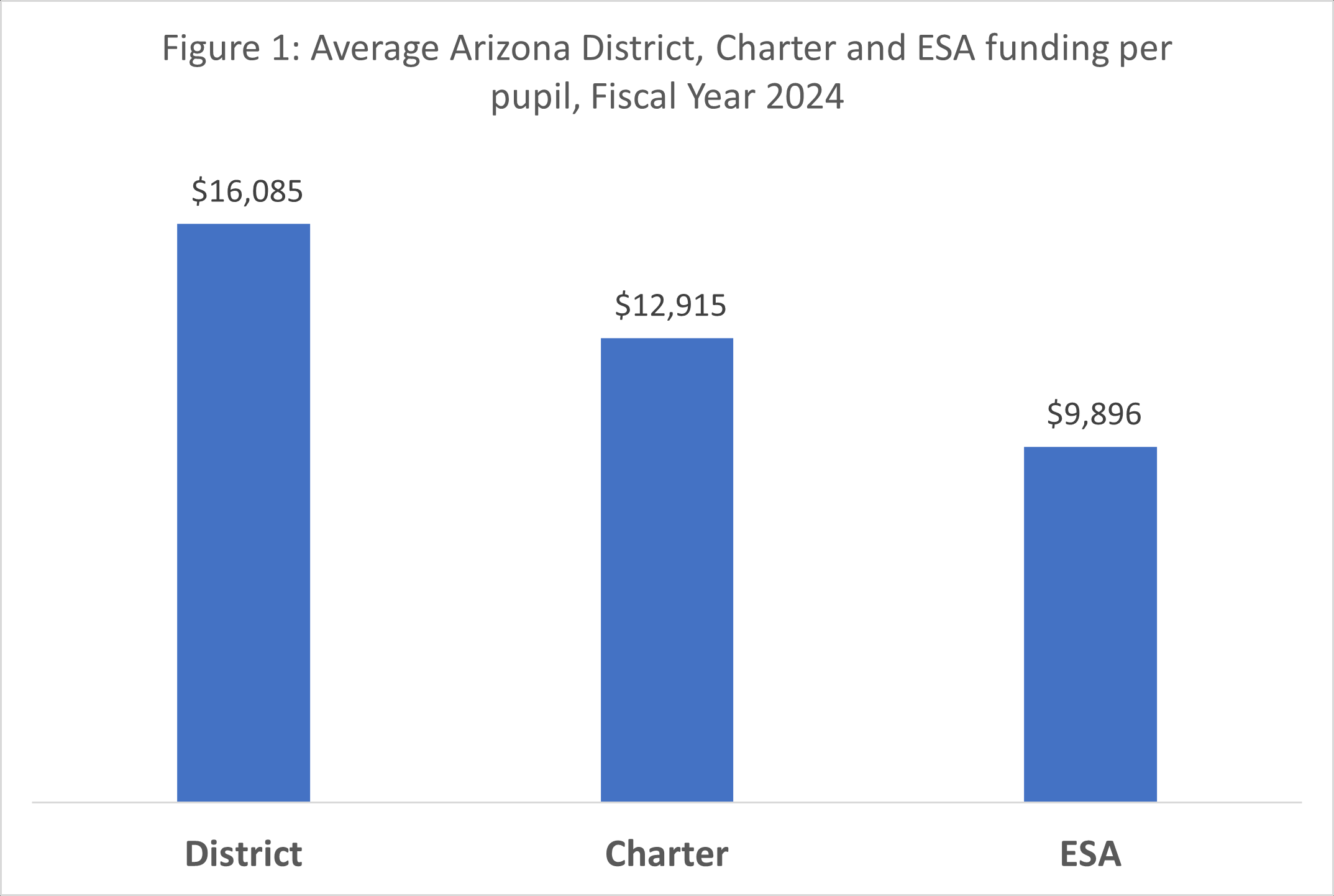
Arizona districts have exclusive access to local funding among other things and are by far the most generously funded K-12 system in the state. Districts, charters and ESAs all use the state’s weighted student funding formula, and ESAs get the lowest average funding despite having a higher percentage of students with disabilities participating than either the district or charter sector.
If you track the percentage of students served by the district, charter and ESA sectors respectively, and the funding used by each as a percentage of the total, you get:

So, there you have it; supposedly the sector educating 6% of Arizona students for 4% of the total K-12 funding is “bankrupting” the state of Arizona. Meanwhile the system, which generated an average of $321,700 for a classroom of 20 ($16,085*20), is “underfunded.”
A group of 20 ESA students receiving the average scholarship amount receive $123,780 less funding, but they are (somehow) “busting the budget.” The fact that a growing number of Arizona students opt for a below $10k ESA rather than an above $16k district education tells us something about how poorly districts utilize their resources. So does the NAEP.
There is a school sector weighing heavily upon Arizona taxpayers, but it is not the ESA program.
David Osborne recently predicted academic doom for red states having recently passed universal private choice programs. “This will accelerate the process of the rich getting richer while the poor fall further behind,” Osborne asserted. Osborne problematically ignored our nation’s actual experience with universal choice programs, making his column more a litany of faith than a clear-eyed analysis.
Osborne predicts a bleak future for states with universal private choice programs, with poor families left behind. Osborne prefers a charter school model of choice, keeping choice within the public realm of regulation and accountability:
"Is there an alternative, other than the status quo of struggling public school systems? Indeed there is. States and school districts could reduce bureaucratic controls, empower educators and increase choice, competition and accountability for performance within the public school system, through the spread of charter schools. Cities that have done so, including New Orleans, Washington, D.C., Denver and Indianapolis, have produced some of the nation’s most rapid improvements in student performance."
Arizona lawmakers created the first universal private choice program in 1997, the nation’s first scholarship tax credit program. Decades passed before another state enacted a private choice law with equally expansive eligibility. Three years earlier, in 1994, Arizona lawmakers had created two de facto public universal choice programs in the nation’s most robust charter school law and a statewide district open enrollment statute. “Large” and “relatively lightly regulated” would accurately describe Arizona choice programs, both public and private. Arizona lawmakers expanded and supplemented scholarship tax credits repeatedly; the Arizona charter sector became the largest among states, and open enrollment between and within districts dwarfed both in combination. Arizona created the nation’s first education savings account program in 2011 and expanded eligibility several times before making it universally available to Arizona K-12 students in 2022.
Given Osborne specifically cites four jurisdictions with the sort of choice programs of which he approves- Denver, Washington D.C., New Orleans, and Indianapolis, it seems in order. The Stanford Educational Opportunity Project provides academic growth data by jurisdiction (schools, counties, and states) and student subgroups for the 2009-2019 period. Comparing the rate of academic growth for low-income students in each of these four jurisdictions with those of Arizona counties in Figure 1:

Academic growth is a very important academic measure. While raw scores are very strongly correlated with student demographics, growth is much less so. Scholars widely view academic growth as the best measure of school quality. Many years into exposure to universal choice programs, Arizona’s low-income students seemed to be too busy learning to suffer Osborne’s predicted calamities. Greenlee County is a rural and remote area of Arizona with approximately 1,500 students and (alas) no charter or private schools during the period covered by the data. In this measure, a “zero” basically entails having learned a grade level worth of material per year on average, so the performances for Denver, DC and Orleans Parish are respectable, Marion County (host county of Indianapolis) less so.
The Stanford Educational Opportunity Project also measures the gap in learning rates by subgroup, which is measured by subtracting the learning rate of poor students from that of non-poor students. The four jurisdictions lauded by Osborne ranked first, second, third, and fifth in comparison to Arizona counties in terms of the amount of learning rate inequality between poor and non-poor students. There was exactly one state that had a positive rate of academic growth for both poor and non-poor students and had a faster rate of academic growth for poor students. It is the state marked “1” and spoiler alert…it is Arizona, the host of multiple universal choice programs.

Osborne’s hypothesis held that what some would regard as wild, lightly regulated “let it rip” choice programs would prove to be a disaster for low-income students, and conversely, well-regulated choice programs should advantage the poor. In practice, however, we find evidence to support the opposite conclusion. These results would not have surprised Milton Friedman in the least:

The results in the above figure also sit comfortably with the diagnosis of John Chub and Terry Moe, who identified politics as the central flaw of the American public school system. The American public school system does not do a terrific job on average in educating students, but it does a fantastic job in maximizing the political power and revenue of employee unions and their associated fellow travelers. Attempting to set up a governance structure of politically disinterested technocrats who will give families just the right amount of freedom and just the right amount of regulation comfortable for technocrats is an appealing theory. In practice, the most powerful and reactionary forces in modern American politics hijack the project easily unless a powerful, supportive constituency rises to defend the programs.

"War, huh, yeah
What is it good for?
Absolutely nothing"
— Edwinn Starr, "War"
The District of Columbia Public School system has a troubled history with special education. In reviewing a U.S. Commission on Civil Rights study on the subject, footnote 4 on page 7 led to a data source in which DCPS stood out like a very sore thumb: disputes between families and the district over special education: In 2018-19, DCPS had a rate of special education due process complaints filed which stood at more than eight times the national average per 10,000 students with disabilities served:

This led me to wonder what more recent data, and to wonder about how the states of Arizona and Florida would compare to DC in that more recent information. A web of policy diffusion between the states of Arizona and Florida resulting in both states eventually adopting robust formula funded education savings account programs for students with disabilities. The process began in Florida in 1999, when Florida Senate President John McKay passed and Gov. Jeb Bush signed what became a statewide voucher program for students with disabilities. Under the federal IDEA legislation, parents had the right to sue school districts for failure to provide a free and appropriate education (FAPE) for a district-financed private school placement. The practical difficulties of financing such a suit, however, left it as an avenue mostly accessible to well-to-do families. Districts have long contended that they do not receive enough funding for special education.
The McKay Scholarship program turned both of these unfortunate facts on their heads: you no longer needed to file a lawsuit to access private schools. Moreover, McKay Scholarship-participating families were entitled only to the funding that districts have spent decades describing as inadequate. Access to private education for students with disabilities was delightfully democratized and a financial win-win developed for families and districts. Tens of thousands of special needs students participated in the program, and it spent many years as the largest school choice scholarship program in the country.
Over in Arizona, our education freedom Scooby-gang was determined to emulate Florida’s success. In 2005, Arizona lawmakers passed, and Gov. Janet Napolitano signed a voucher program for children with disabilities. The Arizona school district industrial lobbying complex sued the program, and in 2009 the Arizona Supreme Court struck it down as violating the Blaine Amendment in Arizona’s Constitution. The Arizona Blaine Amendment forbade aid to “private or religious schools.” Dan Lips had proposed an account-based choice program in a paper for the Goldwater Institute, and the lightbulb moment happened: an account-based program with the option not to spend money at private and religious schools would be meaningfully different than a voucher program as pertaining to constitutional issues, among other advantages. Firing up our school choice Mystery Machine, we passed the first ESA program in 2011 and survived court challenges. Our compatriots in Florida became the second state to pass an ESA program for students with disabilities in 2015, and the ESA and McKay programs were eventually merged into a single ESA program.
How could this help DCPS and their never-ending cycle of special education conflict? Below is that more recent special education conflict data I referred to, and the rate of various conflict measures per 10,000 students with disabilities are displayed for Arizona, DCPS and Florida.

DCPS should not wait on the federal Olympians to look down from their perch on Capitol Hill to impose such a peace settlement on DCPS and the families it is constantly at war with. DCPS should settle this peace themselves as fast as possible by creating a robust ESA program for students with disabilities. You may say I’m a dreamer, but I’m not the only one. Someday DCPS will join us in this humane and beneficial policy and give peace a chance.

Jason Bedrick and I published a piece at the Daily Signal about the Roosevelt Elementary School District in South Phoenix. The Roosevelt district has experienced enrollment loss for decades, and the school board of the district has announced plans to close five schools.
I first learned of Roosevelt Elementary School district some 20 years ago when a Roosevelt student brutally assaulted a co-worker’s child. The staff’s response was far less than satisfactory, but at the time, it was difficult to locate mid-year transfer spots for my co-worker’s children, even after we enlisted the aid of a person who specialized in such situations.
I’m happy to report that in 2025, it is less difficult for desperate parents to execute a mid-year transfer.

Multiple factors explain the decline of Roosevelt’s enrollment, including a nationwide baby bust that began around 2007. Students living in the boundaries of Roosevelt but attending other public schools, both districts and charters, outnumber ESA students approximately 10 to 1. So, Arizona’s open enrollment and charter statutes deserve more credit than the ESA program. An examination of the reviews of Roosevelt Elementary schools left by students, parents and staff on private school navigation websites made my co-worker’s experience from 20 years ago seem to be far from an isolated, unfortunate incident. Here are some examples:
“Please do not take your children here. Almost every child is bullied, and the staff won't do anything. If you truly care about your kid's school experience, don't sign them up.”
“This school makes kids act out by tolerating relentless bullying and cruel treatment by teachers for special needs kids.”
“The kids get bullied, my son got a Black eye the 1st day of school and they told me that because he didn't know who the kid was there was nothing they could do.”
“This school should be shut down.”
“…They don’t take care of bullies; they just ignore the problem and leave the kids (to) fend for themselves; it seems that this is a safe place for bullies not for other kids. I would recommend that you should never enroll your kid here, and if you do, be prepared to endure what seems to be a never ending bully problem, and its not only the teachers that don't do anything about bullies.”
“I would rate it ZERO stars. This school is not SAFE NOR ORGANIZED. Roosevelt school district needs to step up their game or close this school down.”
“Students are constantly fighting or involved in some type of confrontational altercation with each other. Teachers behave more as peers than educators. My grandchild has attended this school for the past five years. I have seen very little improvement. If it were my choice, they would not attend.”
People who work for school districts have organized, and they use the fact that Americans dislike school closures. I would submit, for your consideration, that it is not wicked legislators or dastardly choice supporters who have forced the looming closures of Roosevelt schools. Rather, it has been due to the action of thousands of families who live in the boundaries of the district, who desire safe schools that will equip their children with the knowledge, habits and skills necessary for success. They have chosen to prioritize the long-term interests of their children over the short-term preferences of Roosevelt staff in increasing numbers for decades.
This is a thumbs up for Roosevelt students, whose interests the community has collectively put first, more than a thumbs down for the district schools. Roosevelt district schools will remain the best funded option on a per-pupil basis and might just stage a comeback if they can secure the confidence of families regarding safety and academics. Some of my friends in Arizona’s K-12 reactionary community would prefer that Roosevelt schools receive unconditional immortality. It is difficult to view these folks as engaged in anything other than macabre traffic in other people’s children. Perhaps I judge too harshly; the Phoenix area K-12 industrial lobbying complex is probably large enough to delay the need for difficult decisions in Roosevelt. If they are willing to enroll their own children in Roosevelt schools through open enrollment or otherwise, they might be able to stave off the need for safety and academic improvements.
Opponents of choice in Phoenix have been avid users of choice. One of your humble author’s children graduated from a South Phoenix charter school just a few miles away from Roosevelt. He attended with the children of two gubernatorial nominees who campaigned against choice (including Gov. Katie Hobbs), a child of the president of the Arizona Education Association and a co-founder of Save Our Schools Arizona, among others. Rather than choosing safe and academically performing charter and district schools, this community could instead put their families where their mouths are and lead the renaissance of Roosevelt district schools by enrolling their own children and grandchildren.
While this noble project gets off the ground, we in the Arizona choice community will continue to prioritize the interest of families above those institutions.
 If you look at enrollment trends in the Arizona districts with the largest total enrollment losses, look at the Arizona Open Enrollment report and the Quarterly ESA report, you get Figure 1. In Figure 1, both the gains from open enrollment (blue columns) and the losses to other districts and to charter schools (red columns) are presented. The purple columns represent the ESA enrollment of students who live in each of these districts.

Note that the ESA students reside in these districts; many of them were never enrolled in the district where they reside when they enrolled in the ESA program. Some students were already attending private schools, in which case they effectively transferred from the private scholarship tax credit program to the ESA program. Others were in those red columns, attending charter schools and other district schools through open enrollment. Others enrolled in kindergarten straight into the ESA program; others moved in from other states. Others, of course, transferred into ESA directly from their resident district. The purple columns, however, undoubtedly overstate the impact of the ESA program on district enrollments.
Even if they did not, I invite you to compare the red and the purple columns. The financial impact to a district school is identical whether they transfer to another district school, to a charter school, to the ESA program, or move out of the state.
I received some interesting responses to last week’s post where I showed some math on how few votes it could have swung control of the Arizona State Senate in the 2024 elections and noted that one of the Arizona political parties having proposed eliminating five popular choice programs may have helped Republicans expand their previous narrow majority. One response focused on a relative who voted for Kamala Harris for president but only voted for state legislative Republicans because her grandchildren participate in the Empowerment Scholarship Program. I had not even considered grandparents and relatives (other than parents) of students participating in choice programs, but they are indeed out there and are registered to vote.
Another response noted that the potential coalition against private choice was much larger than that in favor of private choice in Arizona, given that far more students attend school districts than participate in choice programs. The latter part of this is of course true, but I noted that both absolute and per pupil spending in Arizona school districts stands at or close to all-time highs, making it a fairly latent constituency. Notwithstanding a whole lot of windy rhetoric, no one is proposing to eliminate district schools in Arizona (or anywhere else).
Supporters of private choice programs, on the other hand, have watched as Gov. Katie Hobbs proposed eliminating the programs that they rely upon, making them more of an active constituency. I had a couple of readers inquire as to why I did not include charter school students and families. To my knowledge no one has proposed eliminating Arizona charter schools, so I view them as a mostly latent constituency, at least until someone is reckless enough to threaten their existence.
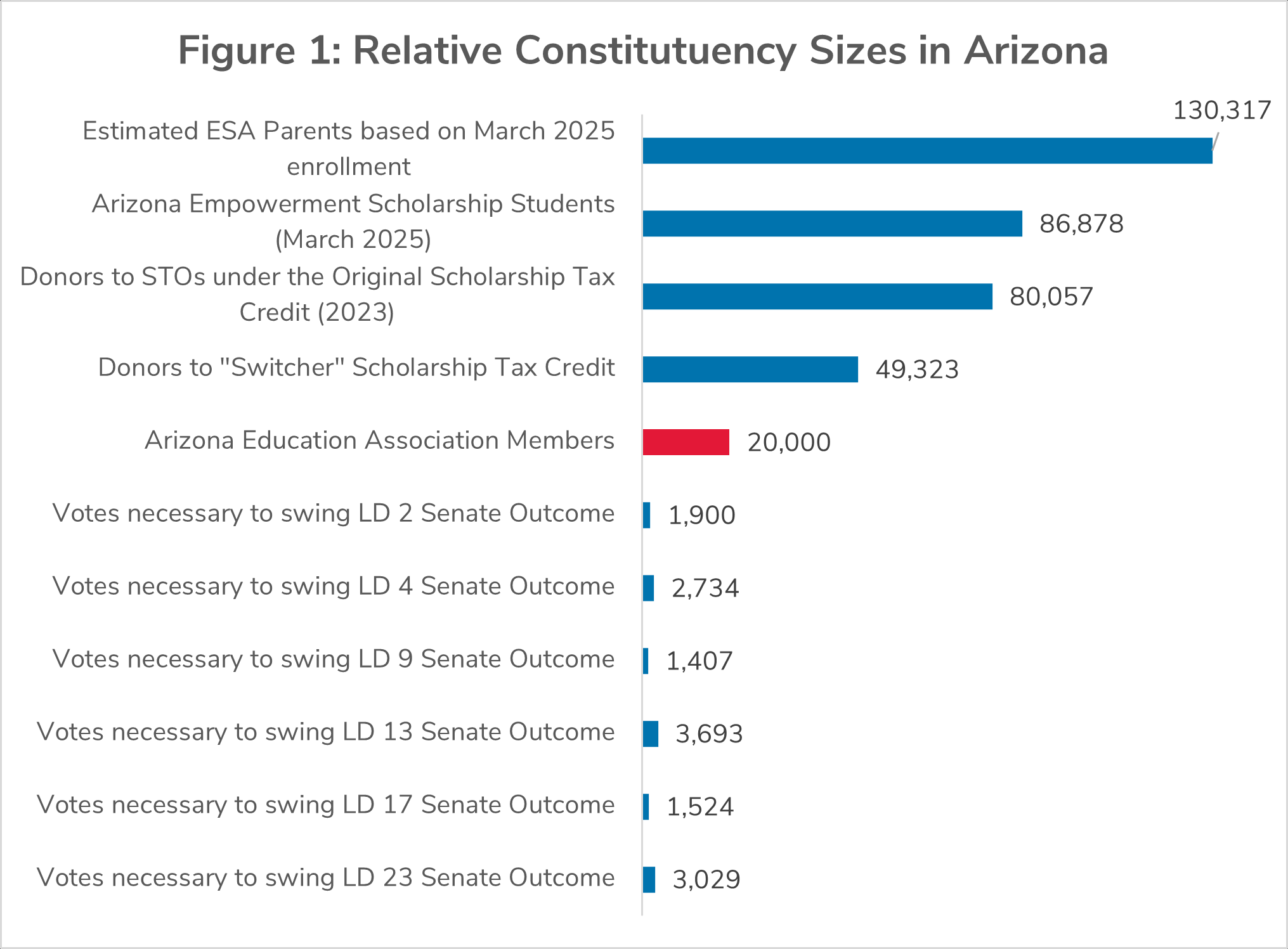
I put together the chart below based on a few different sources of information. Some numbers are from 2025; the tax credit numbers are from the state’s 2023 report. The tax credit donor numbers only count donations, rather than the number of members of the families who made the donation. There is certainly some double counting going on with the original and switcher credits, as many people claim both. The parent figure is an estimate that assumes 1.5 parents per ESA student in 2025 and does not consider the possibility of other relatives. The below list is by no means exhaustive, or even close to it. Also included are the number of swing votes each losing candidate would have needed to win in the swing Arizona Senate races.
Here goes:
By November 2026, these numbers are going to look even less forgiving than they do now. There are a whole lot of registered Democrats in those larger numbers. It might not be a great idea to give them an incentive to split their tickets to vote in their kids’ interests in legislative races.
By the way, did I mention that the margin of victory in Arizona’s 2022 governor’s race was 17,117 votes and, in the attorney general race, the margin was 280 votes?
Arizona’s politics might be described as “Chaotic Purple,” but 2024 elections proved quite red at the state legislative level, with Republicans making gains in both the Arizona Senate and House. It may be the case that some of those gains happened because of the unrelenting level of hostility to school choice on the part of the nominated candidates of the Arizona Democratic Party for state legislature. Surveys show that school choice remains broadly popular among Arizona Democrats, Independents and Republicans. Democratic candidates and officeholders, however, have been much more likely to represent the views of public school-affiliated lobbyists and activists than those of their own voters and (crucially) the independent voters needed to secure electoral victory. Hostility to school choice may have cost Arizona Democrats legislative majorities in 2024, and the likelihood of this will only increase in the years ahead.
The 2018 elections might best illustrate Arizona’s Chaotic Purple tendencies, as Republican Gov. Doug Ducey won re-election by a thumping margin even as Democrat Kirsten Sinema won the race for a seat in the U.S. Senate. “Ducey-Sinema voting” did not end in 2018. In 2020, Arizona voters narrowly went for Joe Biden and in 2022 elected Democrat Katie Hobbs governor, but in both instances kept Republican legislative majorities intact. In 2024, the same electorate swung back to Donald Trump over Joe Biden in the presidential race and expanded Republican legislative majorities but also elected Democratic candidate Rueben Gallego to the U.S. Senate. Arizona was a hotly contested swing state in 2024, and Arizona Democrats privately expressed confidence regarding their chances for capturing majorities in the state legislature.
Arizona Democrats have not always been hostile to school choice. Gov. Janet Napolitano, for example, signed two voucher laws as a part of a budget deal. Arizona’s current governor has espoused an unrelenting hostility to school choice, having called for the repeal of Arizona scholarship tax credit programs and “reforms” to the Arizona Empowerment Scholarship Account program that would effectively eliminate the program. Not to be outdone, Arizona legislators have also filed “reform” and “accountability” proposals on choice programs which, if not actually drafted by Arizona’s NEA affiliate, looked remarkably similar to something they would draft if given the chance.
Arizona has five private choice programs: four scholarship tax credits and the Empowerment Scholarship Account. Well over 100,000 students participated in these programs by November 2024. Some of them were eligible to vote in 2024. Arizona taxpayers made 80,057 scholarship tax credit donations in 2023 under the original tax credit program, and another 49,323 donations under the “switcher” credit. Thousands of Arizonans volunteer and/or work at a private school. A broader universe of therapists and tutoring firms also participate as eligible vendors in the ESA program. The unrelenting hostility of many Democrats to the interests of their children, students and schools would be hard pressed not to notice. Did this hostility cost Democrats at the ballot box?
Perhaps so.
The Arizona Senate has 30 seats, and most of these races are not close, going for either the Republican or the Democrat candidate by a wide margin. The races are close and decide which party will be in the majority. The closest state Senate races in 2024 occurred in Legislative Districts 2, 4, 9, 13, 17 and 23. Republicans won four of these six close races, prevailing by margins of 3,767, 5,465, 7,383 and 3,045 votes, respectively.
For example, Arizona Legislative District 4 featured Republican Carine Werner defeating Democrat Christine Marsh by 5,465 votes. A swing of 2,733 votes would have changed the outcome of the election. Data compiled on Legislative Districts by the Common Sense Institute of Arizona found that 3,399 students were attending private schools in 2021-22 in Legislative District 4. The 2021-22 school year, however, was before the Arizona Empowerment Scholarship Account became universally eligible to all Arizona K-12 students.
The Common Sense Institute Arizona research found private school enrollment increased by 31% between the 2019-20 school year and 2021-22 school year. If we take the conservative assumption of a similar increase by the fall of 2024, it would create an estimate of 4,452 private school students in Legislative District 4 by November 2024. If you assume 1.5 parents for each private school student, you reach a potential voting block of 6,679. Assume further that the 4,452 private school students didn’t get there without corresponding private school staff members, add in the assumption that LD 4 had a proportionate share of Arizona’s 100,000 plus scholarship tax credit donors, and you reach an unavoidable conclusion: pledging to revoke private choice programs may have been a very costly political decision. In Arizona Legislative District 4, not only the Senate race but both House races went to candidates supportive of K-12 choice.

We will never know for certain whether K-12 choice hostility tipped electoral balances in 2024. However, we do know that it will be more likely to happen in 2026 legislative races than it was in 2024 based upon the continued growth in Arizona choice programs. Continuing to threaten the thousands of families relying upon choice programs looks to have been a bad bet in 2024 and a worse bet going forward. Both ESA families and scholarship tax credit donors each separately outnumber members of the National Education Association affiliate by more than four to one. Math is hard, and it is even less forgiving.

When I was in graduate school, one of my fellow students described the movie Sudden Death to me. Something about terrorists, the vice president, a professional hockey game and Jean-Claude Van Damme. “It was a parody, but no one told Jean-Claude Van Damme,” the summary concluded. Arizona’s ESA opponents have an uncanny way of bringing this summary of a movie I have yet to see to mind.
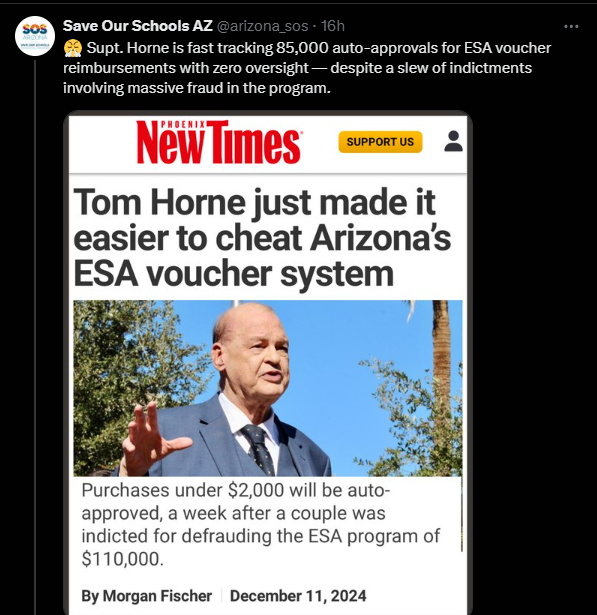
Last week Arizona Superintendent Tom Horne announced that the Arizona Department of Education would begin to use risk-based accounting in Arizona’s Empowerment Scholarship Account program. Risk-based accounting has long been a standard operating procedure in other government policies that provide purchasing power to recipients. The response from ESA opponents displayed their characteristic combination of careful nuance and measured criticism. I am sorry, I must have been thinking about the ESA opponents from the Bizzaro world! Alas, here in the real world we got the same ol' same ol':
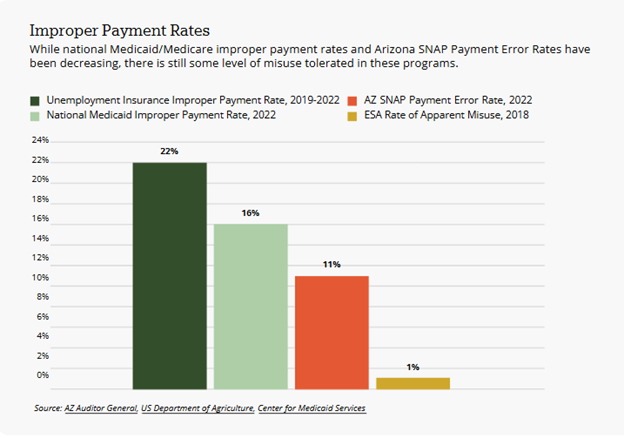
ESA opponents have cited misuse of funds as a rationale for eliminating ESAs, but this appears to be a highly selective form of fiscal conservatism. The misuse of funds rate for programs such as Unemployment Insurance, Medicaid, SNAP and much more stands at several times higher than Arizona ESA program. If we want to eliminate government programs with a misuse of funds rate equal to or higher than the Arizona Empowerment Scholarship Program, we are going to need to bring in the President of Argentina and his chain saw to pull it off.
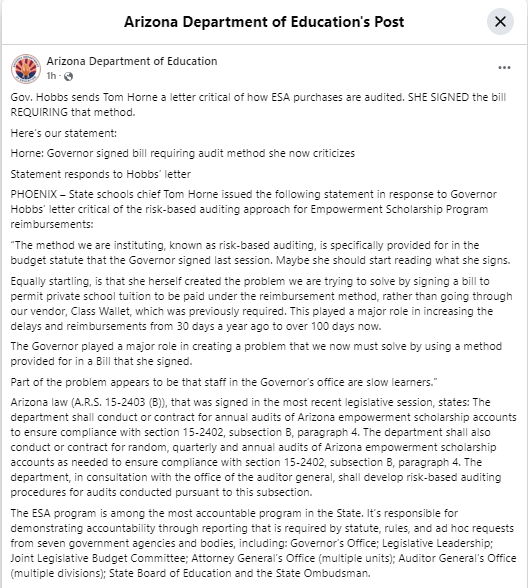
Continuing on the theme of unintentional comedy gold, Arizona Gov. Katie Hobbs put out a press release criticial of the Arizona Department of Education’s decision to employ risk-based audits. The Arizona Department responded by noting that Hobbs signed legislation which, quite sensibly by the way, requires the Arizona Department of Education to employ audits for the ESA program:
The best kind of irony — unintended irony.
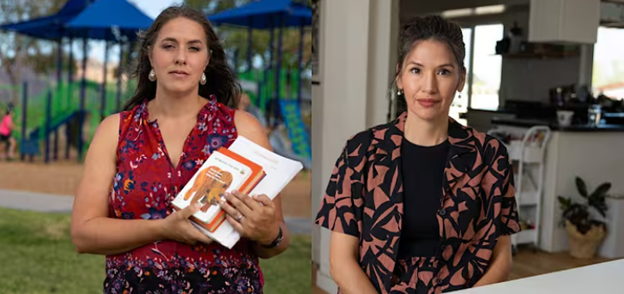
Years ago, education reformers coined the phrase “Big Learning Organization Bureaucracies aka the BLOB” to describe the collection of groups associated with the K-12 status quo. Recently the Arizona blob has tried to slime the ESA program, but ESA parents are fighting back in court. Arizona ESA moms Velia Aguirre and Rosemary McAtee have filed a lawsuit against the state to combat absurd requirements on the ESA program by Attorney General Kris Mayes with the aid of the Goldwater Institute. The case Aguirre vs. Arizona will give Arizona’s courts the opportunity to rein in bureaucratic overreach.
 Some 13 years into the ESA program, which has been administered by both Republican and Democrats, the current Attorney General Kris Mayes reinterpreted the ESA statute to contain previously undiscovered program requirements. Not coincidentally, these new requirements have gummed up the operation of Arizona’s ESA program.
As noted by the Goldwater Institute:
This new glob of bureaucratic goop makes no sense. For one thing, public and private school curriculum documents don’t even necessarily list items like “pencils” and “erasers.” As Velia explains: “No other teacher in the state has to provide curriculum for purchasing things for their classroom.” So, requiring parents to jump through the hoop of documenting a “curriculum” for materials that are obviously educational does nothing to prevent abuse of the program beyond the extraordinary lengths parents already have to go to in submitting expense receipts for every purchase. It does, on the other hand, needlessly exacerbate a backlog of tens of thousands of purchase orders that state officials must now go through to ensure every single book title and school supply satisfactorily appears on a separate curriculum document.
What’s more, the AG’s new mandate simply ignores state law and violates the Department of Education’s own handbook, which safeguards the ESA program by requiring documentation for unusual purchases, but not for common-sense purchases of items that are “generally known to be educational.”
Even as Kris Mayes gums up the program with goop, another Arizona Blob pseudopod is attempting to slime ESA families for not spending ESA funding fast enough. Yes, while the attorney general forces up the unspent balances of ESA accounts by making the program difficult to use, the Grand Canyon Institute criticizes ESA families for (….wait for it…) having too much unspent money! Never mind that these balances would be considerably lower if not for Mayes gumming up the works. Or that Arizona districts have been hoarding resources on a scale far beyond what is happening in the ESA program with no one to blame but themselves.
I’ll be rooting for Mama Bears to maul the Blob in court.

Imagine the major metro area near you if students were free to attend the fanciest school district in the leafiest local suburb. Can Dallas kids enroll in Highland Park? Can Columbus students transfer through open enrollment into Grandview Heights? Will Smith portrayed a kid from a tough background who got to go to school in Bel Air, but how often does this happen in real life? If you mentally put the over/under on the number of students getting the chance to do this at 1, take the under. Thousands of Phoenix students however attend school in Scottsdale. Sadly, a recent report from the Brookings Institution exemplifies the sort of short-sighted thinking that prevents these kinds of opportunities from materializing in other states.
The Brookings Institution recently published a report on the Arizona Empowerment Scholarship Account Program that was long on unsupported claims and short on context. Brookings decided not to engage in nuance in titling its study Arizona’s ‘Universal’ Education Savings Account Has Become a Handout for the Wealthy.
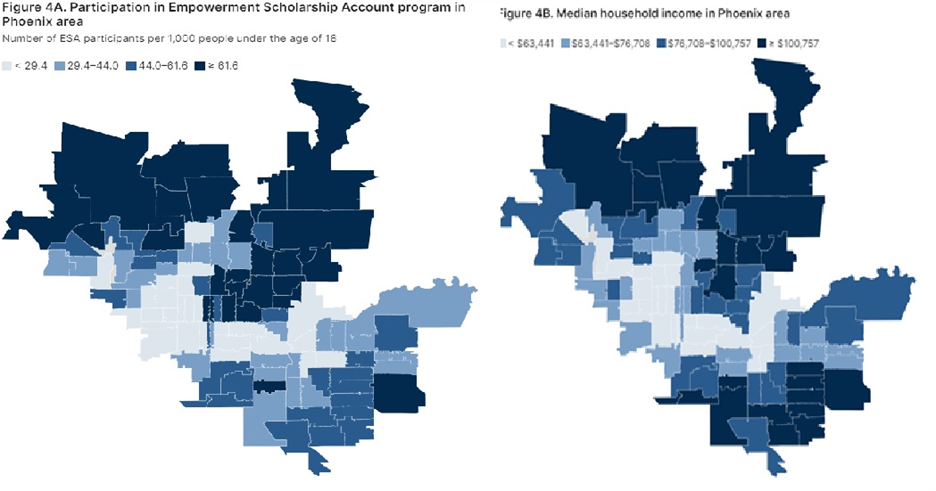
The study can be briefly summarized with two maps from the report: on the left is a ZIP code map of the Phoenix area by the rate of ESA participation (darker=more), and on the right the same zip code map by family income (darker=higher average). The maps look kind of similar. Is Arizona’s ESA program an instrument of plutocracy?
In a word, no. Quite the opposite.
Arizona has four other private choice programs besides the ESA program- all scholarship tax credits. Two of these programs are means-tested for the exclusive use of middle and low-income families. One of the other credits requires scholarship granting organizations to consider income in making awards, and the final credit is for children with disabilities- a fair number of whom will also be from families of modest incomes. These tax-credit programs raised over $264 million for scholarships in 2023, (see below) and higher income families do not qualify for many of these dollars.
Lower-income families desiring to attend private schools often prefer the tuition tax credit program over the ESA program. Meanwhile, higher income families are not eligible for much of the scholarship tax credit funding. Under Arizona law, you cannot participate in both programs.
All the ZIP codes in the Brookings analysis, including those with higher-than-average incomes, have public schools operating in them. The statewide average total district spending per pupil on school is almost twice as high as the ESA program. Higher income Arizonans pay their taxes and are entitled to attend school districts like everyone else, but they are also entitled to participate in the Empowerment Scholarship Account if they desire. If the ESA program is a “give away to the rich” then what pray tell is the Scottsdale Unified School District?
Speaking of Scottsdale Unified, it stands as a shining example of why choice programs should be universal. Scottsdale Unified publishes an ongoing demographic report and publishes the number of out of district open enrollment students served. This graphic is from that report:

The average home price in Scottsdale Arizona stands at $893,000, but 21% of Scottsdale Unified’s enrollment came from out of district through open enrollment. The reason 4,667 students can attend Scottsdale Unified without having a family purchase a $893,000 home is because 9,000 students living in Scottsdale Unified go to school elsewhere- charter schools, other districts through open enrollment, private schools.
Universal choice programs- including the Arizona ESA program but also including charter schools and district open enrollment-help create open enrollment opportunities. A virtuous cycle worked through Arizona schooling as educators supplied high demand school models, nearly all school districts began accepting open enrollment transfers. When a large majority of Phoenix students could attend Scottsdale Unified schools, it had the effect of closing low-demand charter schools.
During the last period in which all six state-level NAEP exams were available, fourth and eighth grade math, reading and science, (2009 to 2015) Arizona students alone made statistically significant gains on all six exams. The Stanford Educational Opportunity Project linked state tests in grades 3-8 across the country for the 2008-2019 period. Arizona’s low-income students have the fastest rate of academic achievement growth in the nation. Counterintuitively, universal choice has worked wonders for low-income students.

The Brookings study is neither the first nor will likely be the last example of folks back east lacking context about Arizona choice. Arizona created two universal choice programs in 1994 (charters and open enrollment) then a mix of universal and means-tested scholarship tax credits and finally the ESA program. Critics predicted doom every step of the way and continue to this day.

A portion of the early adopters of the ESA program, excluded from fully participating in other programs, chose to participate in ESA. Understood in context, you have no reason to feel alarmed and every reason to follow suit in your state- especially if you are concerned about poor students.

