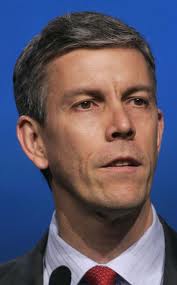
 The next few years are critical for education reform, with the implementation of higher standards likely to put tremendous pressure on political leaders to abandon course, U.S. Education Secretary Arne Duncan said Wednesday.
“The idea of implementing higher standards, the adoption in 46 states of higher standards, is clearly a huge step in the right direction. (But) that’s the easy part,” Duncan, referring to Common Core standards, said at a national education summit organized by Jeb Bush’s Foundation for Excellence in Education. “Will our political leaders have the courage when test scores drop 20, 30, 40, 50 percent? … Will they have the courage not to backpedal and dummy down standards like political leaders did under No Child Left Behind?”
Despite the challenges, Duncan said he was optimistic that state and local leaders would rise to meet them, and in bipartisan fashion. He pointed to recent reforms as proof.
“I’m actually extraordinarily hopeful,” he said in response to a question from moderator Andy Rotherham. “When I look at what states did, local legislative leaders, chief state officers, what they have done over the past couple of years, no one predicted that would happen. No one predicted that 46 states would adopt higher standards. No one predicted that three dozen states have taken teacher evaluations and principal support to a very different level. No one predicted that we would have 44 states working on the next generation of assessments. Frankly, we’ve had almost no rollback. And honestly, if a couple states choose to roll back, that would not be the end of the world.”
Duncan was a keynote speaker at the fifth annual summit, which drew about 800 participants from nearly every state. He made a pitch for continued investment in early childhood education and stressed teacher quality and teacher equity. He said the fact that not a single district has methodically moved to align its best teachers with its most struggling students is a sign of how far reformers have yet to go. (more…)
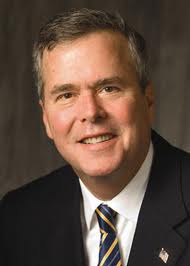 Kicking off his foundation's fifth annual national education summit, former Florida Gov. Jeb Bush stressed the usual components of his reform agenda today but also accented an increasingly big talking point: bipartisanship.
Bush said “new coalitions on the left and right” are moving to revamp teacher evaluation and compensation systems and concluded his 30-minute remarks with a lengthy homage to the leadership skills of former Democratic President Lyndon Johnson. He also noted the bipartisan backing of so-called “parent trigger” legislation, which he predicted would pass the Florida Legislature next year after failing on a dramatic 20-20 tie in the Senate last spring.
“This is one of those great places where the center, left, right coalitions of this world need to work together. And that’s exactly what’s happened,” Bush said, singling out Parent Revolution, the left-wing group that has led the charge nationally for the trigger.
Referring to his own Foundation for Excellence in Education, which organized this week’s conference, Bush continued, “We’re supposed to be center-right, I guess,” but “we will work with everybody to be able to empower parents who right now feel hopeless about whether or not they have any say about their children’s future.”
The summit has grown in both stature and bipartisanship, and this year's event includes nearly 800 attendees from 46 states. John Podesta, former chief of staff to President Clinton, is today's keynote speaker. Arne Duncan, President Obama's education secretary, will address the group tomorrow.
Bush framed his remarks about education reform and expanded school choice with concerns about declining social mobility. (more…)
The lineup for this week’s Jeb Bush education conference is further evidence that a growing centrist coalition has emerged to move the ball on education reform and school choice.
This is the Foundation for Excellence in Education’s fifth national summit, and it grows in both stature and bipartisanship every year. Two years ago, it made headlines when President Obama’s education secretary, Arne Duncan, was announced as a keynote speaker. This year, Duncan’s speaking again. So is John Podesta, the former Clinton chief of staff who heads the left-leaning Center for American Progress; and Gloria Romero, the former Democratic California state senator who authored the original parent trigger bill; and, on various panels, other Democrats like North Carolina Gov. Bev Perdue and Virginia State Delegate Algie Howell.
So, on the one hand, it’s no longer so notable that more and more liberals and progressives and Democrats are part of this constellation. On the other hand, holy smokes! Clearly, they’re not on the same page with Jeb Bush and fellow conservatives on every education issue. But the strength of the arguments in favor of ed reform and school choice, and the leadership of folks like Bush and Obama, have galvanized people from all across the political spectrum to have respectful, thoughtful discussions about our schools and our kids in ways that just weren’t possible 10 or 15 years ago.
I don’t know how long this will last, but the 2012 elections have at least produced a renewed call in Congress for a bipartisan solution to the deficit crisis. I suspect this is a rare opportunity in education, and reformers of all stripes would be wise to recognize it as such, and to do what they can to extend it. One way to foster that political cooperation is to make the public better aware that all this is happening – that Republicans and Democrats have actually found common ground on more than a few planks of ed policy. (more…)

Chavous
Kevin Chavous, a senior advisor to the American Federation for Children, criticizes President Obama in this recent Washington Post op-ed for not supporting the Washington D.C. voucher program and suggests a new approach for Term 2:
I have long been a supporter of the president, and I continue to applaud many of his education initiatives, including his embrace of charter schools. But his administration’s opposition to giving low-income families the full slate of educational options — captured when he zeroed out funding for the program in his budget this year, despite the earlier deal in which he agreed to reauthorizing the program for five years — is unacceptable. ...
These roadblocks are part of a long history of the administration’s resolute opposition to the voucher program, from Education Secretary Arne Duncan rescinding 216 scholarships in 2009 to the department ignoring the positive results of a gold-standard study, conducted by its own Institute of Education Sciences, that found that D.C. voucher students graduate at a rate of 91 percent — more than 20 percentage points higher than those who sought a voucher but either didn’t get one or didn’t enroll in the program after being accepted. Because of the delaying tactics of the department, a credible — and federally mandated — new study of the program cannot be conducted unless the program enrolls hundreds of new students next year. ...
On many occasions during his first term, President Obama demonstrated an ability to embrace education reforms that help kids, and I expect that to continue now that he has won a decisive reelection. What’s different about this one? This is an easy one: All he and his Education Department have to do is get out of the way and let a successful program work. Full op-ed here.
 Andy Ford, president of the Florida teachers union, has done his darnedest to kick out many of the Republicans who continue to run both the executive and legislative branches in this state, and they don’t usually take a shine to his approach. Just the other day, Ford bought a two-page ad in Florida Trend, a leading business magazine, to proclaim: “IT’S MIDNIGHT IN FLORIDA. Do You Know Where Your Public Education Dollars Are Going?” He added: “The foundation of public education in the Sunshine State is devious, unreliable and crumbling before our very eyes.”
Given all that, you’d think Ford would be in a better mood at the Democratic National Convention in Charlotte. And you’d think he’d especially appreciate the speech from U.S. Education Secretary Arne Duncan, who spent much of his time criticizing Mitt Romney for gutting education spending “to cut taxes for millionaires and billionaires.” Even American Federation of Teachers President Randi Weingarten found some reason for cheer, tweeting, “Duncan: "teachers matter" and "no teachers should have to teach to the test"-very different from Romney/Ryan/Rhee agenda.”
Was Ford moved, too? Not so much. As the secretary wrapped up, he tweeted six words: “Glad Duncan is off the stage!”
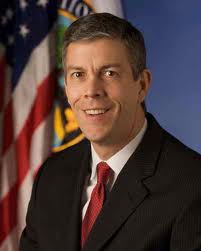 From U.S. Education Secretary Arne Duncan's prepared remarks at the DNC tonight:
I'm here tonight as a parent with two young children who attend a wonderful public school. No one has more at stake in this election than our kids, and that is why we need to re-elect President Obama!
Our president knows education is about jobs. It's about giving every child a shot at a secure middle-class life. Right now, we're in a race for jobs and industries of the future. If countries like China out-educate us today, they'll out-compete us tomorrow. The president believes that education begins at home with parents who take responsibility. But he also believes that teachers matter. In his first two years in office, he helped save the jobs of 400,000 educators.
And President Obama didn't just invest resources; he demanded reform. And 46 states responded by raising education standards. The president also believes teachers must be respected and paid like the professionals they are. No teacher should have to teach to the test. Great teachers should be recognized and rewarded.
And President Obama also knows that higher education is an economic necessity. He fought to keep student loan interest rates from going up. He fought for Pell grants. He took the big banks out of the federal student loan program and passed billions of dollars in savings on to young people. This year alone, he helped nearly 10 million students afford college.
The president knows that the path to the middle class goes right through America's classrooms. That was his path. That's America's path. However, his opponent believes differently.
Under the Romney-Ryan budget, education would be cut by as much as 20 percent. Think about what that would mean: 200,000 fewer children in Head Start, fewer teachers in the classroom, fewer resources for poor kids and students with disabilities, fewer after school programs. Ten million students could see their Pell grants reduced, putting higher education further out of reach. And these cuts wouldn't create jobs or pay down the deficit. They would go toward a huge new tax cut for those at the very top.
In order to cut taxes for millionaires and billionaires, Governor Romney will cut education for our children. That's the difference in this election. They see education as an expense. President Obama's sees it as an investment. That's the choice in this election. And that's why our president needs four more years!
 New Jersey Gov. Chris Christie won applause at the RNC with his zinger, “They believe in teacher’s unions. We believe in teachers.” Ditto for former U.S. Sen. Rick Santorum when he said President Obama’s solution to a failing education system “has been to deny parents choice, attack private schools and nationalize curriculum.”
But with the convention winding to a close tonight, it’s interesting how much the suggestion of stark divisions between Barack Obama and Mitt Romney on K-12 education has not been the norm – at least away from the main stage. Jeb Bush, who speaks tonight, said as much in his appearance with Michelle Rhee. And this is what son George P. Bush said yesterday when asked what’s the most important thing the federal government can do to improve education: No matter who’s elected president, he said, “Keep Arne Duncan … he’s been a fantastic education secretary.”
As we wrote yesterday, George P. Bush and Josh Romney, Mitt Romney’s middle son, also made interesting comments about teacher pay. And Josh Romney seemed to suggest large classes might be an issue when he said, “We sometimes have teachers that aren’t able to cope with the size of their classrooms.” (On a related note about crosscurrents, there’s a post on today’s Politics K-12 blog about the dwindling band of Republican U.S. reps who are backed by teachers unions.)
The political blurring will continue next week at the Democratic National Convention - at least at a town hall meeting organized by Democrats for Education Reform. AFT President Randi Weingarten and NEA President Dennis Van Roekel will be among the panelists, but so will Colorado state Sen. Mike Johnston, a Democrat who sponsored a bill reforming teacher tenure and evaluations, and North Carolina state Rep. Marcus Brandon, a Democrat who co-sponsored legislation this year (which did not succeed) to start a statewide program for tax credit scholarships. Closing remarks will be made by Newark Mayor Cory Booker, a rising star in the Democratic Party who wholeheartedly supports private school vouchers.
by Eva S. Moskowitz

Moskowitz
Big. Bold. Fast. I constantly remind my team at Success Academy Charter Schools in New York City that as well as we are doing in rolling out new high-performing schools (we have one of the most ambitious plans in the nation) we can’t possibly move fast enough. While we now serve thousands of students with a better public education than they otherwise would have gotten, our city has hundreds of thousands of students who need better school options.
It isn’t possible to work as quickly or as urgently as this problem requires. Each year in my city, thousands of students are added to wait lists at high-performing charter schools and the city’s elite public school test-in programs. If you don’t get in, you have school choice but you have to either choose from among lousy zoned district schools, expensive private schools, or move to suburbia.
With the need for more great schools crystal clear in New York and around the country, it is absurd that we could even be having this national debate over whether or not there should be a federal role in education. Of course there should be a federal role, especially in the area of parent choice.
During the recent “I3” competitive grant competition and President Obama’s “Race To The Top” competition, we saw enormous leverage for reform from Washington. Many people didn’t know that leverage was possible, but the proof is in the pudding. States (many with Democratic governors) like Tennessee, New York, Illinois, and Massachusetts lifted caps on the creation of new charter schools – in large part because President Obama and Education Secretary Arne Duncan dared them to.
The Obama administration used its bully pulpit and a relatively small amount of federal money to incent smart, pragmatic policies at the state and local levels. The federal government ought to be able to do the same thing to incent urgency in statehouses, school districts, and on the ground in communities that desperately need good school options.
Bigger. Bolder. Faster. Yes, the federal government ought to be in a position to point its finger at states and districts and say, “Folks, we love you, but your kids are dying. You need to move faster!” At Success Academy Charter Schools, we see this as a moral imperative – the same moral imperative that led to the creation of Title I and IDEA, among other civil rights initiatives. Do federal legislators really think they can afford to sit silently, while the opportunities of another generation of students vanishes? (more…)
School grades tumbled across Florida yesterday, but at least one high-poverty charter school pulled its grade up substantially despite the harder tests and tougher standards that sparked rants from critics.
KIPP Impact Middle School in Jacksonville, part of the nationally celebrated KIPP chain, moved from an F to a C in its second year of operation - and missed a B by three points. For a school that knew it fell short in year one, the new grade was a relief.
 “The pressure was on. We knew we needed to do better not just for our school grade’s sake but our kids’ sake,” Tom Majdanics, the school’s executive director, told redefinED today. “Our students and parents and teachers worked very hard over the year, and ultimately we saw some results we can be proud of.”
Ninety-nine percent of the students at KIPP Impact Middle are African American; about 90 percent are eligible for free- and reduced-price lunch.
Even by Florida standards, it’s hard to imagine a school that felt more pressure to perform.
In fall 2010, U.S. Secretary of Education Arne Duncan cut the ribbon at the school’s grand opening. In spring 2011, Florida Gov. Rick Scott used the school as a backdrop when he signed a bill that made sweeping changes to the teaching profession.
After all that, the F was a shocker.
“There are high expectations for every KIPP school, especially one that happens to be the first in the city of Jacksonville and the state of Florida,” Majdanics said. “We clearly didn’t meet those high expectations in the first year.”
The school worked hard last summer to recalibrate its strategies, he said. The result: (more…)
Editor's note: This guest column comes from Julio Fuentes, the president of the Hispanic Council for Reform and Educational Options (HCREO), a national coalition dedicated to education reform that counts civil rights and Hispanic business leaders along with public school teachers and ministers among its supporters.
The history of our education system is marked by pivotal opportunities when leaders and policy influencers joined forces to bring about improvements and policy changes for the betterment of students. From public school desegregation to teacher quality measurements and standardized testing, the landscape of education has evolved and matured to best serve students and their families.
Last week, U.S. Education Secretary Arne Duncan urged parents, educators and school leaders at the local, state and national levels of government to seize the next of these pivotal opportunities – specifically, he said, we must make Hispanic educational excellence a national priority.
Secretary Duncan noted that the Obama Administration’s goal of having the world’s highest share of college graduates by 2020 will not happen “without challenging every level of government to make the educational success of Latinos a top priority. America’s future depends on it.”
Secretary Duncan’s call to action came in response to a new report from the National Center for Education Statistics (NCES), the U.S. Department of Education’s statistical center, which outlines in grave detail the Hispanic achievement gap that has long been of such concern to my organization and others. Hispanic students are the largest minority group in our nation’s schools, but they continue to fall behind. (more…)

