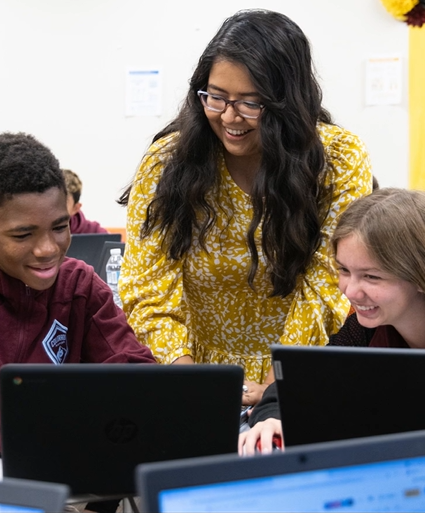
ASU Prep Academy and ASU Prep Digital serves 3,500 students in kindergarten through 12th grade through in-person learning at four Arizona campuses and supports 7,500 K-12 students worldwide through full-time digital education.
Editor’s note: You can listen to Step Up For Students president Doug Tuthill interviewing Julie Young, founder and former CEO of Florida Virtual School who is now deeply engaged with digital education at Arizona State University, here and here.
The nation’s leading education disruptors – proactive individuals who are thinking beyond traditional boundaries – have rallied in recent months around a universal prediction: Families in a post-pandemic world will increasingly be looking for freedom from a once-size-fits-all, single delivery method of education, along with a greater emphasis on blended education, technology, and digital citizenship.
Teachers, many who learned remote instruction on the fly at the start of the pandemic, have taken notice and are upgrading their skills to become more agile as hybrid models become mainstream.
“The choice movement has forced schools to up their game because parents now have so many choices,” said Julie Young, vice president of education outreach and student services for Arizona State University and managing director of ASU Prep Academy and ASU Prep Digital. “If schools don’t meet those students where they are, they have so many options to go elsewhere.”
Young and three members of her staff spoke with reimaginED about their organization’s progress during the past year and discussed emerging trends as the nation continues its transition from pandemic crisis to normalcy.
Bottom line, “normalcy” will look nothing like 2019. Families and educators both are demanding options, which ASU has provided plenty of during the past year. Among ASU’s accomplishments, itemized in a recent video:
Jill Rogier, the organization’s digital head of school, said retention numbers are top of mind for ASU leaders.
“We’re really pleased a lot of parents came to us during the pandemic, and they’re staying or they’re leaving and then coming back,” Rogier said.
The digital school, which began in 2017 as a high school, last year added grades K through 8 in response to pandemic demand. The on-campus and online schools also partner with Arizona State University to offer early college courses.
Additionally, ASU is partnering with parents who want to continue with learning pods, a trend that came on the scene at the height of the pandemic when many campuses across the nation shut down. Rogier received a lot of requests for pods, mainly from parents of students in lower grades, so ASU worked to facilitate a pilot.
“They want that sense of community,” she said. “The parents want to collaborate and get their kids together. It’s really becoming more than just a pilot.”
Hybrid services, where students spend a couple of days each week on campus and a couple of days online, also remain popular, a trend that is expected to continue.
“I think parents don’t want their kids home all the time, but they like them home sometimes,” said Amy McGrath, chief operating officer for ASU Prep and deputy vice president of ASU educational outreach.
Young agreed. “The hybrid model was the one that parents seized upon,” she said. “I think schools are going to lose kids hand over fist if they don’t have strong hybrid models to offer their families.”
As blended education becomes the norm, a K-20 model that includes college will be the wave of the future, the team agrees. ASU is working with Arizona State to incorporate the college experience by allowing high school students to spend a few days a week taking college classes on the university campus as well as offering on-demand courses for college credit.
“We’re hoping to be a rival of AP,” Young said.
Another trend Young identified is the infusion of digital citizenship in all instruction.
“What we’re seeing in schools in terms of misuse and poor behavior with technology and cybersecurity, I think it’s very much top of mind, she said.
The demand for services has come not only from families. Teachers are also recognizing the need to upskill as blended learning becomes more mainstream.
“The demand level has been pretty intense,” McGrath said. “Immediately, we had 800 teachers that heard about it through the Department of Education’s announcement. We set up a landing page and we kept getting hit over and over with teachers saying, ‘We need help.’”
ASU opened evening and weekend workshops to meet the demand.
“We don’t even really have to market,” McGrath said. “Teachers are just spreading the word.”
ASU is now bringing in alums of the program to do the training.
“We’re trying to take ourselves out of it and be a rich place for teachers to share learning and best practices,” she said. “It’s continued to be very dense and robust, and we’ve got some really great stories about teachers who have felt invigorated again.”
One trend that ASU Digital Prep school leaders hope doesn’t last is the tendency for some educators and administrators to sort themselves into tribes that advocate all-or-nothing approaches to education, with one side pushing all in-person instruction and the other all digital.
“They’re risking alienating parents in the long run,” said Kay Johnson, director of strategic communication for ASU Prep Digital. “We as education leaders and innovators need to push people to stop ‘either this or that’ and adopt ‘both-and’ ways of thinking and how we can have a win-win, because we can.
“One size does not fit all.”
 Editor’s note: With this commentary, redefinED welcomes Julie Young as our newest guest blogger. Founding CEO and former president of Florida Virtual School, Young serves as vice president of education outreach and student services at Arizona State University and is managing director of Arizona State University’s Prep Academy and ASU Prep Digital.
As the world continues to work through the pandemic, teachers and students are back in school wading through the new realities of whatever “school” means these days. Among other things, the pandemic has certainly challenged any notions of a “typical” school model. Indeed, if there is any commonality among schools right now, it is that “typical” may no longer exist.
Where will things go from here?
As we wondered aloud about this, we landed on a few predictions, based on our view of the industry in this moment, and our look back at how trends in tech adoption have played out over the years. Here are a few thoughts:
The switch to tech-supported learning is permanent.
While our natural tendency to look at the past with nostalgia is strong, especially during such turbulent times, educators seem to agree that after this mass exodus to remote learning, things will never go back to exactly what they were. This is both good and bad.
On the negative side, no digital learning professional would have wished 2020 on any teacher. Instantly rolling into remote learning was truly a worst-case scenario. What ensued was more about patching holes and saving the ship than proactively building the ship in the harbor and preparing for launch. Teachers have heroically moved forward, but few will disagree with the idea that today’s version of remote learning is not a permanent landing spot.
Because of the rough transition, it’s not surprising that we have lost teachers in the process, especially those on the cusp of retirement or early in their careers. After weighing the frustrations versus the option to leave, some are opting for the exit, especially in light of the reality that once school is “normalized,” digital learning is highly likely to play a bigger role.
On the upside, some teachers who are willing to take on the task of learning both the tools and the strategies for working effectively within online environments have found the online or blended environment to be invigorating. One seasoned teacher told us recently that teaching online for the first time opened up a whole new world of learning to him, helping him to address his own stagnancy.
At our site-based locations, where classes are still largely remote, students and teachers alike are becoming accustomed to some of the new Web 2.0 tools they have adopted. As teachers use various online tools, they often find new ways to incorporate them into their instructional planning. Since many of the tools teachers are using are free or low cost, we expect the uptick in use of digitally supported learning tools is here to stay, even in brick and mortar schools.
Many students will stay online.
Right now, full-time online learning programs are seeing huge enrollments spikes. In fact, as the 2020 school year approached, here in the network of ASU Preparatory Schools, where ASU Prep Digital lives, we saw many parents hedging their bets – enrolling students in both site-based and the fully online school.
We expect that there will be some “leveling out” when parents have more options for a traditional face-to-face environment and want to go back to what is familiar. At the same time, we know there will be parents and students who may have formerly been averse to an online learning environment but are now seeing benefits that they don’t want to lose, particularly the greater sense of student agency.
Innovation and model experimentation will increase.
Now that teachers and administrators in traditional schools have had to build new models in the worst possible conditions, they will soon be able to take stock of their new knowledge and apply it in a much more proactive and strategic manner.
We expect to see more innovation arising from the pandemic once educators can catch their breath. Over the years, we have always found that when teachers have space to try something new, they become the best source of information on how to improve the innovation on behalf of students.
Alternative school ideas – ‘unschool,’ micro-schools, learning pods, homeschooling, ‘outschool’ – will continue to increase.
Years ago, homeschooling was considered a radical notion, a fringe idea for hippies or religious groups. Today, homeschool is mainstream, and similar ideas are taking form.
“Micro-schools,” which harken back to the one-room schoolhouse notion, were already seeing growth before the pandemic. Micro-schools could be seen as an alternative for those who like the creativity homeschools affords, but they either don’t want to teach their own kids or don’t have the option to do so.
Homeschooling and even “unschooling” models, where curriculum is determined by the student’s interests versus a pre-set curriculum, now have access to online material to enhance and support student learning.
The flexibility inherent in alternative programs like these may be something parents increasingly want to see. While having the kids at home is an untenable situation for some families, others have found themselves surprised by the joy of simply being able to watch their kids in the moment of discovery.
Which leads us to the last point.
Notions about how and when students progress will continue to change.
For some time now, we’ve seen signs that old ideas about how a student progresses through material and grade levels are changing.
At the college level, the trend toward incremental learning with shorter-term certifications and stackable credentials has taken hold. This “incremental learning” trend has moved into the high school and even lower grade levels, with students now able to receive badges and other forms of recognition for learning mastery.
We have always known that students don’t all progress at the same rate, and progression across disciplines and skill areas also varies from one student to the next. For years, though, the idea of building a K-20 learning environment where competency and mastery determine advancement versus age or grade levels was hard to imagine.
Today, digital content and data tools are making it easier to envision a time when students will work toward achieving more and more mastery along a competency pathway, versus a course or grade level. At ASU Prep Digital, we already offer glimpses of this model by pulling down college on/off pathways into the high school program.
Students can opt for in-course college paths to get college credit while still in high school. Our full-time students can potentially earn up to 48 college credits at no cost throughout their high school career at no cost to the families. ASU Prep Digital continually works with innovation centers throughout the university to identify university materials and assets that can be repurposed for learning and for college and career readiness for high school students.
The wholesale dive into remote learning was a worst-case scenario. With every crisis, though, innovations arise, and we expect the pandemic to yield a new cadre of newly equipped educators who are ready to implement new possibilities they wouldn’t have explored otherwise.
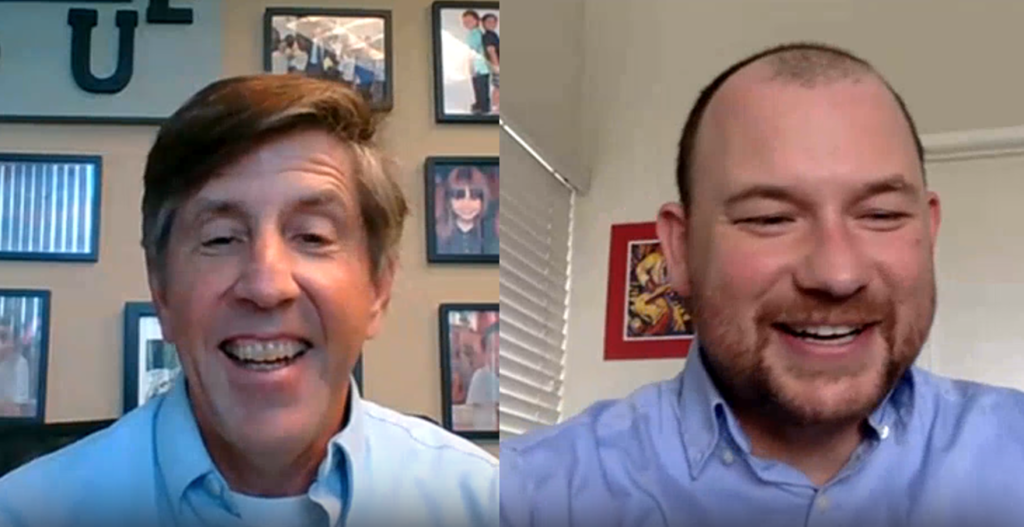 In this episode, Tuthill talks with a senior research fellow in education for the Christensen Institute whose work focuses on studying innovations that amplify educator capacity, documenting barriers to K-12 innovation, and identifying disruptive innovations in education.
Tuthill and Arnett discuss the future of public education and the various “blended learning” models available for students today that leverage technology to customize education based individual needs.
In the midst of a worldwide pandemic that has disrupted education in unprecedented ways, both believe new learning models such as blending online learning with traditional brick-and-mortar education will help alleviate pandemic-related health concerns while serving as a long-term option more families will choose. They also discuss inherent problems of equity surrounding access and varying levels of parental and family involvement.
“As a parent I often found myself wondering, "what are my kids really learning?... I can make this learning much better for them if we can talk about it (at) the dinner table … right now necessitates a greater interdependence between home and school."
EPISODE DETAILS:
· COVID-19 as an accelerant to changes in public education
· How technology can be used more assertively to enhance education productivity and reduce inequity
· Types of learning best delivered face to face versus delivery online and best practice for optimizing lesson plans
· How to help parents meet their growing role in public education
· How public education can begin to unbundle services to better serve communities
LINKS MENTIONED:
Blended learning models that can help schools reopen
A seemingly small change to Florida law could go a long way toward promoting blended learning in public schools.
The measure is sponsored by Rep. Manny Diaz, R-Hialeah, and Sen. Jeff Brandes, R-St. Petersburg, who have teamed up on digital learning bills before.
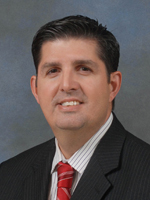
Rep. Manny Diaz Jr.
This one, HB 4013/SB 470 is deceptively simple. It deletes half a sentence from state law, which requires blended-learning students to "receive the online instruction in a classroom setting at the school."
Diaz, a former public-school administrator, said that requirement has held back schools that want to try approaches like the "flipped classroom," where students watch recorded lectures on their own time and spend class time working on projects or with their teachers in small groups.
Right now, the law forces blended learning to look a lot like traditional learning, only with students spending more time on computers. That, Diaz said, misses the point.
"Our current statute defines blended leaning so narrowly," he said. The change would give schools "flexibility to move those students around, and make learning the constant and time the variable."
(more…)
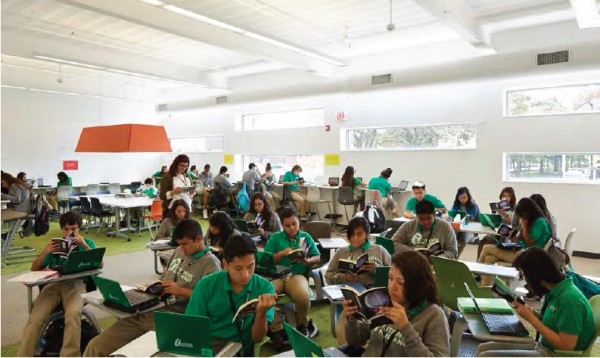
A picture from Chicago's Intrinsic Schools, from a blended-learning presentation given to a state House panel. Do regulations bar Florida schools from building a classroom like this?
Blended learning is beginning to change the way schools are run, and even the way they're built. But Florida schools may be hamstrung by building codes, class-size penalties and outdated teacher-preparation programs, members of a state House panel said Thursday.
"I think our role is to get the roadblocks out of the way," said Rep. Manny Diaz, R-Hialeah, who chairs the House education panel on school choice and innovation.
The panel heard from Michael Horn of Clayton Christensen Institute, who has studied blended learning around the country. He told the panel via Skype that combining virtual education with in-person instruction can allow students to learn at their own pace, and give educators more flexibility.
School buildings designed with blended learning in mind often include open floor plans that cost less to build, slash energy costs and create more engaging learning environments, Horn said. They also lend themselves to different staffing models. In some cases, he said, teachers eschew traditional classes and work together in teams, allowing experienced "master teachers" to work with larger numbers of students. (more…)
For more than two years, administrators at Purcell Marian High School in Cincinnati have been navigating the competing pressures of new and old.
They decided the shift to blended learning could help them meet the varying needs of an increasingly diverse student body, and help their students meet a state requirement to pass four years of high school math courses. They also knew that they couldn't knock down all the walls in their 87-year-old building or upend the traditions that had drawn students to seek a Catholic education in the first place.
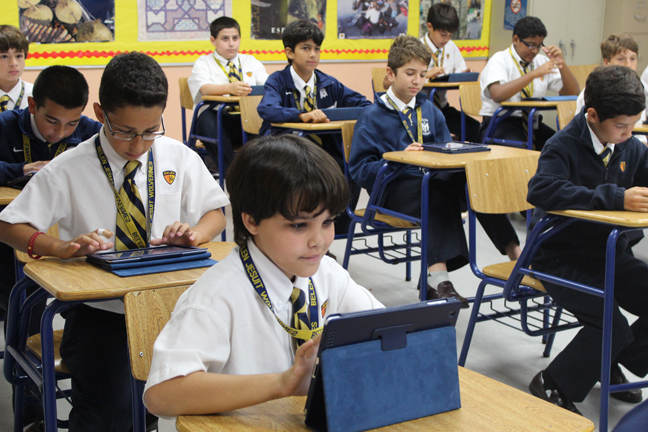
In this 2012 file photo, students at Miami's Belen Jesuit Preparatory School Pads during a Spanish class.
"We couldn't just gut the school and start over as an all-blended learning school," Jeanine Flick, the school's academic dean, told a crowded session at an Orlando conference for thousands of Catholic educators.
Instead, in 2013 the school began a gradual, subject-by-subject shift from paper textbooks to electronic ones, and from instruction led entirely by teachers to what principal Veronica Murphy described as a more "student-centered" approach, in which students work through material based on what they have mastered. It began converting one of its newer buildings into an open-plan "blended learning center."
While Catholic educators, much like their public-school counterparts, have been exploring blended learning for a few years, it's now becoming widespread, and was one of the hottest topics at the National Catholic Educational Association's annual convention last week. Sessions were often packed with teachers and administrators looking to draw lessons from schools like Purcell Marian that have already made the shift and are starting to draw lessons from it.
They've faced many of the same the same hurdles as public schools, and some unique ones. For one thing, they often lack public funding to pay for students' devices or the technology that connects them.
Starting this month, Florida school districts will be able to start their own version of charter schools, which would be bound by performance contracts and freed from a range of state regulations.
The question now is, will they?
Charter school legislation passed last year included provisions allowing districts to create Innovation Schools of Technology. Last month, the state Board of Education approved a process that allowing districts to apply to create the schools. But restrictions on the program could bar most Florida school districts from participating, at least for now.
The original proposal was advanced by Sen. Bill Montford, D-Tallahassee. A former superintendent, he was an early supporter of the charter school movement in Leon County. Now head of the state school superintendents association, he said during last year's legislative session that the proposal would allow school districts "to be able to benefit from the flexibility that the charter schools have used to be innovative and creative in the other public schools."
Though they would still be run by school districts and subject to their collective bargaining agreements, the innovation schools would, in other ways, function a lot like charter schools. They would be exempt from most of the state laws that make up the state's education code. and have the same flexibility charter schools enjoy under the state's class size limits. In exchange for the greater freedom, they would have to enter performance contracts with the state Board of Education.
The legislation ultimately approved by Gov. Rick Scott was also designed to help districts experiment with blended learning. Each innovation school will have to use a system such as the "flex model" or the "flipped classroom," in which students receive a portion of their instruction through a virtual education system, and a portion in-person from their teacher.
To participate in the new option, a district must have been rated A or B in each of the past three school years. Last year’s tumbling school grades shrank the potential pool, leaving 21 districts that meet that requirement.
Nearly half of those districts may not be eligible for other reasons. Districts looking to start innovation schools must have either 5 percent of their students enrolled in charter schools, or a fifth of their students enrolled in schools of choice.
An analysis of enrollment surveys and district grades showed 10 school districts would have qualified based on data from the 2012-13 school year. Two of those - Miami-Dade and Palm Beach - have started other experiments with blended learning in collaboration with Florida Virtual School.

Those days are pretty much over.
To understand the changes that will be brought on by digital learning, think about what's happened in the music industry.
People used to buy all of their music at record stores. Their choices were confined to what the store had in stock. They had to buy entire albums, even if they only wanted one song.
Then came Napster, which allowed people to tailor their music libraries to their individual tastes. It was later replaced by iTunes, which improved the quality of music downloads and developed a business model that was more acceptable to the industry's establishment.
The result was a "vastly more customized and individualized experience," said Derrell Bradford, executive director of the New York Campaign for Achievement Now. He used the analogy Tuesday to introduce a discussion at the American Federation for Children's annual conference about the ways technology can allow students to tailor their education to better fit their needs.
"You have a transformative idea or policy that's introduced into the space and it changes everything forever," he said.
Julia Freeland, a research fellow at the Clayton Christensen Institute, said the goal is to allow students to learn on their own terms, at their own "pace, path, time and place." For that reason, she said, much of the work on digital learning is being done at traditional public schools, which enroll the vast majority of students.
"What we're seeing with the growth of online learning is not full-time virtual schools. It's not kids sitting at home in homeschool environments. It's instead technology being integrated into the classroom," she said. (more…)
Tax credit scholarships. The House passes legislation expanding access to the program to students with higher incomes. Associated Press. News Service of Florida. It's among a host of issues lawmakers expect to tackle after a week-long holiday break. Sarasota Herald-Tribune. The Daytona Beach News-Journal scrutinizes the program in an article that states, incorrectly, that a failed 2012 state constitutional amendment would have "cleared the way" for private school vouchers. A second article also deals with religious schools. The program is administered by Step Up for Students, which co-hosts this blog.
Testing. Parents complain that FCAT conflicts with Passover. Tampa Bay Times. Students prepare to tackle the test one last time in English and math. StateImpact. Lakeland Ledger. Daytona Beach News-Journal. Tampa Tribune. Palm Beach Post. The stakes are high at an F-rated Miami-Dade middle school. Miami Herald. Collier schools are in a race against time to create new end of course exams. Naples Daily News. Lawmakers should get an earful from constituents on testing, including for students on tax-credit scholarships, Orlando Sentinel columnist Scott Maxwell writes.
Virtual schools. A new blended learning model debuts in West Boynton Beach. Sun-Sentinel.
Magnet schools. A Montessori magnet in Fort Lauderdale marks a milestone. Sun-Sentinel. What was once a last-chance home for struggling students is now a career-education magnet program. Gainesville Sun.
Textbooks. A bill aimed at paring back the state's role in adopting instructional materials survives a narrow vote in the Senate. Associated Press. News Service of Florida. Gainesville Sun. Gradebook. Scripps/Tribune.
Student Privacy. A bill banning the collection of biometric data and other sensitive information is headed to Gov. Rick Scott. Scripps/Tribune. Ocala Star-Banner. Associated Press.
 Alabama: The Alabama Education Association runs attack ads against a pro-school choice candidate during Republican special election primaries (AL.com).
California: L.A.'s public school choice initiative became more about collaboration than competition (Huffington Post). San Fernando Valley Charter schools form an advocacy group (Daily News).
Colorado: School choice candidates win a majority on the Jefferson County School Board (Denver Post).
D.C.: Parents will be able to use one application to apply to many different schools of choice (Education Week, Washington Post). Bureaucracy, not school choice, was the problem in D.C. (redefinED). The district approves two Texas-based charter school operators to open new schools (Washington Post).
Florida: A bullied student finds a new home using a tax-credit scholarship to attend a private school (redefinED). With charter and private school options on the rise, the Pinellas County School District markets magnet schools to attract students back to the district (Tampa Bay Times). Robin Gibson, a prominent Democrat with close ties to former Govs. Bob Graham and Lawton Chiles, defends charter schools from critics (The Ledger). The superintendent of the Hillsborough County School District has reservations about allowing a competing charter school on MacDill Air Force Base (Tampa Bay Times).
Georgia: Parents choose private schools for many reasons other than high test scores (One News Now).
Hawaii: A charter school fires its principal after he is charged with the theft of more than $150,000 from the school (Hawaii News Now).
Indiana: Gov. Mike Pence wants to increase the number of charter schools in the state (Post Tribune).
Louisiana: Gov. Bobby Jindal and school choice supporters may be declaring victory against the DOJ's anti voucher suit but the fight isn't over yet (Education Week, Times Picayune, National Review, Wall Street Journal, Bayou Buzz, The Town Talk ). The judge in the DOJ's anti voucher suit ordered both sides to come up with a plan to prevent racial segregation (Associated Press, Bloomberg, New York Times). A former Democrat and state legislature turns from voucher foe to voucher supporter (The Advocate). (more…)

