
Imagine the major metro area near you if students were free to attend the fanciest school district in the leafiest local suburb. Can Dallas kids enroll in Highland Park? Can Columbus students transfer through open enrollment into Grandview Heights? Will Smith portrayed a kid from a tough background who got to go to school in Bel Air, but how often does this happen in real life? If you mentally put the over/under on the number of students getting the chance to do this at 1, take the under. Thousands of Phoenix students however attend school in Scottsdale. Sadly, a recent report from the Brookings Institution exemplifies the sort of short-sighted thinking that prevents these kinds of opportunities from materializing in other states.
The Brookings Institution recently published a report on the Arizona Empowerment Scholarship Account Program that was long on unsupported claims and short on context. Brookings decided not to engage in nuance in titling its study Arizona’s ‘Universal’ Education Savings Account Has Become a Handout for the Wealthy.
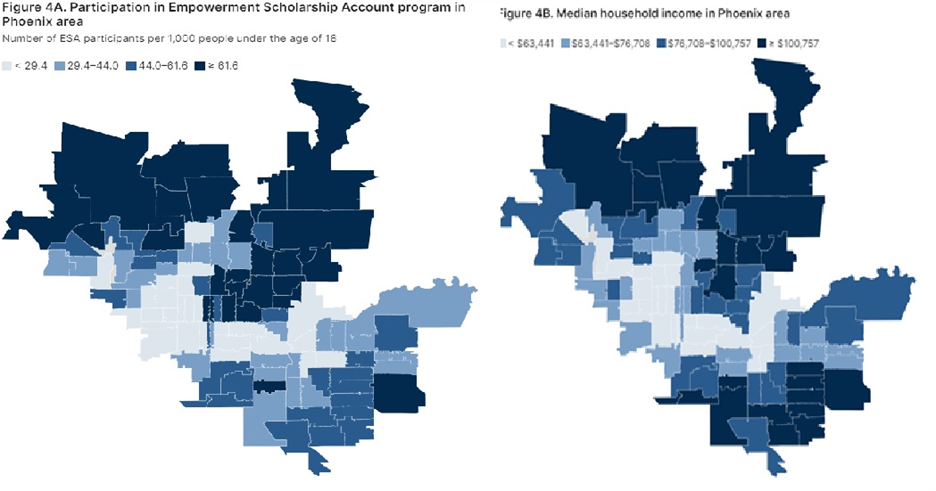
The study can be briefly summarized with two maps from the report: on the left is a ZIP code map of the Phoenix area by the rate of ESA participation (darker=more), and on the right the same zip code map by family income (darker=higher average). The maps look kind of similar. Is Arizona’s ESA program an instrument of plutocracy?
In a word, no. Quite the opposite.
Arizona has four other private choice programs besides the ESA program- all scholarship tax credits. Two of these programs are means-tested for the exclusive use of middle and low-income families. One of the other credits requires scholarship granting organizations to consider income in making awards, and the final credit is for children with disabilities- a fair number of whom will also be from families of modest incomes. These tax-credit programs raised over $264 million for scholarships in 2023, (see below) and higher income families do not qualify for many of these dollars.
Lower-income families desiring to attend private schools often prefer the tuition tax credit program over the ESA program. Meanwhile, higher income families are not eligible for much of the scholarship tax credit funding. Under Arizona law, you cannot participate in both programs.
All the ZIP codes in the Brookings analysis, including those with higher-than-average incomes, have public schools operating in them. The statewide average total district spending per pupil on school is almost twice as high as the ESA program. Higher income Arizonans pay their taxes and are entitled to attend school districts like everyone else, but they are also entitled to participate in the Empowerment Scholarship Account if they desire. If the ESA program is a “give away to the rich” then what pray tell is the Scottsdale Unified School District?
Speaking of Scottsdale Unified, it stands as a shining example of why choice programs should be universal. Scottsdale Unified publishes an ongoing demographic report and publishes the number of out of district open enrollment students served. This graphic is from that report:

The average home price in Scottsdale Arizona stands at $893,000, but 21% of Scottsdale Unified’s enrollment came from out of district through open enrollment. The reason 4,667 students can attend Scottsdale Unified without having a family purchase a $893,000 home is because 9,000 students living in Scottsdale Unified go to school elsewhere- charter schools, other districts through open enrollment, private schools.
Universal choice programs- including the Arizona ESA program but also including charter schools and district open enrollment-help create open enrollment opportunities. A virtuous cycle worked through Arizona schooling as educators supplied high demand school models, nearly all school districts began accepting open enrollment transfers. When a large majority of Phoenix students could attend Scottsdale Unified schools, it had the effect of closing low-demand charter schools.
During the last period in which all six state-level NAEP exams were available, fourth and eighth grade math, reading and science, (2009 to 2015) Arizona students alone made statistically significant gains on all six exams. The Stanford Educational Opportunity Project linked state tests in grades 3-8 across the country for the 2008-2019 period. Arizona’s low-income students have the fastest rate of academic achievement growth in the nation. Counterintuitively, universal choice has worked wonders for low-income students.

The Brookings study is neither the first nor will likely be the last example of folks back east lacking context about Arizona choice. Arizona created two universal choice programs in 1994 (charters and open enrollment) then a mix of universal and means-tested scholarship tax credits and finally the ESA program. Critics predicted doom every step of the way and continue to this day.

A portion of the early adopters of the ESA program, excluded from fully participating in other programs, chose to participate in ESA. Understood in context, you have no reason to feel alarmed and every reason to follow suit in your state- especially if you are concerned about poor students.
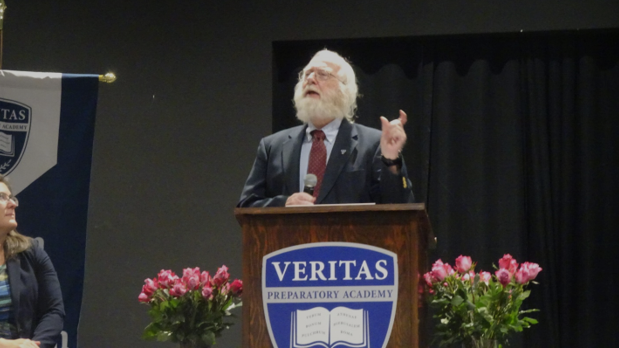
Mike Sullivan, who taught Classical Languages and Humane Letters at Veritas Preparatory Academy for 20 years, retires at the end of this school year. Before coming to Veritas, he was a private practice attorney and served the University of Minnesota in its Student Legal Services department after serving in the U.S. Army Intelligence corps as a translator and interpreter.
Veritas Preparatory Academy, a founding member of the prestigious Great Hearts Academy in the Phoenix metropolitan area, held a joyous retirement ceremony for one of its founding faculty members, Mike Sullivan, on May 20. Great Hearts recruited Sullivan, a 60-year-old attorney living in Wisconsin, to teach Latin and Greek.
Sullivan had enjoyed a career in the military followed by a legal career before finishing strong in the classroom for two decades. His most recent career holds a valuable lesson for policymakers.
Students, colleagues, and students who went on to became colleagues all related fond memories and valued lessons imparted by beloved sage-curmudgeon during the event. Veritas Prep’s first headmaster, Andrew Ellison, told of hosting the visiting Sullivan on a recruiting visit.
Ellison felt a growing sense of desperation over the course of the day, thinking he just had to have Sullivan join the faculty. Sullivan at one point told Ellison that he had been waiting all day for Ellison “to say something wrong” so he could get on a plane and go back to Wisconsin.
“But it hasn’t happened yet, and I don’t think it’s going to happen,” Sullivan said. Ellison described this as “the moment Veritas Prep was born.”
Policy decisions impact lives, sometimes in incredibly positive ways. It is worth noting that many states would not have allowed Mike Sullivan to launch his second career in teaching without jumping through a number of useless hoops. And, yes, I can demonstrate the uselessness of the hoops.
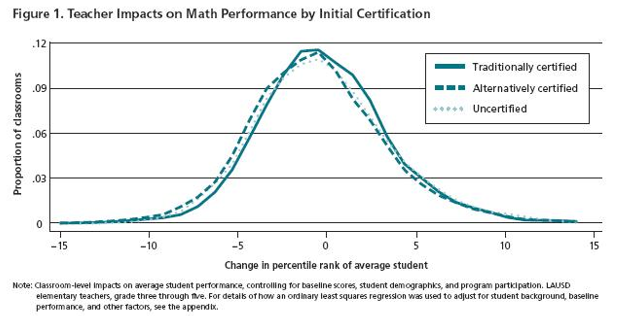 If you look very, very closely at this chart that comes from a study of student learning gains conducted by the Brookings Institution, you will see a dotted curve along with the line and dash curves. The three curves show the learning gains/declines from the students of traditionally certified teachers (the line curve), alternatively certified teachers (the dash curve), and finally from uncertified teachers (the dot curve).
Notice the lack of any meaningful difference in the overall curves; they all have highly effective teachers and highly ineffective teachers. But also note the difference between a right side of the bell-curve teacher and left-side is gigantic. As explained by the authors of the Brookings study:
Moving up (or down) 10 percentile points in one year is a massive impact. For some perspective, the black-white achievement gap nationally is roughly 34 percentile points. Therefore, if the effects were to accumulate, having a top-quartile teacher rather than a bottom-quartile teacher four years in a row would be enough to close the black-white test score gap.
Arizona lawmakers wisely gave charter school leaders the flexibility to recruit from any of the three curves in search of highly effective instructors. Ipsi prudenter elegerunt!
Veritas Prep found Mike Sullivan practicing law in a distant state and had the flexibility to coax him into a next great career. The adoration of Sullivan’s students and colleagues seems like a much greater compensation than any provided by a law firm.
More Sullivan-like instructors are likely awaiting discovery at some unexpected place. Find them and get them in the classroom!
Once again, Florida school districts are well-represented in the Brookings Institution's annual school choice rankings.
Five Sunshine State districts land in the top 25 of the think tank's 2016 Choice and Competition Index: Pinellas, Duval, Lee, Seminole and Broward Counties. No other state has as many districts ranked so highly.
It's worth a look at why these districts score well, and why they fall short of top scorers like Denver Public Schools and New Orleans' Recovery School District. (more…)
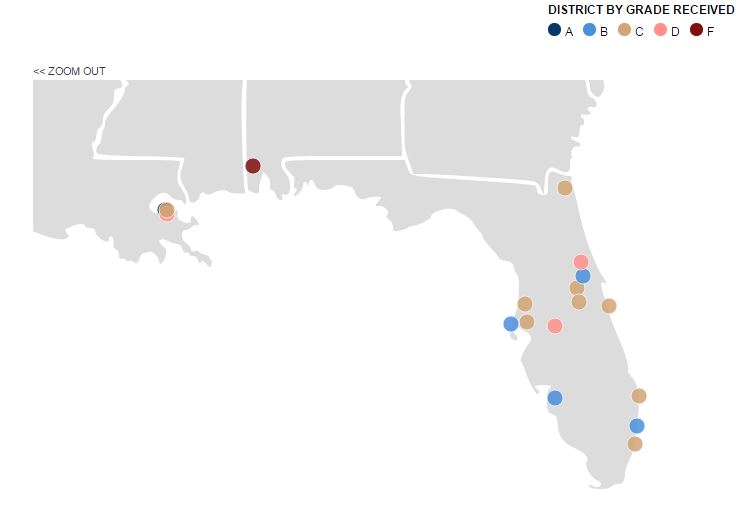
Competition and Choice Index large district grades by location, Brookings Institution.
Pinellas County Schools is Florida's top school choice district according to a new report from the Brookings Institution.
The 2015 Education Choice and Competition Index ranks more than 100 large urban school districts A-F based on thirteen factors such as the availability and popularity of alternatives to neighborhood schools, fairness in school assignments, clear performance data, transportation and the quality of schools.
The index is intended to shine a light on "the ease with which parents can exercise the choices afforded to them, and the degree to which the choice system results in greater access to quality schools for students who would otherwise be assigned to a low-performing public school based on their family's place of residence."
The index reflects the Brookings Institution's ideal school choice system, which would include variety of high-quality options, no default student assignments, a common application, valid information on school performance, a weighted student funding formula that follows students to their school of choice and subsidies to help poor families with things like transportation.
Pinellas County School District ranked 7th on the index. The district comes out on top, in part, due to the popularity of options such as magnet schools, fundamental schools, charter and private schools as well as enrollment in virtual education.
Even in a high-ranking district like Pinellas, barriers remain. In addition to its Failure Factories series highlighting academic turmoil in South St. Petersburg, the Tampa Bay Times recently highlighted the long odds low-income parents face enrolling in popular options like Fundamental Schools.
Once again, no school district in Florida is awarded points for providing transportation to alternative schools. Districts receive zero points for failing to provide transportation to schools of choice, or for not making it clear to parents that transportation is available.
Of the large districts included in the survey, Volusia County was the lowest-ranked in Florida, placing 54th out of 111 districts.
Grover Whitehurst, the author of the report, said that the districts could do a better job supporting school choice through open enrollment. Whitehurst said that Lee County provides the most open enrollment options among large Florida districts, but parents' choices there are still constrained by through choice zones and subzones within the district.
New Orleans' Recovery School District, which is smaller than other districts in the survey but unique in its all-choice design, sits atop the national rankings. Denver Public Schools climbed to the second spot, due to a strong centralized single application process, growth in schools of choice and the elimination of default school assignments for half of the city. The district also allows parents to exercise choice 365 days a year. The state's teacher union sought to overturn these reforms late last year, but failed to capture three school board seats from pro-reform candidates.
The Florida House this week passed a bill that would expand public school choice in every district in the state, and give students more freedom to cross district lines. But districts like Denver offer other lessons about how to lower the barriers to true school choice for students.

Open enrollment and public school choice have become more widespread in districts covered by Brookings Institution's Education Choice and Competition Index. Graph via Brookings.
Over the past 15 years or so, a pretty big shift has taken hold in America's largest school districts. A growing number of students who attend what are still called "traditional" or "neighborhood" public schools are doing so by choice.
The above graph comes from a pair of posts by Russ Whitehurst of the Brookings Institution, who notes the rapid rise of open-enrollment policies and other forms of public-school choice in the country's largest districts.
[C]hanges over time in the availability of intra-district school choice have been dramatic.iv The graph is based on data my colleagues and I have compiled from a retrospective analysis of school choice in the 100+ largest U.S. school districts, which are the districts that are covered in our annual Education Choice and Competition Index.v Only 24 percent of districts in 2000-2001 afforded parents school choice (20 percent through easy transfers from default schools and four percent through a full-fledged open enrollment process). Today, that number has more than doubled to 55 percent of districts allowing choice. Put another way, in 2000-2001, 75 percent of the nation’s large school districts made it difficult or nearly impossible for a child to attend a public school other than the one assigned based on place of residence. Today that number has dropped to 45 percent.
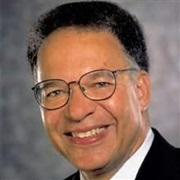
Price
The recent era of education reform has seen achievement gaps narrow, and low-income black and Latino students improve their graduation rates.
Yet, as Hugh B. Price argues in a new paper for the Brooking Institution, "the bottom line, after all these years, all the interventions, all the testing and tough love, and all the investment, is encouraging yet still underwhelming."
Some of the blame for the shortcomings, he writes, lies with something that has historically been a blind spot for reformers and educators: Social and emotional learning, which research shows can lead to students to better academic results, and make them more likely to reach college or find a job.
Stop here, and Price, a Brookings fellow and past president of the National Urban League, might seem to be making the case for schools that nurture children's needs holistically. For some children, that might require schools run by, say, church ministers or other culturally competent adults in their communities — an argument, in short, for school choice.
But Price is primarily concerned with students who have "palpably tuned out" of schooling — the kinds of students who turn up by the thousands in the "drop back in" or dropout-recovery academies (charter schools and otherwise) of Florida's largest school districts.
For these students, often at risk of graduating behind schedule if at all, he argues a new breed of school is needed, organized around a "dual mission of fostering academic and social development."
Like other school choice programs where supply is overwhelmed by demand, the school district in Pinellas County, Fla. offers an option that causes plenty of joy and heartache. Some kids win the “fundamental school” lottery. Some kids lose. Some go on to the high-performing fundamentals, where they’re surrounded by peers with super-engaged parents. Others go to neighborhood schools that struggle mightily.
Are their outcomes different? Matthew Chingos, a respected researcher at the Brookings Institution, is aiming to find out.
Last week, the district agreed to give Chingos the data he requested so he could examine the impact of fundamental schools on math and reading scores. Once he gets the data, he expects to issue findings within a year, according to his research application.
His study is worth watching because it involves a school choice option offered by a school district, not by private schools or charter schools.
The fundamental schools in Pinellas stress parental involvement and student accountability. Students who fall short on academic, behavioral and dress code requirements can be reassigned to neighborhood schools. Ditto if their parents fail to meet requirements, including attending monthly meetings.
The 104,000-student Pinellas district created its first fundamental school in 1976, but expanded them rapidly in recent years. It now has more than 7,000 students in 10 full-fledged fundamental schools and two “school-within-a-school” fundamental high schools.
The schools boast some of the district’s highest test scores and lowest disciplinary rates. They also cause a fair amount of angst. (more…)

