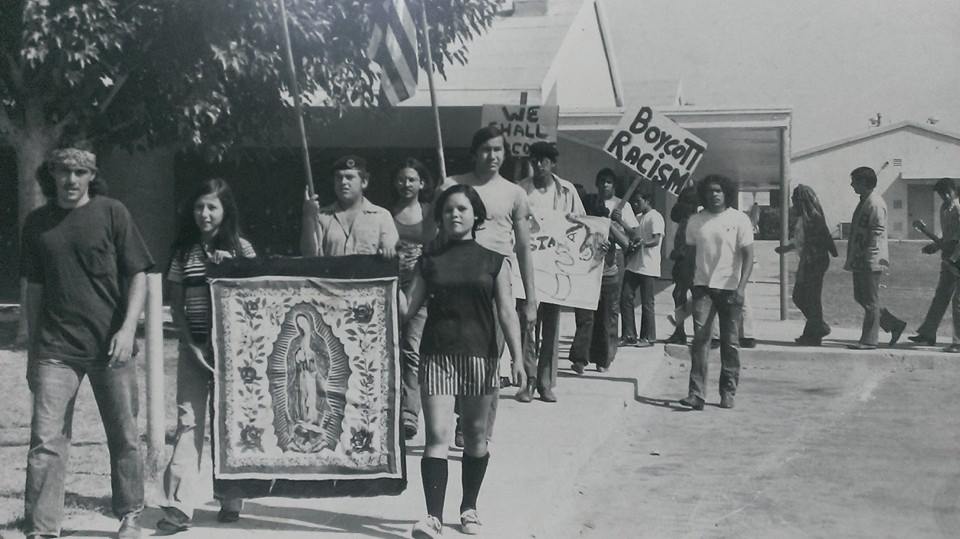
Students picketed public schools in Blythe, Calif. when tensions between the Hispanic community and school district boiled over. The conflict led to the creation of a private school, Escuela de la Raza Unida, which remains in operation.
This is the latest post in our occasional series on the center-left roots of school choice.
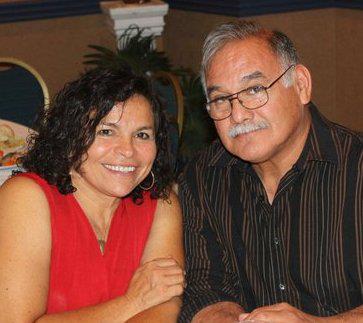
Carmela and Rigoberto Garnica have run Escuela de la Raza Unida for more than 40 years.
If the American left had fully championed school choice decades ago, we may be celebrating what happened in 1972 in Blythe, Calif. as the spark of a movement.
That spring, the Mexican-American community’s frustration with the public school system boiled over, spurring creation of a scrappy “freedom school” that became Escuela de la Raza Unida, which still exists today.
This lost story from a remote desert town is steeped in the progressive politics of another era.
In Chicano Pride. In empowering the “poor.”
Even in Cesar Chavez and the United Farm Workers.
“We were ahead of the curve,” said Carmela Garnica, who has led the school with her husband, Rigoberto Garnica, since the beginning.
Hispanic support for school choice runs strong. But if there is anybody who has chronicled that history, even Hispanic school choice leaders are unaware. Perhaps the story of Escuela de la Raza Unida can inspire the deep dive that this subject deserves.
The school sprang from years of dissatisfaction. The fuse-lighter was an allegation that the principal of the public middle school in Blythe manhandled a female honor roll student, apparently for showing a politically provocative film to a Hispanic student group. But parents had complained about other issues for years. They wanted diversity in the nearly all-Anglo teaching corps. They wanted history lessons that acknowledged contributions of Native Americans and Mexican Americans.
Students picketed the public schools for weeks. In the meantime, the community rallied to create an on-the-fly school where everybody pitched in to teach, cook, clean – whatever they could do. Initially, they met at a local park, according to newspaper articles and “A Choice For Our Children,” a 1997 book by California school choice supporter Alan Bonsteel. At some point, the dissidents decided to rent space for classes, a tiny former post office that could hold 50 students.
They never left.
Escuela de la Raza Unida began as a K-12 private school, and Garnica says it would have preferred to stay that way. But California doesn’t have vouchers or tax credit scholarships, despite multiple attempts at the ballot, including this liberal-led campaign in the late 1970s. Over the years, the school had to shift its mission to best match community needs with available funding. (more…)
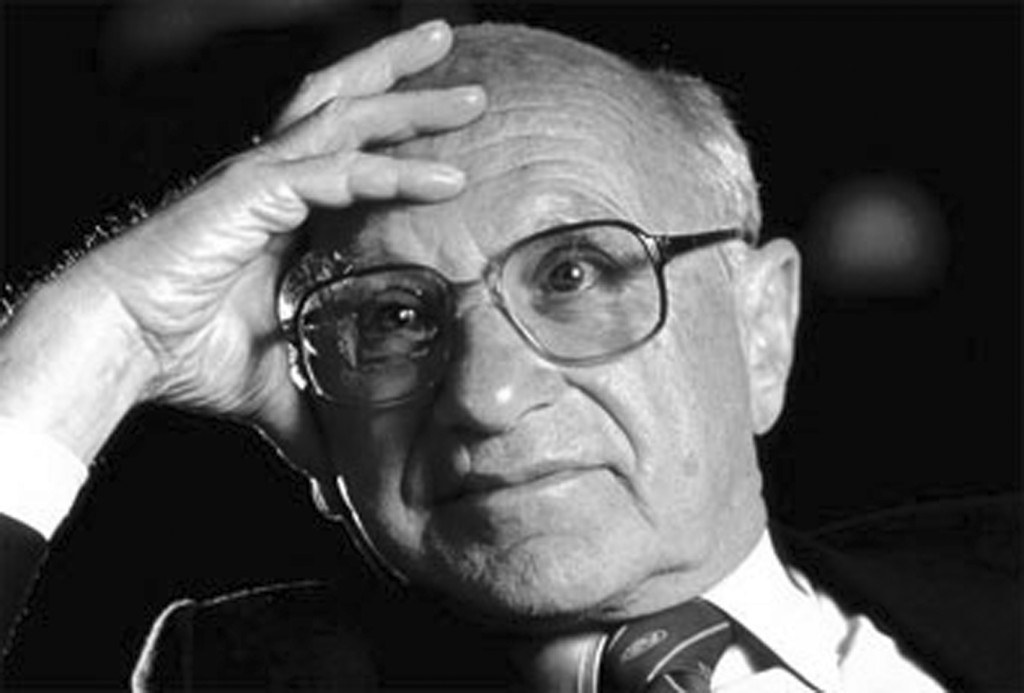
Milton Friedman
This is the latest installment in our series on the center-left roots of school choice, and Part III of a serial about school choice efforts in late ‘70s California. Part II included a closer look at U.S. Rep. Leo Ryan and the game-changing voucher plan he wants to push, while school boards and teachers unions came out swinging.
South of San Francisco, an electronics engineer and inventor in Redwood City read about the liberal-led California Initiative for Family Choice and thought: Disaster.
Not because it would kill the public school system. Because it would perpetuate it.
Jack Hickey saw too many regs, too little freedom, too much potential to “contaminate” private schools. He was certain the massive school choice plan engineered by Berkeley professors Jack Coons and Stephen Sugarman would curtail choice, not expand it.
“I looked at that and said, ‘That’s bad, that’s really bad,’ “ Hickey said in an interview.
Hickey wasn’t content to grump. The libertarian activist would eventually run for office 18 times, including for governor, U.S. Senate and U.S. House of Representatives. In this case, he nimbly sketched out a counter-proposal, something he called a “performance voucher.”
Then he and Roger Canfield, a police consultant in nearby San Mateo, began their own sprint to the ballot.
***
At the time of his meeting with Congressman Leo Ryan, Jack Coons was best known as one of the attorneys who changed how public schools are funded in California.
He and Stephen Sugarman were key players in a legal effort that began in 1968 with a widely publicized case, Serrano v. Priest. It charged that the way California financed public schools – by relying heavily on local property taxes, resulting in huge disparities between rich and poor districts – violated the Equal Protection Clause of the Fourteenth Amendment.
Over the course of a decade, Serrano led to three California Supreme Court rulings that spurred the state legislature to mitigate funding disparities between districts. It’s also credited with sparking school finance reform in other states, even though a ruling from a similar case in Texas was struck down in a 5-4 decision by the U.S. Supreme Court.
Coons’s embrace of school choice flowed, initially, from the funding inequities he saw. Ultimately, he and Sugarman, his protégé and intellectual partner, came to this conclusion: Giving poor parents more power to choose schools for their children best allowed them to rise above an entrenched education system blatantly rigged against them.
The professors first fleshed out their voucher idea in 1971, in a 118-page treatise for the California Law Journal. In the foreword, another Berkeley professor channeled a view about public schools that wasn’t uncommon for progressive thinkers of the era:
If a set of families enters a state park to go hiking, that group would be shocked indeed to discover that the scenic trails were reserved for its richer members and that only barren and rocky paths were held open for the poor. Nevertheless, our public schools operate in such a discriminatory way.
Not all choice enthusiasts looked primarily through that lens.
***
Like Coons and Sugarman, the libertarians wanted to end the old regime, not modify it.
Libertarian Jack Hickey didn't like the Coons-Sugarman school choice proposal, and crafted a competing proposal for "performance vouchers."
Jack Hickey and Roger Canfield’s proposal would abolish government-run schools, end compulsory education and stop measuring academic progress merely by number of instructional days (wonks call that “seat time.”) Every parent would be given a voucher of equal value, $2,000 per year. (Per-pupil spending in California at the time was about $3,000 per year.) Through a contract with the state, the parents could spend the money on a school, on a teacher or teachers, on educational materials, or on any number of other things and combinations.
The performance voucher had, in the words of Hickey and Canfield, “divisibility.” In that respect, they, like Coons and Sugarman, foreshadowed today’s latest spin on vouchers – education savings accounts – years before think tanks fleshed them out.
But the performance voucher also had another irregular feature that made it distinct: It couldn’t be redeemed until the student showed progress, as determined by a standardized test.
No progress. No payment. (more…)
by Alan Bonsteel
Public school test scores are almost always suspect. The tests are rarely secure, and the actual questions are often known to teachers in advance. Excluding low-performing students is easy, and large numbers of the weakest students never get tested because they have dropped out.
On November 7, 2011, Los Angeles Times lead education writer Howard Blume wrote a front-page story about teacher cheating, with one anonymous teacher quote after another admitting that "everyone" cheated. As a result, California's Standardized Testing and Reporting (STAR) test scores have gone up every year for the last nine years, at a time when objective and secure national measurements such as the National Assessment of Educational Progress and the SAT have remained flat.
This next summer our organization, California Parents for Educational Choice, which is closely allied with the American Center for School Choice, will do a publicity campaign timed to coincide with the release of the STAR test scores dramatizing the profound disconnect of the STAR with the NAEP and SAT, and also publicizing statewide the findings on rampant cheating of the Los Angeles Times.
That test score disconnect is present as well in almost all other states. Such a publicity campaign would be easy for activists in other states as well.
In previous blogs posts, I have pointed out that per-student spending numbers in public schools are deceptively low, and that published high school dropout rates are untruthfully low. Taken together, of course this means that the financial resources going into our public schools are understated, while the two main measurements of outputs, test scores and graduation rates, are deceptively high.
From the Los Angeles Times:
Charter schools have won over about half of California voters, but these independent, non-traditional public schools are not widely viewed as the solution to the state's education problems, according to a new poll.
Among those surveyed in the USC Dornsife/Los Angeles Times poll, 52% had a favorable opinion about charters; only 12% had an unfavorable impression.
Asked whether charter schools or traditional schools provided a better education, 48% gave superior marks to charters; 24% considered traditional schools more effective.
"As people learn more about what charter schools are, they tend to like the idea of choice," said USC professor Priscilla Wohlstetter, who directs the university's Center on Educational Governance.
But further in the story:
Far more people favored increasing funding for traditional schools over the strategy of creating more charters, by a 64%-21% tally. Nor are voters inclined to hand over low-performing public schools to outside operators, including those that run charters.
Editor's note: This entry comes from Peter H. Hanley, the executive director of the American Center for School Choice, which last week joined an alliance with redefinED.
California Gov. Jerry Brown’s veto message for a bill that would have expanded the criteria that the state’s Academic Performance Index (API) would utilize in evaluating the quality of a school raises interesting questions about the proper role of data versus softer quality measures, such as parent satisfaction. In deriding the bill as full of “ill-defined" and "impossible to design" indicators, Brown quotes Einstein’s maxim, “Not everything that counts can be counted and not everything that can be counted counts.” He goes on to query:
What about a system that relies on locally convened panels to visit schools, observe teachers, interview students, and examine student work? Such a system wouldn’t produce an API number, but it could improve the quality of our schools.
I agree with those that say the entire assessment of school quality should not be laid on the outcomes of once-a-year high stakes tests, but for this the status quo forces in California that have so long dominated education policy have mostly themselves to blame. The 1999 Public Schools Accountability Act, which created the API, clearly mandated the inclusion of attendance and graduation rates as well as other indicators, but the resistance to and outright obfuscation of accountability has been and continues to be intense. Just a decade ago, the California Department of Education asserted the dropout rate was about 3 percent, when in fact it was closer to 10 times that level. Only in the last two years have we moved closer to accurate dropout rates. Moreover, the perfect is always the enemy of the good in any California debate about school or teacher evaluation.
Instead, we have heard incessant complaints about “teaching to the test” when in fact if you are teaching the standards and the test is aligned, that is what is supposed to be happening. If schools have devolved to rote “drill and kill” curriculum, that is on them, not the testing system. Reading and math can be taught across the curriculum and the best schools do that in engaging ways.
The largest fault with the API and the annual California Standards Tests (CST) is never discussed -- it's a high stakes test for schools and a no stakes test for students. CST results do not go to colleges or appear on a transcript. They have no effect whatever on who graduates or moves on to the next sequenced course. The state, in the 12 years since the Act was passed, has been unable to figure out how to get the results of tests taken in April and May back to the schools before the end of August, thus rendering them virtually useless in placing students in the most appropriate courses or doing any immediate remediation, either for students or for faculty that may be lacking in teaching particular standards. Although impossible to quantify, undoubtedly student performance is affected, especially for middle and high school students that have figured out that the tests mean nothing to them personally.
But Brown, probably unintentionally, makes an excellent case of why we need more parental choice in the Golden State. Not only, as Jack Coons noted in his recent post on redefinED, do parents know their children’s needs in ways that no one else can, but they can do the kind of school assessment that Brown noted in his message, visiting the school, observing teachers, and reviewing student work and then aligning those with their child’s needs. This is perhaps one of the most reliable methods of ensuring school quality.
Every survey shows that parent satisfaction in the charter school community is off the charts compared with those parents who have not been able to have choice. Like any other measurement, it’s not perfect. Some parents, particularly in our cities, define a good school as one where their child will not be shot or stabbed, but overall expanding choice options has been a strong positive for families.
California charter schools remain under unceasing attacks that attempt to limit their flexibility and make them exactly like the traditional public schools. Instead, we need to seek ways to expand parental choice and authority for their children’s education as well as increase their access to good schools with diverse methods of attaining achievement. Introducing a tax credit scholarship program could do this and would likely save the California budget some money. Clearly, this is working well in other states such as Florida. We are losing some excellent private schools, particularly in California’s urban communities, which have served those areas well for decades and which parents would continue to choose if funding were available. If Governor Brown follows his reasoning to a logical conclusion, trusting parental choice and satisfaction should become a key and leading indicator for school accountability and making more schools accessible.
From the Sacramento Bee's Capitol Alert:
The State Board of Education today gave tentative approval to rules outlining how parents may petition to dramatically restructure their children's low-performing schools.
The nine-member board voted unanimously to provide a final 15-day comment period before they vote in September to officially adopt the regulations. But board president Michael Kirst doubted members would make any significant changes to what was approved today.
The rules reflect a give-and-take between the powerful California Teachers Association and the well-funded advocacy group Parent Revolution. The regulations would fill in the gaps of the controversial "parent trigger" law signed last year by former Gov. Arnold Schwarzenegger after it squeaked through the Legislature.
The law allows parents to demand one of four school overhauls if a majority of parents at the school or from feeder schools petition for the change.

