“What do you think of Betsy DeVos?”
I get this question a lot. Family members and longtime friends know me as a left-wing activist with over 30 years of experience advocating for everything from women’s reproductive rights to environmental causes to gun control.
I’m a card-carrying member of the ACLU.
My loved ones trust me.
I’m one of them.
A professional, liberal rabble-rouser.
Surely I hate U.S. Secretary of Education DeVos.
Right?
Wrong.
While I hold many of the most socialist views, I’m adamantly and unapologetically pro-school choice. As executive director of Florida Parent Network, I’ve been helping families protect and defend their choices for over six years.
I consider myself a progressive and yet support a movement that most progressive politicians oppose.
It’s hard for those who see things in tribal terms to come to grips with this idea.
I don’t have a problem with it.
I’ve been thinking for myself for years.
But I get it. There are so many issues, movements and campaigns out there, bombarding us with information every day, and we’re all fatigued by it. Most just want to know where their political leaders and champions come down on an issue. That’s how they know where they stand as well.
It’s not that they’re lazy or uninterested.
They’re overwhelmed.
I’m Irish and Jewish. A pro-choice feminist from a strong pro-life family. I’m a vegetarian who cooks chicken for friends and loved ones. I’m an anti-capitalist who routinely partners with Americans for Prosperity. I’m the granddaughter of Teamsters who thinks the teachers unions have done serious harm to American education.
I volunteer for Bernie Sanders.
I’m overwhelmed, too, but I don’t get to rely on my political heroes because I don’t have any. I don’t enjoy the privilege of deferring to someone else’s judgment.
I must research and dig for answers to find out how I think.
This means I’m exhausted most of the time.
I was fortunate this week to attend the American Federation for Children’s annual summit in Chicago, networking with educational choice activists from all over the country.
Our education secretary was the keynote speaker.
Here comes that question again.
What do I think of Betsy DeVos?
I like her.
This answer surprises everyone I know.
I agree with her on one issue, educational choice, but I find her agreeable in every way. In the few conversations we’ve had, she has proven herself to be open-minded, kind and generous.
My friends hate when I report this.
“You hardly like anyone, and you like her?”
My genuine and nuanced view of a divisive political figure causes those who trust me to think twice before dismissing someone based on what others think.
In this day and age, that’s a good thing.
Years ago, when Florida started the Gardiner Scholarship program, the Legislature didn’t allocate funding for Step Up for Students (which hosts this blog) to run it properly. Betsy made a personal donation to help us get started. It is a shame that parents, who’ve benefited from this program, have no idea how much she helped them.
She continues to work for children and families all over this country.
Betsy’s is an inclusive message, encouraging us to think outside the box about all the ways personalized learning can help our kids. At the AFC Summit Thursday night, she talked about post-high school learning, other than four-year colleges, that can open up a whole new world regarding career and technical education for our kids. She talked about establishing a federal tax credit scholarship program and the ways in which teachers should be able to control their own personal and professional development.
As she has often said, our movement is about more than vouchers.
I tell advocates in Florida that we don’t have to worry about the mess in D.C. and I follow that same advice. We are a statewide program. We don’t need to argue with opponents about Congress or the White House.
I liked and respected Betsy before she became education secretary and the mess that is D.C. has not changed that.
When asked about how she maintains civility and poise in the midst of such partisan vitriol and anger, Betsy said simply that she applies advice given to her by her father. Turn the page, he would say after challenging episodes. Keep moving. Start the next chapter.
That’s advice that will help all of us as we leave this summit of like-minded folks and tread back into a polarized country. I will keep thinking for myself and puzzling liberal loved ones. Betsy will continue advocating for those who need help the most. And all of us will keep moving.
Editor’s note: This opinion piece, written by the executive director of the Florida Parent Network, appeared in the Tallahassee Democrat March 27.
Imagine grocery shopping with your friend. She lives near a safe and convenient store with a wide variety of options that meet the nutritional needs of your family.
Now imagine that you can only shop in your neighborhood.
The store near you doesn’t have what you need, but that’s too bad. The only way you can shop with your friend is to move into her neighborhood.
This, in a nutshell, is the system championed by Sally Butzin. In her recent op-ed, she called it free, universal public education (created in the late 1830s!), even though it has never been free or universal. It’s a system that works quite well for those who can pay for it, which is precisely why they mourn its passing.
Welcome to 2019.
Florida Parent Network champions students over systems. Thousands of our parents have seen their children’s lives transformed thanks to scholarships, charters, magnets and vouchers. Others have found success in virtual or homeschools.
These options have not been around since the 1830s, but they’re helping more of today’s children, and growing in popularity each year. We help parents defend and fight for these options.
Butzin doesn’t really get it. The world she is describing, where taxes “fund a free public system for all,” is a fantasy world.
For eight years, I taught in district schools and my sons attended their neighborhood high school. Public education isn’t free. We paid a premium in rent and mortgage payments. And those who couldn’t were out of luck.
That doesn’t sound universal to me.
The op-ed is full of offensive tropes, like blaming choice (read: low-income, mostly minority parents who choose something other than their district school) for segregation. Has she been to Leon County schools lately?
Let’s not blame minority moms for that one.
When she compares low-income parents choosing private schools with low-income parents abandoning their children or selling them for drugs — suggesting the state has a right to protect all their babies from “bad parent choices” — she disparages an entire population. Many of whom I doubt she even knows.
Moms who sit up with their children every night, children crying and scared because they don’t feel safe in school. Parents who often work multiple jobs to afford tutors after being told their children can’t learn like other kids. Parents researching schools that offer glimmers of hope. Parents who sacrifice and cut back to supplement scholarships and vouchers, putting their children’s needs ahead of their own.
Butzin is wrong. Money should not be spent on schools; it must be spent on children. Children who have parents. Parents who love them. Parents who have every right to make the same decisions Butzin was allowed to make for her own children.
What else has been around since the 1830s? Educational choice, for those who can afford it.
These days, we’re aiming to open that up for everyone.
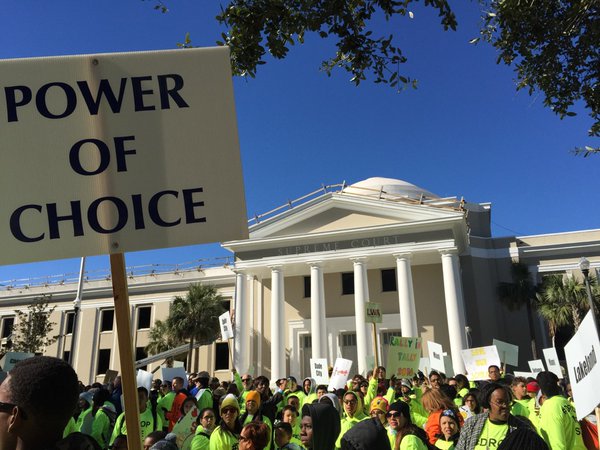
Parents rally outside the Florida Supreme Court in January 2016 to protect school choice options.
Recently, I was invited to a local coffee and conversation-type event in Florida between my former state representative and former neighbors who are predominantly white progressive women.
Then I was invited to a conversation at a late-night dinner event in New Jersey with five conservative white men.
Both discussions were more similar than different.
Both discussions involved topics about educational choice and branched off from there.
Both groups have heard a lot about people like me.
On the left, they like my work with the ACLU and Moms Demand Action for Gun Sense. Then they hear that I organize parents who choose something other than their district school. That means I’m a union-buster out to destroy public education.
On the right, they like my advocacy for education choice , but then they learn I’m a democratic socialist. That means I’m trying to turn the United States into Venezuela.
Over coffee, I looked around and noticed all that we have in common – white, progressive, living in a highly valued neighborhood with stellar schools. And we could take time off to attend such an event in the middle of a workday.
Or between salon appointments.
Most women attending were against parental choice in education.
Of course. Our opponents are almost always privileged white liberals.
I watched these participants struggle to understand as I explained why I supported educational options for everyone, not just those who could afford it.
One mom tried to sum up their opposition.
“We support the democratization of the public school system,” she said.
“What does that mean?” I asked.
“It means we support free public schools that are open to everyone.”
I smiled at them.
“We all know these schools aren’t free,” I said. “We pay for them in our rents and our mortgages.”
They stared at me.
“And our schools here don’t accept everyone. They only take kids from a particular ZIP code.”
“That’s not true!” one mother objected. “Our high school took Tony Dungy’s kids from Avila.”
I almost spit out my coffee. Tony Dungy is a black man, the former coach of the Tampa Bay Buccaneers, and a millionaire. Avila is a gated community north of town.
“That’s true,” other moms nodded in agreement. “They accepted Tony Dungy’s kids.”
“How nice of them,” I said. “But they don’t take kids from the projects around the corner. Do they?”
Silence.
“Do any of you know anyone who desperately needs a good school for their children? Do you know at least one mom who can’t afford to move into this neighborhood, who’s trapped in her ZIP code and can’t afford private school?”
Silence.
“If you met anyone like that, what would you say? How would you explain your position to them?”
More silence.
A few weeks later, in a very different conversation with conservative men, it didn’t take long before they found out I leaned far to the left. Naturally, they wanted to know my views on transgender issues.
Instead of speaking for a group of people who do a much better job speaking for themselves, I tried a different tactic.
“That’s why we support educational options for all students, right?” I asked. “So every student, even those you can’t quite understand yet, will find a school that’s the best fit for them. Choice is beginning to accommodate students based on gender identity – and really, isn’t our message that we all benefit when all our kids are succeeding in school?”
Lots of mumbles and one guy looked at the ceiling.
“Do any of you know anyone who identifies with a different gender than the one they were assigned at birth? Have you talked to them about this?”
Silence.
“If you met anyone like that, would you listen? Would you try to hear their point of view?”
More silence.
Perhaps we should open any and all conversations to include those who’ve typically been excluded. If you’re convinced you know where you stand on any issue, including educational choice, perhaps you should talk to someone who’s affected by it. Invite them into a conversation. Ask them their opinions, and then listen for a while.
We’d all learn so much, and I could go back to answering only for myself.

