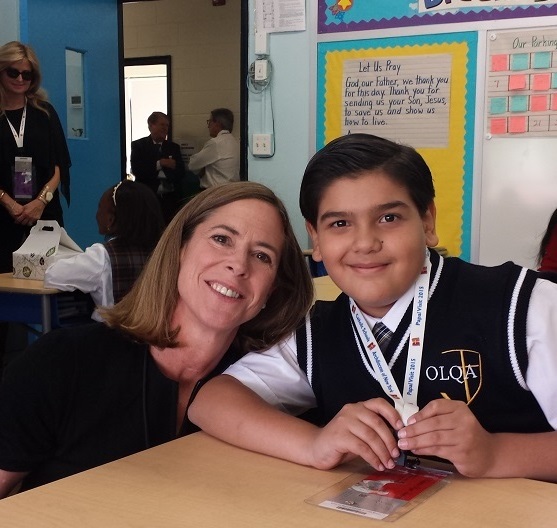
 Over the summer, a group of Catholic schools in Harlem and the Bronx posted some attention-grabbing results.
Their students took the same tests as children in New York's charter and traditional public schools. State data showed that, on average, all types of schools improved. But the Partnership Schools improved faster.
For the second-straight year, the results of this experiment in urban Catholic education lent credence to the idea that— like a few related efforts elsewhere in the country — it belongs in the larger effort to improve urban school systems, particularly for disadvantaged students.
"We really can be a proof point," Jill Kafka, the executive director of the Partnership for Inner-City Education, says in the latest edition of our podcast.
"I think what we're able to prove and show is that Catholic schools can be an excellent choice for parents in these neighborhoods," she says. In addition to traditional and charter public schools, "we end up being the third leg of the stool. We can bring the excellence to the point where we are part of the education reform conversation."
The six schools are looking to turn the tide in a city beset by enrollment declines and Catholic school closures that hurt surrounding communities. (more…)
The annual release of state test results in New York State saw rising scores across the board — as well as debate about what, exactly, that meant. But for a half-dozen inner-city Catholic schools, the results brought some unequivocal good news: Their students' gains outpaced not only their public-school peers, but also the city's charter schools, which are being lauded for outsize gains.
Collectively, the Partnership Schools increased student proficiency rates by 16 percentage points in language arts and 13 percentage points in math. Where they once trailed statewide averages in student achievement, they now surpass them.
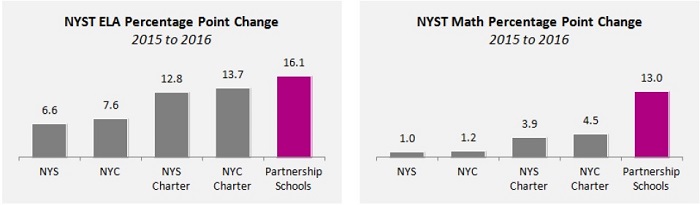
Gains in a group of inner-city New York Catholic outpaced even high-performing charter schools. Source: Partnership Schools
The Partnership for Inner-City Education is part of the national Catholic school renaissance.
The proliferation of school choice programs, the growth of new organizations devoted to academic excellence in Catholic education, and the pressures created by what partnership superintendent Kathleen Porter-Magee calls a healthy fear of closure have prompted a growing number of Catholic schools around the country to explore new approaches to academic improvement and rediscover their calling to serve disadvantaged students.
An agreement reached in fall 2013 allowed the partnership to take over academic operations for six schools in Harlem and the Bronx. They serve about 2,100 students in grades Pre-K-8, 80 percent of whom qualify for federal lunch programs. Some 72 percent of their students qualify for financial aid, which Jill Kafka, the partnership's executive director, said is provided through roughly $3 million in privately funded scholarships.
Catholic schools' efforts to improve education of low-income students have a champion in Pope Francis, who visited one of the partnership schools — the 124-year-old Our Lady Queen of Angels — last fall.
Writing in Flypaper, Porter-Magee notes it wasn't long ago that Catholic schools were widely cited as a source of hope in urban education. (more…)
A new report looks at a key aspect of the Catholic school renaissance we've explored before on this blog: The rise of private school management organizations — which, it turns out, are not confined to Catholic schools.
 The report, from the Friedman Foundation for Educational Choice, looks at the rise of these private school networks, which borrow some features from their cousins in the charter school world.
Charter management organizations like KIPP and education management organizations like Charter Schools USA now run a third of America's charter schools, providing financial backing, back-office support and other advantages to schools in their networks.
According to the report, new organizations are starting to do similar things for private schools.
These budding private school management organizations (PSMOs) are independent entities that operate or help operate three or more private schools. They are a potentially important innovation in the supply of private schools.
The authors — Kelly Robson, Juliet Squire and Andy Smarick of Bellwether Education Partners — tracked down 14 organizations that meet their definition, which means they exist outside the government or existing church structures. Eight of the organizations have some kind of church affiliation. Most of those, including the two that are active in Florida, are Catholic. There's also a network of Lutheran schools. (more…)
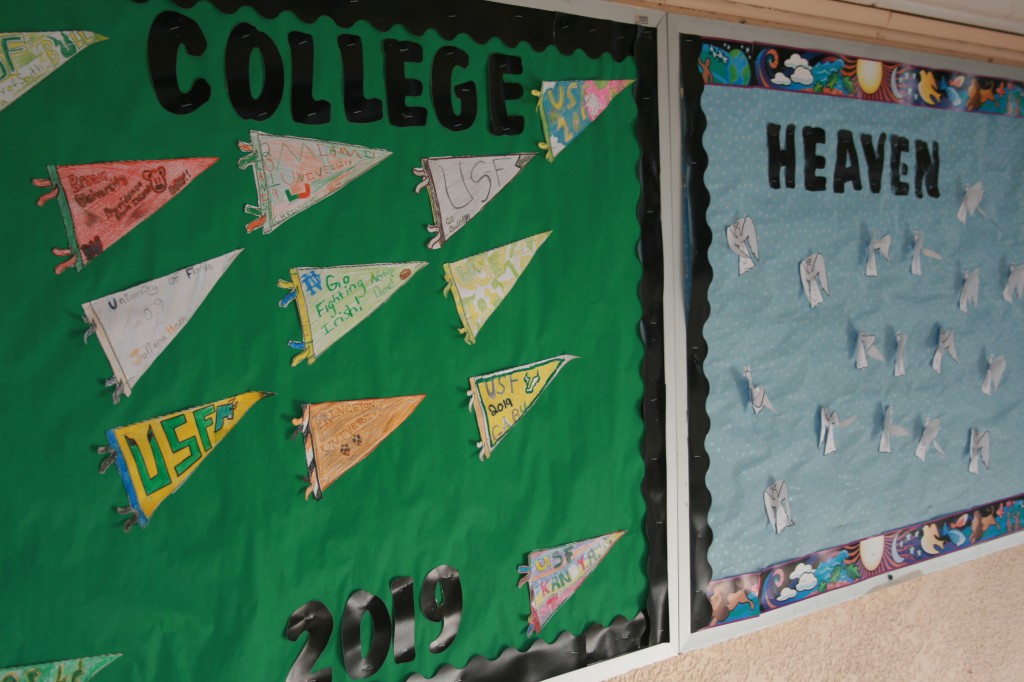
St. Joseph's goals for students are evident throughout the school.
Students know their priorities the moment they enter St. Joseph Catholic School. A sign by the front door reads, “Our Goals: College. Heaven.’’
Inside the West Tampa school’s cafeteria, boys and girls gather for Holy Karaoke, a morning program that encourages them to dance and sing, and focus on the lessons ahead.
Cartoon pumpkins belt out “Blue Moon’’ while bobbing across a giant movie screen. Sister Nivia Arias, in full habit, croons along at the pulpit before prompting her charges to recite daily affirmations.
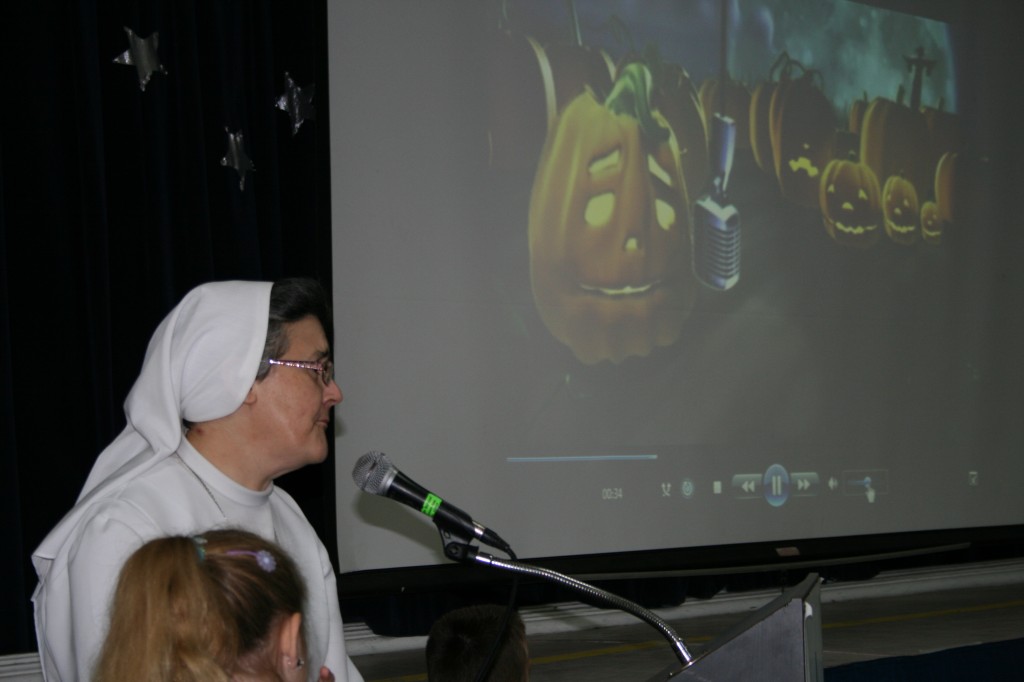
Sister Nivia Arias oversees St. Joseph Catholic School's Holy Karaoke morning show.
“We are active learners who do our best work every day,’’ little voices say in unison. “We do the right thing at the right time.”
The saying sums up the philosophy of this 116-year-old parochial school once run by Salesian nuns. It may also be prophetic.
Like other Catholic schools across the nation, St. Joseph struggles with limited resources while trying to attract students and teachers. But a new partnership with the Diocese of St. Petersburg and the University of Notre Dame might be the right thing at the right time.
St. Joseph and another local Catholic school, Sacred Heart in Pinellas Park, are among five schools in the nation taking part in the Notre Dame ACE Academies, a pilot program in conjunction with the university's Alliance for Catholic Education that aims to strengthen Catholic schools and the communities they serve.
The idea is to boost enrollment and help schools develop better leadership, curriculum, instruction, financial management and marketing. (more…)

