Editor's note: This post is shared by our sister organization, Step Up, Step Further Scholarship Fund, a new federal scholarship program launching in 2027 to support students in public and private schools.
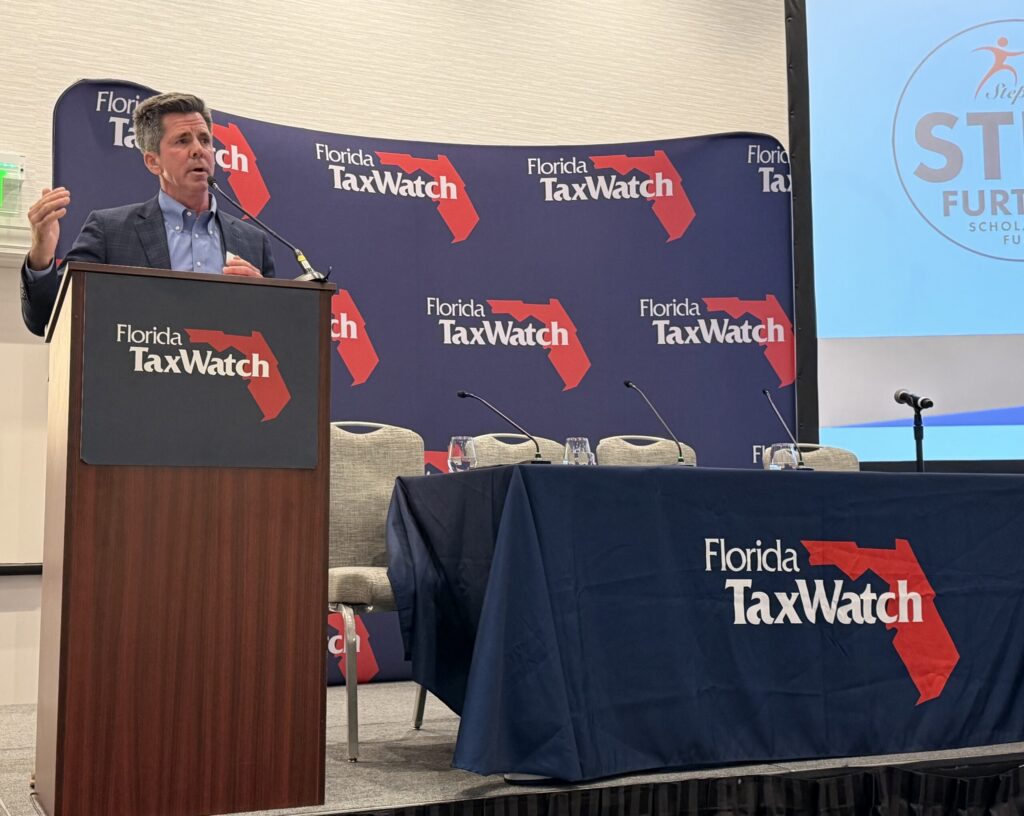
At Florida TaxWatch’s policy forum, Step Up For Students Founder and Chairman John Kirtley shared how the new federal Education Freedom Tax Credit will help expand opportunity for K-12 low income district school students. “The income levels that the federal law allows are, in my opinion, pretty generous,” Kirtley said. “They’re 300% of the area’s median income, which in Florida will be anywhere up to probably $250,000. However, a scholarship organization can set its own income limits.”
The new tax credit will continue to allow Step Up, Step Further, sister organization of Step Up For Students, to focus on serving the lowest-income students in Florida.
Kirtley went on to illustrate how Florida school districts have seen a dramatic increase in graduation rates since 1981, when the graduation rate hovered under 50%. He noted that a statewide push for greater accountability in schools and grading them has resulted in a graduation rate of over 90%.
“That’s an incredible improvement, and we should all be very proud of that. A great example of how the districts have responded is very close to home for me. My high school, Fort Lauderdale High School, when schools were first graded back in 1999, my high school was an ‘F.’ And it was an ‘F’ for several years,” Kirtley said.
Read the full article at Florida Politics > https://floridapolitics.com/archives/791109-john-kirtley-makes-case-for-choice-encouraging-use-of-education-savings-accounts/
Less than two months after the application season began, record-breaking interest continues with more than 500,000 students applying for Florida’s K-12 education choice scholarships.
Step Up For Students, the nonprofit organization that administers 98% of the state’s scholarships, opened applications for the 2026-27 school year on Feb. 1. A record 200,000 applied during the first three days.
By midday Feb. 10, a total of 300,106 students had applied for scholarships, which represents an 11.7% increase over the same 10-day period last year. By Friday morning, Feb. 27, a total of 401,507 students had applied.
Applications reached the 500,000 mark on March 30, which was 22 days earlier than in 2025.
Step Up For Students CEO Gretchen Schoenhaar said last week that the organization’s team and systems were ready for the surge of interest. Step Up’s technology systems processed 15% more applications on the first day this year than at the same time last year. Of the families who called for assistance, more than 90% reported being “satisfied” or “very satisfied” with the support they received.
“Florida continues to set the pace for the nation in education choice,” Schoenhaar said. “Families have become accustomed to seeking options in their children’s education and Step Up For Students is proud to support them every step of the way.”
Since its inception in 2002, Step Up has administered more than 3 million scholarships.
During the 25-26 school year, more than 525,000 students have been funded on Florida’s K-12 scholarship programs to access learning options of their choice. If these students were counted as a single school district, it would be the largest in the state and the third largest in the country. That makes Florida the national leader in education options.

However, not all families end up using their scholarships. Top reasons include: Their preferred private school lacked capacity; they were on a waitlist for a charter school and were accepted; they chose to attend a district school, etc.
Step Up is on track this school year to have 2.75 million transactions on MyScholarShop, its online marketplace, for over $425 million. Step Up is on track to process over 4.5 million reimbursement requests this year, worth over $595 million, four times what it had just two years ago.
Current scholarship families have until April 30 to renew their scholarships for the next school year. All families who want a PEP scholarship must also apply by April 30.
Applications and more details are available here.
We will continue to update the numbers in this post until applications close.
By Lauren May and Ron Matus
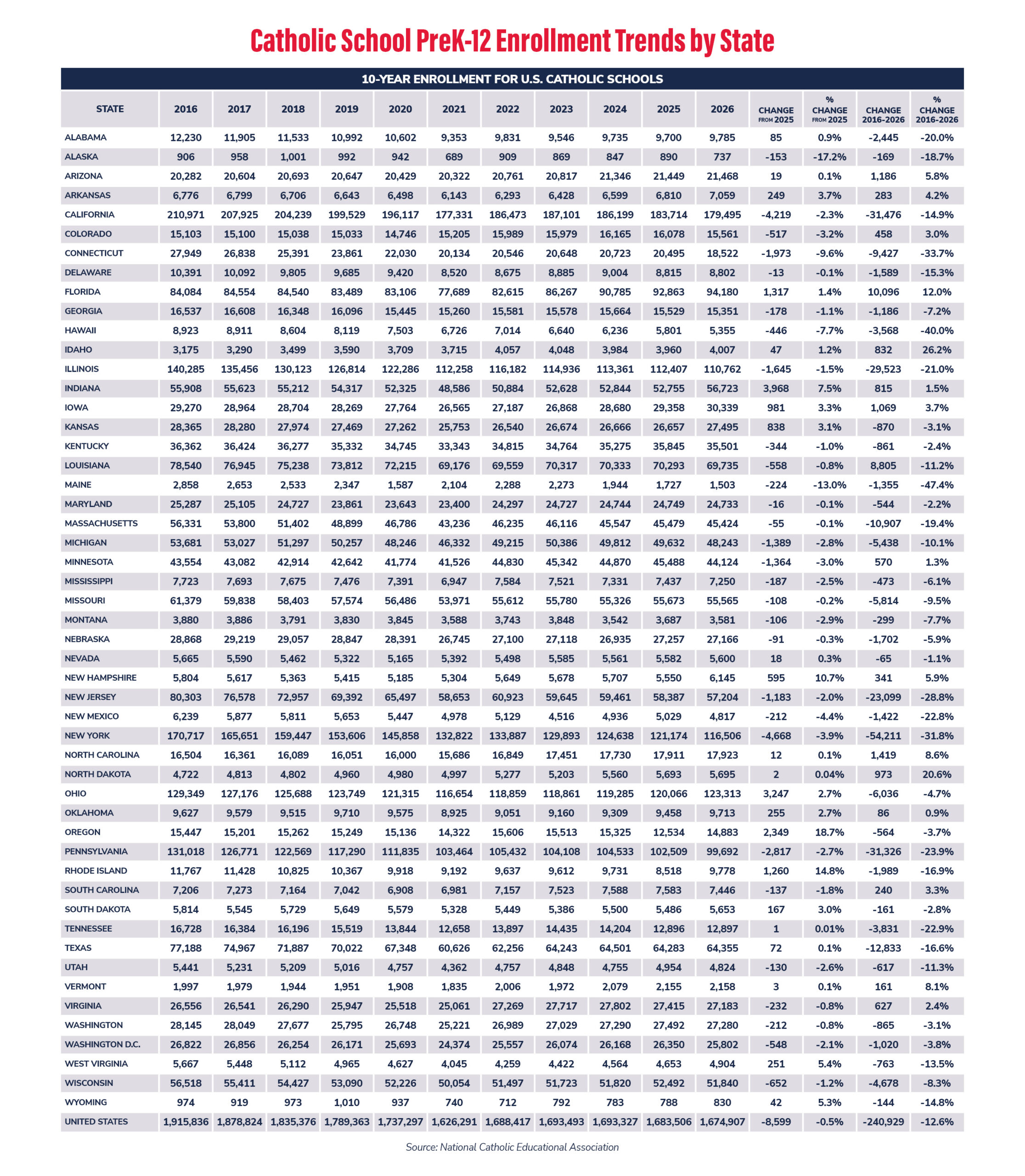
Florida continues to be a standout in Catholic school growth. But the latest national data from the National Catholic Educational Association, released Tuesday, shows other states with expansive new school choice programs are gaining steam.
In fact, Florida is no longer the only state in the Top 10 states for Catholic school enrollment to show a net gain over the past decade. This year it’s joined by Indiana. The Hoosier State is now in the plus column thanks to this year’s jump of nearly 4,000 students.
(Indiana, by the way, replaced Missouri in the Top 10. Missouri’s enrollment has been relatively stable for the past five years, but it dipped just enough for Indiana to pull ahead.)
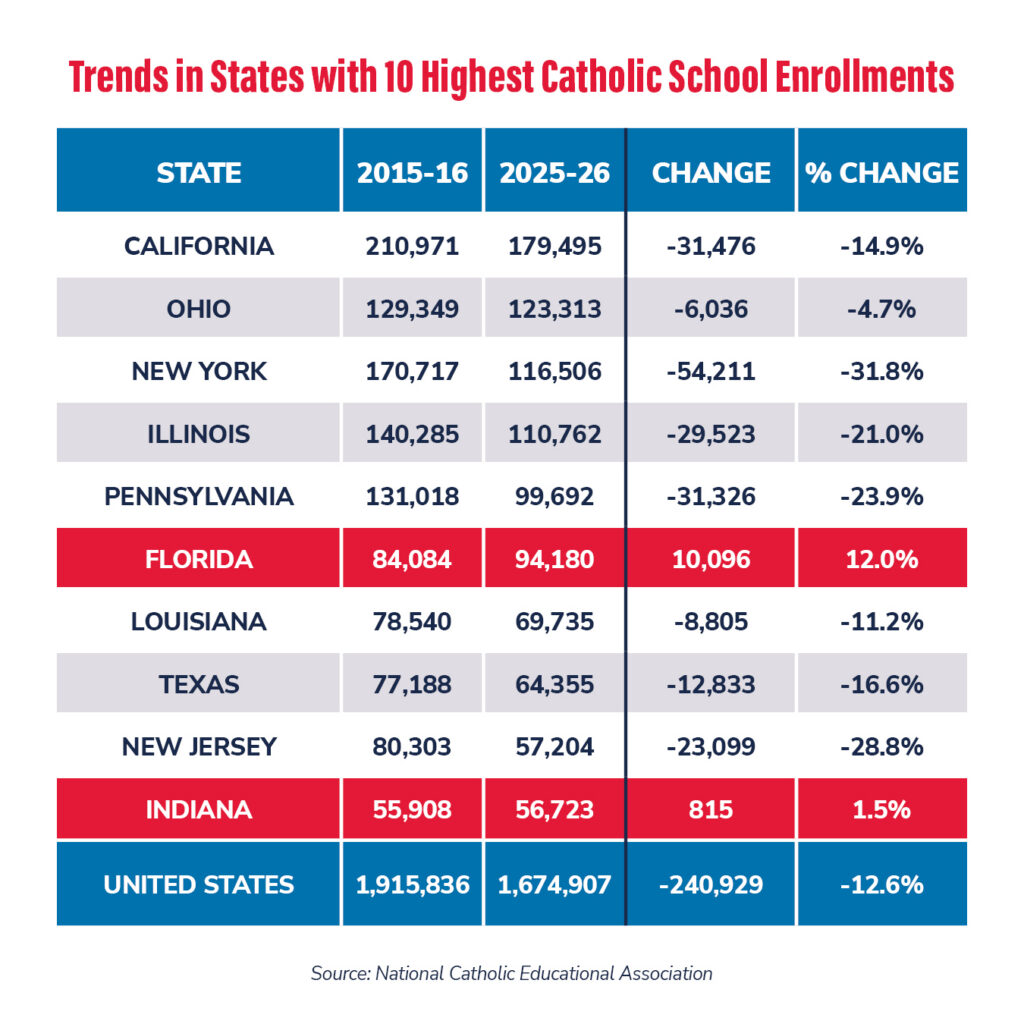
No state had a bigger one-year increase than Indiana, the new report shows. Plenty of others, though, are seeing significant growth, including Ohio, Iowa, and New Hampshire, all states with choice programs that encompass universal eligibility.
Check out the data for yourself in the chart we put together at the bottom of this post. It includes the NCEA’s year-by-year numbers for all 50 states, going back a decade.
The report isn’t just good news for individual states. Nationally, enrollment stayed pretty steady for a fifth straight year. After decades of falling numbers, that’s encouraging – and supporters of Catholic education, and education pluralism more broadly, should feel the wind at their backs.
Meanwhile, don’t forget about Florida just yet.
Catholic school enrollment down here is up 12% over the past decade, while total K-12 growth ran about 10% over that span.
The Sunshine State’s been the outlier for years, buoyed by the most robust school choice programs in America. It’s for that reason that we issued a special report, “Why Catholic Schools in Florida Are Growing: 5 Things to Know,” in 2023, and followed it up with update briefs in 2024 and 2025.
Stay tuned for the 2026 update soon.
About the authors
Lauren May is Vice President and Head of the Federal Scholarship Tax Credit Program at Step Up For Students and a former Senior Director of Advocacy at Step Up For Students. As a proud graduate of the University of Florida, she received her bachelor’s degree in special education and her master's degree in early childhood education. She then completed another master's degree in educational leadership from Saint Leo University. A former Catholic school teacher, early childhood director, and principal, she was honored with the University of Florida’s “Outstanding Young Alumni” award in 2018. As a believer
that parents are the first and best educators of their children, Lauren loves working with families across the state and beyond to ensure they can find and make use of the best educational options for their children.
Ron Matus is Director, Research & Special Projects, at Step Up For Students. He earned a bachelor's degree in history and English/creative writing from Florida State University and a master's degree in Florida Studies from the University of South Florida. He joined Step Up in 2012 after more than 20 years as an award-winning journalist, including eight years as the state education reporter for the Tampa Bay Times, the state’s biggest and most influential newspaper.
TALLAHASSEE, Fla.– Amanda Thompson said she will be the president of the United States.
Not wants to be or hopes to be but will be.Amanda Thompson said she will be the president of the United States.
Not wants to be or hopes to be but will be.
Just like she will be the attorney general of Florida, the governor of Florida, and the United States attorney general before reaching the Oval Office.
“That’s the plan,” she said. “I’m going to get there.”
Of course, there is some prep work to be done before she begins a career of service to her state and country.
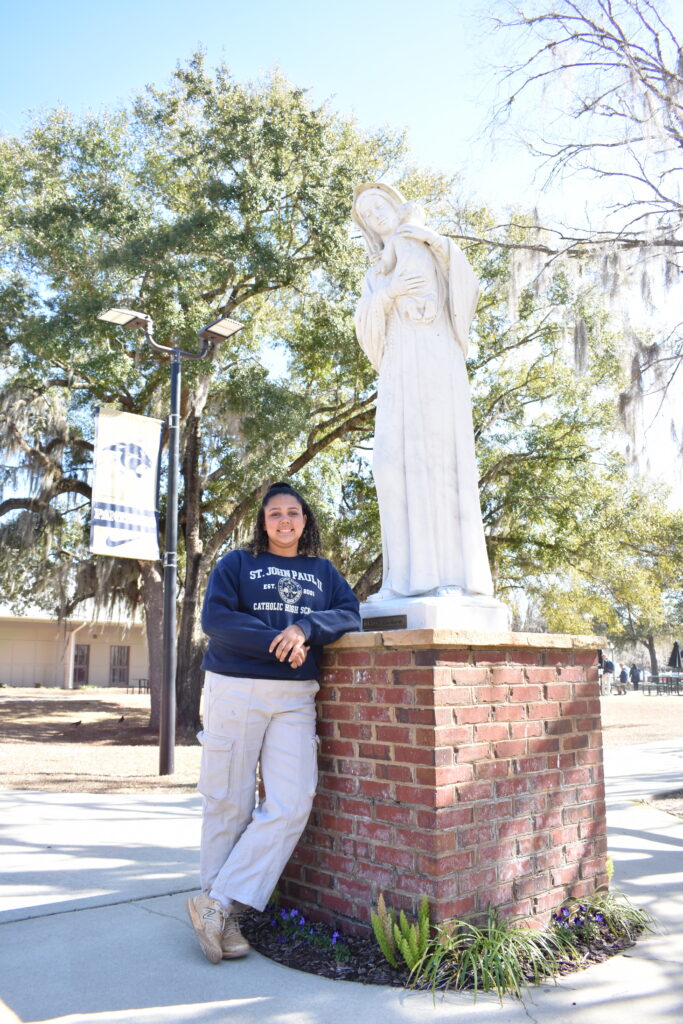
First, Amanda, 17, is set to graduate this May from St. John Paul II Catholic High School (JPII), where she will be class valedictorian. She attends the parochial school in Tallahassee with the help of a Florida education choice scholarship managed by Step Up For Students.

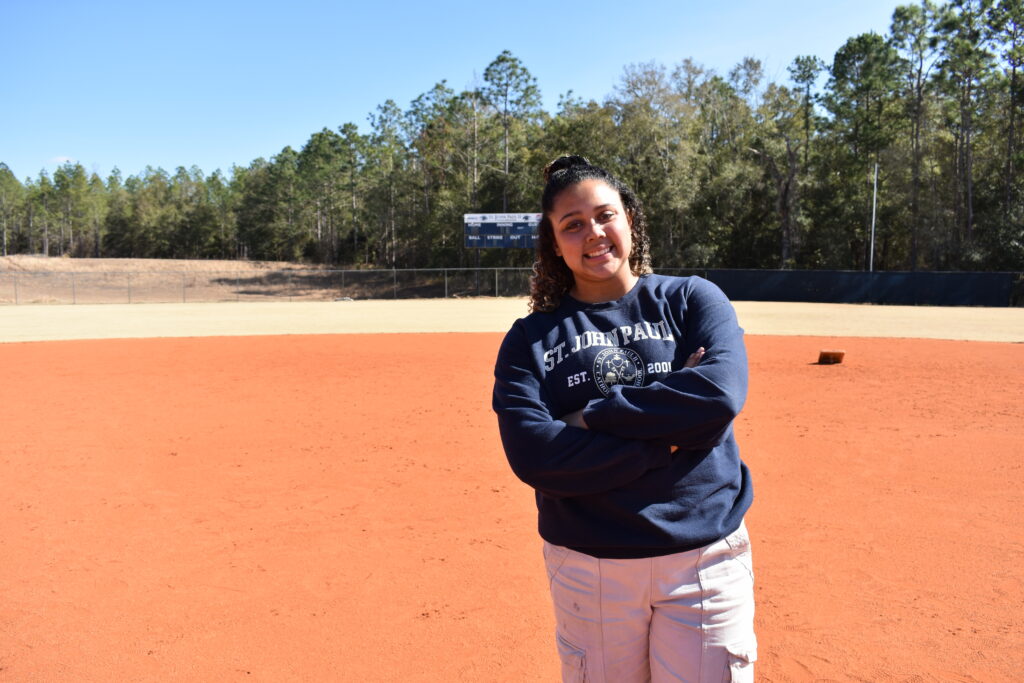
Then it’s off to Harvard University, where she plans to double-major in government and history and earn a degree from its prestigious law school. Along the way, Amanda will pitch for the Crimson softball team with designs on leading the program to its first appearance in the Women’s College World Series.
As that unfolds, Amanda is determined to play softball in the Olympics. She has attended tryouts for Team USA and is a member of the United States Virgin Islands national team.
Taken separately, any one of her goals is ambitious.
But combined?
“She has very, very high expectations,” said JPII Principal Luisa Zalzman. “She’s a go-getter, a high achiever. She has a drive that is very mature for her age.”
“She's done everything she's ever put her mind to,” said Amanda’s mother, Ashley Williard. “She said she wanted to be valedictorian, and I said, ‘OK, go be valedictorian.’ And she did it.”
Amanda is a bundle of energy and confidence. On the softball field, she has a running dialogue with everyone – teammates, opponents, coaches, umpires. In the classroom, she’s involved in every class discussion.
If you had approached her in August 2022 as she took the initial steps of her high school journey and told her she would graduate first in her class and be a member of Harvard Class of 2030, she would have been stunned.
“I would have said, ‘You got the wrong person.’ The difference between me then and me now is astronomical, and I think it’s because I attended this school,” she said. “It has to be.”
Amanda was a star as she rose through the ranks of the Tallahassee youth softball programs. Her parents, Ashley and James Thompson, envisioned their daughter earning an athletic scholarship to college. They were thinking of a high-end academic university like Duke or Notre Dame. That’s how Amanda, who attended her district schools until eighth grade, landed at JPII.
“We wanted a high school that was college-focused,” Ashley said. “Education is what we were looking for, and we could not have done it without Step Up For Students. No way could we afford to put her in that situation.”
There were “little things,” Amanda said, that shaped her academic future.
Her freshman English teacher encouraged her to write outside the margins during tests and essays.
“He said, ‘You don’t have to stay within this box. If you know more, write more on the paper.’ That stuck with me,” Amanda said.
Her freshman world history teacher announced to the class that Amanda scored the highest on the first test of the year.
“He congratulated me,” she said. “I thought that was insane.”
Midway through that semester, Amanda realized she had A’s in all her classes. That’s when she began to believe in herself as a student. Future valedictorian?
“Why not?” she said.
Amanda took AP World History as a sophomore and aced the AP test.
“That’s the class where I learned to learn,” she said.
Also, her love of history and government was born in that class, Amanda said. She can name all the countries of the world, tell you where they are located, and identify the flags.
“I’m working on my capitols,” she said. “It’s my hobby.”
Amanda took Spanish I and II in middle school and passed each, but not with grades that would stand out on a high school transcript. Sara Bayliss, JPII’s college advisor, suggested that Amanda retake those courses.
“She said the grades weren't good enough, that I could do better,” Amanda said.
Amanda retook both classes. She asked Principal Zalzman, a native of Venezuela, for tutoring help. The result was a pair of grades that fit proudly on the transcript Amanda sent to Duke. Duke was her dream school for education and softball.
And then Harvard called.
At midnight on Sept. 1 of her junior year – the first day college coaches can contact 11th graders – Amanda received a phone call from the Harvard softball coach.
“I didn’t even know they had a softball program,” Amanda said.
Intrigued, Amanda accepted a recruiting visit to the university located just outside of Boston. That trip marked the end of her Duke dreams.
“I want to make a difference in this world, and I think Harvard is the perfect school for me,” she said.
Terrence Brown, JPII’s softball coach, has watched Amanda emerge as an Ivy League student and a Division I softball player good enough to attend Team USA tryouts and earn a spot on the national team of a small territory with Olympic ambitions.
“She’s goal-oriented, and she doesn’t let anything get in the way of achieving those goals,” he said. “She’s worked very hard to get to where she’s going.”
Ashley and James are proud parents, but Ashley said they won’t take too much credit for Amanda’s success.
“We have nothing but pride,” Ashley said. “She is self-driven, self-motivated. We try to provide motivation. She’s missed proms and dances because of softball travel and schoolwork, and that was all her decision.
“There are a lot of sacrifices made to go along with this. She’s not afraid of hard work. She says she’s going to do something, and she goes out and does it.”
By Lauren May and Ron Matus
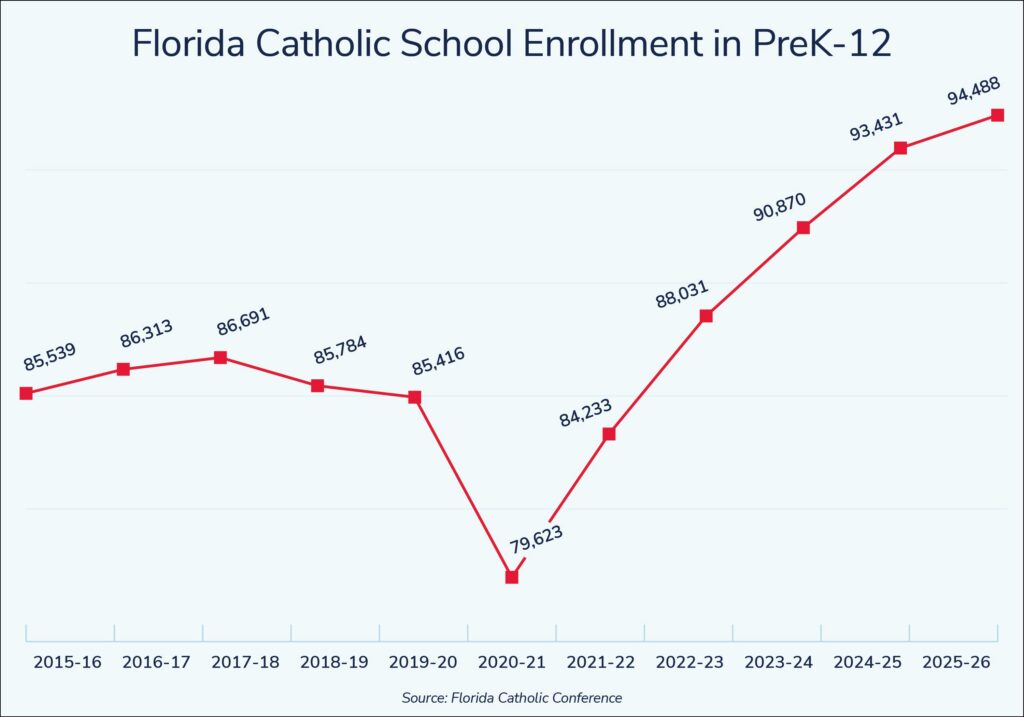
Catholic school enrollment in Florida is up again this year, rising 1.1% to 94,488 students, according to the latest numbers from the Florida Catholic Conference.
The continued growth is likely to bolster Florida’s reputation as the national standout in Catholic schooling. Through last year, Florida Catholic school enrollment was up 12.1% over the past decade. Nationally, it was down 13.2%.
To spotlight the trend lines, we published a special report in 2023, “Why Catholic Schools in Florida Are Growing: 5 Things to Know,” followed by update briefs in 2024 and 2025.
In that spirit, here are five things to know about the 2025-26 numbers:
The trend continues. This year marks five years of consecutive growth. Since 2020-21, when enrollment dipped in the wake of the pandemic, Catholic school enrollment in Florida is up 18.7%.
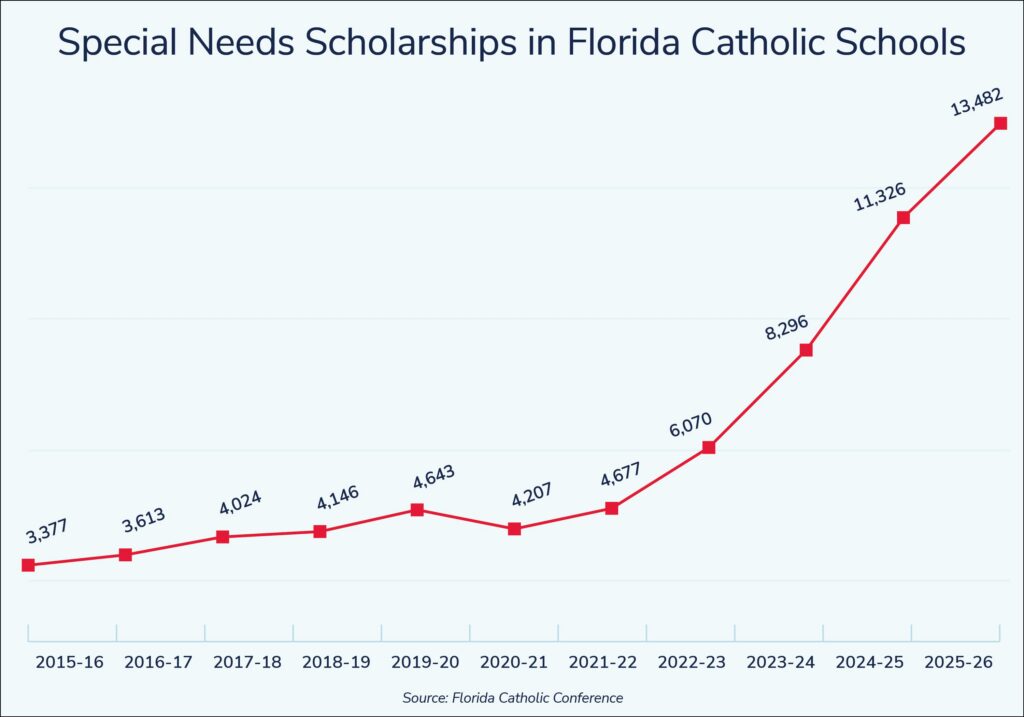
Special needs surge. Students with special needs are a leading factor. This year, Catholic schools in Florida are serving 13,482 students who use the state’s Family Empowerment Scholarship for Students with Unique Abilities. That’s up 19% from last year and triple the number from five years ago. FESUA students now encompass one in seven of all Catholic school students in Florida.
Non-Catholic students. Catholic schools have a long history of serving a diverse array of students. This year, 20% of students in Florida Catholic schools are non-Catholic, up from 14% a decade ago.
Choice scholarships are critical. In 2022-23, the year before choice in Florida became “universal,” 47.2% of all Catholic school students in Florida used choice scholarships. This year, 92.1% use them.
Context for the trend line. This year’s enrollment increase is smaller than any of the past five years. Time will tell whether that’s an anomaly. But it’s worth noting that except for a la carte learning, K-12 enrollment in Florida is slowing all over:
It’s likely that demographic shifts, including falling birth rates and declining immigration, are significant factors here. With private schools, it’s also possible that barriers such as zoning and building codes are preventing supply from better meeting demand. Last year, a Step Up For Students survey of parents who were awarded choice scholarships but didn’t use them found one in three said there were no seats available at the schools they wanted.
One final note: This post, not to mention our reports on Catholic education in Florida, wouldn’t be possible without the Florida Catholic Conference. FCC Director of Accreditation Mary Camp has been carefully tracking the enrollment and scholarship data for years. We are grateful to partner with the FCC and particularly indebted to Mary.
About the authors
Lauren May is Vice President and Head of the Federal Scholarship Tax Credit Program at Step Up for Students and a former Senior Director of Advocacy at Step Up For Students. As a proud graduate
of the University of Florida, she received her bachelor’s degree in special education
and her master's degree in early childhood education. She then completed another
master's degree in educational leadership from Saint Leo University. A former
Catholic school teacher, early childhood director, and principal, she was honored with
University of Florida’s “Outstanding Young Alumni” award in 2018. As a believer
that parents are the first and best educators of their children, Lauren loves working
with families across the state and beyond to ensure they can find and make
use of the best educational options for their children.
Ron Matus is Director, Research & Special Projects, at Step Up For Students. He
joined Step Up in 2012 after more than 20 years as an award-winning journalist,
including eight years as the state education reporter for the Tampa Bay Times, the
state’s biggest and most influential newspaper.
TAMPA, Fla. — The words on the trophy read “Future Philanthropist,” and Mrs. Finley, who taught fifth grade that year, cried when she presented it to Andrew Weber during graduation.
Andrew smiled at the memory.
“It was one of the highlights of my elementary school career,” he said. “Mrs. Finley said I was one of her favorite students. That meant a lot to me.”
So did receiving the trophy, which still holds a place of honor on his nightstand.
“It made me realize my potential and how I can help others,” Andrew said.
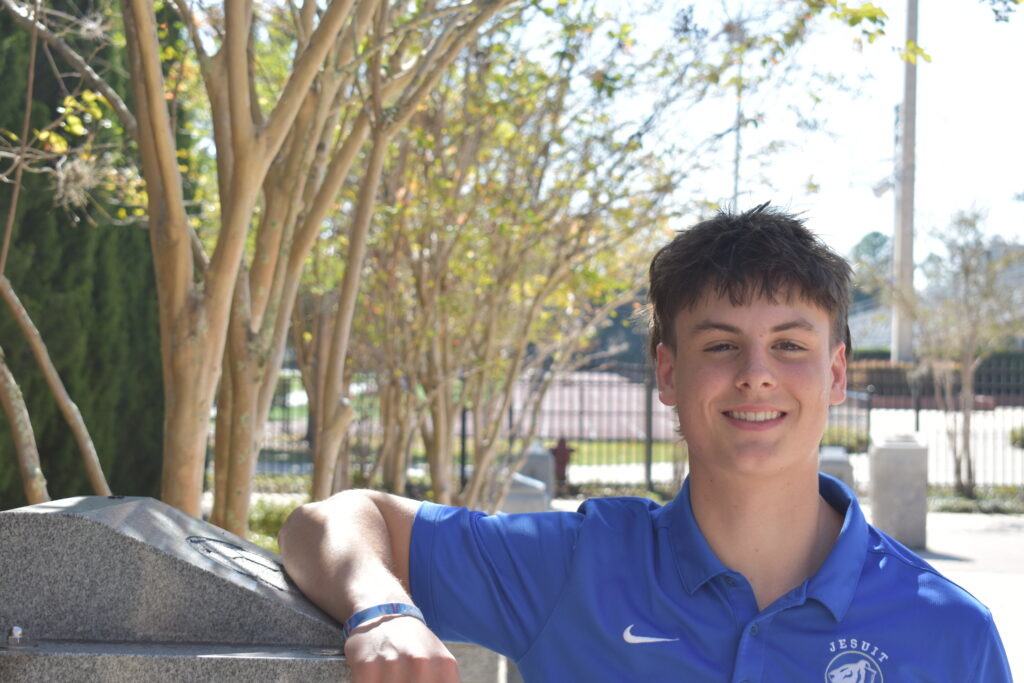
Almost seven years later, Andrew, a 17-year-old senior, is nearing another graduation, this time from Jesuit High School, the Catholic school in Tampa he attends with the help of a Florida education choice scholarship.
The altruistic nature Mrs. Finley saw in Andrew when he was in elementary school blossomed during the ensuing years.
Jesuit’s mantra is “Men for Others,” and Andrew embodies that.
“He does 100%,” said Andy Wood, Jesuit’s athletic trainer and track and field coach, and the school’s former director of community service. “Andrew is one of our top students. And when you talk about a total package, including his community service work, being a student athlete, he's what we envision our seniors being at graduation.”
Andrew volunteered for eight service organizations while in high school.
He made two trips to an orphanage in Guatemala with his Jesuit classmates, feeds people at Metropolitan Ministries, and delivers Meals on Wheels with his mother, May.
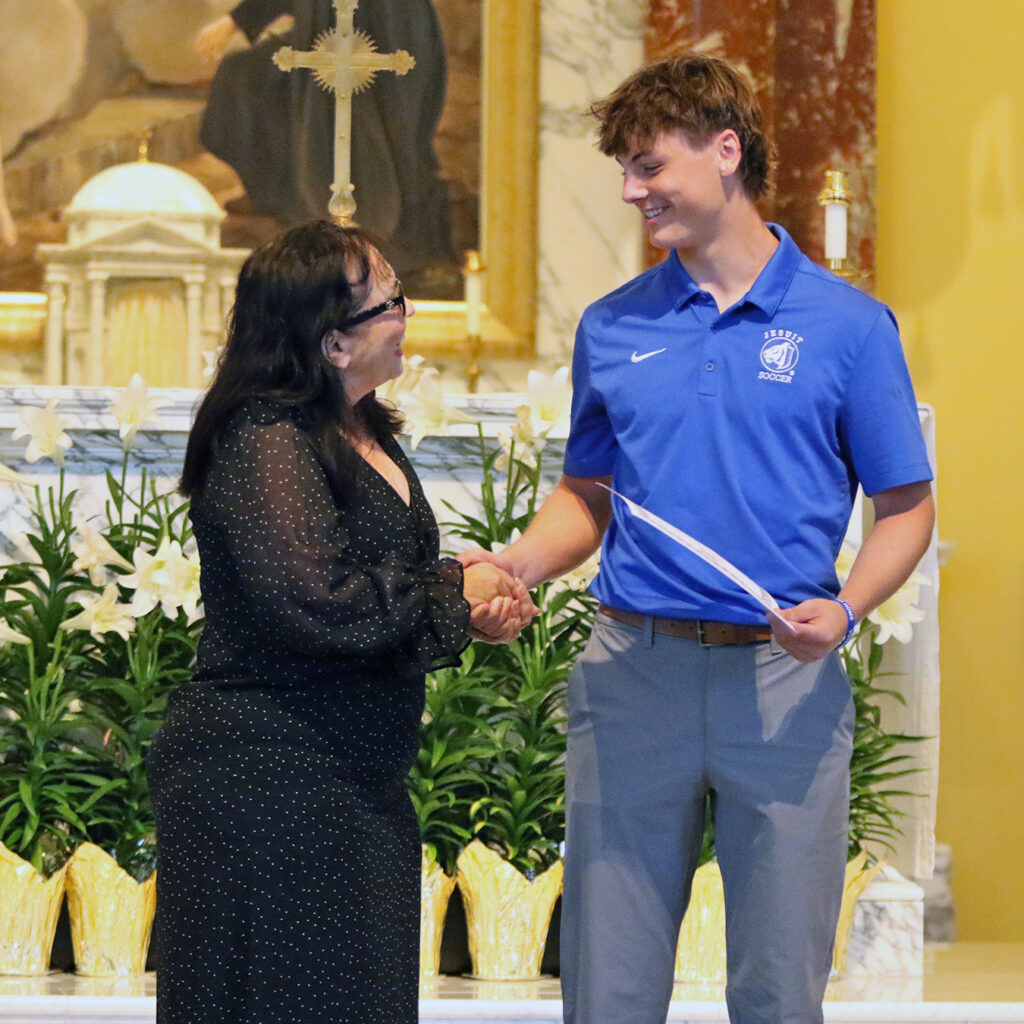
He’s volunteered for the Faith Café, the Young Men’s Service League, Teens United Florida, the Leukemia and Lymphoma Society, and the Ryan Nece Foundation, a non-profit founded by a former Tampa Bay Buccaneer that empowers teens to become leaders through volunteering.
Andrew traveled to Asheville, North Carolina, last June with the Ryan Nece Foundation to help families with home repairs still needed after the flooding caused by Hurricane Helene.
He is a pole vaulter on the track and field team, and in his spare time, he plays the piano at a local nursing home.
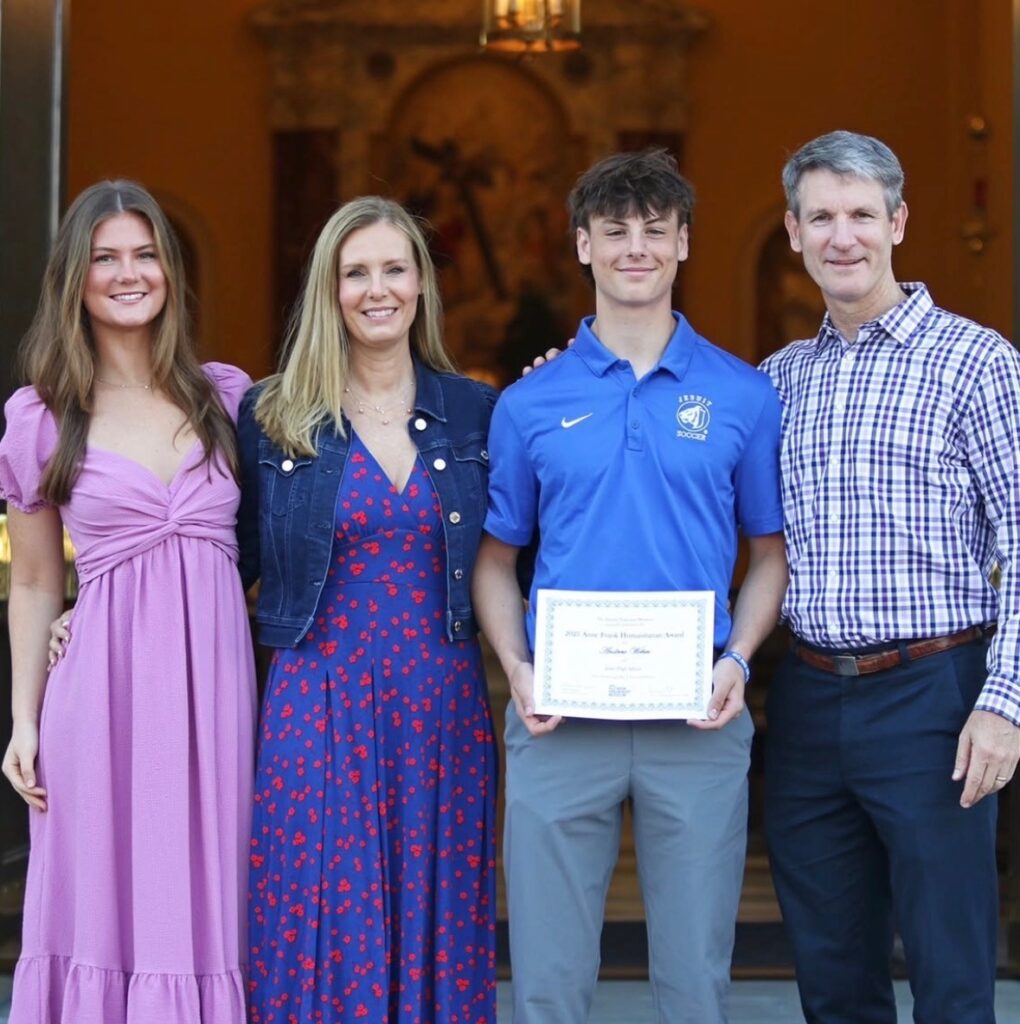
As a junior, Andrew received the Anne Frank Humanitarian Award from the Florida Holocaust Museum in Tampa for his outstanding humanitarian efforts.
Andrew’s parents, May and Tim, raised him and his older sister, Elise, to be community-minded. Elise, now a sophomore at the University of Georgia, also volunteered for the Ryan Nece Foundation while in high school.
“As his parents, we always wanted Andrew to be very involved in a lot of things and explore different passions, and luckily for him, many of those passions really stuck,” May said.
Andrew set the foundation in elementary school when he sold lemonade, handmade crafts, and rocks (crystals and gems) from a stand in the front yard of the family’s Tampa home. He said he would raise maybe $100 over several weeks and donate the money to charities such as Dogs Inc (formerly Southeastern Guide Dogs).
“I was 8,” he said. “I felt the money could benefit other people more than it could benefit me.”
“His heart was always generous,” May said.
For a teenager as service-oriented as Andrew, he certainly found a home at Jesuit, where students are required to complete a minimum of 150 hours of community service during their four years. Andrew, though, has accrued more than 500.
Yet, the decision to attend Jesuit was not easy.
“It was a very hard decision,” Andrew said.
His options were these: his district school, where Elise was a rising junior and where a lot of his friends were headed, or Jesuit, an all-male parochial school with demanding academic standards.
For help, Andrew turned to his role model: his big sister.
“She said, ‘Andrew, if you pass up this opportunity, you might regret it for the rest of your life.’ So I said, ‘I'm going to listen to you,’” Andrew said.
Thinking back on it now, Andrew added, “She was right.”
He has no regrets.
Andrew’s two trips to Orfanato Valle de Los Angeles (the Valley of the Angels orphanage) outside of Guatemala City with his classmates opened his eyes to how fortunate he is to live in America.
The orphanage did not have air conditioning, and hot water was spotty at best.
Wi-Fi? Yeah, right.
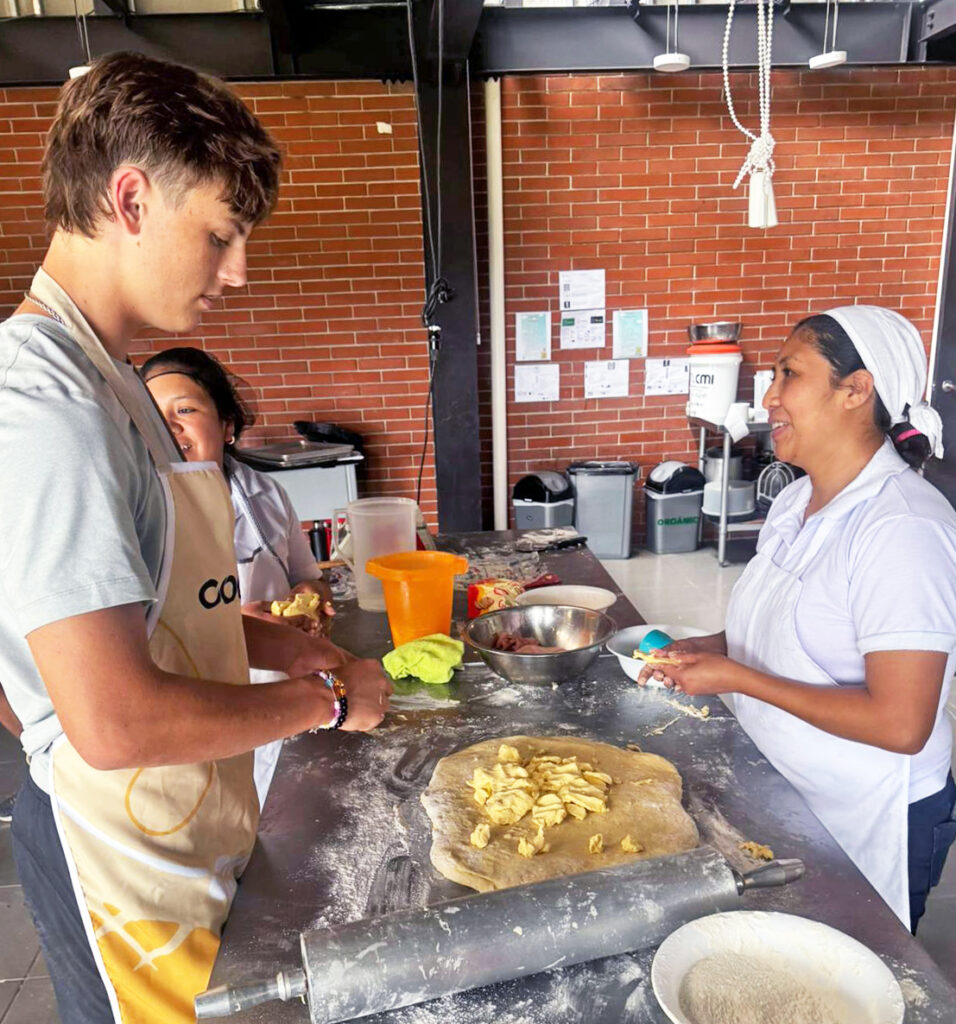
“I just put down my phone and started living in the environment, living how these kids live, and I realized that life can be fun,” Andrew said.
The Jesuit students spent nine days with at-risk children, teaching them English and about their faith.
Andrew called the experience “life-changing.”
“In Tampa, we really live in a bubble,” he said. “There are things I don’t take for granted anymore.”
Like AC, hot water, and a strong Wi-Fi signal.
And how a simple act of kindness can make a world of difference in someone’s day.
During the summers, he and his mom deliver Meals on Wheels to older adults and others unable to leave their homes without difficulty. It’s a bonding moment between the two, quality time spent together for a mom and her son.
“It's probably my favorite thing that we have done together,” May said.
“It’s the favorite thing that I do,” Andrew said.
They don’t rush through their route. Instead, they spend a few minutes at each stop, checking on the people receiving the meal, making small talk, and letting them know they matter.
When they first started delivering the meals, May told Andrew: “We’re probably the only people they're going to talk to that day, so even though this is sort of a blip on your radar, this is their day; this is their weekend; this is their week. So, make it count.”
Andrew took that lesson to heart.
A man for others.
“I feel like if I were in that situation where I needed help, I obviously want someone to do the same thing for me,” he said. “Spreading Jesuit’s values across what I do is a big part of why I do it. What I've learned here, it really propels me to do what I do in such a great way.”
Andrew wants to major in business in college. Where? He hasn’t decided. His choices are the University of Georgia, the University of Tennessee, Boston College, and Florida State University.
Where will that major lead him? He’s not sure.
“I can tell you it will be with people,” May said. “Whether it's finance or accounting, marketing or entrepreneurship, his love is working with people. I think it's just what comes naturally to him. He motivates people and makes people feel better about themselves. So, that’s my prediction.”

Keith Jacobs II, affectionately called "Deuce," with his parents, Keith and Xonjenese Jacobs. Photos courtesy of the Jacobs family
When our son Keith — affectionately known as “Deuce” — was diagnosed with autism spectrum disorder at age 3, we were told he might never speak beyond echolalia (the automatic repetition of words or phrases). Until age 5, echolalia was all we heard.
But Deuce found his voice, and with it, a unique way of seeing the world.
He needed to find the right learning environment, with the assistance of a Florida education choice scholarship.
Deuce spent his early academic years in a district public school, supported by an Individualized Education Plan (IEP). Despite the accommodations, learning remained a challenge. We realized that for some, a student’s success requires more than paperwork. It requires community, compassion, and collaboration with the parents.
Imagine having words in your head but lacking the ability to communicate when you need it most. That was Deuce’s experience in public school. His schools gave him limited exposure to social norms and rigor in the classroom. Additionally, through his IEP, he always needed therapy services throughout the school day, which limited his ability to take electives and courses he enjoyed.
His mother and I instilled the importance of having a strong moral compass and working hard toward his social and academic goals. Although we appreciated his time in public school, we knew a change was needed to prepare him for post-secondary education. We applied and were approved for the Family Empowerment Scholarship for Students with Unique Abilities.
Knowing the potential tradeoffs of leaving public school and the IEP structure behind, we chose to enroll Deuce at Bishop McLaughlin Catholic High School in Spring Hill, about 35 miles north of Tampa. We believed the nurturing, faith-based environment would help him thrive. It was the right decision.
Catholic school provided Deuce with the support he needed to maximize his potential. Despite his autism diagnosis, he was never limited at Bishop. He was accepted into their AP Capstone Program. This was particularly challenging, but Bishop was accommodating. The school provided him with an Exceptional Student Education (ESE) case manager dedicated to his success, and he received a student support plan tailored to his diagnosis and learning style. The school didn’t lower expectations; instead, it empowered him to take rigorous coursework with the right guidance.
Any transition for a child with autism will take time to adjust. On the first day, I received a call: Deuce had walked out of class. This was due to his biology teacher using a voice amplifier. The sound overwhelmed Deuce’s senses, and he began “stimming”— rapidly blinking and tapping his hands. Instead of punishing him or ignoring the issue, the staff immediately reached out.
Together, we crafted a Student Success Plan tailored to Deuce’s needs, drawing from his public school IEP without being bound by it. His plan included preferential seating, frequent breaks, verbal and nonverbal cueing, encouragement, and clear direction repetition. For testing, he was given extended time, one-on-one settings, and help understanding instructions.
These adjustments made all the difference.
Throughout high school, Deuce maintained a grade-point average of over 4.0 while taking honors, AP, and dual enrollment courses. Additionally, he was inducted into the National Honor Society and Mu Alpha Theta Math Honor Society while also playing varsity baseball. Because of his success at Bishop, he will continue his educational journey at Savannah State University, where he will major in accounting and continue to play baseball.

Deuce Jacobs earned an academic scholarship to Savannah State University, where he plans to major in accounting and continue playing baseball.
Catholic schools in Florida increasingly are accommodating students with special needs. The state’s education choice scholarship programs have been instrumental in making Catholic education available to more families. Over the past decade, during a time when Catholic school enrollment has declined across much of the nation and diocesan schools have been forced to close, no state has seen more growth than Florida.
At the same time, the number of students attending a Catholic school on a special-needs scholarship has nearly quadrupled, from 3,004 in 2014-15 to 11,326 in 2024-25. Clearly, many families are choosing the advantages of a private school education without an IEP versus a public school with an IEP.
So, I’m puzzled why federal legislation being considered in Congress, the Educational Choice for Children Act (ECCA), includes a mandate that that all private schools provide accommodations to students with special education needs, including those with IEPs.
Although more and more students with special needs are accessing private schools, not every school can accommodate every student’s unique needs (which is also true of public schools). And, as I learned with Deuce, some schools can accommodate students more effectively if they aren’t bound by rigid legal mandates and have the flexibility to collaborate with parents who choose to entrust them with their children’s education.
If the IEP mandate passes, it would prohibit many schools from accepting funds through a new 50-state scholarship program, undermining the worthy goal of extending educational choice options to more families. The U.S. Conference of Catholic Bishops has called it a “poison pill” that would “debilitate Catholic school participation.”
Bishop McLaughlin’s willingness to partner with me as a parent not only allowed Deuce to succeed academically but also gave him the dignity and respect every child deserves. IEPs work for many. For others, like Deuce, it takes something more like collaboration to build a path forward together.
The story: With less than a week to go before the U.S. Supreme Court hears arguments about the constitutionality of religious charter schools, supporters and opponents are making wildly different predictions about the possible effects.
 Supporters, who include advocates for religious education, are framing a win for their side as a victory for religious freedom and a logical extension of recent rulings that affirmed faith-based schools’ right to participate in publicly funded programs.
“This is a way of getting new choice options in the context of performance accountability,” said Andy Smarick, a senior fellow at the Manhattan Institute, during a recent debate about religious charter schools sponsored by the American Enterprise Institute. “A small number of religious organizations might apply to run charter schools, and I think that’s wonderful and not going to change the world.”
The Manhattan Institute is among the organizations weighing in on the side of religious charter schools.
Opponents, which include the National Alliance for Public Charter Schools, are sounding the alarm over what they say could cripple a movement that began more than 30 years ago to launch innovative new public schools.
The other side: The National Alliance for Public Charter Schools warned that a ruling allowing religious charter schools could carry “catastrophic consequences” for the nation’s existing charter schools.
For religious charter schools to exist, they argue, the high court would have to redefine charter schools as private. That would overturn laws in 46 states, plus Washington, D.C., and Puerto Rico, that define charters as public and thus threaten their ability to be funded under the same per-pupil formulas as school districts.
Yes, and: Charter supporters also point out the potential for ripple effects, such as charter schools losing facilities funding, questions about teacher participation in state benefit programs, or more drastically, calls to halt the approval of new schools or even funding of existing ones.
“This could lead to the destruction of chartering or limiting of chartering,” said Kathleen Porter-MaGee, a managing partner at Leadership Roundtable, an organization that brings together laity and clergy to support the Catholic church.
Instead of extending charters to religious groups, she encouraged a doubling down on private K-12 scholarship programs, which are now established in 29 states, with Texas poised to become the 30th.
Expanding scholarship programs for private education would let faith-based schools maintain instructional and employment practices that align with their beliefs, free from government interference, while allowing them to serve families who would not have access without private funding.
Catch up: The legal and political battle rocketed to the Supreme Court shortly after two Catholic dioceses won approval from Oklahoma’s statewide virtual charter review board in 2023 to open St. Isidore of Seville Catholic School, an online charter school that would include the same Catholic teachings as the church’s in-person schools.
The fight pitted Republicans against one another, with the current Oklahoma attorney general taking a position opposite his GOP predecessor and filing a lawsuit. It also divided the charter school movement, with national groups forcefully opposing a legal argument that could redefine their status as public entities and some charter schools arguing they would welcome the change.
While Oklahoma has a refundable tax credit that pays up to $7,500 per child for private school tuition, the program was not available until January 2024, about six months after St. Isidore applied for charter school authorization.
Possible upsides of a win for St. Isidore:
“Catholic schools have been doing things on the cheap for far too long,” Smarick said. “This is the opportunity to say you can remain private for as long as you want…but if you think you can do more for your mission in the charter school context, you can.”
Possible downsides:
Charter groups preparing: In case the court rules in favor of St. Isidore, advocates of established charters are working on model legislation that would allow states to maintain funding. A finding that says charter schools are not state actors also raises many questions, such as whether the ministerial exception, a legal doctrine that shields religious organizations from non-discrimination laws in the hiring of staff with ministerial duties, would apply to faith-based schools.
“No one knows what the court is going to say,” Smarick said. “State legislatures need to step up fast and answer these questions.”
Tune in: The U.S. Supreme Court has scheduled oral arguments in the case for 10 a.m. April 30. Audio will be livestreamed.
FORT LAUDERDALE, Fla. – Zori Brown was in the sixth grade when she made a plan for her future that was concise and to the point:
“I don’t know of any sixth-graders who have a life plan,” said Zori’s mom, Endea Mathis.
Endea said she was raised in a home where education was stressed above all else, and she passed that on to her only child.
“It was taught to her at a young age that you're a student first. We pride ourselves on that,” Endea said. “But she took it to a whole other level.”
Six years later, the plan is still in play.
Zori, 17, is set to graduate in May near the top of her class from St. Thomas Aquinas High School (STA) in Fort Lauderdale. She will continue her education at Dartmouth College, an Ivy League school in Hanover, New Hampshire, where she received a volleyball scholarship. She will major in finance.
The end goal hasn’t changed – become a CFO, possibly on Wall Street.
“She’ll be something someday, that’s for sure,” Lisa Zielinski, STA’s volleyball coach, said.
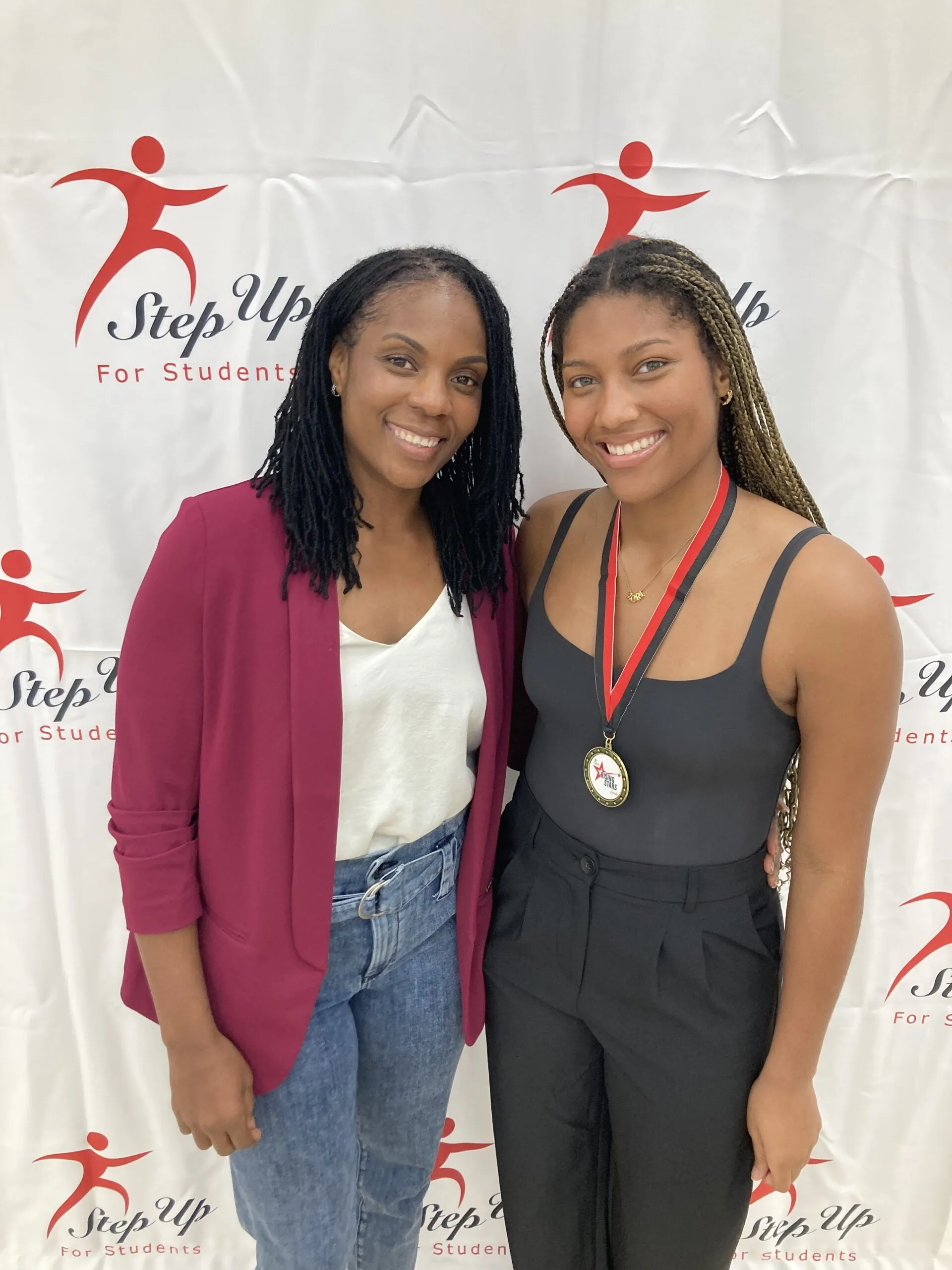
Endea and Zori, after Zori received the Super Senior Award at the Rising Stars Awards event in February.
Ambitious goals like these and the means to reach them are what attracted Zori to STA. She attends the academically and athletically competitive private Catholic high school with the help of a Family Empowerment Scholarship for Educational Options (FES-EO). The scholarship is managed by Step Up For Students.
“If it wasn’t for Step Up, she wouldn’t be able to attend St. Thomas, her dream school, because I couldn’t afford it,” Endea said. “The scholarship has been tremendous for us.”

As a senior, Zori was team MVP, all-Broward County first team, and a member of the American Volleyball Coaches Association's third team. (Photo provided by Zori Brown)
Zori attended a charter school near her home in Pembroke Pines, which is a half hour south of STA. She enjoyed her time there and felt she was pushed academically. But for high school, she wanted something more.
Athletically, Zori joined one of the top volleyball programs in Florida. She finished her high school career as a captain of a team that won back-to-back state titles. As a senior, Zori was team MVP and first-team all-Broward County. She was also named to the American Volleyball Coaches Association's third team.
In volleyball, college coaches recruit players from the AAU national circuit. Zori gained attention playing for the Wildfire Volleyball Academy’s national team, playing weekend tournaments in Atlanta, Kansas City, and Indianapolis, as well as Orlando and South Florida. Dartmouth coaches first approached her when she was in the ninth grade.
“Volleyball has impacted my life a lot,” Zori said. “It’s brought so much joy into my life, and I’m going to a great college through volleyball. I'm so grateful for it.”
Her academic life is equally important. She pushes herself just as hard in the classroom as she does on the volleyball court.
Athletically, Zori joined one of the top volleyball programs in Florida. She finished her high school career as a captain of a team that won back-to-back state titles. As a senior, Zori was team MVP and first-team all-Broward County. She was also named to the American Volleyball Coaches Association's third team.
In volleyball, college coaches recruit players from the AAU national circuit. Zori gained attention playing for the Wildfire Volleyball Academy’s national team, playing weekend tournaments in Atlanta, Kansas City, and Indianapolis, as well as Orlando and South Florida. Dartmouth coaches first approached her when she was in the ninth grade.
“Volleyball has impacted my life a lot,” Zori said. “It’s brought so much joy into my life, and I’m going to a great college through volleyball. I'm so grateful for it.”
Her academic life is equally important. She pushes herself just as hard in the classroom as she does on the volleyball court.
“I have to get a high mark, I just challenge myself,” she said. “There may be a class I don't really know much about, but in X amount of months, I'm going to walk out of here, and I'm going to know as much as I can.
I think what keeps me going is thinking about the future and how I want to be successful in life, and I feel by challenging myself academically, that's going to help me get there.”
Zori's play on the court, where she is an outside hitter, drew the attention of the coaches at the Ivy League universities Yale, Brown, and Princeton. She was also recruited by Georgetown University, Stony Brook University and Davidson College.
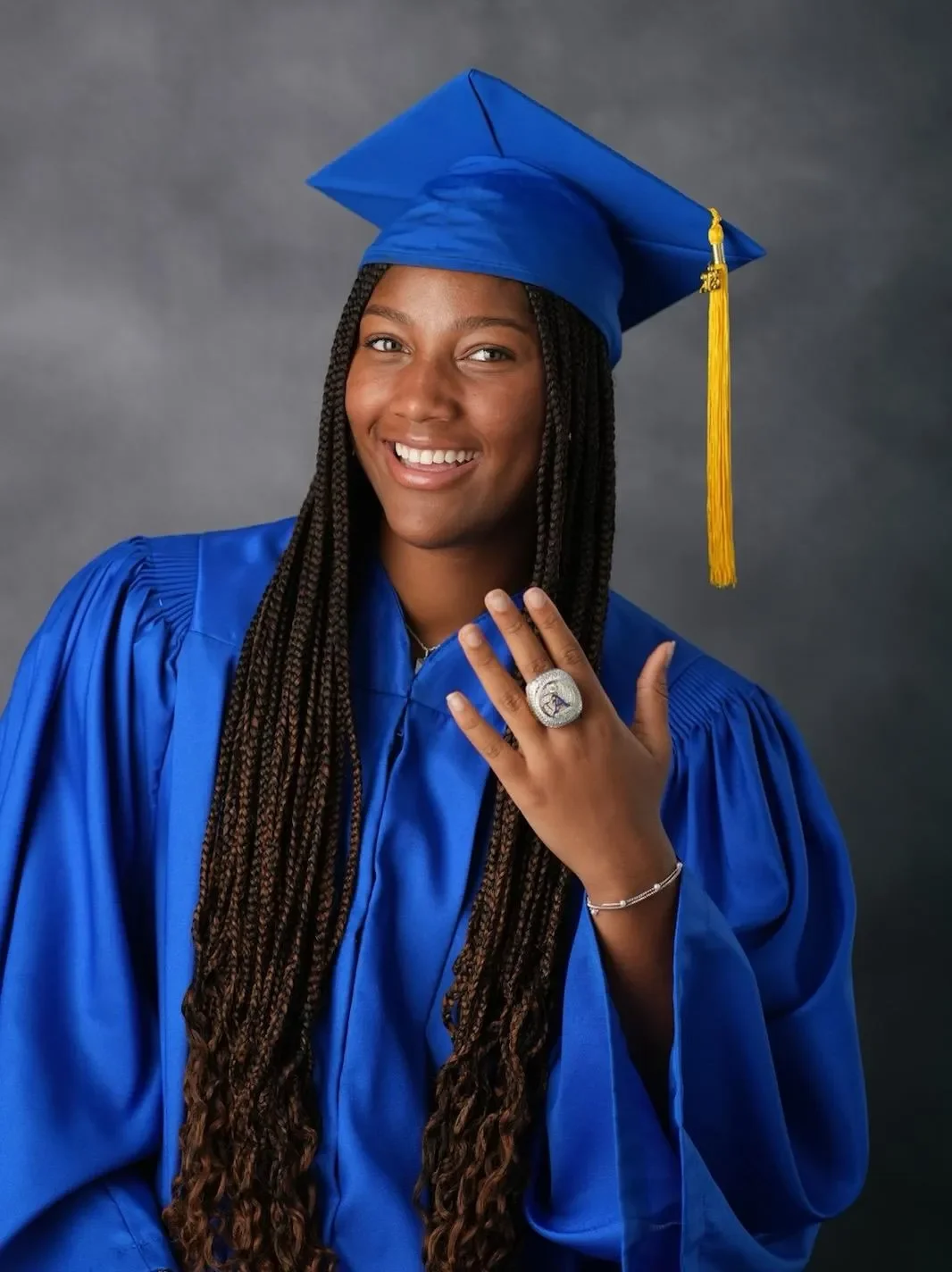
As a senior, Zori was team MVP, all-Broward County first team, and a member of the American Volleyball Coaches Association's third team. (Photo provided by Zori Brown)
As a senior, Zori was team MVP, all-Broward County first team, and a member of the American Volleyball Coaches Association's third team. (Photo provided by Zori Brown
In addition to her athletic prowess, Zori brings leadership and a high moral character to the team, which, Coach Zielinski said, enables her to be successful.
“Once in a while, you get a player who has it all,” Zielinski said. “I know the Dartmouth coaches are going to be happy to have her, because she’s going to contribute to that school and that program. She’ll make a difference. She’ll thrive in that academic setting.”
Endea, who is slowly changing her wardrobe from STA’s blue and gold to Dartmouth’s green, is not surprised her daughter is headed to an Ivy League school, though she was quick to add, “I brag all the time.”
“She’s always been confident, always been competitive,” Endea said. “She always wanted to do well, always wanted to be first in everything. That’s from her upbringing. I always pushed her to be the best she could be. She always wanted more out of life.”
Zori doesn’t feel she would be heading to an Ivy League college without the education she received at STA. The faculty helped her lift her academics to a higher level. That, combined with her competitive nature and her laser-like focus on her future, means she will trade sunny South Florida for some New England winters.
“I know this is really cliché, but you only live once,” Zori said. “I think about that all the time. You have to work hard in this life because you don’t get another one. You have to take advantage of the opportunities you have. The decisions you make now affect your future.”
NAPLES, Fla. – Owen Phypers’ commute from his new home to his new high school took about 15 minutes. Meanwhile, his parents were driving 90 minutes one way to their old jobs near their old home so their son could have the opportunity to attend a private high school with high academic standards and a top-flight baseball program. Their sacrifice did not go unnoticed.
“It made me realize I can't mess around,” Owen said. “I have to make this worth it.”
Not that Owen messed around at his district school in his hometown of Lake Placid. He was a top student, a member of the National Honor Society, and captain of the baseball team. Yet, he felt he wasn’t reaching his potential in the classroom and on the diamond.
Neither did his parents, Brittany and Drew.

So, last year, the Phypers moved to Bonita Springs, and with the help of a Family Empowerment Scholarship for Educational Options (FES-EO), administered by Step Up For Students, Owen enrolled at St. John Neumann Catholic School in Naples as a junior.
Was it worth it?
Well, as graduation nears, Owen is ranked fourth in the senior class. He is captain of his house (one of four that form Neumann’s student government) and captain of the baseball team. In June, he begins Plebe Summer at the United States Naval Academy, where he will major in engineering and continue his baseball career.
“This school has brought me to where I am now,” Owen said. “I honestly think so.”
Neumann’s baseball program was a big attraction for Owen. Its state-of-the-art facilities, respected coaching staff, and on-field success against some of the top programs in the state draw the attention of Division I-A coaches and Major League Baseball scouts. The Celtics fit what Owen was looking for as a means towards earning a Division I-A scholarship.
A right-handed pitcher, Owen noticed an improvement in every aspect of his game within a month of joining the program.
“I got better at everything,” he said.
His motivation to continue improving increased when a teammate committed to Division I-A power Florida State shortly after Owen enrolled.
“I saw that and said, ‘I want to be that guy,’” he said.
But, as his mom, Brittany said, “Owen loves baseball. But he’s not all baseball.”
Owen grew up on the family farm in Lake Placid, amid cattle pastures, citrus orchards, and caladiums. Lots of caladiums. Lake Placid bills itself as the caladium capital of the world.
But after 52 years, the farm was dissolving, and Drew needed a new line of work. He helped shut down the farm last year before landing a job as a project manager for a construction company in Collier County. Brittany, a teacher, finished the year at the district high school in Lake Placid before taking a teaching position at Neumann this school year.
Hence, the long commutes.
“Owen knew it was a sacrifice for us, both time-consuming and financially, but we were ready to make that sacrifice for him,” Brittany said.
The FES-EO scholarship, managed by Step Up For Students, helped ease some of the financial burden.
“Without a scholarship, we wouldn't have been able to afford to come here,” Brittany said. “It's just been life-changing for us. For everyone to be able to apply for it and have that opportunity is wonderful. It gives you an opportunity, and then it's up to you.”
It wasn’t long after Owen enrolled at Neumann when Brittany knew he would make the best of his opportunity.
“Coming here has just opened his eyes to the fact that there are students that are like him,” Brittany said. “They want to do well in class and have the same moral code and Christian values.
Owen found the academics at his new school just as challenging as the athletics and that inspired him.
“There’s a lot more homework, and classes are a lot harder, and that pushed me,” Owen said. “It really caused me to grow.
“It’s an environment where all the kids want to be here. People want to become better. People grow in their faith, in every aspect of life.”

Neumann is designed to prepare high school students for college.
“It's not if you go to college, it's where you're going to college,” said Neumann Principal Sister Patricia Roche. “That's the attitude of everyone. This is not the end but the beginning.”
Owen knew he would attend college. The question was, where?
Two years ago, he wasn’t sure if he would garner the attention or develop the skills necessary to play NCAA Division I baseball. Whatever future he had in the game, he certainly didn’t think it would be at the Naval Academy. But the Navy coaches showed an interest in him, and once Owen gave it serious thought, it began to make sense.
He enjoys math, so a career in engineering was always attractive. He considers himself a leader, and the Naval Academy is filled with leaders.
“The main focus of Neumann is getting involved, helping others, which in turn, helps yourself,” Owen said. “I like to lead others, I feel confident leading others, and I saw at the Naval Academy the opportunity to grow as a leader and to support my country in any way.”
Also, Owen added, “I have a couple buddies who are playing baseball in college, and they play baseball, and that's kind of the only reason they’re there.”
He decided he wasn’t going to be just a baseball player. If he was going to major in engineering, he was going to do it at one of the top engineering colleges in the country.
“For my husband and I, this seems like the natural fit for him,” Brittany said. “He wanted to go somewhere where he was going to play and not sit on the bench, but he also felt like he had worked so hard his whole academic career to make really good grades and test scores, so he wanted to go somewhere that was going to be challenging as well. The value of that education has to be a payoff.”
The Celtic Ball, Neumann’s annual fundraiser, was held in January. Owen was one of the seniors picked to speak in front of the school’s alumni and donors.
“He represents the school well,” Sister Patricia said. “He's very articulate, and he's a role model among his peers. He's a leader, which is good. It's nice to have athletes who are on the right track.”
Owen spoke about his journey to Neumann and how it led to his journey to the Naval Academy.
And, with a nod toward the tradition that awaits him, he closed the speech with this:
“Go Navy!
Beat Army!”

