 Charter school closings: A watchdog organization reports that 38 percent of charters schools in Florida have closed since 2000, a failure rate that's 7 percentage points higher than the national average. Of the 1,091 charter schools that have opened in Florida since 2000, 491 have closed (the state Department of Education disputes that number and says 389 have closed). David Armiak, a researcher for the Center For Media and Democracy in Wisconsin, calls the closure rate "alarming." He says it raises questions about accountability for charter schools, which get funding from the state but have greater operational freedom than traditional public schools. Armiak also noted that the closures disproportionately affected minority students. Gradebook.
Effects of teacher turnover: A new study concludes that midyear teacher turnover has a negative impact on student learning, especially in schools that have large proportions of minority and low-income students. “While it is possible for turnover to be beneficial for school systems, an extensive body of research points to the ways that teacher turnover disrupts … the continuity of a child’s learning experiences, particularly in underserved schools,” write study authors Christopher Redding of the University of Florida and Gary Henry of Vanderbilt. The researchers studied data from 2008 to 2014 collected from of North Carolina schools. Chalkbeat. (more…)
 School settlement: Miami-Dade County Public Schools settles with the U.S. Department of Justice over a claim that the system discriminated against job applicants who were immigrants. The county does not admit to any wrongdoing, though it has paid a $90,000 civil citation. Miami Herald.
School testing: State Sen. Alan Hays, R-Umatilla, is confident the Legislature will consider reforms to school assessment testing in the next session. Daily Commercial. Highlands County teachers complain to the school board that there's a mismatch between reading curriculum and testing. Highlands Today.
Instructional coaches: Are Florida schools getting their money's worth for the increasingly popular practice of having district instructional coaches? A legislative committee wonders. Gradebook.
Principal legislation: A Florida House committee has approved a bill for a three-county pilot program that would give principals of underperforming schools greater autonomy to hire and fire teachers. Bay News 9.
Transfers for sports: Too many Polk County high school students are switching schools for athletics, a practice that doesn't always work out for the students, county school officials say. Lakeland Ledger.
STEM classes in jeopardy: Four teacher training classes - middle grades and secondary math, middle grades science and secondary biology - are suspending enrollment at Florida SouthWestern State College due to a lack of interest. Fort Myers News-Press. (more…)
 Center for Media and Democracy PR Watch
Are school vouchers really a “libertarian scheme cooked up out of an ideological hostility toward the idea of public schools” or a means to “subsidize and perpetuate segregation?” If you leave half the history out of the equation, you might reach that conclusion. This is what PR Watch, a left-wing group out to expose right-wing spin, ironically ends up achieving in a blog post on school vouchers.
Let’s not forget that desegregation efforts began because public schools were racially segregated for more than a century.
Following the landmark ruling in Brown v. Board of Education, a resistance movement to desegregation began. Some segregationists did find a solution in a short-lived form of private school vouchers. But many more resisted integration through public schools, sometimes by shutting them down (which also contributed to an increase in private school enrollment) or by zoning black students completely out of their districts.
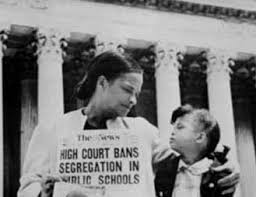 Some public school districts remain highly segregated to this day. Opponents of school choice sometimes forget that racial imbalances can occur between school districts, like in North Carolina or St. Louis (where a mostly white district recently tried to prevent mostly black students from transferring in).
PR Watch brushes aside this history to de-legitimize the modern school choice movement's focus on equity, civil rights and improving education quality for low-income and minority students.
The reality is that our entire education system has to confront a legacy of racism and segregation. The question is what to do about it. Giving all families alternatives to what was once an oppressive system of geographic school assignment can be part of the answer.

