 Variety is the spice of life, and policymakers created charter schools to inject a bit of pluralism into the K-12 space. Sadly, a combination of factors, including a lack of population density and poorly crafted charter school laws, have led to a lower rate of charter schools operating in rural areas.
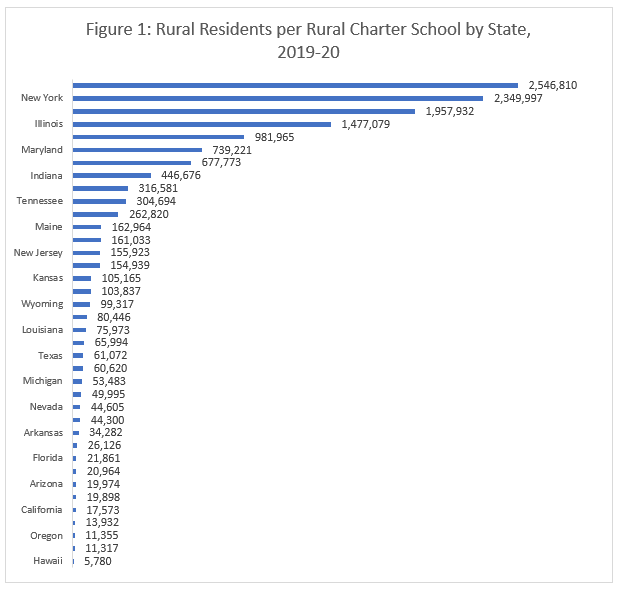
Figure 1 calculates the number of rural residents per rural charter school in states with one or more rural charter schools. The lower the number, the better. Note that there are some states not included in the table because they don’t have a single rural charter school.
Shhh! Someone was sneaky in both Ohio and New York and opened a single rural charter school. I won’t tell anyone if you don’t.
It’s not clear to me if Alabama’s charter law is biased against rural charter schools, because it seems biased against opening charter schools at all given that there are four statewide. The same goes for Virginia with eight charters statewide after passage of a charter law in 1998.
Many of the top states in Figure 1 have large charter sectors, they just discriminate against non-urban school. If you are in the Top 10 in Figure 1, there is a good chance that your state’s laws or practices have some sort of bias against opening rural charter schools.
Last year, Ohio legislators removed geographic restrictions on charter schools. Two different national charter organizations have ranked Indiana’s law tops in the nation for many years running. That, alas, is not of much use to rural students in Indiana.
Indiana lawmakers discriminating against rural communities is a bit like the National Basketball Association discriminating against tall people. More telling, Indiana’s top ranking speaks to a deep conceptual confusion about what constitutes a desirable charter school law.
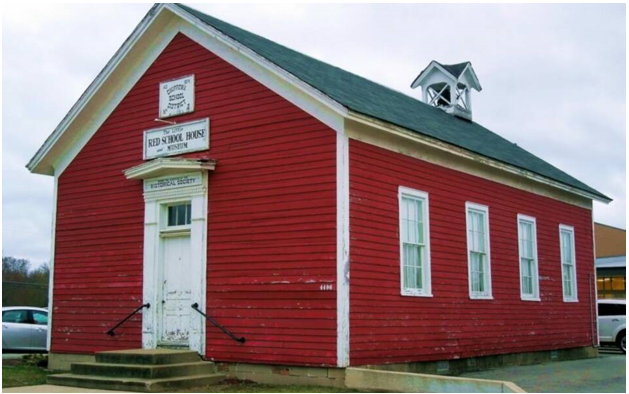
Micro-schools, charter and otherwise, seem like a golden opportunity to diversify rural schooling. The one-room schoolhouse is making a comeback, and rural students and educators have much to gain from the process.
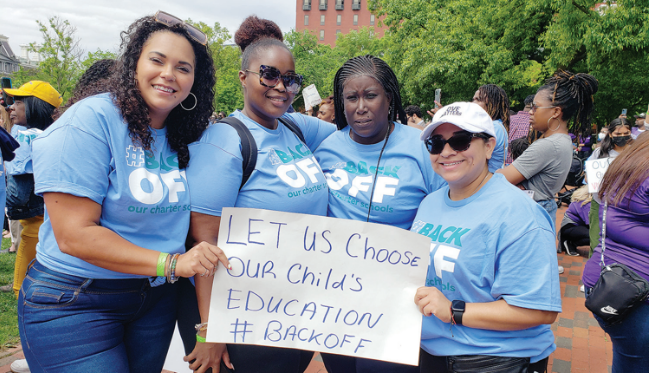
South Florida parents traveled to Washington, D.C., in May, joining about 1,000 advocates from across the country, for a rally in support of charter schools. PHOTO: Beverly James/Florida Courier
Editor’s note: This article appeared Thursday on The 74.
States and charter operators have just a month to scramble for grants under a vastly revamped federal program in which, for the first time, they’ll have to justify the need for new charter schools.
The U.S. Department of Education on Wednesday posted two notices for grants under the Charter Schools Program — one for states and another for those developing charter schools. The announcements reflect new rules meant to create more racially diverse schools and increase transparency when for-profit companies are involved in running them. The deadline is Aug. 5, giving states far less than the four months they’ve had to apply in previous years.
The regulations represent a compromise between the Biden administration, which wanted to limit competition between a growing charter sector and traditional schools, and advocates who argued that such schools play an important role in meeting students’ needs after the pandemic.
Karega Rausch, president and CEO of the National Association of Charter School Authorizers, described the new rules as “workable,” but said he remains concerned about a requirement that new charters be racially and socioeconomically diverse — or explain why they’re not. The rule says operators must note how their charter school won’t “hamper, delay or negatively affect any desegregation efforts in the local community.”
The provision “places additional unnecessary and unwarranted burdens on schools proposing to serve large proportions of lower-income students and students of color,” Rausch said. “And there is no clarity on what constitutes a valid desegregation effort and how applicants will know if any effort exists.”
To continue reading, click here.
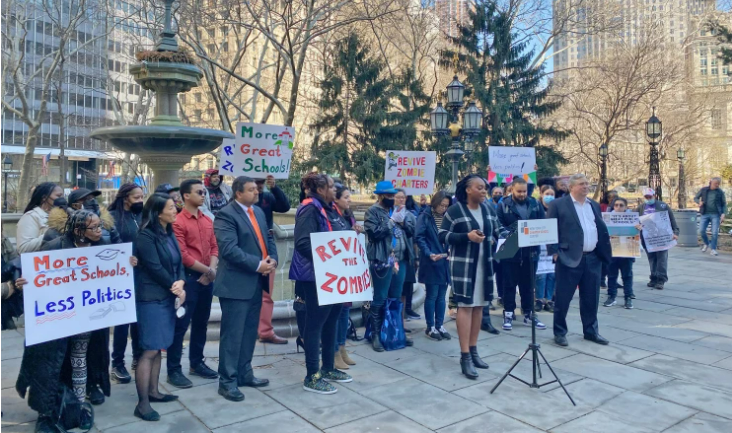
Charter school supporters in New York City rallied earlier this month to push state lawmakers to take action to increase the number of charter schools in the state. PHOTO: Cayla Bamberger
Last week, the Biden administration proposed new rules for its start-up grant program for charter schools. If adopted, the rules would make it tougher for those seeking to open new charter schools, which are publicly funded by privately managed enterprises.
The biggest proposed change would affect for-profit charter companies that run charter schools, making them ineligible for funding if they manage entire operations. Some proposed charter school changes, including this one, have drawn opposition from education choice advocates, including the National Alliance for Public Charter Schools.
For perspective on the proposed changes, reimaginED Senior Writer Lisa Buie turned to Michael Petrilli, president of the Thomas B. Fordham Institute and a supporter of education choice. Answers have been edited for brevity and clarity.
reimaginED: Please give us a broad overview of these new rules. What do they entail?
Petrilli: These are proposed regulations for three of the largest federal charter school grant programs. The grants support the start-up and replication of high-quality charter schools; the money goes either to state entities, charter networks, or individual schools (in states without a federal grant). These rules establish new priorities for the programs, and most critical, introduce new application requirements that go far beyond the statute and could severely limit the number of schools that receive grants.
reimaginED: Why are these rules being proposed, and why now?
Petrilli: The generous answer is that the Biden Administration is trying to make good on its campaign promises. A related, but less generous interpretation, is that the administration is repaying its debt to the teachers’ unions and other reform opponents. It's telling, for instance, that charter opponent Carol Burris expressed enthusiasm for the proposed regulations in a recent Washington Post article.
reimaginED: Are the proposed rules aimed at all charter schools or certain ones, such as those managed by for-profit companies?
Petrilli: Both. Some pertain to all charter schools, and others are targeted at those managed by for-profit companies. Most analysts believe that the rules, if adopted, would make it virtually impossible for schools managed by for-profit companies to receive federal start-up grants going forward.
reimaginED: If schools managed by for-profits are producing favorable educational results, why not reward rather than penalize them for those results?
Petrilli: Good question! The program is already geared toward providing support to schools that show promise of getting great results (for start-up grants) or have already demonstrated great results (for replication grants). That's what should matter, not how a school manages its affairs. But, alas, the far left is on a rampage on for-profit companies, and that is reflected here.
reimaginED: Do the rules also include provisions that make it more difficult for local non-profits to qualify for funding?
Petrilli: Absolutely. Indeed, it will likely be "mom and pop," community-based schools that struggle the most to receive funding under these proposed regulations. That's because the rules add an enormous amount of complexity to the process, which will be hard for small entities to handle.
But the worst part of the proposed regulations applies to everyone: a new requirement for a "community impact analysis." That's a euphemism for the union's concern that charter schools will take kids and money away from traditional public schools. In particular, note this language: "Charter school must provide evidence that demonstrates that the number of charter schools proposed to be opened, replicated or expanded … does not exceed the number of public schools needed to accommodate the demand in the community."
By this logic, new charter schools would only be allowed in communities with rising enrollment – which is almost nowhere right now. In the wake of the pandemic, and the baby bust, enrollment is flat or declining almost everywhere. So, this would stop charter growth in its tracks.
Never mind that rising charter enrollment has a positive impact on kids in traditional public schools and that charters don't actually hurt districts financially. The question shouldn't be whether there are enough schools, or seats, to serve students, but whether there are enough high-quality schools and seats to serve all students, especially those from disadvantaged backgrounds. The answer in virtually every community in the country is “No.” These rules would ignore that fact.
reimaginED: President Biden and other Democrats used to support charter schools as a way to help level the playing field for economically disadvantaged students who wanted a way out of their low-rated zoned district schools. What happened to change that?
Petrilli: Politics. What we're seeing is the impact of the Democratic Party moving left on a host of issues, including education. It's certainly nothing about the charter school movement itself, which has become higher performing over time, especially in cities.
reimaginED: What changes, if any, would be welcomed by charter schools and those who support education choice?
Petrilli: For starters, the language I quoted above needs to be struck. There's nothing in federal law indicating that charter schools should launch only in neighborhoods without flat or declining enrollment, and neither should there be anything in federal regulations saying so.
Second, the new regulations around for-profit schools should be revised to focus on results instead of tax-status.
And third, the rules in general should be pared back and simplified, so as not to create barriers of entry for community-based schools.
reimaginED: How significantly would these changes, if adopted, affect the ability to expand education choice via charter schools? Do most start-ups depend on these grants?
Petrilli: Almost half of the existing 7,000 charter schools in the country received federal start-up grants at one point. So, these grants are extremely important, especially for community-based groups without access to philanthropic support. If these rules go through, it's hard to imagine many applicants qualifying for support. That will leave hundreds of millions of federal dollars wasted and will make a huge dent in charter school growth.

