An organization that helped lay the foundation for private school choice plans to honor two well-known education philanthropists who supported it from the beginning.
The Children’s Scholarship Fund plans to fete Eli Broad and Julian Robertson with its Champion for Children award at its annual gala on May 15 in New York City.
Broad founded both SunAmerica Inc. and KB Home. He now the heads the Broad Foundations. He and his wife, Edythe, have donated more than $4 billion to philanthropic causes and pledged to give away 75 percent of their wealth. Among other things, they back an annual prize for the nation's top charter school organization and efforts to improve public education in Los Angeles. Broad recently announced his retirement.
He was part of the Children’s Scholarship Fund's inaugural advisory board and helped launch the program in L.A. In its first year, the parents of more than 54,000 children applied for 3,750 CSF scholarships awarded in Los Angeles. (more…)
 In 2006, thousands of people jammed the courtyard next to the Florida Capitol not long after the Florida Supreme Court struck down the state’s first school voucher program. I was a reporter covering the state education beat, and in the second sentence of my story I noted the obvious: The majority of rally goers were black.
Somehow, almost every other print reporter missed that, leaving readers with an incomplete picture of an extraordinary event. The omission baffled me then, but I’ve since learned to expect it. It doesn’t take a sophisticated media analysis to see that the parents and children who are clamoring for and benefiting from expanded learning options are too often left out of the story.
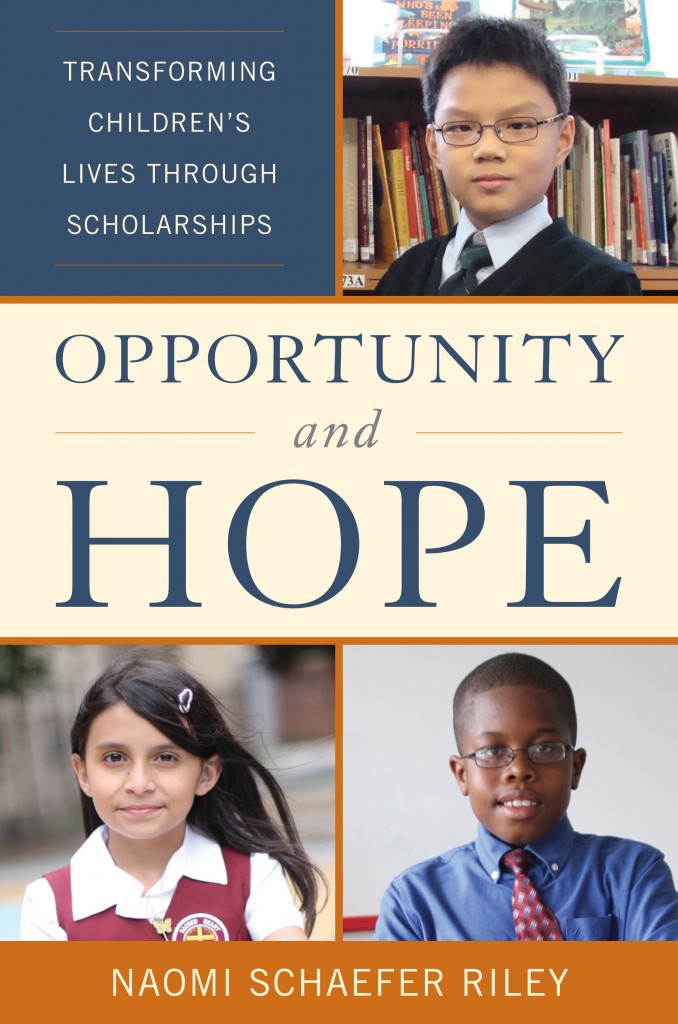
Against that backdrop, a new book by former Wall Street Journal editor and writer Naomi Schaefer Riley fills in the gaps. To give visibility to those at the heart of the school choice debate, and to dispel the abstractions that cloud it, Riley follows a simple formula.
She tells us about the kids.
There’s a lot of pluck and love in the 10 profiles in “Opportunity and Hope.” And a lot of shattered stereotypes about low-income parents and faith-based schools. And a hammered-home fact that is again obvious but overlooked: a different school can put a child on a remarkably different trajectory in life.
Riley
Aleysha Taveras’s mother, a teacher’s aide at a public school in the Bronx, saw too much violence and too little learning. So she enrolled her daughter in a Catholic school with, as Aleysha puts it, “teachers who would always be on top of me.” Now Aleysha is on the verge of graduating from Manhattan College and embarking on a career as a teacher.
Carlos Battle was raised by a single mom in a tough Washington D.C. neighborhood. He had ADHD. But after a stint in a private school, Carlos got a full ride to Northeastern University in Boston, where he’s now majoring in psychology and social service. He envisions starting a nonprofit that will rescue kids from being stuck in neighborhoods like his. “I just want to break that cycle of stuckness,” he says.
Most of the black and Latino students profiled by Riley received scholarships through the Children’s Scholarship Fund, the pioneering, privately funded choice program started in 1998 by Ted Forstmann and John Walton. Danielle Stone is one of the exceptions, with her scholarship coming from Step Up For Students, which administers Florida’s tax credit scholarship program and co-hosts this blog.
Riley lets the students and parents do most of the talking. She asks the basics. Who are these kids? What were their lives like before the scholarship? What are they like now? What made the difference? (more…)
by Darla Romfo
When Children’s Scholarship Fund received 1.25 million applications for the first 40,000 CSF scholarships in 1999, it became painfully obvious that many parents were unhappy with their assigned public school and were demanding better educational alternatives. That demand for better choices hasn’t changed; every day, we continue to hear from parents who want the chance to make a different school choice.
 Even with the rise in the number of charter schools and the expansion of public school choice, too many families still live in neighborhoods with limited options and poorly performing traditional public schools. Like many more affluent parents, they recognize that providing their children with a good education would put them on the path to future success and security. But they simply cannot afford to move to a good public school district, or choose a private school.
At the same time, many private schools – especially lower-cost inner-city private schools – have empty seats available. These private schools often operate on a fraction of what nearby public schools spend per student, yet they have higher graduation rates and test scores. The only thing standing between a child in an underperforming school and an empty seat in a private school is funding for a scholarship. While scholarship organizations across the country work hard to raise private funding, if more tax credit or voucher programs were adopted, many more parents could afford to move their children to schools where they could get a safe, quality education.
Parents need good information to make good school choices, too. When given the option to choose a private school, or a public charter school, families unfamiliar with evaluating and comparing schools often find the selection process confusing and frustrating. If parents are to be truly empowered to choose, they need to be better informed.
While many schools (and some schools districts) are open about sharing test scores and other metrics online, more transparency is needed – especially from private schools. (more…)
The American Center for School Choice, which partners with Step Up For Students to host redefinED, has just established a Commission on Faith-based Schools. Here is the press release announcing its formation.
An ecumenical commission of leaders representing the majority of faiths that operate schools in the U.S. plans to collaborate and inject the importance of full parental choice in education into the national dialogue, the American Center for School Choice announced today. The Center’s newly-established Commission on Faith-based Schools met for the first time last Thursday in New York City.
“It is essential that the right and freedom of parents to choose the best education for their children be recognized and we believe this Commission will make an important contribution toward that goal,” stated Peter Hanley, executive director of the Center.
The Commission’s two immediate tasks will be to: 1) expand public understanding and appreciation of the role of faith-based schools in American education, especially in low-income communities; and, 2) address the need for expanding publicly funded school choice to increase a family’s ability to choose from among a full range of options, including a faith-based school. Over the coming months the Commission will be documenting the characteristics and benefits these schools provide to families and to American education. It will be releasing a report and convening a national conference in spring 2013 to communicate its findings.
“Faith-based schools have served families well since America's earliest years. In recent years, many religious communities have opened new schools, and today faith-based schools are more diverse than ever. Unfortunately, many more have closed, especially in urban areas where they have been a powerful source of hope for many families. Faith based schools are precious assets, not only for the families they serve, but for the nation. Families have a right to choose faith based schools, and a wise nation should support their choice" commented Commission Chairman Michael Guerra, an American Center board member and former president of the National Catholic Educational Association. (more…)
When I graduated college and was lucky enough to get a job at a new venture capital firm, I heard about an emerging kind of investment, the “leveraged buyout." Unlike today, back then there were no business school courses or “industry” publications on the topic -- it wasn't yet an industry! I had to learn about this investment technique by reading obscure government filings by the few firms that were practicing this financial art. One of the most prominent was the firm started by Ted Forstmann. I read everything I could about his investments.
Little did I know that years later, Mr. Forstmann would influence my life in even a bigger way. In late 1997, I decided to start a privately funded scholarship program for low-income families in Tampa Bay. I wanted to see how many of these parents would choose a private school for their children, if they had some financial assistance. I hadn’t done as well as Mr. Forstmann, so I could only offer 350 scholarships worth $1,500 a year.
As I was preparing to announce the scholarship progam, I read in the paper about an effort launched by Mr. Forstmann and John Walton, of the Wal-Mart family. I couldn’t believe it -- they wanted to partner with local funders to create scholarship programs in major cities! I actually flew to New York without an appointment, went to the offices of the newly created Children’s Scholarship Fund and said, “I am your partner in Tampa Bay.” The staff, literally still unpacking boxes, said, “Um, okay ... I hope all the other cities are this easy.”
Forstmann and Walton each contributed $50 million to the national CSF effort, and they allowed me to double the number of scholarships in Tampa Bay. With little publicity, we received 12,000 applications for our 700 scholarships. Similar incredible responses were seen in other cities. In Baltimore, over a quarter of the eligible families applied!
This response was, to me, the great accomplishment of CSF and a great legacy of Mr. Forstmann, who died Sunday at the age of 71. Prior to CSF, opponents to parental choice would say, “Poor parents don’t want vouchers. They want more money for their childrens’ public schools.” CSF demolished this lie forever.
As we fought in Florida to expand choice for low-income families, nothing was more powerful than this response from parents. I will never forget one committee meeting when the state Senate was considering the tax credit scholarship bill. A Senator from Miami scolded the bill sponsor: “Senator, I know my constituents, and they don’t want this voucher program.” He didn’t know we had brought up 15 parents from his own district to give testimony during public comment. I will never forget the Senator’s face as parent after parent came to the podium and said “Senator, I am from your district, and I want this scholarship.” The politics of choice had changed forever.
Since the tax credit scholarship program was created by the Florida Legislature in 2001, more than 200,000 low-income children have attended the private school of their parents’ choice, using over $900 million of donations from companies. CSF has become the spark for tax credit and voucher programs in many other states, and hopefully soon many more. Mr. Forstmann’s generous contribution made that possible. On behalf of all those families, and all those to come, I say thank you, Mr. Forstmann. May you rest in peace.
Editor's note: Theodore Forstmann, philanthropist and co-founder of the Children's Scholarship Fund, died Sunday at the age of 71. Forstmann created the scholarship fund in 1998. Darla Romfo, the fund's president and an associate with the American Center for School Choice, recently contributed this post for redefinED.
News from the education front tends to be grim these days. Despite all the significant education reform efforts in recent years, there are still hundreds of thousands of students in underperforming schools in every state. But there are pockets of hope, and it’s important to remember there are always reasons to be optimistic.
This fall marks the thirteenth year that thousands of low-income children were able to attend the private school of their family’s choice with a partial scholarship from Children’s Scholarship Fund (CSF). Now that almost 123,000 children have gone through our program, we are beginning to witness our CSF Scholars become young adults and take their place in the world. The value of what we are doing struck me again this August at a CSF alumni gathering when I met Jason Tejada, an impressive young man in his junior year at Columbia University.
Jason was in fourth grade when a teacher at his public school told his mother, Luz, about CSF because she thought it would open the doors to better educational opportunities. Although Jason was smart and did well at school, Luz liked the idea of a more disciplined environment, and with a CSF scholarship, she enrolled Jason at Incarnation School in Washington Heights.
While Luz and her husband, Francisco, couldn’t afford full tuition at Incarnation on the money they earned from their cleaning jobs, the small family contribution required by CSF was manageable. When Jason’s younger sisters, Joandalys and Jorvelyn, were ready to start school, they also became CSF Scholars at Incarnation.
Jason’s sister, Jorvelyn, recently told us, “The day you gave my brother that scholarship marked a huge change in our lives.”
After Incarnation, Jason went on to All Hallows High School with another scholarship, eventually graduating as valedictorian. As he told us, “The CSF scholarship afforded me a disciplined and thorough education which set my standards and goals. Incarnation gave me a second family. All Hallows made me a responsible gentleman.” After high school, Jason earned a full scholarship to Columbia. An economics major, he interned at J.P. Morgan Chase this summer.
Jason’s success inspired his sisters to set high academic goals too. Joandalys, who just began her senior year at St. Jean Baptiste High School (also with a scholarship), plans to major in international business. She is already making college visits with an after-school program at Barnard College. And Jorvelyn, who won a scholarship to attend Notre Dame High School in Manhattan this fall, wants to become an archeologist or paleontologist.
Their mother, Luz, told me, “As parents, we wish the best for our children. I hope to see all three of them become professionals with careers.”
What a privilege it is to watch young people like Jason and his sisters grow up to fulfill their potential and to empower parents like Luz and Francisco to choose a high-quality school for their children. Our families remind me there is no better way to break the cycle of poverty than through education. So however difficult it may seem as the latest round of test scores are released or a new political fight about charters or vouchers or accountability emerges, we have to remember the real people involved, and persevere to offer more and more children access to a high-quality education. Our future as a nation depends on it.

