 Hope Scholarship: With some Florida school districts saying they're confused by the law that offers state scholarships for bullied K-12 students, state Sen. Manny Diaz, R-Hialeah, has filed a bill intended to clarify the rules and further expand the scholarship. S.B. 1410 would remove school districts from making any decisions about a student's eligibility for a Hope Scholarship. Instead, parents would go directly to the scholarship funding organization for an application and simply have to report a bullying incident to be eligible, with no verification required. The bill would also offer the scholarships to students from private schools. Gradebook. redefinED.
Gardiner Scholarship: Two bills are filed that would expand Gardiner Scholarships for students with special needs and make it simpler for parents to renew them. H.B. 1051, filed by Rep. Elizabeth Fetterhoff, R-DeLand, and S.B. 1380, sponsored by Sen. Keith Perry, R-Gainesville, would allow parents to submit applications when their child turns 3, and use the scholarship to pay for tuition and fees associated with art, music or theater programs. Step Up For Students, which hosts this blog, helps administer the state's Gardiner, Hope, tax credit and reading scholarships. redefinED.
School safety grand jury: Florida's Supreme Court unanimously approves Gov. Ron DeSantis' call for a statewide grand jury to investigate whether schools are following safety requirements and to “make recommendations about what some of the various school districts could do better.” The grand jury will also investigate whether school districts have accepted state school safety money but failed to make improvements, and whether school officials are underreporting criminal incidents to the state. Eighteen jurors will be drawn from Broward, Miami-Dade and Palm Beach counties, and meet for a year. Broward Chief Circuit Judge Jack Tuter will preside. Sun Sentinel. News Service of Florida. Tampa Bay Times. WCTV. WWSB. WFSU. Florida Phoenix. Associated Press.
Alternative discipline: The Broward County School Board will consider making changes in the district's Promise program, the controversial alternative discipline program that's been under fire since the deadly shooting last year at Marjory Stoneman Douglas High School. The state commission that investigated the massacre said the program had no bearing on the shooting, but criticized it as creating a lenient system in which students committing their 10th minor offense could be treated the same as ones committing their first. Among the proposed changes: Students will get fewer chances to repeat the program, and law enforcement will be alerted about the students who enter the program. Sun Sentinel. (more…)
Florida Gov. Ron DeSantis signed an executive order recently to transition the state away from the current academic standards, which begs the question: What will replace them? I have a suggestion on that front, but first, some basics.
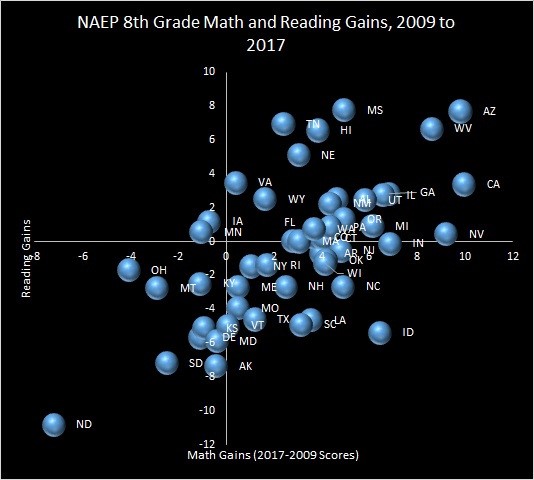
Federal law requires states to have a set of academic standards and to test students against those standards in grades 3-8 and again in high school as a condition of federal funding. About a decade ago, a number of states adopted “Common Core” academic standards and tests, which eventually became quite controversial. As an education reform strategy, both center-right analysts like Erik Hanushek and center-left analysts like Tom Loveless found little prospect for broad improvement in outcomes due to adoption of the standards.
In fact, if we examine eighth-grade trends in scores since 2009, just before many states adopted the standards, to the most recent numbers, the results are decidedly less than meh, although multiple factors always are at play in influencing scores at any given time. While “meh” results square with the Hanushek/Loveless research findings, this does not preclude the possibility of states doing themselves some harm in transitioning to new standards.
Practices eliciting a great deal of controversy for ambiguous benefits don’t tend to endure. The theory of change behind the standards movement seems straightforward: States create (hopefully) an integrated set of academic standards, test students against those standards, make the results transparent to families, and perhaps reward/sanction schools based on them. If in fact it were this straightforward, we would expect to see broad improvement in a variety of academic indicators since the adoption of the strategy in the mid-1990s. But the theory-of-change bucket seems leaky. Meanwhile, much of the public has grown deeply fed up with a culture of test prep in public schools.
Supporters of academic transparency – I include myself in this category – ought to use this opportunity to consider carefully what it is we want from our system of standards and tests, how to minimize unintended consequences, and how to increase the utility of the system to students. Federal law requires states to have them, so why not adopt the best standards that any state has developed?
Massachusetts was a pioneer in the standards movement, creating standards almost a decade before the federal requirement. Massachusetts also adopted several other K-12 reforms simultaneously, so we should exercise caution in concluding that standards and testing led to the state’s improvement. Nevertheless, those standards were widely admired by scholars. Even prominent supporters of the Common Core project judged them superior to the Common Core standards.
Massachusetts has long held the highest scores in all subjects on the National Assessment of Educational Progress. We can’t be certain what they did right, but they seemed to have done something right, and it might be the standards. The reality is that there would be a large amount of overlap in a three-circle Venn diagram between the old Florida standards, the more recent Florida standards, and the old Massachusetts standards. Massachusetts may, however, have succeeded in positively influencing curriculum with its standards, which have been described as “content rich.” Color me skeptical as to whether there is either a Florida, Arizona or even (blasphemy!) Texas way to teach long division, but Massachusetts seemed to do better than others with its old standards, and in fact better than itself after adopting Common Core.
There is no issue of federal nudging or compulsion, real or imagined, at this point. Florida is entirely free to adopt whatever standards it wishes. You won’t find many areas of agreement between me and Diane Ravitch, but I think this qualifies as one: You must have standards, and Massachusetts has developed what appear to be the most useful set. Why settle for less?
My advice, not that you asked for it, is to call up the Bay State and see if anyone there can send over a copy.
Senate education plan: Florida Senate Republicans release their own plan to change the state's education policies. Senators want to start a Family Empowerment Scholarship to reduce the 14,000-student list of low-income students waiting for a Florida Tax Credit Scholarship. Their proposal is similar to Gov. Ron DeSantis' proposed Equal Opportunity Scholarship, but would be available only to students already in public schools. Senators also want to allow principals to reward high-impact teachers who don't qualify for a bonus under the state's bonuses plan, give teachers more time to pass the teacher certification exam, and expand a program that offers grants to schools in low-income communities so they can offer health care, social services and other aid to students. The proposals will be in a single bill that will be introduced the first week of the legislative session, which starts March 5. News Service of Florida. Gradebook. Florida Phoenix. redefinED. Politico Florida. Tallahassee Democrat. WFSU.
School shooting trial: South Florida Circuit Judge Elizabeth Scherer says she wants to start the trial of the accused Marjory Stoneman Douglas High School shooter in January. Nikolas Cruz, 20, is charged with 17 counts of first-degree murder and 17 counts of attempted murder in the mass shooting just over a year ago. If convicted, he faces the death penalty. Sun Sentinel. Associated Press. Miami Herald. WLRN. (more…)
Education proposals get a look: This week, legislators will begin to consider Gov. Ron DeSantis' proposals to rework the educator bonuses program, launch an Equal Opportunity Scholarship to erase a waiting list for state scholarships for low-income students, improve career and vocational education programs, and make adjustments to the Schools of Hope program and to graduation requirements. Since announcing his ideas, DeSantis has followed up with specifics on each. State Rep. Chris Latvala, R-Clearwater, chairman of House PreK-12 Appropriations and vice chair of House Education, says legislators could approve, rewrite, or even kill the ideas. “The governor’s proposals certainly were bold. But just because he put it forth doesn’t mean it’s going to be something we automatically do.” Gradebook.
Search for standards: The Florida Department of Education is asking for input from educators, parents and others as it begins the process of rewriting Florida's version of the Common Core standards. Gov. DeSantis has given Education Commissioner Richard Corcoran a year to set new standards of what Florida K-12 students should learn in math and language arts courses. The state will use the new standards to rework the Florida Standards Assessments tests, and school districts will use the standards to determine their curricula and textbooks. Orlando Sentinel. WFTS. (more…)
Arming teachers: A bill that would broaden the state's 2018 armed guardian law and allow some teachers to carry guns in schools clears the Senate Education Committee in a 5-3 vote along party lines, with Republicans in the majority. Last year's bill specifically prohibited the arming of teachers, but calls grew to change that after the Marjory Stoneman Douglas High School Public Safety Commission recommended arming willing teachers. Senate Bill 7030 also broadens state oversight over districts' compliance with the law's security rules, and would require sheriffs to train teachers in districts that opt in. The bill may get a hearing in the appropriations committee before heading to a Senate floor vote sometime after the Legislature opens March 5. News Service of Florida. GateHouse. Associated Press. Tampa Bay Times. Gradebook. Politico Florida. Tallahassee Democrat. Florida Politics.
Superintendent's contract: Cynthia Saunders is approved as school superintendent in a 3-2 vote by the Manatee County School Board. The contract runs through June 30, 2021, and pays her $196,000 a year. She had been acting as interim superintendent since Diana Greene left last summer. Her ascension was delayed last year when Florida Education Commissioner Pam Stewart accused Saunders of manipulating student data to inflate the district's graduation rate. Saunders is negotiating a settlement with the DOE in which she would neither admit nor deny the charge. Bradenton Herald. Sarasota Herald-Tribune. (more…)
Next for Common Core: The imminent end to the Common Core standards in Florida schools has many state educators and parents worried about what they'll be replaced with, how students will be affected, whether standardized testing will change and how much the change will cost. TCPalm.
DeSantis' busy start: In just a few weeks in office, Gov. Ron DeSantis has proposed eliminating Common Core standards, changing the bonus system for teachers and principals and eliminating the waiting lists for state K-12 scholarship programs. What's next? Gradebook. Tampa Bay Times. Would the proposed bonus system solve Florida's teacher shortage? WFSU. DeSantis' proposal to rework the bonus program for teachers and principals faces several obstacles before it becomes state law. Florida Phoenix.
After the shooting: Nearly a year after the shooting deaths of 17 people at Marjory Stoneman Douglas High School in Parkland, repercussions continue to be felt around the state. School security laws are still being made and updated, and students and parents are continuing their activism. Here's an update of where the key players are and what they're doing today, the memorials to the victims and the potential effects of heightened security in schools. USA Today. Sun Sentinel. Miami Herald. Associated Press. GateHouse. Naples Daily News. Palm Beach Post. Associated Press. WLRN. Education Next. WFTS. (more…)
Arming teachers: A bill is filed in the Florida Senate that would eliminate a clause in state law prohibiting teachers from being armed in classrooms. Other new provisions include a requirement that county sheriffs establish an armed guardians program if asked to by local school boards, and allowing contract employees to serve as guardians. The first hearing for the bill is Feb. 12. It was submitted by the Senate Education Committee, and follows the recommendation of the chairman of the state commission that investigated the shootings at Marjory Stoneman Douglas High School last February. Tampa Bay Times.
Gardiner waitlist: Gov. Ron DeSantis says his budget proposal includes $18.8 million to end the waiting list for students who are trying to get Gardiner scholarships. About 1,800 students are on the list for the program, which provides aid for students with disabilities. About 12,000 students now get the scholarships, and most use them for tuition to private schools. Step Up For Students, which hosts this blog, helps administer the program. News Service of Florida. Orlando Sentinel. Florida Times-Union. Florida Phoenix. redefinED. WKMG. WFTV. WPTV. WBBH. Florida Politics. Daytona Beach News-Journal. WFSU. (more…)
Governor's budget: Gov. Ron DeSantis is proposing a $91.3 billion budget that includes $21.7 billion for the K-12 public school funding formula, with a spending boost of $224 per student. DeSantis wants to allocate $582.8 million for the Bright Futures scholarship program for high-achieving students and use state funds to replace cuts in local school property taxes. He's asking for $500 million for the Best and Brightest teacher bonuses program, and wants to scrap the use of teachers' college entrance exams as a factor in determining bonuses. He's also asking for $99 million for school safety grants for hardening buildings and wants to carry forward the $57 million in unspent money for school guardians from last year. House and Senate committees will review the request as they prepare a final spending plan. News Service of Florida. Associated Press. Orlando Sentinel. Tampa Bay Times and Miami Herald. GateHouse. Politico Florida.
Common Core caution: Much of the reaction to Gov. Ron DeSantis' decision to eliminate the use of Common Core standards in Florida schools has been positive. But the issue isn't as simple as just signing an order, and some educators say it could be years before the state fully eliminates the Common Core standards. "Now you have curriculum materials that will be not aligned, probably, to the new standards,” says Pasco County Superintendent Kurt Browning. “How do teachers teach? ... I think we need to be very, very cautious and careful about how we go about doing this.” WTSP. WTVT. WJAX. Sarasota Herald-Tribune. WLRN.
Common Core: Gov. Ron DeSantis says he will sign an executive order “eliminating Common Core and the vestiges of Common Core” in Florida schools. DeSantis made that promise during his 2018 campaign, saying he had heard complaints from many people about the national academic standards for math and language arts that were adopted in 2010. The state adapted the standards with about 100 changes in 2014 and renamed them the Florida Standards. DeSantis says he's instructed Education Commissioner Richard Corcoran to develop new state curriculum standards over the next year that will then be presented to the 2020 Legislature. News Service of Florida. Associated Press. Orlando Sentinel. Tampa Bay Times. GateHouse. Florida Politics. Politico Florida. Fort Myers News-Press. Orlando Weekly. WFTX. WKMG. Some reaction from parents and educators around the state. WPTV. WCTV. WEAR.
Parents, Runcie meet: Parents of students at Marjory Stoneman Douglas High School unload on Broward Superintendent Robert Runcie at their first face-to-face meeting Thursday. Parents wanted to know why there were no metal detectors at the school, who would respond in the next emergency, how district officials can assure them no student with a gun will get on campus again, and more. Several called on Runcie to resign. Runcie spoke little, and apologized for not meeting with them earlier. The next meeting, with 10th-grade parents, is Monday, followed by meetings with parents of juniors Tuesday and seniors Feb. 11. Sun Sentinel. A Broward County task force reviewing the shootings at Stoneman Douglas reviews a report that urges an upgrade to the county's radio communication system. Sun Sentinel. (more…)

