 Corey DeAngelis, national director of research at the American Federation for Children, recently joined podcast host Andrew Gutmann for an episode of “Take Back Our Schools” on Ricochet, an online platform whose purpose is to spread conservative philosophy through the experience of its members to right-of-center readers.
DeAngelis spoke to Gutmann about legislation being pursued in many states to give parents choice in their children’s education, including education savings accounts, by funding students rather than public schools. DeAngelis gives advice on how to counter teacher union objections to school choice issues and shares his views on what parents can do to join the growing movement to break what he calls the public school monopoly.
Among his points:
To listen to the podcast, click here.
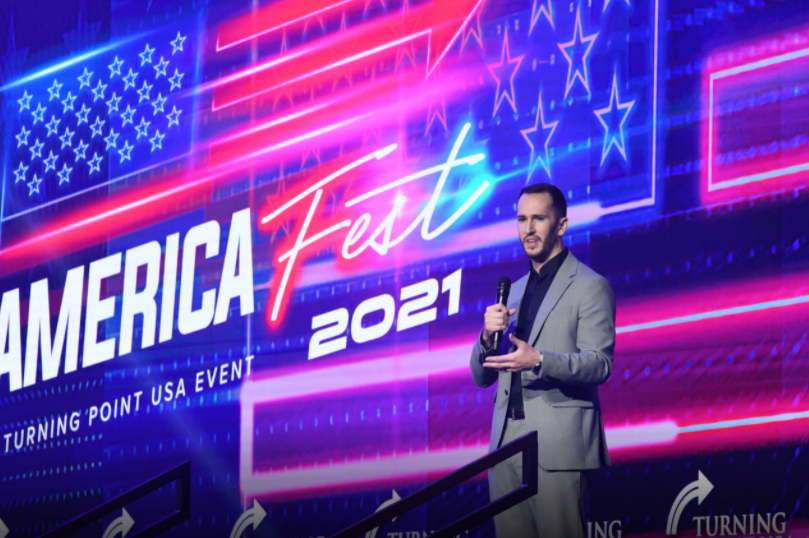 Longtime education choice advocate Corey DeAngelis, national director of research at the American Federation for Children and executive director at the Educational Freedom Institute, continued to champion the rights of families to make education choices for their children recently, speaking on behalf of the American Federation for Children at America Fest in Phoenix.
Here are some excerpts from DeAngelis’ pitch for school choice:
“It’s a great time to be an American. And it’s also a great time to be a school choice advocate. The teachers’ unions have finally overplayed their hand, showed their true colors, and in a way, inadvertently done more to advance the concept of homeschooling, parental rights and educational freedom than anyone could have ever imagined.”
“This year has been the year of school choice, and we’re just getting started. Nineteen states have already expanded or enacted programs to fund students as opposed to systems. Parents have woken up. A way that I would put it is that COVID didn’t break the government school system, it was already broken. And families are never going to forget how powerless they felt in 2020 and they’re going to fight to make sure that they never feel powerless ever again.”
“We already fund students directly when it comes to Pell grants and the GI bill for veterans. The money doesn’t go straight to the community college regardless of your choice. Instead, the money goes to the student, and you can pick the community college if you want, but you can also take that money to a private, religious, or non-religious university. We do the same thing for pre-K programs.”
“Imagine if we forced low-income families to take their food stamp dollars to a government-run provider of groceries. That wouldn’t make any sense. Instead, the money rightfully goes to the families, and they can choose Walmart if they want. We can also take that money to Safeway or Trader Joe’s. The money follows the decision of the family. We do the same thing with Medicaid; we do the same thing with Section 8 housing vouchers. All I’m arguing is that we apply the same logic to K-12 education and fund people, not buildings.”
“Choice is the norm with higher education, pre-K and thankfully, for now, just about everything else in the United States. Choice threatens an entrenched special interest only when it comes to the in-between years of K-12 education. So, they fight as hard as possible against any change to the status quo, and they make up stuff and repeat the same arguments over and over again.”
“School choice doesn’t defund government schools; government schools defund families. School choice initiatives just return the money to the hands of the rightful owners — or at least the intended beneficiaries.”
One of the largest and oldest Lutheran high schools in the nation, Milwaukee Lutheran High School participates in the Milwaukee Parental Choice Program, allowing families who meet the household income requirements to attend at no charge or for significantly reduced tuition.
America’s oldest urban private school choice program has the vital effects of steering young adults away from both crime and out-of-wedlock births, thus laying a strong foundation for them to live more successful lives.
What predicts future life success for young adults from disadvantaged backgrounds? Two vital factors are avoiding a criminal record (see here and here) and an out-of-wedlock birth.
That reality might be one reason why private schools often describe their mission as educating the “whole child,” mind, body and soul. Education should shape the character of students in positive ways. Strong character traits, such as conscientiousness and self-restraint, are especially important for youth growing up in challenged family circumstances. They rarely get second chances.
Given that avoiding a criminal record and refraining from causing a non-marital birth are keys to life success, and private schools may have advantages over public schools in promoting the character traits of their charges, it is shocking that almost no research has been conducted on the effects of private school choice programs on rates of crime and out-of-wedlock births.
Corey A. DeAngelis, director of school choice at the Reason Foundation, and I have set out to fill that gaping hole in our understanding of the potential long-term, life-changing effects of school choice.
Our first foray examined the medium-term effects of the Milwaukee Parental Choice Program (MPCP) on the likelihood of a person being charged with a crime by age 22-25. The MPCP is restricted to low-income families in Milwaukee. We matched more than 1,000 eighth- and ninth-grade students in the MPCP in 2006 with Milwaukee public schools (MPS) students in the same grade, with the same race, gender, English Language Learner status, and similar initial achievement test scores.
Importantly, we also matched the MPCP students with peers from their own neighborhood. Family values and behavioral expectations tend to be similar in urban neighborhoods, so matching students based on where they lived likely helped us control for vital unmeasured factors.
We then searched the public database of all criminal records for the state of Wisconsin as of fall 2015. The searchers were not aware if a given student was in the MPCP group or the MPS group when they looked to see if that study participant had committed a crime in the state. We found that MPCP students who remained in their private school of choice throughout their high school years were significantly less likely to have committed a crime during young adulthood, compared to their matched peers in MPS.
When MPCP students who switched from their private high school to a public school were included in the analysis, however, the effect of the MPCP on reducing crime became less clear. We concluded that students may need a steady “dose” of the character education treatment of private schooling for it to change their life trajectory.
Our initial study was published last year in the peer-reviewed journal Social Science Quarterly.
This year, we returned to the question with more and better data. We also employed more conservative analytic methods, to be even more confident that the selectivity of MPCP students was not biasing our results. In a study published in the peer-reviewed Journal of Private Enterprise, we revisited the same set of MPCP and matched MPS students three years later, when they were 25-28 years old. The additional three years gave the MPCP students more time to distinguish themselves from their MPS peers regarding avoiding criminal behavior.
We also found data on paternity suits in Wisconsin and added that key outcome variable to our study. Finally, we did not separate out students who stayed in the MPCP for their entire high school career from those who switched back to MPS. Thus, we conservatively tested to see if experiencing the private school choice program for any length of time from eighth to twelfth grade affected crime outcomes or non-marital birth rates. In these three ways, our recent study improved upon our original one.
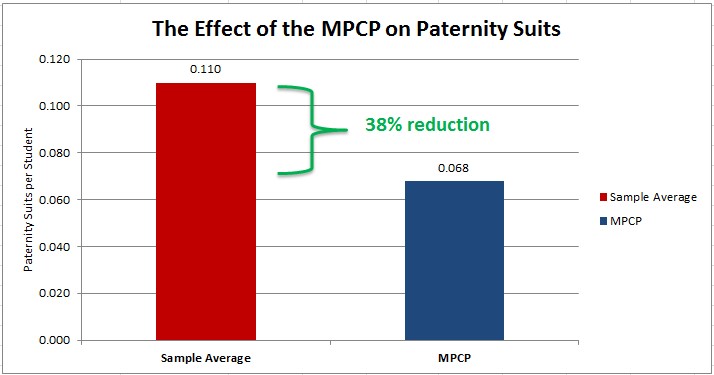
We found that participating in the Milwaukee Parental Choice Program reduced the likelihood of a young adult having a drug conviction by 53%. The MPCP also decreased the chances of a person having a conviction for a property damage crime by an astounding 86%. MPCP alums were 38% less likely than their matched MPS peers to have been named in a paternity suit by age 25-28.
The positive effects of the private school choice program on reducing criminality were larger for males, who commit most crimes, and for participants with lower initial achievement test scores. The benefit of the MPCP in reducing the likelihood of causing a non-marital birth was similar for both males and females, since it takes two to tango.
Our research was not designed to reveal what the private schools in the MPCP did to generate these reductions in crime and out-of-wedlock births. Religion, re-enforcing parental values, and the influence of better-behaved peers all may have played a role. Future research should continue to study those questions.
For now, we can say that America’s oldest urban private school choice program had the vital effects of steering young adults away from both crime and out-of-wedlock births, thus laying a strong foundation for them to live more successful lives.
That’s a big deal.
 “There are more things in heaven and Earth, Horatio, than are dreamt of in a test score analysis …” Shakespeare by way of Ladner
Learning to read proficiently and to understand math are two jolly important goals for our schools. They are by far, however, not the only goals.
Americans want students equipped with the academic knowledge and training for success, but they also aspire to broader types of success in the formation of character – the ability to exercise citizenship responsibly and to function as productive members of society, for instance.
A new study from Patrick Wolf, a professor of education policy at the University of Arkansas, and Corey DeAngelis of the Reason Foundation, published in the Journal of Private Enterprise, tracks long-term outcomes associated with the Milwaukee Parental Choice Program. The MPCP makes low-income students eligible to receive a voucher to attend a private school.
The authors carefully construct a comparison group and analyze the long-term social welfare effects on students who have been offered a voucher after controlling for a variety of student background characteristics. They found that exposure to the MPCP is associated with a reduction of about 53% in drug convictions, 86% in property damage convictions and 38% in paternity suits. Effects tend to be largest for males and students with lower levels of academic achievement at baseline.
So, in addition to academic benefits of the program, including a higher high school graduation rate, MPCP participants also have lower criminal conviction rates and less time in family court. The average MPCP voucher was worth $7,943 in 2018-19 while the average total spending per pupil in the Milwaukee Public Schools was $15,250 in 2017-18.
Just imagine what Milwaukee students might do if they got equitable funding, and if their families could utilize that funding for educational benefits beyond private school tuition. There would almost be enough money left over to pay for the sort of enrichment activities that the top decile American families pay for things like summer camps and tutors.
Researchers at the University of Arkansas have found that math and reading scores for voucher students in Louisiana remained negative in the fourth and final report on the program.
Voucher supporters had remained hopeful that negative results observed over the last several years would disappear. Despite a big first year plummet in test results, voucher students made significant gains in years 2 and 3, but by the third year, the difference between voucher students and their peers in public schools was not statistically significant.
Meanwhile, fourth-year results dipped enough to be considered “statistically significant” by researchers, a term that implies the researchers are certain the results did not occur by pure chance.
One of the researchers said he was “surprised” by the results.
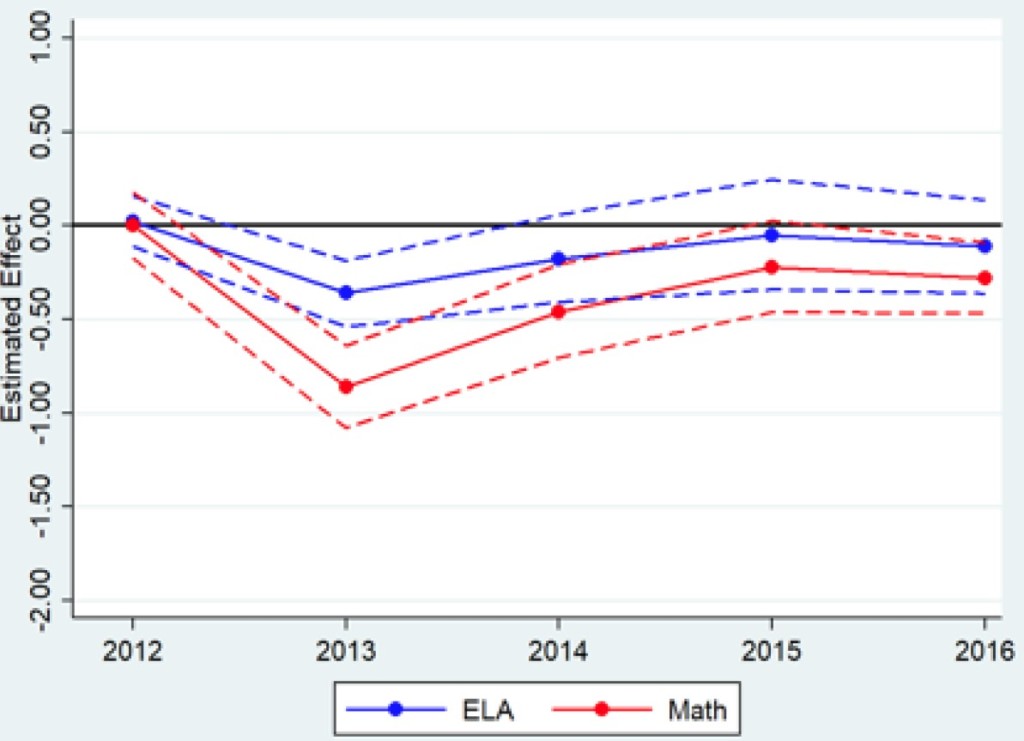
Estimated Local Average Treatment Effects over time for baseline achievement for sample inclusion. Figure presents point estimates from fully specified models for 2011-12 (baseline) through 2015-16 for English language arts and math. Results are presented for a consistent sample of students with Spring 2016 outcome data. English language arts and math results are based on student achievement on the Louisiana state assessments (LAA) in 2011-12 through 2013-14, PARCC assessments in 2014-15, and LAA in 2015-16. Dashed lines represent 90 percent confidence intervals for the performance averages. (The Effects of the Louisiana Scholarship Program on Student Achievement After Four Years, University of Arkansas College of Education and Health Professions)
Despite negative math and reading scores compared to public school counterparts, voucher students were no less likely to enroll in college, the researchers found.
Several points should be taken into consideration when considering the results.
Students on the scholarship program must come from C-, D- or F-rated public schools and must live in households earning at or below 250 percent of the federal poverty level (about $64,000 for a family of four). This doubly disadvantaged group was eligible for a voucher that averaged just $4,925 compared to a per-pupil spending of $8,500 in the study’s baseline year.
Private schools were required to accept all students that applied and were required to administer the state exam in grades 3 through 8 and again in grade 10. Private schools also were required to accept the voucher as the full-tuition amount and were prohibited from charging more. Very few Louisiana private schools participated in the program as a result.
According to the researchers, the severity of regulations may explain why only one-third of private schools in Louisiana have been willing to participate in the voucher program.
A 2013 Fordham Institute study found that certain regulations, such as restrictions on admissions and curriculum testing, negatively impacted a school’s willingness to participate in a voucher program.
Florida’s original voucher, the Opportunity Scholarship, had many of the same strict regulations as the Louisiana voucher when it began in 1999. A Miami Herald survey of 300 private schools in South Florida found only three schools willing to participate in the first year and only 50 in the second year.[1] Statewide, the number of participating schools was just over 100, but only after a $500,000 donation to the Children’s Scholarship Fund to provide grants to participating schools.[2] Today, more than 1,800 private schools participate in the less restrictive Florida Tax Credit Scholarship program.
Corey DeAngelis, a researcher at the Cato Institute in Washington, D.C., believes the limited number of participating private schools in Louisiana also led to a reduction in the number of quality schools participating.
“Evidence suggests it is more likely that the burdensome regulations have unintentionally led to fewer high-quality options for families,” DeAngelis wrote.
Researchers also disproved a claim that the voucher “cream skimmed” the best students. In the Louisiana program, voucher students were far more likely to be black and have lower household incomes and lower test scores in the year prior to accepting the voucher.
[1] De Vise, Daniel. “Voucher Plan Finds Limited Support 24 Private Schools Willing to Commit,” Miami Herald, January 30, 2000.
[2] Hegarty, Steven. “With money and fight, Kirtley pushes for school choice,” St. Petersburg Times, May 21, 2000.
Private schools were less likely to participate in a voucher program with more regulations, according to a recently released study.
Editor’s note: redefinED continues its journey through the archives, reviving on Saturdays interesting posts on various topics that deserve a second look. Throughout March, we’re featuring pieces on school accountability. In today’s post, which originally appeared in October 2018, Step Up For Students’ public affairs manager Patrick Gibbons interprets a study that examined the impact of three potential regulations on a hypothetical voucher program.
Ramping up regulations on a hypothetical school choice voucher program results in fewer private schools opting to participate, and lower quality among those that do, according to a new study released this week.
The study is based on responses from private school leaders in Florida.
“The Effects of Regulations on Private School Choice Program Participation: Experimental Evidence from Florida” is spotlighted in the latest edition of Education Next. It examined the impact of three different potential regulations on a hypothetical voucher program: standardized testing, open-enrollment, and the prohibition of charging tuition beyond the voucher amount.
Researchers Corey A. DeAngelis, Lindsey Burke and Patrick J. Wolf emailed 3,080 private schools in Florida and received 327 completed surveys. Of the responding schools, 57 percent were religious, 70 percent accepted the Florida Tax Credit Scholarship for lower-income students, 65 percent accepted the McKay Scholarship for students with disabilities, and 54 percent accepted the Gardiner Scholarship, an education savings account for students with special needs such as autism and Down syndrome. Step Up For Students helps administer the Florida Tax Credit and Gardiner Scholarships, and publishes this blog.
Schools were randomly assigned to one of four groups, including a control group whose leaders were asked if they’d participate in a hypothetical voucher program worth $6,500 and came with no additional regulations. The other groups were assigned one of the three regulations.
Private schools were 17 percentage points less likely to participate with an open-enrollment requirement, and up to 11 percentage points less likely to participate with a state standardized test requirement. (Standardized testing is required for the Florida Tax Credit Scholarship, but participating schools are allowed by law to choose from a range of state-approved tests beyond the Florida Standards Assessment required for public schools.)
For every $1,000 increase in private school tuition, there was a corresponding decrease of 1.4 percentage point participation when a state standardized testing mandate was offered.
Prohibiting private schools from charging tuition beyond the voucher amount also had a negative effect, but the result was not statistically significant.
All three of these regulations are present in Louisiana’s voucher program, which drew a fair amount of unflattering publicity because of negative, short-term impacts on test results. Some researchers have hypothesized that the regulations may have reduced the number and quality of participating private schools.
A study from the University of Arkansas reveals that students who participated in Milwaukee's voucher program showed a reduced rate of criminal activity
While most studies of private school choice programs have focused on academic outcomes as measured by standardized tests, some recent studies have begun to look at other indicators of success.
The Urban Institute, for example, in a study released earlier this month, found that lower-income, mostly minority students using the Florida Tax Credit Scholarship to attend private schools are up to 43 percent more likely to enroll in four-year colleges than like students in public schools.
Those same students, the study found, are up to 20 percent more likely to earn bachelor’s degrees – and the outcomes are even stronger for students who use the scholarship four or more years.
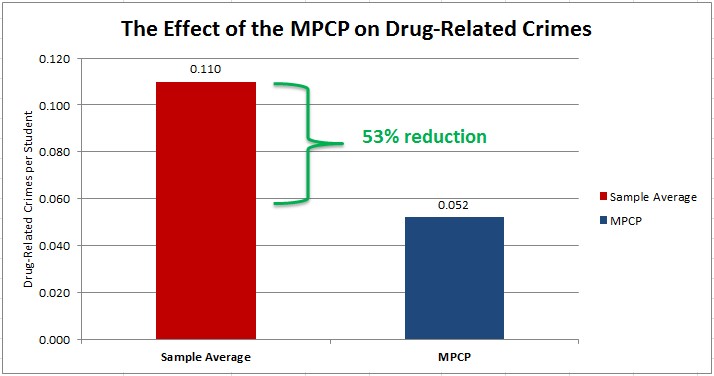
The Effect of the MPCP on Drug-Related Crimes
Now, a new study from the University of Arkansas shows that students who participated in a school voucher program showed a reduced rate of criminal activity as well as lower rates of paternity suits by ages 25 to 28.
The study by Corey A. DeAngelis and Patrick J. Wolf, titled “Private School Choice and
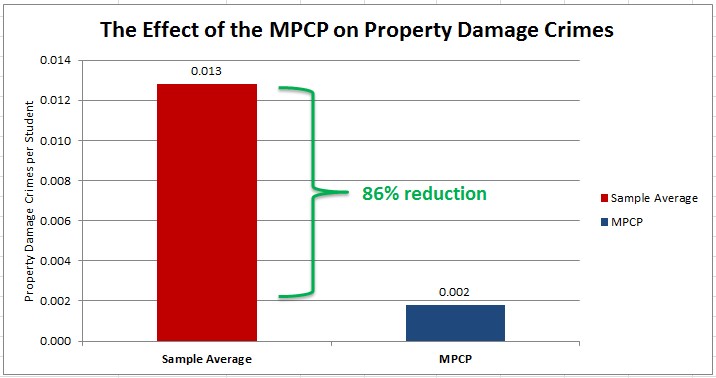
The effect of the MPCP on Property Damage Crimes
Character: More Evidence from Milwaukee,” found that students who were exposed to the Milwaukee Parental Choice Program voucher in grades 8 or 9 experienced an approximately 53 percent reduction in drug convictions, an 86 percent reduction in property damage convictions, and a 38 percent reduction in paternity suits.
The Effect of the MPCP on Paternity Suits
A reduced rate of drug convictions and property damage convictions tend to be greater for males than females. Across the board, positive outcomes are greater for students with lower levels of academic achievement.
The Milwaukee Parental Choice Program is a voucher program for low-income students living in Milwaukee. The voucher, worth up to $8,400 for high school students, helped 28,917 students attend 129 private schools this academic year. Wisconsin’s second, statewide voucher program, which serves another 7,140 students, was not covered in the report.
Private schools were less likely to participate in a voucher program with more regulations, according to a recently released study.
Ramping up regulations on a hypothetical school choice voucher program results in fewer private schools opting to participate, and lower quality among those that do, according to a new study released this week.
The study is based on responses from private school leaders in Florida.
“The Effects of Regulations on Private School Choice Program Participation: Experimental Evidence from Florida” is spotlighted in the latest edition of Education Next. It examined the impact of three different potential regulations on a hypothetical voucher program: standardized testing, open-enrollment, and the prohibition of charging tuition beyond the voucher amount.
Researchers Corey A. DeAngelis, Lindsey Burke and Patrick J. Wolf emailed 3,080 private schools in Florida and received 327 completed surveys. Of the responding schools, 57 percent were religious, 70 percent accepted the Florida Tax Credit Scholarship for lower-income students, 65 percent accepted the McKay Scholarship for students with disabilities, and 54 percent accepted the Gardiner Scholarship, an education savings account for students with special needs such as autism and Down syndrome. Step Up For Students helps administer the Florida Tax Credit and Gardiner Scholarships, and publishes this blog.
Schools were randomly assigned to one of four groups, including a control group whose leaders were asked if they’d participate in a hypothetical voucher program worth $6,500 and came with no additional regulations. The other groups were assigned one of the three regulations.
Private schools were 17 percentage points less likely to participate with an open-enrollment requirement, and up to 11 percentage points less likely to participate with a state standardized test requirement. (Standardized testing is required for the Florida Tax Credit Scholarship, but participating schools are allowed by law to choose from a range of state-approved tests beyond the Florida Standards Assessment required for public schools.)
For every $1,000 increase in private school tuition, there was a corresponding decrease of 1.4 percentage point participation when a state standardized testing mandate was offered.
Prohibiting private schools from charging tuition beyond the voucher amount also had a negative effect, but the result was not statistically significant.
All three of these regulations are present in Louisiana’s voucher program, which drew a fair amount of unflattering publicity because of negative, short-term impacts on test results. Some researchers have hypothesized that the regulations may have reduced the number and quality of participating private schools.
 Mental health services: The mental health provider that determined accused Parkland school shooter Nikolas Cruz shouldn't be Baker Acted in 2016 has been hired by the Florida Consortium of Public Charter Schools to provide mental health services for students at their schools. Henderson Behavioral Health will provide assessments, diagnoses, interventions, treatment and recovery services for students in the 500 state charter schools that belong to the consortium. Henderson has been criticized for recommendation to not hospitalize Cruz after a suicide assessment, and is being sued for wrongful death by the parent of a student who was killed at Marjory Stoneman Douglas High School on Feb. 14. Miami Herald.
Private school safety: Private schools are safer for students than public schools, according to a report published recently in the Journal of School Choice. Researchers Danish Shakeel and Corey DeAngelis say students at private schools were 8 percent more likely to have never experienced physical conflicts, 28 percent more likely to have never experienced another student possessing a weapon on campus, and 13 percent more likely to have never experienced racial tension between students. redefinED.

