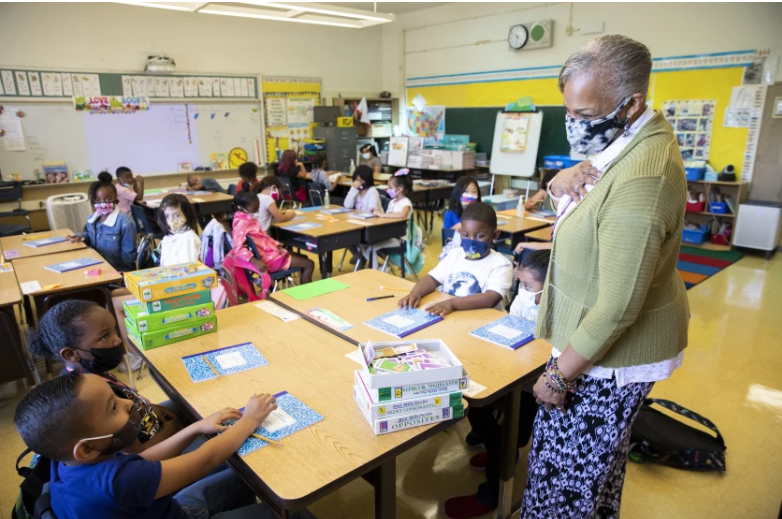
A teacher at an Oakland, California, public school instructs second graders. A poll conducted by the UC Berkeley Institute of Governmental Studies showed in February that confidence in California public schools had declined since the start of the pandemic. A new poll shows parental dissatisfaction in California is greater than that of parents in every other state polled.
Editor’s note: This article appeared Tuesday on the 74million.org.
From their dislike of local teachers’ unions to a lack of confidence in school administrators, California voters are more disillusioned with the state of education than voters nationally, a new poll has found.
Commissioned by the reform-oriented nonprofit, Murmuration, likely California voters who were also parents were much less satisfied with the performance of traditional neighborhood public schools during the pandemic than in every other state polled, including Colorado, Georgia, Indiana, Louisiana, Missouri, Texas, New Jersey, Tennessee, and the District of Columbia.
“Many places in California struggled to get remote learning set up and make it effective. There were also fights with the unions when it came to school reopenings,” said Brian Reich, vice president of communications at Murmuration. “I think that over the course of the pandemic, issues just continued to compound themselves.”
In California, controversy over remote learning and how school reopenings were handled were particularly extreme, Reich said. In San Francisco for example, three school board members were recalled for the first time since 1983 because parents felt the board was prioritizing progressive politics over school reopenings, said Reich.
“Ultimately I think what really frustrated parents was expectations being set and not met and the lack of transparency with decision making,” said Reich. “It felt very much to a lot of parents in California that they were not being listened to by school officials during the pandemic.”
To continue reading, click here.
 Editor’s note: This commentary from Julie Young, managing director of ASU Prep Academy and ASU Prep Digital and a reimaginED guest blogger, appeared Wednesday on The 74.
A story is told about a flood that rose so quickly, a man had to go to the second floor of his home, where he prayed for God to save him. Before long, a neighbor came by in a canoe and yelled to the homeowner, “Come on in. I’ll get you out of here.”
The man answered, “No, I’ll be fine. I have faith God will save me. You go help the other neighbors.”
A little while later, the man had to climb into the attic, where he looked out a window and saw the waters rising further. Just then, a fire department rescue boat arrived and urged the man to let them send up a rescuer to bring him down.
The man yelled out the window, “No, you go on ahead to the other neighbors. I have faith God will save me.”
The waters rose still further, and the man had to go up on the roof. Not long after, a helicopter came by with a rescue worker dangling from a ladder to hoist the man up.
“No, no!” the man said, “I’m going to be fine. God will save me. You go help the other neighbors!”
Soon, the man was swept away in the flood, and he died. When he got to heaven, he was sad, dejected and a little angry. When God asked, “Why the sad face?” the man replied, “I prayed for you to save me, and you didn’t!”
God replied, “I sent you a canoe, a rescue boat, and a helicopter! What more did you expect?!”
The analogy describes the crisis many schools are encountering now as they face a flood of school disruptions, students in quarantine, and a growing number of students being left behind academically. We’ve been given a technological canoe, boat, and helicopter, but we aren’t using them.
In spring of 2020, schools across the nation scrambled to implement the hardware, systems, long-neglected tech infrastructure, software, and online curriculum to serve students in any location. It was the worst possible way to deploy online learning on a national scale, but our nation’s educators had no choice.
Dedicated teachers moved mountains to get resources, however imperfect, into the hands of their students and families. District leaders, committed to their teams, did everything in their power to resource and support their staff.
It was messy and monumentally frustrating, and it was a wake-up call to schools and districts everywhere to systematically design for resilience through digitally supported options and alternative learning models.
How is it possible that now, in the fall of 2021, we are nearly back where we started?
Nationwide, schools are again being forced into rolling closures, not only because of COVID but also because of teacher shortages, compounded further by legislated mandates regarding face-to-face learning. When it comes to tech infrastructure, content solutions, and teacher readiness, schools are leaps and bounds ahead of where they were pre-pandemic.
That’s why it is almost surreal that many schools, facing yet another round of closures, are actually prohibited from leveraging the very infrastructure they built precisely for this purpose.
To continue reading, click here.

