ORLANDO, Fla. — The whiplash of uncertainty has buffeted the nation’s charter school movement during the past five years. First, COVID-19 disrupted learning for millions of students . That was, followed by restrictions on federal grant money. Then came a lawsuit challenging the public status of charter schools.
The leader of the National Alliance of Public Charter Schools empathized as the movement’s annual conference kicked off on Monday.
“Starting, running and teaching at a charter school has never been easy,” the alliance’s CEO Starlee Coleman said during her keynote speech to more than 4,000 charter school representatives. She said plenty of changes lie ahead.
“Some of the changes you’re going to like, and some will be hard.”
But charter school supporters also had plenty to celebrate, including the sector’s growth alongside private school choice, students who outperformed district peers on national tests, and state laws that require charters to receive a share of capital funding. The U.S. Department of Education also infused an additional $60 million into the fund for charter schools, bringing the total to $500 million to support charter school expansion.
Leaders also hailed the opportunities created by the rise of private school education savings accounts, or ESAs, which have skyrocketed in popularity in states that have passed them.
“Choice is working. Choice is here to stay,” said Hanna Skandera, CEO of the Daniels Fund and a former secretary of education in New Mexico. Skandera was one of a four-member panel that discussed the future of charter schools.
Leaders in Texas and Florida discussed how to seize those opportunities by offering a la carte courses to students with ESAs. Florida, where in 2023 lawmakers made all K-12 scholarship programs into ESAs that are universally available and created the Personal Education Program for students not enrolled full-time in a public or private school, has already recruited school districts and charter schools to provide access to part-time classes. The latest to sign on is Charter Schools USA, which announced a collaboration with Step Up For Students earlier this week to expand options for students.
"This is the future, and it's great to see,” said Derrell Bradford, president of 50CAN and who serves on several charter school boards. “These sorts of collaborations are what happen when families are in the driver's seat, and they have real resources to direct the education of their children. I hope more states and providers follow them on the path to educational pluralism."
Texas won’t start offering its ESA program until 2026, but in preparation a coalition of charter school leaders has already started a pilot program for private-pay students at four schools. They offer a la carte classes online and in person, including some after school.
“We think this is an opportunity, not as a threat,” said Raphael Gang, K-12 education director at Stand Together Trust.
The panel advised those considering offering part-time services to capitalize on their strengths when deciding what to offer, start small and educate parents on how to access the programs.
In Florida, where education choice scholarship programs have been in place since 1999, representatives shared the history leading up to the state’s 2023 passage of House Bill 1, which converted all choice scholarships into ESAs and made them available to all K-12 students. That law also established a new ESA, the Personalized Education Program, for students who are not enrolled full-time in a public or private school. PEP allows parents to use $8,000 per student to create a customized education for their children.
“It has been a game-changer,” said Keith Jacobs, assistant director of provider development at Step Up For Students. Jacobs, a former charter school leader, works to recruit and onboard charter schools and school districts as providers of part-time services for ESA students.
Jacobs said school choice used to exist only for families who could afford private school tuition or buy a home in a certain ZIP code, but ESAs have taken choice to a new level.
“We have placed the funds in the hands of the parents,” he said.
What does that look like?
It might be a virtual class in the morning, band at a public school in the afternoon, and a session with a private tutor.
“Or it might be ‘My child needs an AP bio class and the charter school down the street has a good bio teacher,’” he said.
Charter Schools USA Florida Superintendent Dr. Eddie Ruiz said the decision to offer courses to part-time students was easy given the demand for flexibility.
“Charter Schools USA believes in innovation,” Ruiz said. “It’s given parents the flexibility to really design their student’s education.”
He said when he approached his principals about the idea, they wondered how it could be done. Ruiz compared it to Amazon.
“Parents can just pick and choose,” he said. “Whatever it may be, they design their educational experience.”
The implementation will look different for each state based on the laws, but in Florida, approved providers can list their offerings and prices on an online platform, where parents can purchase the services with their ESA funds.
Charter schools set their prices based on local costs, said Adam Emerson, executive director of the Office of School Choice for the Florida Department of Education. In calculating those, leaders should not overlook operational costs, such as putting the students in the school information system.
Emerson said serving ESA families is a financial win for charters, but also the chance to make a positive difference for students in their communities.
“Yes, it’s a revenue stream, but it’s also a calling,” he said.
For the first time last week, I flew home from an education conference with a feeling that recalled Hunter S. Thompson's wistful remembrance of San Francisco in the mid-'60s.
You could strike sparks anywhere. There was a fantastic universal sense that whatever we were doing was right, that we were winning.
Eight years ago, we saw a swirl of sparks in Florida. More families, including those with the most profound needs, were taking learning into their own hands. Educators were trying things I'd never seen before, like schools that used a whole downtown as an extended classroom, or small learning environments that challenged definitions of what school could be.
I could feel a high and beautiful wave building but couldn't quite make out its shape.
Now, its shape is becoming clearer.
All of the country, families, communities and entrepreneurs are devising new ways to educate themselves and each other. Some of the things they’re doing could be called homeschooling. Some of the things they’re building could be called microschools. Most of it defies tidy labels. But much of it was on display in the nation’s capital during the first-ever gathering convened by the Vela Education Fund, a grantmaking effort designed to supercharge this trend.
It was clear this is where the energy is. In most rooms full of people thinking about education these days, there’s a lot of doom and gloom. Learning loss, fiscal cliffs, political turmoil, teacher strife. Talk of depressed and distracted students and whether technology might be to blame. Not here.
The British academic James Tooley told the assembled entrepreneurs he’d been stunned to learn the topic of his life’s work—The Beautiful Tree, a catalogue of privately created learning environments educating the world’s poor—was blooming in the United States. Paraphrasing Abraham Lincoln, he heralded a new birth of freedom, buoyed by the idea of education of the people, for the people, by the people.
Derrell Bradford of 50CAN called them the heroes of Act III of education reform. The movement had emerged after A Nation at Risk, gotten lost in the wilderness during the Obama Administration, fallen into crisis during Covid, and now, thanks to this rebel alliance, stood poised to rise anew.
And Todd Rose, the oracle of individuality, said that each effort to break free of educational conventions lowered “the cost of courage” for everyone who might follow.
I met Floridians who teach science through surfing and skating, a Mississippian offering free-of-charge college counseling, a Texan helping families of color start their homeschooling journeys, and more founders of small schools and school-like learning communities than I could name.
It’s hard not to spend a few days among these people and not succumb to the sense that what they are doing must be right. And they are winning. They’re winning in the 19 states (and counting) that allow parents to direct public education funding to providers of their choice. They’re also winning in the 31 states and District of Columbia that don’t.
It puts our work in perspective. There is a movement all over the country, of educators looking to unleash their passion and creativity to help students, of families looking to control their own child’s education.
The question, now, is how we build systems capable of supporting them.
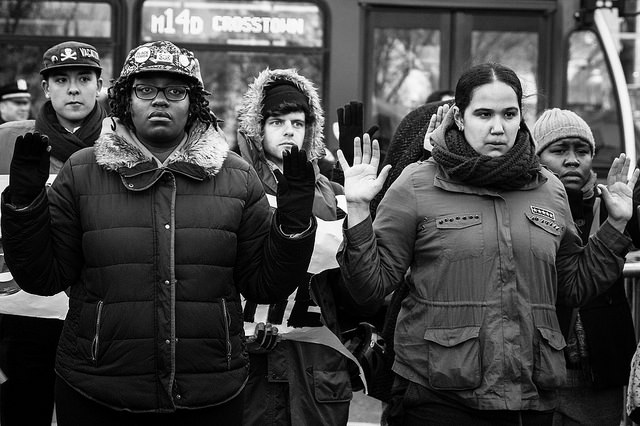
Photo via Graeme Stoker.
The tragedies that drew thousands of people into the streets in cities around the country this past weekend have also prompted soul-searching in the education reform movement.
If our goal is to respond to the educational needs of disadvantaged communities, can we ignore the other injustices in their lives? How can we help transform the institutions that failed Eric Garner, long before he died at the hands of New York City Police?
Derrell Bradford, executive director of the New York Campaign for Achievement Now, wrote this reaction to the non-indictment of the officers responsible for Garner's death, which is worth reading in full:
These children, overwhelmingly black and brown, are financial assets of the highest order. Despite this, they graduate from high school with limited economic possibilities and, very likely, broken souls. And like many other young black men whose God-given potential has been squandered in schools with long histories of underperformance, they act out in a manner that ultimately becomes criminal. Here we find Garner, who despite being described by his minister as a “gentle giant,” was arrested almost 30 times during his life-cut-short, and more than once for selling loose cigarettes. And while he spent nights in local precincts, and other men like him spent nights in prisons, they again gave the city and the state the right to tax on their behalf. This time, however, it was not for his or their own freedom or safety, but for the ostensible freedom and safety of others. According to Pew, in 2010 black men were six times as likely to be incarcerated as white men. In New York City it costs $167,000 a year to keep a person jailed. The average corrections officer with 10 years on the job makes $60,000 annually.

Those days are pretty much over.
To understand the changes that will be brought on by digital learning, think about what's happened in the music industry.
People used to buy all of their music at record stores. Their choices were confined to what the store had in stock. They had to buy entire albums, even if they only wanted one song.
Then came Napster, which allowed people to tailor their music libraries to their individual tastes. It was later replaced by iTunes, which improved the quality of music downloads and developed a business model that was more acceptable to the industry's establishment.
The result was a "vastly more customized and individualized experience," said Derrell Bradford, executive director of the New York Campaign for Achievement Now. He used the analogy Tuesday to introduce a discussion at the American Federation for Children's annual conference about the ways technology can allow students to tailor their education to better fit their needs.
"You have a transformative idea or policy that's introduced into the space and it changes everything forever," he said.
Julia Freeland, a research fellow at the Clayton Christensen Institute, said the goal is to allow students to learn on their own terms, at their own "pace, path, time and place." For that reason, she said, much of the work on digital learning is being done at traditional public schools, which enroll the vast majority of students.
"What we're seeing with the growth of online learning is not full-time virtual schools. It's not kids sitting at home in homeschool environments. It's instead technology being integrated into the classroom," she said. (more…)
Derrell Bradford, executive director of the New Jersey-based Excellent Education for Everyone (E3) and possibly the hippest education reformer in America, told a National Summit audience Tuesday that there are only two ways to get your child in a school: You choose one, or your ZIP code chooses one for you. That formulation is the basis for radical change in this nation’s education landscape, and, on that measure, Florida is more than just host to this educational gathering. Its parents are choosing their child’s school at a rate that makes you stand up and take notice.
Roughly one of every three public schoolchildren in Florida now attend a school other than the one tied to their ZIP code. Take a look at the 2009-10 enrollment numbers associated with a dozen different options and remember that most of them didn't even exist a generation ago. (more…)