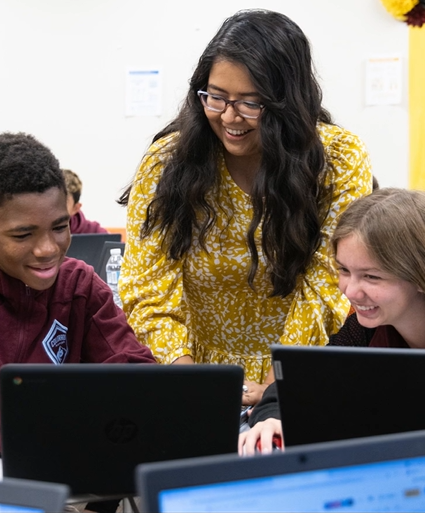
ASU Prep Academy and ASU Prep Digital serves 3,500 students in kindergarten through 12th grade through in-person learning at four Arizona campuses and supports 7,500 K-12 students worldwide through full-time digital education.
Editor’s note: You can listen to Step Up For Students president Doug Tuthill interviewing Julie Young, founder and former CEO of Florida Virtual School who is now deeply engaged with digital education at Arizona State University, here and here.
The nation’s leading education disruptors – proactive individuals who are thinking beyond traditional boundaries – have rallied in recent months around a universal prediction: Families in a post-pandemic world will increasingly be looking for freedom from a once-size-fits-all, single delivery method of education, along with a greater emphasis on blended education, technology, and digital citizenship.
Teachers, many who learned remote instruction on the fly at the start of the pandemic, have taken notice and are upgrading their skills to become more agile as hybrid models become mainstream.
“The choice movement has forced schools to up their game because parents now have so many choices,” said Julie Young, vice president of education outreach and student services for Arizona State University and managing director of ASU Prep Academy and ASU Prep Digital. “If schools don’t meet those students where they are, they have so many options to go elsewhere.”
Young and three members of her staff spoke with reimaginED about their organization’s progress during the past year and discussed emerging trends as the nation continues its transition from pandemic crisis to normalcy.
Bottom line, “normalcy” will look nothing like 2019. Families and educators both are demanding options, which ASU has provided plenty of during the past year. Among ASU’s accomplishments, itemized in a recent video:
Jill Rogier, the organization’s digital head of school, said retention numbers are top of mind for ASU leaders.
“We’re really pleased a lot of parents came to us during the pandemic, and they’re staying or they’re leaving and then coming back,” Rogier said.
The digital school, which began in 2017 as a high school, last year added grades K through 8 in response to pandemic demand. The on-campus and online schools also partner with Arizona State University to offer early college courses.
Additionally, ASU is partnering with parents who want to continue with learning pods, a trend that came on the scene at the height of the pandemic when many campuses across the nation shut down. Rogier received a lot of requests for pods, mainly from parents of students in lower grades, so ASU worked to facilitate a pilot.
“They want that sense of community,” she said. “The parents want to collaborate and get their kids together. It’s really becoming more than just a pilot.”
Hybrid services, where students spend a couple of days each week on campus and a couple of days online, also remain popular, a trend that is expected to continue.
“I think parents don’t want their kids home all the time, but they like them home sometimes,” said Amy McGrath, chief operating officer for ASU Prep and deputy vice president of ASU educational outreach.
Young agreed. “The hybrid model was the one that parents seized upon,” she said. “I think schools are going to lose kids hand over fist if they don’t have strong hybrid models to offer their families.”
As blended education becomes the norm, a K-20 model that includes college will be the wave of the future, the team agrees. ASU is working with Arizona State to incorporate the college experience by allowing high school students to spend a few days a week taking college classes on the university campus as well as offering on-demand courses for college credit.
“We’re hoping to be a rival of AP,” Young said.
Another trend Young identified is the infusion of digital citizenship in all instruction.
“What we’re seeing in schools in terms of misuse and poor behavior with technology and cybersecurity, I think it’s very much top of mind, she said.
The demand for services has come not only from families. Teachers are also recognizing the need to upskill as blended learning becomes more mainstream.
“The demand level has been pretty intense,” McGrath said. “Immediately, we had 800 teachers that heard about it through the Department of Education’s announcement. We set up a landing page and we kept getting hit over and over with teachers saying, ‘We need help.’”
ASU opened evening and weekend workshops to meet the demand.
“We don’t even really have to market,” McGrath said. “Teachers are just spreading the word.”
ASU is now bringing in alums of the program to do the training.
“We’re trying to take ourselves out of it and be a rich place for teachers to share learning and best practices,” she said. “It’s continued to be very dense and robust, and we’ve got some really great stories about teachers who have felt invigorated again.”
One trend that ASU Digital Prep school leaders hope doesn’t last is the tendency for some educators and administrators to sort themselves into tribes that advocate all-or-nothing approaches to education, with one side pushing all in-person instruction and the other all digital.
“They’re risking alienating parents in the long run,” said Kay Johnson, director of strategic communication for ASU Prep Digital. “We as education leaders and innovators need to push people to stop ‘either this or that’ and adopt ‘both-and’ ways of thinking and how we can have a win-win, because we can.
“One size does not fit all.”
Company officials are questioning the state's accountability framework for virtual providers.
Florida’s public school accountability system could be on the verge of snaring one of the nation’s largest online education providers.
K12 Inc. is expected to get an initial “incomplete” when letter grades for Florida public school are released this month. But it’s still possible the final grade, whenever it is released, could be unflattering – with serious consequences for K12’s operation in Florida.
The state awarded K12 a D last year, and the company’s appeal was stymied in part because of data conflicts with school districts. If the company receives a D or an F in the next three years, it could be forced to sever its ties with nearly 50 school districts, its five virtual charter schools, and new virtual charters expected to open next year.
That would be the first time a digital learning provider faces that penalty since lawmakers first created a new system of "approved providers" and district-managed virtual instruction programs.
Representatives for K12 and the schools it helps manage in Florida say it's hard to predict what its grade will be, or whether it will receive one for the current school year. The main reason, the company says, is that it has struggled to obtain student information from the districts where it operates virtual instruction programs.
But company officials are also questioning the state's accountability framework for virtual providers, which grades those providers based on combined results for independently run virtual charter schools and school district programs, over which they have less control.
The state Department of Education has indicated it would give the company a grade of incomplete, at least for now, while officials try to sort out issues with data reported by 17 districts that have contracted with K12. It is not clear when a final grade may be out.
To understand K12’s situation, a little history is in order.
Florida’s virtual education system took a turn in 2008, when a new law required school districts to create new virtual instruction programs. The revised law allowed districts to supplement local virtual programs by hiring outside providers like K12, which currently contracts with 48 districts. It also required districts to offer at least three different options, which often included locally run franchises of Florida Virtual School, the state’s publicly run provider.
In 2011, Florida law authorized virtual charter schools. Their boards can hire companies like K12, or other state-approved providers, to manage their schools.
Under the current grading system, the state can issue grades to virtual charters. It also issues grades to providers, which for grading purposes combine their virtual charters and district instruction programs together. (more…)

Julie Young
Julie Young announced earlier this year that she would be stepping down as the head of Florida Virtual School, after more than 30 years in public education. Her announcement reverberated in education circles around the country, where she was recognized as a pioneer in her field and the "godmother of digital learning."
I sat down to talk with her about the early days of virtual education, the lessons she learned while it grew, and what the future might hold both for digital learning as a whole and for the institution she led for 17 years. The interview formed the basis of my profile of Young, which was published on redefinED Monday.
So the first thing I’m wondering is, why now?
I started thinking about it about a year and half ago. I started hinting to the team about a year and a half ago ... I just had something inside of me going, ‘Ok, we’ve done this. It’s in a really good place, and together this team has had the opportunity to have a huge impact on the field of education, and really the world of learning, and now what?’ I was asking myself the same questions and just feeling like there was something I wanted to do, and didn’t know what it was.
I’m really the type of person that when I’m in the middle of something, I’m all in. And so even thinking about it, for me, felt like blasphemy. I didn’t feel like I could explore other opportunities. I didn’t feel like it was the right thing to be thinking that while I was still totally engaged as CEO.
Looking out across the education landscape in Florida, there’s a lot of things that were maybe tried out 15 or 20 years ago that are now reaching maturity. What do you see in the virtual realm that are these signs of maturity – where FLVS can kind of grow on its own?
When we started, virtual education was this thing over here that was, I think, in many respects, to be feared by many. Intriguing to the business community, very intriguing to parents, but feared by the education community. When I look at it now, and I think about where we are, and I see that the school districts have their franchises and they’ve embraced virtual learning for their students – whether they’re using us to provide that or whether they’re using their own programs – to me really indicates that very soon, it’s going to be ubiquitous. Very soon, we’re not going to be asking kids, ‘Are you taking a course online?’ It’s just going to be, ‘I’m taking English,’ and people aren’t going to be paying attention to whether it’s English online or English in the classroom. And we’re there at the post-secondary level.
In addition, I think that the onset and the acceptance of the full-time virtual programs and the proliferation of those have really given students and families that additional opportunity, beyond Florida Virtual School, or within Florida Virtual School, to get a diploma.
I think you reach a point where there’s no turning back, and I think that we’re there. I think it’s going to look different every year. … Our student base – the students we serve – (is) potentially shrinking, and the district’s service (is) potentially growing, which really indicates that it’s permeating the status quo, so that we don’t have to do it all by ourselves. But we should look for the total population of virtual education in the state of Florida to be growing. And I think what Florida Virtual School’s value and niche going forward is and should continue to be is that we will continue to look for new ways to deliver virtual education, where we can work with students to determine, what’s the next thing? What’s the next learning opportunity that we haven’t thought of yet? We’ll be able to then move those ideas out into the masses as well. (more…)
Virtual schools. The Tampa Tribune writes up legislative changes to digital education.
 Charter schools. Several new charters in Jacksonville are moving into old buildings. Florida Times Union. Charter school enrollment in Pinellas is projected to climb 28 percent this fall. Tampa Bay Times (reprise of an earlier Gradebook blog post).
Magnet schools. Applications are still being taken for all of Hillsborough's magnet programs except IB. Gradebook.
Career academies. Summer means internships for many of those enrolled in Brevard's business academies. Florida Today.
Low-performing schools. Five of Pinellas' toughest schools hope to begin getting traction this summer. Tampa Tribune. A former student at struggling Lacoochee Elementary in Pasco is now the principal. Tampa Bay Times.
Dual enrollment. Another story on the financial hit to districts from the Legislature's decision to shift dual enrollment costs to them. TCPalm.com.
Teacher evaluations. Not a single teacher in the Palm Beach County School District is rated below effective. South Florida Sun Sentinel.
Teachers. A band teacher's departure from Lake County for a higher-paying gig at a charter in Connecticut is a sign teachers will "seek communities where teachers are respected and education is a priority, and that description doesn't fit either Lake County or Florida." Lauren Ritchie. (more…)
 Charter schools. Tampa Bay Times columnist John Romano uses the specter of for-profit charter schools to slam state lawmakers who support parent trigger: "They say tomato, I say morons." Times columnist Bill Maxwell, meanwhile, highlights the success of Urban Prep Academies, a high-performing, all-male, all-black charter school in Chicago where, for four years in a row, every graduate was accepted into a four-year college.
The Palm Beach Post looks at lawmakers with charter school ties. The Lake Wales Charter School system is considering adding a second middle school, with the waiting list for the existing one at 360 and growing, reports the Winter Haven News Chief. The Athenian Academy charter in New Port Richey and the Pasco school district are clashing over whether the school has the right to expand, reports the Tampa Bay Times. A charter school in Miami Shores is getting better at private fundraising, reports the Miami Herald. The state's charter school appeals commission recommends approval of a proposed Orange Park charter school twice rejected by the Clay County School Board, reports the Florida Times Union. Lawmakers should limit charter school to districts with failing schools, editorializes the St. Augustine Record.
School choice lotteries. A lot of parents in Palm Beach County are about to get bad news: They did not get their children into the district school choice they wanted. According to the Palm Beach Post, "At more than half of the choice programs, less than 1 in 3 students that applied got a seat. At four of the 185 choice programs, fewer than 1 in 10 students won a seat."
Vouchers. The League of Women Voters asks if McKay vouchers and tax credit scholarships are constitutional in a Gainesville Sun op-ed.
Parent trigger. Former Board of Education member Julia Johnson responds to critics in this op-ed in the Tallahassee Democrat: "I don’t understand what a critic of parent empowerment meant when she recently wrote that it would use parents like “cheap napkins.’’ But I do know that low-income kids were used as a cheap paycheck and their schools were oftentimes used as a training ground for novice teachers and a depository for ineffective ones." The Tampa Tribune writes up the debate. Pensascola News Journal columnist Shannon Nickinson doesn't like it: "How about the state fulfilling its obligation to the public education system, rather than working to pass off that responsibility under the guise of “parental choice.”
Virtual schools. The Miami Herald writes up the bills that will expand digital education. (more…)
Tax credit scholarships. Tampa Bay Times columnist Robyn Blumner doesn't like U.S. Sen. Marco Rubio's proposal for federal scholarships.
 Charter schools. Tampa Bay Times columnist John Romano bemoans the number of charter schools that close because of low enrollment (but curiously doesn't mention traditional public schools that don't get closed despite the same problem). The Cape Coral City Council will consider a resolution asking the Lee County School Board to share capital funding with the city's charter schools, reports the Cape Coral Daily Breeze. More from the Fort Myers News Press.
Virtual schools. Expanding digital education is a top issue in the coming legislative session. The Florida Current.
Jeb Bush. In education, "he has a record of making messes," the Palm Beach Post editorializes (just days after two more credible, independent reports find Florida students leading the country in progress).
Parental engagement. Duval Superintendent Nikolai Vitti wants to import a Parents Academy program similar to one he worked with in Miami-Dade. Florida Times Union.
Education leadership. The Sarasota Herald-Tribune profiles Sen. Bill Galvano, R-Bradenton, the chair of the Senate Education Appropriations Subcommittee.
Teacher evaluations. The first year of statewide teacher evaluation data using the complicated the VAM formula shows the big difference in progress for students with the highest-rated teachers versus the lowest-rated teachers. StateImpact Florida.
Teacher testimony. Megan Allen, Florida's 2010 Teacher of the Year, testifies movingly before Congress about the impact that budget cuts will have on high-needs students. Answer Sheet. (more…)
Private schools. What happens to private school records when private schools close? Sometimes, they disappear. Palm Beach Post.
Charter schools. The Broward school district is taking a closer look at how much it charges charter schools for bus transportation after a citizens task force complains the district is losing money on the deal and subsidizing the competition. Miami Herald. (The district is considering other ways to reduce busing costs, too, reports the South Florida Sun Sentinel.) A K-8 charter school that teaches boys and girls separately is proposed for Palm Beach Gardens, reports the Palm Beach Post.
School choice. The Palm Beach district gets 17,500 applications for about 9,000 district choice seats. Palm Beach Post.
Digital education. Florida's mandates on digital offerings brings opportunities and challenges, editorializes the Palm Beach Post.
Privatization. The Volusia school district is right to consider outsourcing custodial services to save money, editorializes the Daytona Beach News Journal. The move could save about $5 million a year, the News Journal reports.
Florida's progress. Matt Di Carlo at the Shanker Blog: "Again, Governor Bush and supporters of his reforms have some solid evidence to draw upon when advocating for the Florida reforms, particularly the grade-based accountability system. The modest estimated effects in these high-quality analyses are not as good a talking point as the “we quadrupled the number of A-rated schools in six years” argument, but they are far preferable to claiming credit for what’s on the scoreboard after having changed the rules of the game."
Pace of change. Sweeping changes to teacher evaluations, academic standards and testing have district officials on edge and lawmakers considering changes. Tallahassee Democrat. (more…)
Rick Scott's proposed budget. Includes $1.2 billion more for public schools. Coverage from South Florida Sun Sentinel, Gainesville Sun, Fort Myers News Press, TCPalm.com, Associated Press, Pensacola News Journal. "A relief to educators," reports the Lakeland Ledger.
Digital education. Jeb Bush on CNN's Schools of Thought Blog: "Digital learning is just one important element of the overall school choice movement being celebrated during National School Choice week – and rightfully so. There is no silver bullet. There is no one-size-fits-all option. There can and must be only a proliferation of ever-growing options so that students and parents can embrace whatever educational scenario is best for them."
Exposed, day two! The Tampa Bay Times plugs the Jeb-Bush-corporate-connections-conspiracy "story" by offering a link from the front of its web site to The Buzz, which channels the "news" from, of all places, The Answer Sheet blog, which The Buzz curiously describes as merely "the Washington Post's education blog."
PTA activism award. The Florida chapter is honored for successfully defeating parent trigger legislation last year. Gradebook.
School spending. The Brevard school board considers a bus fee for students in choice programs. Florida Today.
Teacher pay raises. A constitutional amendment for that is a bad idea. Palm Beach Post.
ESE changes in Hillsborough. Latest from Tampa Bay Times and Tampa Tribune.
Concordant scores. They're out now. Tampa Bay Times.
PARCC. StateImpact Florida relays a DOE overview of the coming tests.
Superintendents. Manatee adds a sixth candidate, reports the Bradenton Herald and Sarasota Herald Tribune. Whoever he or she ultimately is "must have the skill set, character and strength to bring this district back from disaster," editorializes the Bradenton Herald.
Race to the Top. Florida is back on track a year after federal education officials warned it for falling behind on grant-funded projects. Associated Press.
Editor's note: For those new to redefinED, "blog stars" is our occasional roundup of good stuff from other education blogs.
Jay P. Greene's Blog: The Way of the Future: Coursera
Watch this video from start to finish from Coursera co-founder Daphne Koller as in right now:
I’m calling it- I think that we’ve passed Clayton Christensen’s inflection point where the disruptive technology (online learning) is better than the dominant technology (traditional universities). The required mastery element that Koller describes in the video seals the deal by itself. I’m willing to bet that it is simply a matter of performing high quality evaluations and getting the results for documentation.
Second while most of the commentary on these developments naturally focuses on higher education, which is in for a major disruption, we need to start thinking about the implications of these developments for K-12. Coursera courses are available for free to anyone. K-12 students can take these courses, and other courses suited to various educational levels will certainly be developed. Full post here.
Jay Mathews' Class Struggle: Let charters bloom. Let teachers be creative.
Petrazzuolo says if a charter doesn’t offer innovative programs, that is one reason not to approve it. ... Successful charters have exposed the weakness of that argument.
When the KIPP DC: KEY Academy began in a Southeast Washington church basement in 2001, it offered a standard curriculum of math, science, English and social studies, plus two hours a day of homework and strict discipline, very old school. Before long, despite the lack of innovation, its students were performing far above the level of their neighbors in regular D.C. public schools.
What is the secret for success? The best charters and regular schools are careful about whom they pick to supervise and teach. Most schools say they have the best principals and instructors. They say they give them strong support. The best schools actually do that. Full post here. (more…)
 Florida: The Seminole County School District, one of the state's biggest, offers more online classes and other educational options to compete with private and charter schools and home schooling (Orlando Sentinel). Meanwhile, another large district receives 36 applications for new charter schools (Palm Beach Post).
Tennessee: Gov. Bill Haslam says questions remain on a voucher proposal that's expected to get legislative attention next year (Nashville Public Radio). State education officials and the Nashville school board are in a standoff over a proposed charter school that wants to open in an affluent part of the city (Education Week).
Louisiana: In the wake of the new voucher program, state education officials will consider tightening rules for the establishment of new private schools. (New Orleans Times Picayune) Expanded online learning options give Louisiana students a chance to graduate early or catch up on credits. (The Advocate)
Washington: The state PTA opposes the charter school initiative on the November ballot. (The News Tribune)
Texas: Some charter school supporters oppose a state education funding lawsuit that suggests state resources are inadequate. (Austin American Statesman)
Indiana: Between vouchers and charter schools, northwest Indiana parents have more school choices than ever before. (Post Tribune) (more…)

