Editor's note: For those new to redefinED, "blog stars" is our occasional compilation of good stuff from other ed blogs (with a newspaper op-ed thrown in now and then, too).
 Huffington Post: In search of the elusive, reform-minded school board member
What most people don't understand is that managing failure is just as hard as managing success. And this is, I believe, part of the reason school boards don't improve schools. Stability and coherence are watchwords in both the high-achieving and low-achieving systems. Administrators want to keep their staff happy and their board at arm's length. In both successful and failing districts, "micromanaging" by the school board is considered a no-no. I recall a woman addressing our board not along ago. "We're not supposed to rock the boat," she said. "But the trouble is that the boat has tipped over and we're lashed to our seats." Rocking the boat is exactly what must be done to effect change -- change, one hopes, that leads to better student outcomes.
I spent most of the last 10 years, on and off the board, pushing for a rigorous curriculum, stopping the disproportionate disciplining of African-American students, and complaining about the over-identification of special ed students (almost a quarter of our student body). But, for the most part, no matter what I proposed -- a new bus route, a paint job for the flag pole, or a curriculum -- I was mostly ignored. In order to get a pile of old lumber and rusty nails removed from the edge of a playground I had to threaten to dump it in the superintendent's driveway! Full post here.
Dropout Nation: The NAACP should listen to Romney (and Obama) on school choice
By embracing an education traditionalist thinking and Zip Code Education, the NAACP is aiding and abetting the damage to black children that it is supposed to defend. By taking money from NEA and AFT affiliates (including the $16,200 picked up by its New York branch from the AFT’s Big Apple unit during the union’s 2010-2011 fiscal year), the association is also betraying its obligations as a civil rights group to oppose policies that promote the same denials of equal educational opportunities against which it supposedly fights. In the process, the NAACP refuses to be a much-needed public policy voice and activist on behalf of transforming a failed system, alienating the very school reformers and black families (especially in urban communities) who are looking to build schools that black children (and all kids) deserve. And by adhering to the thinking of aging members who have a vested interest in maintaining failed ideas about how schools should serve black children, the NAACP has also lost opportunities to gain support from a new generation of African-Americans who realize that education is the most-important key to achieving social and economic equality.
When both Romney and Obama share common cause on systemic reform and on expanding choice, it is clear that the NAACP is on the wrong side of history. Now it is time for it to do the right thing. Full post here. (more…)
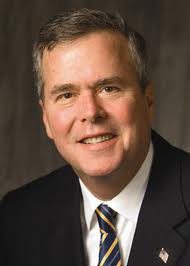
Jeb Bush
With the creation of The Jetsons in the 1960s, Hanna-Barbera projected what 100 years into the future could look like. Set in 2062, The Jetsons lived in an automated, push-button world. Long distance conversations took place face to face through a television screen, groceries were ordered on-line and delivered to your doorstep, and household chores are performed with the click of a button. What Hanna-Barbera missed was the time horizon. It wouldn’t take 100 years for these changes to occur, it would happen in half of that time.
Little did they know, at the beginning of the 21st century soldiers across the ocean would be able to read their kids a bedtime story via Skype or Facetime. Questions would be answered with a simple Google search. Music would be downloaded straight to your phone with the click of a button. And kids in rural Nebraska would learn physics from engineers in Japan without leaving their 11th grade classroom.
Most schools around the nation operate the same way today as they did a century ago. They have the same schedule, the same classrooms, the same grade levels, the same teachers, and the same courses. With the ring of a bell, students move to the next subject, and the cycle starts all over again.
What if we were to channel our inner Hanna-Barbera, and visualize what public education should look like in the digital age?
I submit we would have an education system focused on student learning. No arbitrary schedules or seat-time requirements. Just learning. Each student at his or her own pace, according to their learning style.
Interactive and adaptive learning technologies can allow students to learn in their own style and at their own pace. This means no student gets bored and no student gets left behind. Teachers are no longer forced to use textbooks that become outdated the moment they leave the printer.
Digital learning can provide real-time data so teachers can differentiate instruction with laser-like precision. Data brings a level of efficiency to both teaching and learning that will improve both the experience of education as well as the outcome.
Imagine with me an education system where a student’s homework is listening to their teacher’s lecture, and class time is spent working through the military genius of Napoleon by using the latest GPS mapping software.
Or it might be a 10th-grader in his backyard, at the picnic table, diving into his chemistry lesson via his mobile tablet. He gets so caught up in what he is learning that two hours go by before he even looks up.
It could be a fifth-grader whose classroom consists of students from several grade levels engaging in an interactive learning environment where grammar skills and concepts are practiced through gaming. After providing an overview lesson on sentence structure and basic concepts, her teacher works with each student individually, based on their specific needs.
This modernized education system cares less about HOW she learns sentence structure as long as she learns it. (more…)
Editor's note: In our third installment of "blog stars," we're shifting course slightly. We'll continue to highlight posts from ed blogs. But if we stumble on a thoughtful newspaper column now and then, we'll throw that in the mix, too.
Rick Hess Straight Up: The Culture of 'Can't' in American Schools
 When it comes to reforming our nation's public schools, we hear a lot about what educational leaders can't do. Contracts, laws, and regulations assuredly handcuff school and system leaders. But the ardent drumbeat for "reform" has obscured the fact that school and system leaders can actually do much that they often complain they can't, if they have the persistence, knowledge, ingenuity, and motivation. In truth, it's tough to know how much blame should be apportioned to contracts and laws and how much to timid school boards and leaders who prize consensus and stakeholder buy-in ...
The problem is that in selecting, training, socializing, and rewarding leaders, we do not equip or encourage them to lead. Traditional educational leadership counsels tell leaders that they should rely wholly on coaching and consensus -- while placidly accepting contractual, bureaucratic, or policy barriers. Meanwhile, would-be reformers divert attention from lethargic leadership by rushing to blame "the union." Full post here.
Hartford Courant: A Eulogy For New London's St. Mary's School
That the school hung on until 2012 may be a minor miracle. The nuns are gone, but like other Catholic schools it managed to attract talented lay teachers willing to work for less than they would make at a public school. I chatted with the church's pastor, the Rev. Robert Washabaugh, who said a foundation called The Compass Fund has been a godsend to the school, helping many youngsters from low-income families — the traditional constituency of Catholic schools — make the $2,600 tuition. Alas, the recession caused the fund to cut back on its support.
What is particularly sad is that the school had come up with a good pedagogical plan. The school's 115 students today are 60 percent Latino, 30 percent African American and 10 percent Caucasian. Last year the school developed a dual language initiative, a plan that would make it the first Catholic school in the state to teach classes in English and Spanish. It was an excellent idea for 21st century America; sadly, the fiscal realities stopped it barely out of the gate.
In New London, where the public schools have struggled, St. Mary's was a great option for many families. At the risk of offending my friends at the ACLU, a situation such as this cries out for school vouchers. Religion and ethics aren't the worst problems these kids face. Full column here. (more…)

