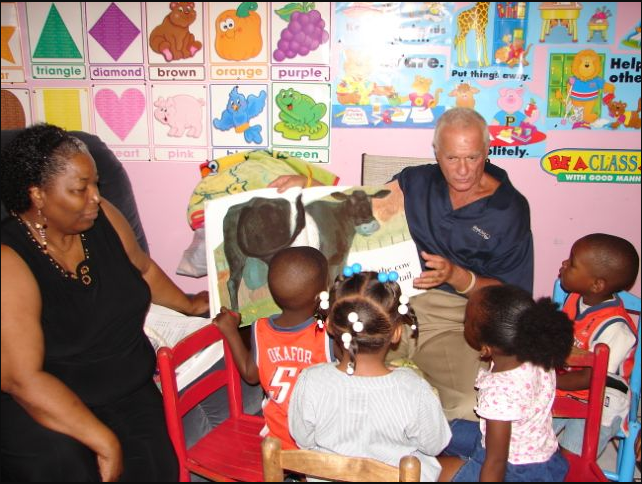
Orlando hotelier and philanthropist Harris Rosen, pictured here at one of the 10 preschool programs his foundation funds, saw a need to improve educational outcomes for young children in an impoverished area of his community.
A public school district in the Hoosier State that is seeking to expand education opportunities to its youngest learners has drawn inspiration from a privately funded program in Florida that has changed its community for the better.
Fort Wayne Community Schools recently sent a team of six to visit the Tangelo Park Program in Orlando, Florida. Created in 1993 by hotelier and philanthropist Harris Rosen, the program offers free preschool for children ages 2 through 4 living in the Tangelo Park area. It is funded through Rosen’s nonprofit organization, Rosen Foundation.
The nonprofit also provides resources for parents and full scholarships to college or vocational school to all of the area’s high school graduates.
Fort Wayne Superintendent Mark Daniel described the Orlando program as delivering “unbelievable results” during a recent school board meeting, according to the Fort Wayne Journal Gazette.
Before the program began, Tangelo Park, a community near International Drive in the shadow of the area’s theme parks and resorts, was plagued by overt drug dealing and use, poor school attendance, declining test scores and dropout rates of about 25%. Most of neighborhood’s 2,500 residents came from low socioeconomic backgrounds.
Rosen, who owns eight hotels and resorts in the Orlando area, was looking for a way to give back to his community when an Orange County commissioner told him about Tangelo Park. He began meeting with community groups whose members were also seeking to improve the neighborhood.
The result was the three-fold program that includes free, mostly home-based preschools for small groups of children as well a resource center that offered training to parents, along with the scholarship program that covers tuition, fees, textbooks, and housing for neighborhood students who earn high school diplomas and go on to college or vocational school.
The program also allows middle and high school students access to resources that aid in navigating public schools and college admissions.
Since its inception, Rosen has donated more than $12 million to the program, which also has received support from many Orlando groups including the Orlando Magic and the Edyth Bush Charitable Foundation.
As a result of those investments and the work of community partners such as the Tangelo Park YMCA, Tangelo Park Elementary School, Tangelo Baptist Church and the Tangelo Park Civic Association, Tangelo Park experienced a dramatic turnaround.
Today, virtually 100% of the Tangelo students graduate with a regular diploma – 98% since the program’s inception. Grade point averages have steadily increased and are predicted to exceed 3.0 in the coming years. The program has produced more than 160 college graduates since it began.
Property values have risen from an average of $45,000 to $150,000. Rosen’s program also has made the neighborhood desirable to parents who want the educational benefits for their children.
In 2010, University of Western Ontario economics professor Lance Lochner conducted a study on the program and determined that crime had been reduced by 63% and drug dealing has been essentially eradiated. He calculated that every dollar invested by the Rosen Foundation in Tangelo Park results in a return of $7 to society.
“We have a lot of students who grew up in the community, and they’re returning,” said JuaNita Reed, a retired guidance counselor at Dr. Phillips High School, who now oversees the college scholarship program for the Rosen Foundation. “They now have families, and they want their families to take advantage of this program.”
(You can listen to a podcast featuring Rosen, Reed and program statistics coordinator Chuck Dziuban of the foundation here.)
Rosen says the foundation has become more of a safety net as more students excel in school and earn scholarships on their own. He has begun encouraging other communities to replicate the program, which was expanded in 2017 to the Parramore community near downtown Orlando.
For Fort Wayne, the biggest challenge will be funding. The U.S. Census Bureau estimates Fort Wayne has more than 18,000 children younger than 5. With 908 students, the school system has the largest pre-K class statewide this academic year.
The Hoosier State relies on federal Title I funds which are limited to schools that serve children living in high poverty areas, as well On My Way Pre-K, a state program for students who meet income guidelines. But Stockman said the money is designed to help students attend established programs, not start new ones.
The district also offers preschool at two magnet schools, a Montessori school and an early childhood center, and funds those programs through the district budget. Officials say access to those programs is limited.
Fort Wayne officials hope to find their community’s own version of Harris Rosen.
“We are identifying and meeting with potential partners, including neighborhood associations,” district spokeswoman Krista Stockman said.
The following bill has been filed for the 2022 Florida legislative session, which begins Jan. 11 and runs through March 11.
BILL NO: HB 911
TITLE: Early Learning Scholarship Program
SPONSOR: Rep. Rick Roth, R — Palm Beach Gardens
WHAT IT WOULD DO: Allow children who are or were in foster or out-of-home care who have not yet begun kindergarten or turned 6 years old to receive scholarships to attend early learning programs through eligible providers. The scholarship covers the total cost of the private providers' pay rate or the difference between a child’s school readiness voucher and the providers pay rate subject to appropriation.
For more information, click here.
 Presidents should resist the urge to rewrite the dictionary. Such powers are not in the Constitution. Yet, President Joe Biden seems bound and determined to treat language in the style of Lewis Carroll’s Humpty Dumpty: “When I use a word, … it means just what I choose it to mean—nothing more nor less.”
Exhibit A is the title he has given his attempt at domestic policy micromanagement: the “Build Back Better Act.” As private and religious preschool leaders told a gathering of U.S. Senators last week, the plan will do more limiting than building. What the White House has defined as “the most transformative investment in children and caregiving in generations” will turn out to be “a complete flop,” according to these preschool leaders.
“There is no way that this government will provide families with enough subsides to make up for the cost that the ‘build back broker’ plan is going to increase,” said Sen. Tim Scott (R-S.C,) in his opening remarks at the roundtable. That view was echoed by U.S. Sens. Richard Burr (R-N.C.), Susan Collins (R-Maine), Jodie Ernst (R-Iowa), and Mitt Romney (R-Utah) and a host of private school leaders, including leaders from religious and non-religious institutions.
Examples of the bill’s proposed restrictions include a provision that says private preschool providers cannot set their own salary and wage scales. Operators must follow the pay scales of public school elementary teachers—taking away private companies’ ability to decide how to pay their employees.
Another new rule would require centers to reduce student-teacher ratios, making it increasingly expensive for private preschools to operate. Economic reality would force schools to pass these new costs on to families.
Scott Bright, from ABC Child Development Center in Colorado, told the senators, “The Build Back Better plan will take the 31 flavors, so to speak, of options, that parents have and narrow them down to one or two options in the end.”
Thomas Carroll, superintendent of schools for the Archdiocese of Boston Catholic Schools, said the plan would be a “complete flop” and would interfere with the “deep relationships [that religious schools have] with communities and parents.” Boston’s Catholic school system operates 101 schools serving more than 30,000 students; approximately one-fifth of their students are age 5 or below.
Carroll is concerned that the bill does not contain religious freedom protections for participating private providers and threatens the operations of some 52% of all providers in the U.S. because these private schools adhere to their religious faiths.
“It’s important that we have a set of pluralistic options” for parents, Carroll said. He explained that religious schools would have to “give up their faith” in order to comply with the restrictions in the proposal. Stephen Reel, head of school for Mitchell Road Christian Academy and former acting CEO of the Association of Christian Schools International, echoed Carroll’s concerns.
(Full disclosure: I am on the board of directors at the Academy).
In total, the proposal seems to have a new regulation for each of the $3.5 trillion that will be spent on everything from construction and transportation to health care and preschool.
As Max Eden explained in Newsweek, the proposal stipulates that child care centers cannot use federal funds to repair or expand buildings that are “primarily” used for religious purposes. This means that if a church operates a child care center, they cannot use Build Back Better funds to renovate their buildings to comply with the proposal’s requirements that the centers operate more like federal Head Start centers.
That the Biden administration wants child care and preschool operators to resemble Head Start centers is another concerning element of the proposal. Head Start has been an utter failure for decades. A longitudinal study of students participating in Head Start centers found that the children experienced no lasting academic benefits from their participation. Research finds that the centers are plagued by wasteful spending and even negligence and child abuse in some cases.
Working families need more options when it comes to childcare and education, not more restrictions cloaked in Humpty-Dumpty obscurantism. The administration wants to redefine childcare and preschool to mean “what Washington chooses to allow,” a definition with which no parent can be happy.
 While leaders of some religious organizations that provide childcare and prekindergarten believe their students could benefit from President Joe Biden’s $1.85 trillion Build Back Better bill, they worry that a nondiscrimination provision in the social policy bill could disqualify children who utilize their programs from such benefits.
The United States Conference of Catholic Bishops and the Orthodox Union are part of a coalition of faith-based groups that are lobbying to have parts of the legislation rewritten to prevent them from having to turn families away who want to enroll in their centers.
In an action alert, Catholic leaders urged their advocates to write to Congress about the potential impact of the bill’s current language, which would give certificates to parents to choose their providers. The funding method would classify faith-based providers as recipients of federal financial assistance.
Such a move would place the providers, who have historically been exempt under current funding methods, under requirements of certain federal laws, namely the Americans with Disabilities Act and Title IX, which forbids sex discrimination.
“As a general rule, Catholic schools and most nonpublic schools purposefully avoid federal financial recipient status, because it triggers a whole host of federal regulatory obligations with which nonpublic schools are not currently required to comply,” Michael B. Sheedy, the executive director of the Florida Conference of Catholic Bishops, wrote in a letter last week to U.S. Sen. Marco Rubio, Republican of Florida, according to the New York Times.
Catholic leaders say the bill also might require the church to obey laws that govern Head Start programs, even if their programs don’t offer Head Start.
“Head Start nondiscrimination provisions to faith-based providers could, for instance, interfere with faith-based providers’ policies or practices that acknowledge any difference between males and females, such as sex-specific restrooms, or with their preferences for hiring employees who share the providers’ religious beliefs,” according to the Conference’s bill analysis.
Leaders also fear the Americans with Disabilities Act provisions would force providers to pay for expensive renovations to facilities and in some cases, churches.
“Although, of course, Catholic schools and other Catholic entities endeavor greatly to be accessible to all persons, especially persons with disabilities, there are, nevertheless, many cases where new renovations would be required that are cost-prohibitive at present,” according to the analysis.
Faith-based providers make up a substantial part of the nation’s child care services, with 53% of families who used center-based care choosing them for their children, according to a 2020 survey by the Bipartisan Policy Center. Trust was the main reason parents cited for choosing their provider.
“The Archdiocese of Miami serves over 2,600 students in pre-kindergarten, over half of which would be classified as coming from a high-poverty background,” said Jim Rigg, superintendent of schools for the Archdiocese of Miami. “If non-public schools are excluded from this bill, many new families will be drawn toward programs that are free of cost, regardless of their quality. We know we do an excellent job of educating young children and believe that families should make the best choice for their child’s education regardless of their economic status.”
Jennifer Daniels, the Conference of Catholic Bishop’s associate director for public policy, said religious protections have been in place for years and have allowed faith-based providers to maintain their religious identity and offer religious instruction.
“They’ve changed the way that program is going to be designed,” she said. Previous scholarship programs for low-income families allowed them to choose religious schools, but the new law would force those schools to comply with the same rules as secular schools thereby eliminating that choice for those parents.
“Catholic teaching tells us that parents are their child’s first and primary educator, so they should have a say in where their child gets to go to school and what type of school that is,” said Daniels. “If they choose a religious school for their child, they should have the ability to do that.”

Included in an array of legislative proposals aimed at improving educational outcomes for Florida’s students are two that focus on early childhood learning and literacy.
On Tuesday, the House PreK-12 Appropriations Subcommittee approved legislation to establish a statewide program to deliver free books to elementary-school students identified as struggling readers.
HB 3, sponsored by Republican State Rep. Dana Trabulsy would be Florida’s first book distribution plan to provide at-home literacy support for students reading below grade level. The plan would feature the New Worlds Reading Initiative, delivering one free book each month for nine months of the year.
At least 557,344 elementary school students would be eligible to participate in the initiative according to an analysis of the bill.
Trabulsy acknowledged that cost of the initiative is unknown; funding, including purchase and delivery of books, would depend upon an appropriation provided by the Legislature in the Fiscal Year 2021-2022 General Appropriations Act.
Earlier today, the House Early Learning and Elementary Education Subcommittee unanimously advanced legislation designed to overhaul and update how voluntary prekindergarten providers are evaluated. HB 419, under the leadership of Republican Rep. Erin Grall, would establish a timeline for phasing in a new VPK accountability system based on a performance metric that includes student outcomes, learning gains and observations of child-teacher interactions.
The measure is backed by the Florida Chamber of Commerce, which has long supported accurate and appropriate metrics to evaluate student progress. To prepare for this continued growth, the Florida Chamber Foundation’s 2030 Blueprint established a goal that 100% of Florida’s children will be kindergarten-ready by 2030.
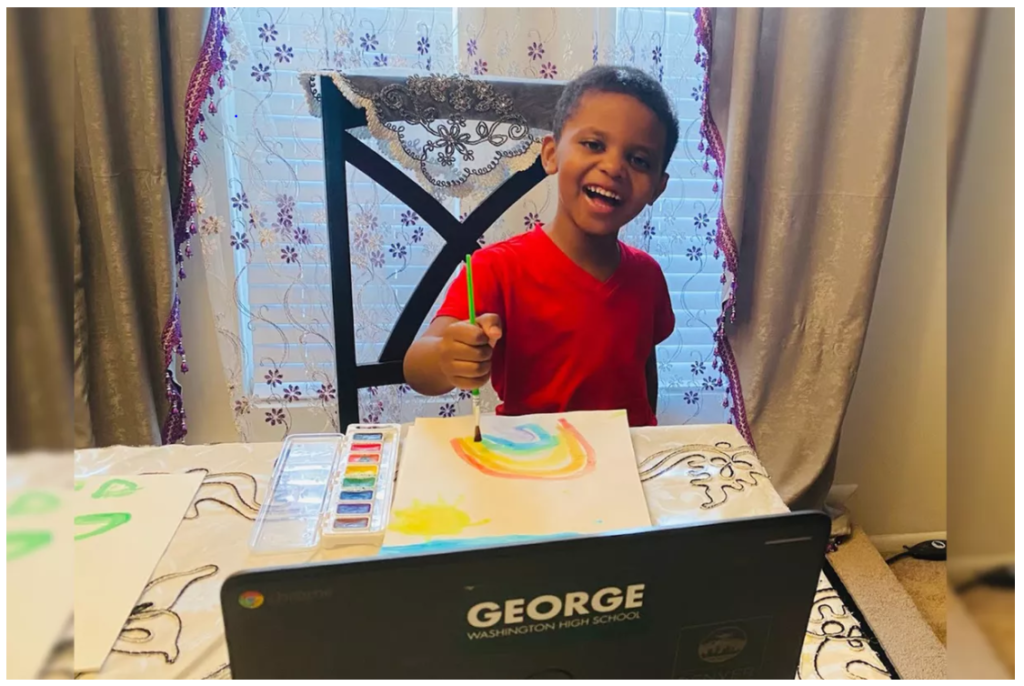
Moumin Elgizoli, 4, paints with his class as part of a virtual preschool pilot program, a partnership formed in response to parent demand between Denver Public Schools and the taxpayer-supported Denver Preschool Program.
Editor’s note: This post by Chandra Thomas Whitfield published earlier this month on Chalkbeat.
Sara Mohamed and her husband had intended to enroll their 4-year-old son in in-person preschool at Holm Elementary, a nearby Denver public school, but as COVID-19 infection rates soared through the fall in Colorado, they had second thoughts.
They placed their two older children into virtual learning but struggled to find a district program for their preschooler.
“All summer he’d been excited about going to school in the fall; he was so ready to go,” said Mohamed, of Denver. “He was so disappointed when we eventually told him that he would not be able to go to school in person.”
The family’s saving grace came when a call to Mile High Early Learning, a network of nine subsidized Montessori-inspired learning centers in Denver, confirmed they had space in its virtual preschool pilot program.
The program stems from a partnership between Denver Public Schools and the taxpayer-supported Denver Preschool Program, in response to parent demand. Unlike some other Colorado school districts, Denver Public Schools originally did not offer a virtual preschool option. Administrators there believe strongly that in-person learning is better for the youngest students.
It wasn’t quite the “big boy school” experience Mohamed and her family had envisioned for their energetic little Moumin, but they quickly concluded that any help getting him kindergarten ready was worth a try. Mohamed says weeks into the program her son is flourishing, and they’re grateful to have him enrolled.
“He’s so happy, he loves it,” said Mohammed, who supports new Arabic-speaking families and teaches English classes virtually for Holm Elementary. “It’s only 30 minutes a day, but it’s still made a big difference for him. He can’t wait to log in at 3:30 p.m.”
Mile High Early Learning and the Denver Preschool Program said the pilot appears to be working well for enrolled families.
Mile High Early Learning is among 47 providers that had enrolled in the pilot as of Dec. 3, according to Denver Preschool Program President and CEO Elsa Holguín. Some providers are offering remote learning while some are planning virtual programs in case they have to pivot later in the school year.
Mile High Early Learning students log in Monday through Thursday with program-issued iPads preloaded with learning apps, to join a teacher and more than a dozen classmates for 30 minutes. Families also receive books, paper, crayons, markers, and art supplies. The program asks parents to engage their students outside of class in drawing, painting, writing letters, and even homework.
Holguín says the pilot aims to support early childhood education providers. Since the onset of the pandemic, many said they felt like they were, “flying by the seat of their pants,” with limited guidance and direction.
“We decided that the best thing to do was not just to continue to help out our providers, but also to figure out how to start learning more about how to do [distance learning] at a quality level,” Holguín said.
Denver Preschool Program has underwritten sliding-scale tuition and teacher training and coaching, and provided funding to help sites remain afloat as they navigate the challenges of the pandemic.
Mohamed says she believes the program, especially the tuition support and supplies, is a lifesaver especially for working parents who are leery about risking in-person schooling but also want to ensure their children don’t miss out on critical learning opportunities.
“We were so worried that he might get behind,” she said. “We wanted to make sure that he was ready to go to school next year.”
Occasional technical glitches aside, Mohamed says their program experience has been virtually problem-free. They’ve noticed improvements in Moumin’s attention span. She said he’s grown more focused and engaged with each session he joins with his teacher and classmates.
Rebecca Kantor, a Denver Preschool board member who sits on the task force that is developing the distance learning curriculum, said the group sought to incorporate best practices in early childhood education.
“The two most important things that we know about young children’s learning is that they learn through direct experience and they learn within the context of stable trusting relationships,” said Kantor, dean of the School of Education and Human Development at the University of Colorado Denver. “So, we’re trying to recreate that using tech as a tool and we’re really getting very creative in figuring out a lot of different ways to do that.”
For example, she said, one suggested activity entails a student and parent painting together at home, while a teacher discusses with them on screen.
“One of the benefits of doing it that way is that the adult at home is also learning effective conversation skills from the teacher,” she said. “So, there’s a modeling going on that’s really good for the adults, too.”
Mile High Early Learning President and CEO Pamela Harris said along with providing a solid foundation in academics, administrators and teachers in the program have incorporated critical social and emotional learning opportunities.
“Even babies can develop true relationships using technology,” said Harris, who also co-chairs Colorado’s Early Childhood Professional Development Advisory Working Group. “I think it’s the interactivity that is key, having an adult person kind of on both sides, helping the child navigate.” The pilot also provides families resources on a YouTube channel and videos.
The pilot program, which is scheduled to run through the end of this school year, will begin enrolling some 3-year-old programs starting Jan. 4
“We still believe that we need to increase the quality of the distance learning experiences in Colorado,” Holguín said.
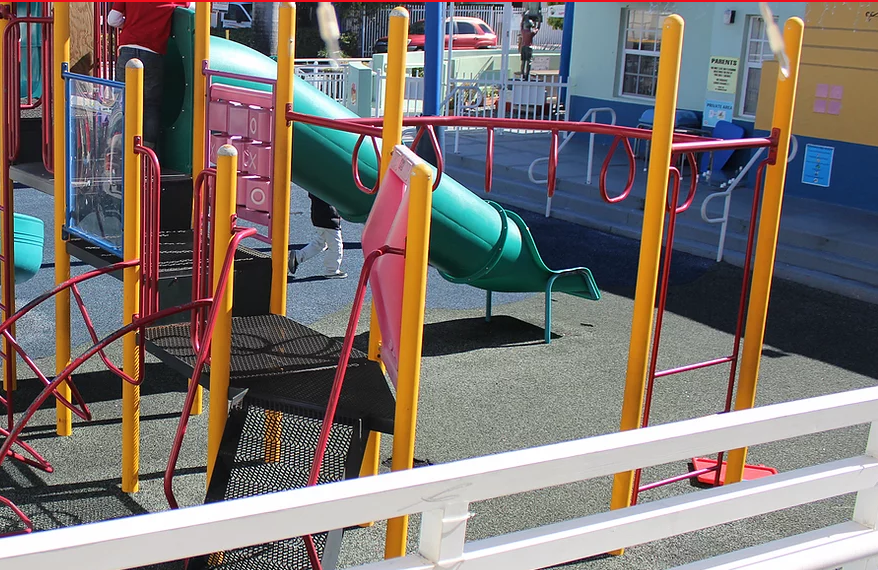
Happy Kids Childcare & School is one of dozens of options for Miami Beach families in search of preschool programs for their children. A new program aims to make such programs possible for more kids.
Known as paradise for the uber rich, Miami Beach has become the first city in Florida to provide enhanced pre-kindergarten services to its youngest residents.
City commissioners during the summer quietly approved a $250,000 yearlong pilot program that would provide scholarships to supplement the state-funded voluntary pre-kindergarten program for Miami Beach residents. The program is set to begin in August 2021.
"I'm really proud when I think about how we were the first city in Florida to offer this kind of program," said Miami Beach City Commissioner Steven Meiner, who championed the proposal along with commissioners Rickey Arriola and Mark Samuelian. "We pride ourselves on taking the lead."
The new program represents a partnership between the city and Teach Florida, a statewide education choice advocacy group for Jewish schools. Participation, however, is open to any student who lives in the city limits of Miami Beach regardless of religion or family income. Education providers outside the city limits also can participate by accepting scholarship funds that follow eligible families.
Scholarships are valued at up to $2,700 per child, and the extension is not allowed to overlap the three hours of VPK funded by the state. All providers must by certified by the Florida Department of Children and Families.
Teach Florida executive director Daniel Aqua said the program was a response to repeated studies showing the benefits of early childhood education and the role it plays in long-term educational success. The state program pays for only three hours of learning per day, creating hardships for families who can’t afford wrap-around care. The scholarship will pay for a 2.5-hour daily extension for each participating child.
“One operator with whom we spoke said that some families must pick their children up at noon when VPK ends,” Aqua said. “That simply doesn’t work for parents.”
Aqua said Teach Florida chose Miami Beach as the pilot site because of its extremely high cost of living, which has pushed out many young families, and because it has a history of support for education. The city already funds arts and sciences programming and recently paid to add mental health counselors in public schools.
According to the cost calculator Expatistan.com, it costs $5,111 per month for a family of four to live in Miami, where the cost of living is 74% higher than other U.S. cities.
“Friends are moving out of Miami Beach,” said Meiner, who with his wife is raising a 13-year-old son and an 8-year-old daughter. “This is a good way to incentivize living in Miami Beach.”
The one-year pilot is being funded through the city’s $327.6 million general fund budget. If city leaders choose to extend it, long-term funding could come from the Miami Beach Convention Center Hotel, expected to open by 2023 and which will earmark a portion of tax revenues for education.
Providers have been opting into the program and parents will be able to apply starting this month, with scholarships awarded to eligible students by lottery. With a program cap of $250,000, there is funding for about 92 scholarships, since the program funds a maximum of 2.5 hours per day for 180 school days at $6 per hour, Aqua said.
The scholarship program drew praise from area Catholic education leaders.
“The early years are the influential years and provide the building blocks for learning in elementary and secondary school,” said Kim Pryzbylski, superintendent of schools for the Archdiocese of Miami in a joint statement with Doreen Roberts, principal at Holy Family Catholic School in North Miami. The statement emphasized the importance of the amount of quality time pre-k students receive and said the program’s additional funding would enable teachers to focus more on language, social and readiness skills vital to success in kindergarten and beyond.
The program puts Miami Beach in elite company across the nation. Cities like Denver and New York City have offered universal pre-kindergarten for several years. The Denver program has proven so popular that voters voted to extend it. Both of those cities began with 4-year-olds and have since been expanded to include 3-year-olds.
“Ideally, this program will continue and expand, especially as the Convention Center funding comes online,” Aqua said.

