 Nearly a quarter century ago, Florida’s Lake Nona community near Orlando made history by being the first in the nation to combine its YMCA with a public elementary school.
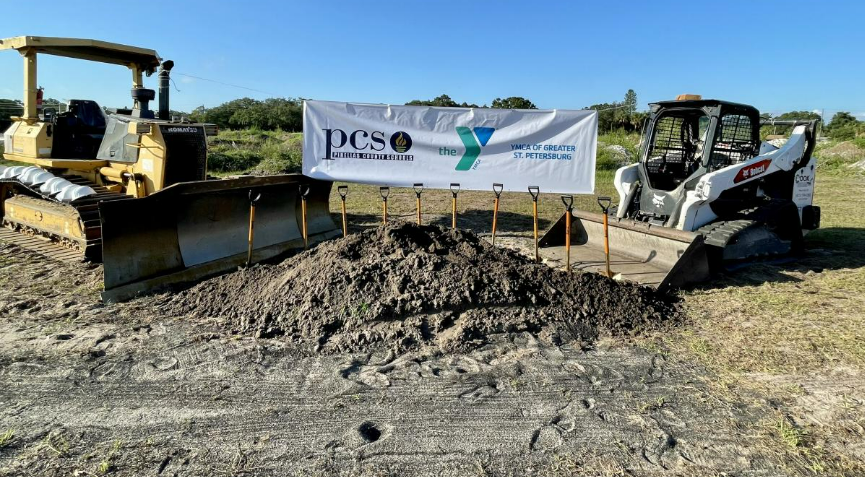
Today, the Pinellas County School District in the Tampa Bay area is poised to become home to the second such project in the state with a $50-million combination middle school-YMCA slated to open in St. Petersburg in 2024.
The 111,757-square-foot, two-story building sits on 19 acres. It includes 15 classrooms, an art room, family science lab, TV lab, music room and four classrooms for students with special needs.
The YMCA will feature a fitness center with state-of-the-art cardio and strength equipment, three group exercise studios, a cycling studio, a wellness terrace, and a childcare center for Y members. The Y will also feature a lap pool, splash pad and playground.
The Y and school will share the media center, dining hall, gymnasium, science lab, pool, sports field, and garden.
Pinellas schools superintendent Mike Grego, who is retiring July 1, said at a groundbreaking ceremony earlier this month that the partnership represents good fiscal stewardship.
“The days should be gone where everybody has to do something separate,” Grego said. “It’s so much more cost-effective. This partnership in this building will be the right thing for the community because it will be a shared community,” Grego said, adding that the project will be “the hub of this community.”
The school will be a health and wellness magnet and house 600 students, making it one of the smallest middle schools in the county. The combination school and Y will be built on the same site as Riviera Middle School, which district officials closed in 2008 during the recession.
Fast forward 14 years, and the area’s population is booming.
Students as well as surrounding neighborhoods will have access to the Y’s afterschool programs, childcare services, youth sports, fitness activities, aquatics offerings, community health classes and senior wellness programs.
David Jezek, president and CEO of the YMCA of Greater St. Petersburg, said services at the new Y will go beyond those for middle school students, reaching out to everyone, from infants and toddlers to seniors, and everyone in between.
“Having decades of experience with the Y, I understand how having access to Y services can impact a community,” Jezek said. “And I understand how fortunate we are to have an opportunity to embark on this journey with our longtime trusted partner Pinellas County Schools.”
Jezek announced the YMCA will be named for the Speer Foundation, founded by Roy Speer, who also founded the Home Shopping Network and was a long-time supporter of the YMCA. The foundation also had a hand in the Speer YMCA Preschool Academy in an underserved part of St. Petersburg.
“My family has a personal history with this neighborhood, and we know firsthand that it can be a special place to live and raise a family,” Lisa Speer Vickers said speaking on behalf of the Speer Foundation. “It means a great deal to us that education and wellness are at the heart of this endeavor and that neighbors of all ages will benefit from the excellence in learning and programming that will be found here every day.”
While innovative, the public-private partnership isn’t new. For years, YMCAs have served as sites for public charter schools, including Tiger Academy in Jacksonville, which opened in 2009.
The first school district partnership launched in Central Florida in 1999, when five organizations came together as part of a $12.5 million campaign to build the Lake Nona YMCA Family Center, which combined Northside Community School with the YMCA. Northside, known as Orlando’s only public elementary school with a pool, and the center, became a community hub, and the Lake Nona YMCA set a national precedent.
As the only Y in the United States to share facilities with an elementary school – with those shared facilities including a lobby, classrooms, ball and soccer fields, music and art rooms, a multi-media center, computers, a cafeteria, office and even phones – Lake Nona became a magnet for visitors from every state and many countries. It also won an international award from the Urban Land Institute in 2000 for the best use of land and resources.
Construction on the St. Petersburg project is anticipated to start immediately to allow the YMCA to open by the fourth quarter of 2023 with the school set to open at the start of the 2024-25 academic year.
Editor's note: This is the second installment of "A Choice Conversation," an ongoing dialogue between Doug Tuthill, president of Step Up for Students and a redefinED host, and John Wilson, a former NEA leader who writes the Unleashed blog at Education Week.
 Doug Tuthill: John, in our last exchange you called “for a new contracting arrangement for providers to serve the unique educational needs of targeted student populations and innovation.”
Floridians have heeded your advice and are expanding options for educators and families through innovative public-private partnerships. For example, the Okaloosa school district contracted with Embry-Riddle Aeronautical University to run Florida’s best aeronautics high school institutes. The Florida Virtual School contracts with Connections Academy to operate its K-5 program, and last year the Duval County school district contracted with local churches to implement programs for suspended students. The Pinellas County teachers union has a corporate subsidiary that contracts with its school board to tutor students; career academies throughout Florida contract for services from a plethora of businesses and trade associations; and the state’s charter schools, Voluntary Pre-K program, McKay Scholarships and tax credit scholarships are all implemented through public-private partnerships, as are many magnet schools.
Managing all these public-private partnerships is challenging, and you’ve suggested using the “institution of public schools” as the oversight entity. I’m curious what you mean by the term “institution of public schools.” I’m also interested in your criteria for distinguishing between acceptable and unacceptable public-private contracts.
John Wilson: Doug, I guess you could say I am a traditionalist when it comes to describing the institution of public schools, but I am an innovator when it comes to expanding the providers of customized education for targeted students and innovation.
I see the district board of education as the "traffic cop" for assuring that all providers, whether charters, private, or public-private, operate within a contract signed by the board of education and the provider. The "traffic cop" should assure that providers meet their fiduciary responsibility, improve student achievement, and adhere to the relevant laws and regulations as well as the contract that was signed with the board of education. I think the community needs to know these arrangements are cost-efficient and effective with their tax dollars and that their children are receiving a high-quality education. Let me add that I am not so naive as to know that we will need to build, and in some cases rebuild, trust and a shared vision with all parties that provide education opportunities. (more…)

