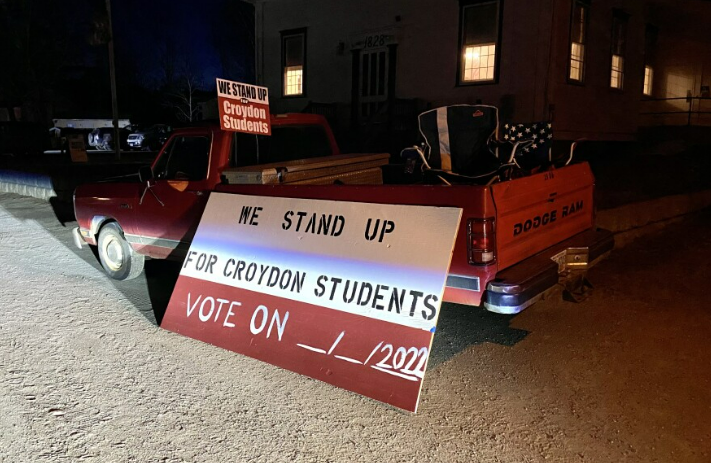
While some Croydon, New Hampshire, residents are wary of what education funding cuts could mean for local students, others see the budget as a blueprint for how to radically reshape public education in the state – and beyond.
Editor’s note: This commentary from Jim Peschke, a former member of the Croydon, New Hampshire, school board, appeared Wednesday on concordmonitor.com.
Every year, small towns across New Hampshire grapple with ways to keep their budgets in check. This usually entails minor adjustments and revisions that tighten up spending, but don’t dramatically alter the character of town or school operations.
This spring, residents of the town of Croydon adopted a novel approach, setting the school budget based on a simple per-pupil formula multiplied by a total student population. The final number, $800,000, came in at less than half of the board’s original $1.7 million-plus figure. This budget was disruptive, as it was meant to be.
As one of 20 vilified residents who voted in favor of the budget overhaul, I’ve heard many concerns about this approach, from the reasonable “can we deliver on this small budget?” to the absurd “the kids will end up in prison because they didn’t get enough art class.”
Among the cacophony of hyperbolic scenarios, one comment sounds quite reasonable: “This budget amendment seems abrupt and severe. Why was it necessary to cut the budget this way?”
It’s a good question, and it deserves a good answer.
To continue reading, click here.

At Liberty Academy High School, learning is project and competency based with no traditional grades and no traditional seven-period day. Students are encouraged to work in small groups and interact frequently with teachers.
Editor’s note: You can watch videos of how Liberty Academy High School is rethinking education here and here.
A virtual tour of Liberty Academy High School in Liberty, Missouri, a suburb with a population of 30,167, is as notable for what you don’t see as much as for what is visible.
Instead of traditional classrooms crammed with desks, you’ll see multipurpose spaces with comfy chairs. The walls and ceilings are decorated with student artwork. Teachers collaborate with groups of students on projects and chat about goals for the day.
Rather than responding to a bell schedule, students move freely from area to area and are encouraged to come and go from campus as they practice the skills they’re learning in real life settings, thanks to agreements with more than 100 community business partners.
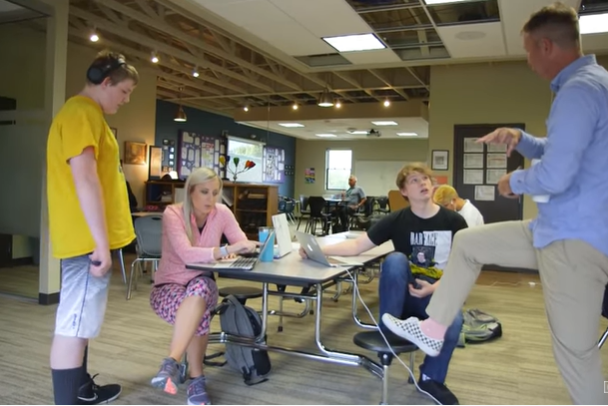
Social studies teacher Art Smith, right, believes strongly in each student's ability to pursue projects that interest them as a way to keep them focused on school.
Social studies teacher Art Smith, a 24-year veteran of Liberty Public Schools and a self-described “crazy guy,” redesigned the 26-year-old alternative high school’s format in 2016 with his colleagues so it would be more in line with what he calls “schools of the future.”
“We’re probably in a period of history where technology is allowing us to rethink schools,” said Smith, who doesn’t shy away from the title “education disruptor.”
During his career, Smith has tried almost every possible way to help kids derive meaning from what they’re learning, from carving canoes to building Conestoga wagons to staging archeological digs. He is among a rapidly expanding breed of educators who believe a break with the established educational model is necessary to improve the existing one.
Though Liberty Academy is a traditional district school, it looks and feels more like a public charter or private school with a model that draws inspiration from the unschooling movement of the 1960s, which encouraged exploration of activities initiated by students themselves. The basic idea is that the more personal learning is, the more meaningful it will be.
Here’s how it works. When students enter the program, they are allowed four weeks to determine their interests and long-term goals. Learning is then organized in six-week bursts of interest-based learning, which often includes participation with one of the school’s community partners in what school officials describe as “a reverse internship.”
Among the partners: a miniature horse farm, a greenhouse operation, cosmetology schools, a homeless shelter, and a host of nonprofit organizations. The aim is to allow students to explore careers, help others, and solve problems.
Students set goals based on three or four success skills during each segment. Teachers, who are referred to as advisers, help students document their growth each week and link their projects to standard and class credits.
At the end of each project, students give a presentation to a panel of at least three adults. At the end of each semester, they write an essay and display artifacts for a school and community showcase.
Learning is project based and competency based; there are no traditional grades and no traditional seven-period day. For staff members, it all adds up to an environment that looks more like life than school.
“Until you come and visit, it’s really hard to describe,” said Summer Kelly, Liberty Schools’ 2020-21 Teacher of the Year. (You can learn more about her here.) “I’m obviously a teacher, but I do way more than just teaching.”
A former middle school math teacher, Kelly left her traditional teaching job in the district three years ago to join the faculty at the alternative high school, which serves about 100 at-risk students.
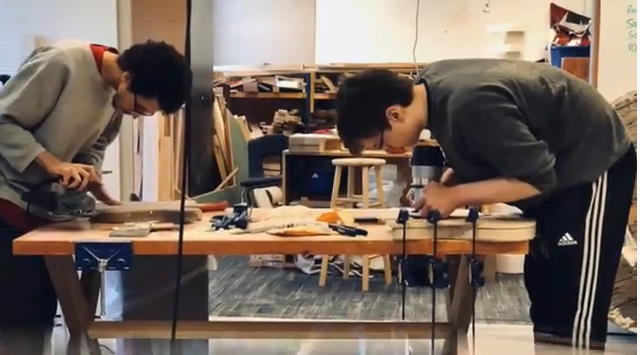
Among the project-based activities available to students at Liberty Academy High is guitar building, which teaches math and engineering skills.
A typical day starts with physical activity, with a yoga class offered weekly. Afterward, students gather for a “circle meeting” and check in with their advisers and learn about trips available that day. Students then go out in small groups to participate with advisers.
“Nothing about our building is traditional in any way, and I think that’s where I needed the change,” Kelly said. “It gave me new motivation.”
Smith, the social studies teacher who helped redesign the school, said he came to a conclusion early in his career that school needed to look different to be effective, especially for students who don’t like going to school.
“They’re forced to be there, and they’re compliant and sitting in their classroom and sitting in their desks, but a lot of kids weren’t interested in anything happening on a day-to-day perspective, and that bothered me,” he said. “If they don’t love it and don’t feel intrinsically driven to be a part of it, then we should try to build a framework that does that, because no human wants to be a part of something that they don’t have ownership of and empowerment in.”
The school, which has the support of the district and school board, has won several awards and was named a grand prize winner in the 2020 Magna Awards sponsored by the National Association of School Boards. Other nearby districts have taken notice and are seeking to incorporate parts of Liberty Academy's model.
Said Smith: “We all feel blessed to be in this position at this time and to continue pushing the envelope of what school can be for kids.”
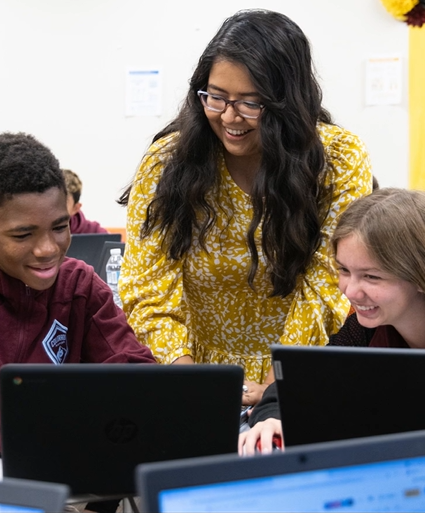
ASU Prep Academy and ASU Prep Digital serves 3,500 students in kindergarten through 12th grade through in-person learning at four Arizona campuses and supports 7,500 K-12 students worldwide through full-time digital education.
Editor’s note: You can listen to Step Up For Students president Doug Tuthill interviewing Julie Young, founder and former CEO of Florida Virtual School who is now deeply engaged with digital education at Arizona State University, here and here.
The nation’s leading education disruptors – proactive individuals who are thinking beyond traditional boundaries – have rallied in recent months around a universal prediction: Families in a post-pandemic world will increasingly be looking for freedom from a once-size-fits-all, single delivery method of education, along with a greater emphasis on blended education, technology, and digital citizenship.
Teachers, many who learned remote instruction on the fly at the start of the pandemic, have taken notice and are upgrading their skills to become more agile as hybrid models become mainstream.
“The choice movement has forced schools to up their game because parents now have so many choices,” said Julie Young, vice president of education outreach and student services for Arizona State University and managing director of ASU Prep Academy and ASU Prep Digital. “If schools don’t meet those students where they are, they have so many options to go elsewhere.”
Young and three members of her staff spoke with reimaginED about their organization’s progress during the past year and discussed emerging trends as the nation continues its transition from pandemic crisis to normalcy.
Bottom line, “normalcy” will look nothing like 2019. Families and educators both are demanding options, which ASU has provided plenty of during the past year. Among ASU’s accomplishments, itemized in a recent video:
Jill Rogier, the organization’s digital head of school, said retention numbers are top of mind for ASU leaders.
“We’re really pleased a lot of parents came to us during the pandemic, and they’re staying or they’re leaving and then coming back,” Rogier said.
The digital school, which began in 2017 as a high school, last year added grades K through 8 in response to pandemic demand. The on-campus and online schools also partner with Arizona State University to offer early college courses.
Additionally, ASU is partnering with parents who want to continue with learning pods, a trend that came on the scene at the height of the pandemic when many campuses across the nation shut down. Rogier received a lot of requests for pods, mainly from parents of students in lower grades, so ASU worked to facilitate a pilot.
“They want that sense of community,” she said. “The parents want to collaborate and get their kids together. It’s really becoming more than just a pilot.”
Hybrid services, where students spend a couple of days each week on campus and a couple of days online, also remain popular, a trend that is expected to continue.
“I think parents don’t want their kids home all the time, but they like them home sometimes,” said Amy McGrath, chief operating officer for ASU Prep and deputy vice president of ASU educational outreach.
Young agreed. “The hybrid model was the one that parents seized upon,” she said. “I think schools are going to lose kids hand over fist if they don’t have strong hybrid models to offer their families.”
As blended education becomes the norm, a K-20 model that includes college will be the wave of the future, the team agrees. ASU is working with Arizona State to incorporate the college experience by allowing high school students to spend a few days a week taking college classes on the university campus as well as offering on-demand courses for college credit.
“We’re hoping to be a rival of AP,” Young said.
Another trend Young identified is the infusion of digital citizenship in all instruction.
“What we’re seeing in schools in terms of misuse and poor behavior with technology and cybersecurity, I think it’s very much top of mind, she said.
The demand for services has come not only from families. Teachers are also recognizing the need to upskill as blended learning becomes more mainstream.
“The demand level has been pretty intense,” McGrath said. “Immediately, we had 800 teachers that heard about it through the Department of Education’s announcement. We set up a landing page and we kept getting hit over and over with teachers saying, ‘We need help.’”
ASU opened evening and weekend workshops to meet the demand.
“We don’t even really have to market,” McGrath said. “Teachers are just spreading the word.”
ASU is now bringing in alums of the program to do the training.
“We’re trying to take ourselves out of it and be a rich place for teachers to share learning and best practices,” she said. “It’s continued to be very dense and robust, and we’ve got some really great stories about teachers who have felt invigorated again.”
One trend that ASU Digital Prep school leaders hope doesn’t last is the tendency for some educators and administrators to sort themselves into tribes that advocate all-or-nothing approaches to education, with one side pushing all in-person instruction and the other all digital.
“They’re risking alienating parents in the long run,” said Kay Johnson, director of strategic communication for ASU Prep Digital. “We as education leaders and innovators need to push people to stop ‘either this or that’ and adopt ‘both-and’ ways of thinking and how we can have a win-win, because we can.
“One size does not fit all.”

