
**SPOILER ALERT! DO NOT READ IF YOU ARE UNDER THE AGE OF 8**
Western cultures, for some strange reason, involve rituals where we pretend that various “fairy creatures” exist, particularly with children: the Tooth Fairy, a jolly old elf with flying reindeer who brought me an awesome Big Wheel in 1973, egg and goody hiding rabbits, etc. When I became a parent, I played along with these rituals, but then at some point questioned why I was doing it. On the one hand, I didn’t want my children to be those killjoy types who went around bursting the bubbles of other kids. On the other hand, I did not want to train my children not to trust me. I decided to allow the “fun” to go on until they each reached a certain age, then to explain to them that these things are traditions and that it would be best to allow their friends to figure it out on their own.
So, dear reader, I assume that you have reached a certain age and that you are prepared to know the truth about the last fairy creature. Belief in this one tends to persist much longer than the others and is alas, more detrimental. Sorry to be a killjoy, but here goes:
Philosopher kings are not real.
This was my main thought upon reading Mike McShane’s recent entry in a debate about school choice regulation. Go read it. I’ll wait here.
Go on…
Okay, good. My favorite part involved the Gilded Age meat baron, but McShane made several crucial points. Local school boards, state governments and the federal government all regulate public schools in a very active fashion. I could produce multiple graphs from NAEP, PISA, etc., showing what a pig’s breakfast American academic achievement has become, but you have already seen them, so I will spare you. Why are American schools so wretched despite so much regulation? Oh well, that is simple: regulation is not made by philosopher-kings but rather by politics. Politics has an amazingly consistent record of fouling things up.
The philosopher-king fairies, invented by Plato, are a specially trained and educated aesthetic elite who, disinterested in fame or wealth, love only wisdom and justice. Having thus earned the right to rule over us lesser mortals, we proles should feel deferential and deeply grateful for their sacrifice. Again, sorry to burst your bubble, but these people do not exist in the real world. Out here in the real world, mere humans with all kinds of motivations (political and otherwise), limits to their knowledge, greed, stupidity and other normal human failings create regulations. Those of us fortunate enough to live in a democracy get the chance to throw the bums out when we’ve had enough. Just in case you haven’t noticed, a major subtext of politics these days involves bums that voters can’t throw out.
Politics, not philosopher-kings, runs regulation, and politics runs on self-interest far more than on benevolent technocratic wisdom. Choice programs must cope with powerful organized interests that yearn to use regulation as a tool to domesticate choice opportunities and find it in their self-interest to do so. The default position of choice supporters should therefore be to view the calls for regulation with a deep skepticism; it is not paranoia when people really are out to get you.
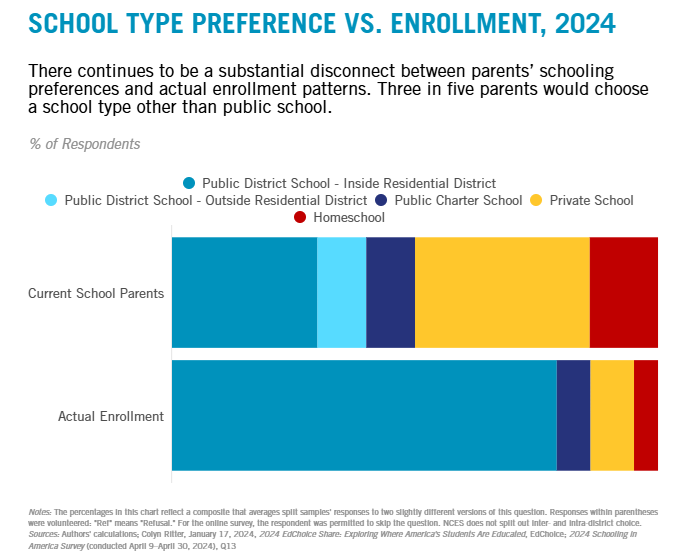
None of this is to say that it is possible to pass choice legislation without regulation; it is not. I am not aware of any program anywhere that operates without some degree of regulation. American parents, however, want a radically different K-12 system than the one government forces them to pay for (see above). The way forward is to allow families to partner with educators to sort through new schools and education methods. Heavily regulated choice systems might get to something close to the K-12 system parents want and deserve before the heat-death of the universe, but then again, they might not.
America’s founders fought a grueling war against the most powerful country in the world based upon what was then a radical idea, that people could live better without royalty to boss them around. The divine right of kings was another myth humanity needed to grow up and discard, and that should include philosopher-kings.

The current debate over ESAs in Texas has brought irresponsible claims about the Edgewood Horizon program back to life. A voucher program funded by philanthropists, Edgewood Horizon made all Edgewood Independent School District students (located within San Antonio) eligible to receive a voucher to allay private school expenses. The Horizon program ran from 1998 to 2007, peaking at approximately 16% of Edgewood’s enrollment. Research on choice programs consistently finds positive competitive effects when districts are exposed to competition; as the ability of district students to exit to other options increases, so too do district scores. Choice opponents have been claiming Edgewood as a cautionary tale, but the available evidence demonstrates that Edgewood ISDs academic performance and financial trends were consistent with the research findings on the impact of choice.
Texas choice opponents of 2025, like Jurassic Park scientists, have cloned previous claims about this old program, and set them loose in the current debate. A recent San Antonio media report revisited the claims of Horizon program opponents Diana Herrera and Aurelio Montemayor:
“‘There’s like 1,000 school districts … and out of every school district in the state of Texas, Edgewood was the one selected. And once again, we had zero low-performing schools,'” (Herrera) said. “'So why did they come to Edgewood? The word was because they wanted to destroy us.’”
Herrera remembers the district cutting resources, expanding class sizes by combining smaller classes and cutting positions as the program expanded.
Students from all 23 campuses used vouchers, according to Montemayor, an educational specialist for IDRA, which opposes voucher programs.
“’What was happening at Edgewood was very painful,’ Montemayor said. ‘You had larger classes and they couldn’t shut down a school or hire more teachers. It was very difficult.’”
Was the Edgewood Independent School District destroyed, or for that matter visibly damaged? The Texas Education Agency keeps extensive academic and financial records on school districts. In 1997-98 the Edgewood Independent School District spent $85,695,522. By 2008 this total expenditure had not declined but rather had increased to $95,093,331. Spending per pupil went from $6,060 to $9,039 during the same period. Average teacher salaries increased from $32,753 to $48,742 during the same period. By the end of the Horizon program, Edgewood ISD total expenditures stood at an all-time high and per pupil funding exceeded the statewide average.
Consistent with decades of research results, Edgewood ISD’s academic results also improved during the Horizon period. In 1997 55.1% of Edgewood ISD students taking state accountability exams passed all exams, compared to a statewide average of 73.2 percent. By 2008 this had increased to 57% of Edgewood students compared to a statewide average of 72% statewide. Far from falling apart academically, Edgewood narrowed the achievement gap with the state. Far from “destroying” Edgewood ISD the available evidence shows that district academic performance improved, and the district spent more rather than less money.
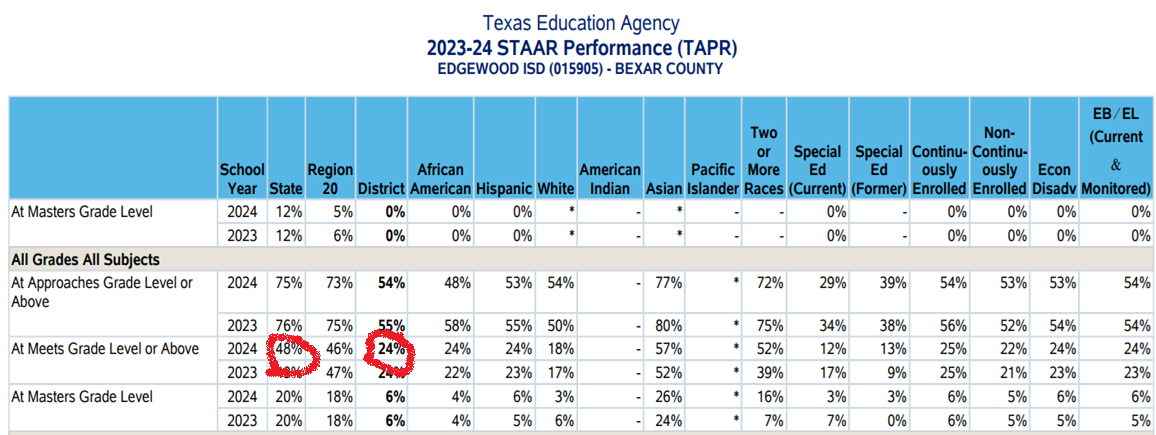
Unfortunately, the Horizon program ended in 2007, and the recent academic results of the Edgewood ISD do not indicate that the incremental academic progress was sustained after the conclusion of the program. In 2023-24 Edgewood students had one half the rate of meeting or exceeding grade level compared to the statewide average. The cautionary tale from the Edgewood experience is what happens when students lack an exit option, not when they actually hold one.
Arizona’s politics might be described as “Chaotic Purple,” but 2024 elections proved quite red at the state legislative level, with Republicans making gains in both the Arizona Senate and House. It may be the case that some of those gains happened because of the unrelenting level of hostility to school choice on the part of the nominated candidates of the Arizona Democratic Party for state legislature. Surveys show that school choice remains broadly popular among Arizona Democrats, Independents and Republicans. Democratic candidates and officeholders, however, have been much more likely to represent the views of public school-affiliated lobbyists and activists than those of their own voters and (crucially) the independent voters needed to secure electoral victory. Hostility to school choice may have cost Arizona Democrats legislative majorities in 2024, and the likelihood of this will only increase in the years ahead.
The 2018 elections might best illustrate Arizona’s Chaotic Purple tendencies, as Republican Gov. Doug Ducey won re-election by a thumping margin even as Democrat Kirsten Sinema won the race for a seat in the U.S. Senate. “Ducey-Sinema voting” did not end in 2018. In 2020, Arizona voters narrowly went for Joe Biden and in 2022 elected Democrat Katie Hobbs governor, but in both instances kept Republican legislative majorities intact. In 2024, the same electorate swung back to Donald Trump over Joe Biden in the presidential race and expanded Republican legislative majorities but also elected Democratic candidate Rueben Gallego to the U.S. Senate. Arizona was a hotly contested swing state in 2024, and Arizona Democrats privately expressed confidence regarding their chances for capturing majorities in the state legislature.
Arizona Democrats have not always been hostile to school choice. Gov. Janet Napolitano, for example, signed two voucher laws as a part of a budget deal. Arizona’s current governor has espoused an unrelenting hostility to school choice, having called for the repeal of Arizona scholarship tax credit programs and “reforms” to the Arizona Empowerment Scholarship Account program that would effectively eliminate the program. Not to be outdone, Arizona legislators have also filed “reform” and “accountability” proposals on choice programs which, if not actually drafted by Arizona’s NEA affiliate, looked remarkably similar to something they would draft if given the chance.
Arizona has five private choice programs: four scholarship tax credits and the Empowerment Scholarship Account. Well over 100,000 students participated in these programs by November 2024. Some of them were eligible to vote in 2024. Arizona taxpayers made 80,057 scholarship tax credit donations in 2023 under the original tax credit program, and another 49,323 donations under the “switcher” credit. Thousands of Arizonans volunteer and/or work at a private school. A broader universe of therapists and tutoring firms also participate as eligible vendors in the ESA program. The unrelenting hostility of many Democrats to the interests of their children, students and schools would be hard pressed not to notice. Did this hostility cost Democrats at the ballot box?
Perhaps so.
The Arizona Senate has 30 seats, and most of these races are not close, going for either the Republican or the Democrat candidate by a wide margin. The races are close and decide which party will be in the majority. The closest state Senate races in 2024 occurred in Legislative Districts 2, 4, 9, 13, 17 and 23. Republicans won four of these six close races, prevailing by margins of 3,767, 5,465, 7,383 and 3,045 votes, respectively.
For example, Arizona Legislative District 4 featured Republican Carine Werner defeating Democrat Christine Marsh by 5,465 votes. A swing of 2,733 votes would have changed the outcome of the election. Data compiled on Legislative Districts by the Common Sense Institute of Arizona found that 3,399 students were attending private schools in 2021-22 in Legislative District 4. The 2021-22 school year, however, was before the Arizona Empowerment Scholarship Account became universally eligible to all Arizona K-12 students.
The Common Sense Institute Arizona research found private school enrollment increased by 31% between the 2019-20 school year and 2021-22 school year. If we take the conservative assumption of a similar increase by the fall of 2024, it would create an estimate of 4,452 private school students in Legislative District 4 by November 2024. If you assume 1.5 parents for each private school student, you reach a potential voting block of 6,679. Assume further that the 4,452 private school students didn’t get there without corresponding private school staff members, add in the assumption that LD 4 had a proportionate share of Arizona’s 100,000 plus scholarship tax credit donors, and you reach an unavoidable conclusion: pledging to revoke private choice programs may have been a very costly political decision. In Arizona Legislative District 4, not only the Senate race but both House races went to candidates supportive of K-12 choice.

We will never know for certain whether K-12 choice hostility tipped electoral balances in 2024. However, we do know that it will be more likely to happen in 2026 legislative races than it was in 2024 based upon the continued growth in Arizona choice programs. Continuing to threaten the thousands of families relying upon choice programs looks to have been a bad bet in 2024 and a worse bet going forward. Both ESA families and scholarship tax credit donors each separately outnumber members of the National Education Association affiliate by more than four to one. Math is hard, and it is even less forgiving.

Australian defense economist/YouTube PowerPoint superstar Perun has provided another insightful video which is must-see viewing for anyone seeking to understand politics.
US Navy Procurement Disasters - The Littoral Combat Ship and Zumwalt Class Destroyer is a cautionary tale for anyone seeking to expand the role of politics in life and should be mandatory viewing, full “Clockwork Orange” style if necessary, for anyone seeking any office.
Given that the runtime lasts over an hour, I’ll do my best to summarize. At some point, Navy wargamers discovered that a scenario closely resembling “Iran attempts to close the Persian Gulf in part by using shore-based missiles and drones” proved very difficult for players controlling the U.S. Navy. Think of all the problems the already obsolete HIMARS systems gave the Russian army in Ukraine, but apply those “shoot and scoot” tactics to ships.
The Navy brass decided they needed a new type of warship to counter such a threat: the Littoral Combat Ship (LCS). It needed to be fast, stealthy, and multifunctional. That last part drew inspiration from modular ships in the Danish navy. In this context, the idea developed into modules that could be put on/off the ship to expand the capacity to fight shore-based opponents, sweep sea mines, or combat submarines. 
Okay, so the disaster begins to unfold when the Navy does not settle on a single design but instead on two designs. From an operational standpoint, this made absolutely no sense, complicating a whole suite of requirements to train crews and repair ships. However, it made all the sense in the world in one important way: politics. By adopting two different ship designs, you made many members of Congress happy.
This disaster is just getting started, however. Both ship designs have serious problems. One of them had a super advanced propulsion system, but it is delicate and requires specialized contractors to repair it. The other ship's design had a problem keeping water out.
Next up, while modules might be a great idea for the Danish navy, the Danish navy rarely sails very far from Denmark. This is not the case for the U.S. Navy, which sails around the globe. If the modules are to be very useful, you need to be able to change them out, which means they must be proximate to wherever you are going to use them. When the Navy wargamer nerds played subsequent games of Navy Dungeons and Dragons, the nerds playing the opponents put the destruction of modules sitting onshore somewhere near the top of their to-do list. Hopefully, you like the module you are using now; you won’t be making any changes anytime soon.
These ships were such a disaster that the Navy tried to retire one of them only five years after it was commissioned. I say “tried” because you’ll be shocked to hear that politics intervened again, as Congress did not want the ships retired.
A scenario very similar to the original wargame broke out in the Red Sea last year courtesy of the Houthis. The U.S. Navy did not send forth the mighty LCS to combat the Houthis’ shore-based missile and drone attacks on commercial shipping, preferring to use, you know, functional warships. Unable to retire these duds, the Navy has decided to pop the minesweeper module on them and use them to replace aging minesweepers. Without a doubt, these are the most catastrophically expensive minesweepers produced in human history.
My telepathic powers inform me that some of you dear readers are wondering what any of this has to do with K-12 education. Thanks for asking! Running a public school system, just like procuring new ships for the Navy, is a political process. Politics can (sometimes, hopefully) involve reason and logic, but far more often it runs on the self-interests of lobby groups and politicians. Deciding to order two deeply flawed ships instead of zero made no sense if you wanted to fight and win a war, but it made perfect sense in serving the interests of the players in this political game. Lucky you; you get to pay the bill.
Politics gifted us with costly minesweepers with overpowered and delicate propulsion systems or issues with floating. Likewise, politics has straddled the United States with one of the most costly and ineffective school systems in the world. When it comes to the education of your children and grandchildren, politics is not a game you want to play.
By Shaka Mitchell
After this month’s election, which has resulted in a surprising Republican trifecta, the first action GOP lawmakers should take is to pass and sign the Educational Choice for Children Act (ECCA). This bill aims to provide educational opportunities outside the public school system for millions of students over the next four years alone.
The push for educational choice has been growing across the country, primarily driven by state legislatures, which control most K-12 education legislation. However, states like California, Kentucky, Colorado, New York, and Michigan have faced challenges in advancing such legislation, largely due to Democratic majorities and significant influence from teachers' unions.
The ECCA would create a federal scholarship tax credit program that allows tax-paying individuals to direct up to ten percent of their adjusted gross income to a Scholarship Granting Organization (SGO). SGOs already grant scholarships to students in 22 states, but they are products of state-level legislation and implicate the state tax code. Therefore, these programs are non-starters in states without personal income tax. The ECCA represents a first at the federal level and just this year the bill made significant progress, having passed the House Finance Committee.
Be like water
While subject to change, if the ECCA passes with a $10 billion cap, it would likely benefit more than a million students from low- and middle-income families. Families would apply to an SGO for a scholarship, and upon receiving one, parents could use the funds for a range of educational expenses including tuition at private schools, online courses, special education services, and tutoring. Some families will likely choose to keep their student enrolled in a public school and use scholarship funds to supplement the experience with technology or tutoring – enhancements normally reserved for more wealthy families.
The federal nature of the ECCA presents a new opportunity to deliver educational options for children in states where state legislatures have been resistant to educational freedom.
California serves as a prime example. Despite substantial investment in public education (on average more than $18,000 is spent on K-12 students in the state), student outcomes remain disappointing. Only 3 in 10 students in 8th grade are proficient in reading, according to the 2022 National Assessment of Educational Progress (NAEP).
Earlier this year, and at the behest of the California Teachers Association, the state legislature defeated a proposal that would have created an $8,000 voucher program. Like water flowing around a stubborn obstacle, the ECCA would give donors and parents another option in their quest for an educational best fit.
While not a cure-all, this bill would significantly improve educational outcomes for all children.
Elections matter
Finally, the ECCA allows Republicans to fulfill the responsibilities entrusted to them by voters, ensuring a prosperous future for all children, regardless of their state's political leaning.
Famously, or infamously depending on your point of view, President Jimmy Carter established the Department of Education as a way to further endear himself to the National Education Association (NEA), the country’s largest teachers union. The Department’s creation was the fulfillment of his 1976 campaign promise, and he was further rewarded in 1980 by receiving the union’s endorsement.
In a similar fashion, candidate Trump and many other Republican candidates including Tim Sheehy (MT), Bernie Moreno (OH), Dave McCormick (PA), and Gov. Jim Justice (WV), expressed their desire to support American families through education choice. President Trump was rewarded on election night in large part thanks to increased support among Black and Latino voters.
On election night, NBC News chief political analyst Chuck Todd noted that “Latino voters align more closely to the conservative party [on] school choice.” Many of these voters live in states with little hope of state-initiated school choice legislation.
The ECCA could deepen the bonds between Republicans and Latino voters and bring much-needed opportunities to students who need them most.
— Shaka Mitchell is a senior fellow at the American Federation for Children.
Vice President Harris received more votes from every generation of Americans except Gen X, but as it happens the loss of Gen X proved decisive. Gen X, Americans born between 1965 and 1980 (which includes your humble author) are of an age to have been the parents of school aged children during the COVID-19 fiasco/goat-rodeo.
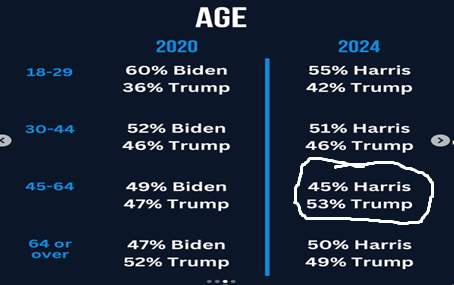
Uniquely among generations, President-elect Trump carried both men and women of Gen X. Right about now readers of a certain Gen Xish age may be humming a certain Gen X anthem. Something about having the right to choose and an unwillingness to surrender it. Feel free to belt it out in your head:

This did not exclusively play out at the national level. Over the past 10 years, for example, donors have sent an unimaginable amount of political funding into Arizona. Much of the resulting rhetoric and activity fixated upon bellyaching about school choice. As the smoke clears on the 2024 election, we find that Arizona’s 11 electoral college votes were never decisive in either the 2016, 2020 or 2024 presidential elections. Meanwhile the three “blue wall states” of Michigan, Pennsylvania and Wisconsin moved in unison to determine the winner for the third election in a row. Opportunity cost is a harsh mistress.
In addition to serving as a costly sideshow in the presidential race for the third time, Arizona’s Republican Party will add to their majorities in both the Arizona House and the Arizona Senate. The battleground legislative races included a number of very tight outcomes. The parents of private choice program children outnumber the membership of the Arizona Education Association by six or more to one.
That ratio will only continue to grow. Having fallen on the losing side of the crucial 2024 legislative races, the president of the Arizona Education Association described her own organization as “union thugs.”
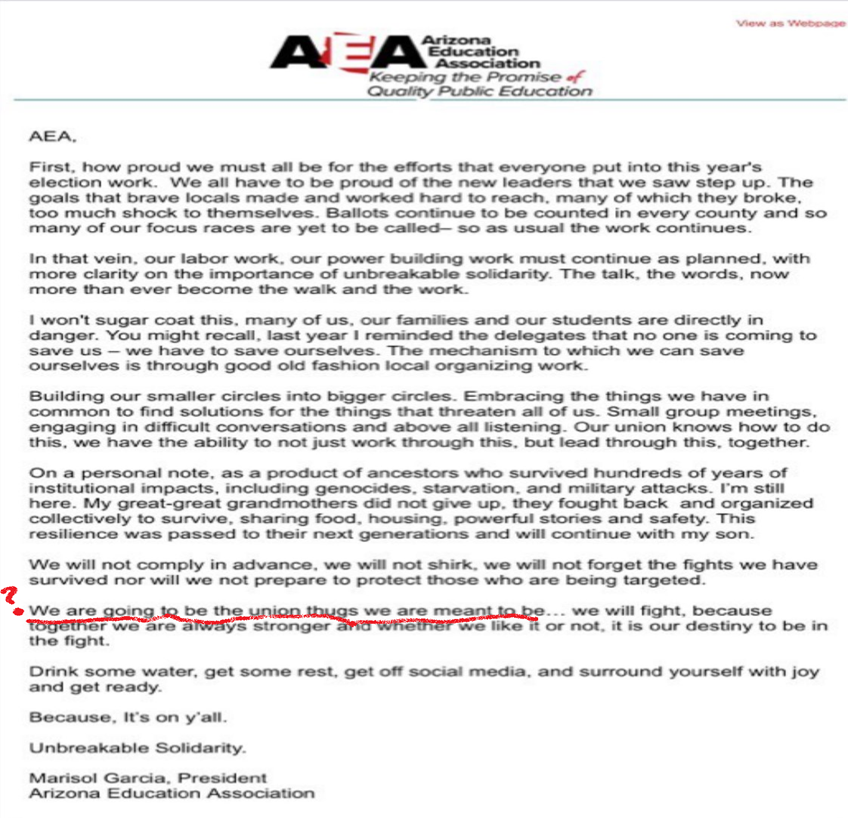
Hmmm…both parties might want to think about competing for the votes of families with school-age children. Those who find themselves aligned with “thugs” might want to consider losing the zeroes and getting with the heroes. If not, the beatings might just continue until morale improves. In the meantime, color this Gen Xer happy that parent power is REAL, and it is SPECTACULAR!

Today is election day in America. In the immortal words of C3PO “Thank the Maker!” I do not know about the rest of you, but I am well past my factory-specified structural tolerance levels for unsolicited texts and calls. I get it; all of you want me to vote for you. Some of you will receive my vote, and some of you will not. Now that it is election day, all of you need to GO AWAY.
Negative partisanship has been on the rise, meaning that an increasing number of voters find their primary motivation in voting against parties and candidates rather than for anyone. Thus, whatever happens with the elections, a substantial portion of the American public will react to it as if a trio of heavily armed and armored trolls just burst through the gates leading a legion of bloodthirsty orcs.
As they say in the military stay frosty.
Like many, I find turbulence unsettling while flying. When I encounter it, however, I think of our flight crew and the fact that they have flown by a factor of 100 times or more than me, and they are delightfully still alive. At that point I will calmly wait to get our wheels on the ground. Likewise in an election year I remind myself what Matt Ridley taught me when I read his book, “The Rational Optimist.”
In that book, Ridley builds a persuasive case that so long as people are out there developing new products and services and grinding on solutions for problems, the human condition continues to improve. Government can and has done things to speed things along (for instance by enforcing property rights) or slow things down in a wide variety of idiotic ways. Overall progress has proven to be robust in liberal market-based societies. As an example, Ridley noted that despite the collapse of a market bubble, unimaginably stupid policy errors by the Federal Reserve, Congress and Hoover starting a global trade war, and too many policy mistakes by the Roosevelt administration to count, followed the onset of a World War, the average American was still better off in material terms in 1939 than they had been in 1929.
Ridley’s perspective should both get you, regardless of your perspective, to stand your ground no matter what comes through that election gate.

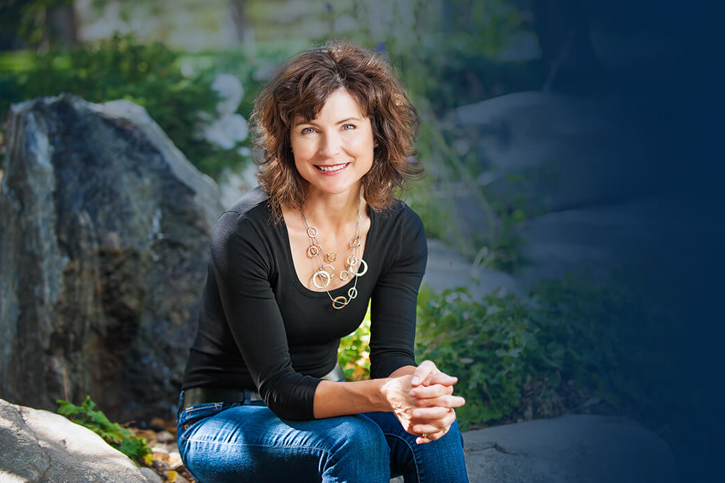
Nevada Sen. Heidi Seevers Gansert introduced SB 220, which would have expanded the state’s Opportunity Scholarship program and increased eligibility for 400% of the federal poverty line, children with disabilities and children o first responders.
This commentary from Valeria Gurr, a senior fellow for the American Federation for Children and a reimaginED guest blogger, appeared last week on thenevadaindependent.com.
During his State of the State address, Nevada Gov. Joe Lombardo pledged to increase funding and eligibility for Opportunity Scholarships, expand charter schools, create the Office of School Choice, and increase funding for public schools at a record number.
Legislators such as Sen. Heidi Seevers Gansert went to work introducing SB220, which would expand the Opportunity Scholarship program to serve approximately 6,000 students who cannot afford another educational option to attend schools of their choice if their current assigned public school is not working for them.
SB220 would also increase eligibility for 400% of the federal poverty line, children with disabilities and children of first responders. However, because Democrats in Nevada have control of both chambers and are vehemently against educational choice, SB220 was never set to get a hearing.
As a matter of fact, Democrats in the Silver State have continuously denied the Opportunity Scholarships a hearing and use education as a political pawn incessantly pointing at school choice as a way to defund public education — a talking point that could not be further from the truth.
Giving families 5% of options won’t defund public schools. Instead, it will bring opportunities to those who need them.
Enter Lombardo, a leader not afraid to go against the grain and willing to expend political capital for the children instead of accepting the status quo.
To continue reading, click here.

Texas Christian School in Houston, one of about 900 accredited private schools in Texas serving approximately 250,000 students, was established as a college preparatory school with an advanced curriculum to challenge eager minds based on a character development program.
Editor’s note: This article appeared Tuesday on Texas’ spectrumlocalnews.com.
With just about six weeks to go in the Texas legislative session, tensions are running high, and the gloves are coming off for two big issues dominating debate at the Capitol.
The House and Senate are split over how best to provide property tax relief to Texans and whether the state should use public money to let parents send their kids to private school.
During an interview on Capital Tonight Tuesday, Lt. Gov. Dan Patrick threatened to force a special session over the issues.
“I can’t call a special session, but I can create one by not passing a key bill that has to pass,” he said when asked about school vouchers. “If we don’t get some major priorities that people want us to pass because [the House] acted very slowly in the session, then I think we ought to finish the job. I’ll leave it at that.”
Only Gov. Greg Abbott can call a special session. But Abbott’s spent the past several months touring the state to build support for a voucher-like proposal.
The Senate passed legislation that would establish an education savings account program that would give parents up to $8,000 per student each year. The measure also makes an appeal to rural Republican lawmakers who have been reluctant to back vouchers since public schools are often the backbone of their community.
The Senate plan includes a provision for districts with fewer than 20,000 students to receive $10,000 each year for five years for every child who enrolls in the savings account program and leaves their district.
But the same day the Senate passed that measure, the House took a key vote during its budget debate to ban state funding for “school vouchers or other similar programs.” Still, a House committee has since considered proposals on the subject.
“I’m optimistic we’ll get a bill through. We’ll see what they send us,” Patrick said.
To continue reading, click here.
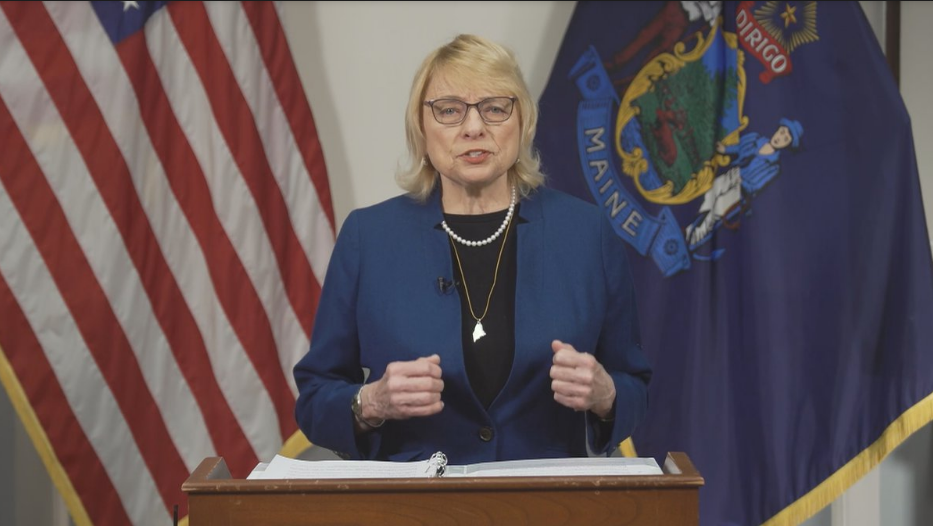
While the subject of school choice was largely absent in Maine Gov. Janet Mills’ recent bid for re-election, her platform emphasized her belief that all children deserve equal access to the same opportunity to attend quality schools, regardless of where they live.
This analysis appeared Wednesday on the 74million.org.
The COVID pandemic — the topic that has dominated education conversations for the past three years — is largely missing from the State of the State addresses that governors are delivering to their legislatures this winter.
Instead, state leaders are using their bully pulpits to call for bigger investments in early learning and in the transition into the workforce and college. They are supporting better pay for public school teachers while pushing for public money to flow to private schools, which could ultimately make it more difficult to fund public school pay increases.
FutureEd analyzed 39 governors’ speeches and partnered with The 74 to convert our analysis into a series of interactive maps. We found that despite the academic gaps exposed in last year’s National Assessment for Educational Progress scores, there was surprisingly little talk of learning loss and efforts to catch students up.
There was also little explicit “culture war” rhetoric around teaching racial history or banning books — and more lofty talk about the value of education.
“Education is a great equalizer in our society,” said Democratic Gov. Janet Mills in her Feb. 14 address to the Maine legislature. “Every child, regardless of where they live, deserves a world-class education that will prepare them for a successful adulthood.”
Here are some of the topics trending among the nation’s governors this year:
Teaching profession
The teaching profession was a top priority across party lines, with 20 governors discussing ways to improve pay and support educators. Most of those governors proposed raising salaries, largely in response to shortages in their states but also as a way to recognize the important role teachers play.
In Kentucky, Democratic Gov. Andrew Beshear is supporting an across-the-board 5% pay hike, which he called “both vital and necessary to address Kentucky’s shortage of nearly 11,000 public school teachers.”
Idaho Republican Gov. Brad Little also pledged to increase salaries — both for starting teachers and for all instructors — by an average of $6,300 annually because “students and their families deserve quality teachers who are respected and compensated competitively.”
To continue reading, click here.

