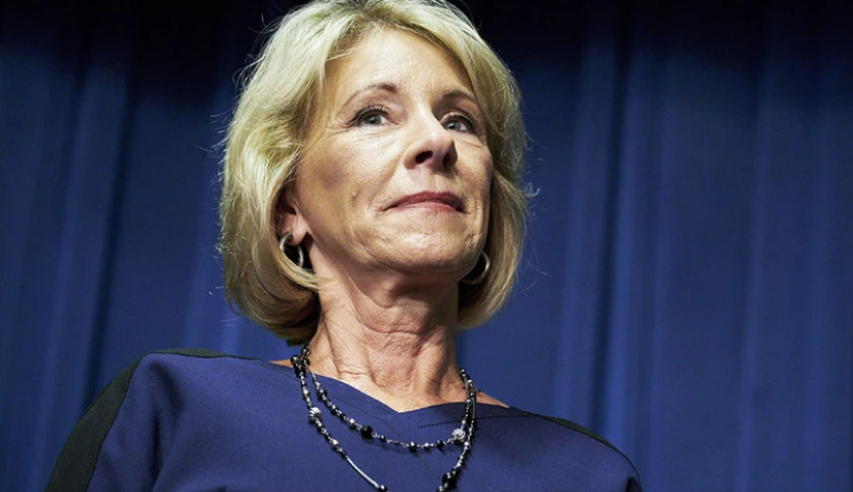
Former U.S. Education Secretary Betsy DeVos has written a new book about the importance of education choice.
Editor’s note: Former U.S. Secretary of Education and longtime education choice champion Betsy DeVos is promoting her new book, “Hostages No More: The Fight for Education Freedom and the Future of the American Child,” which is set to be released on June 21. DeVos recently sat down with her former education department colleague, Denisha Allen. A former state scholarship student, Allen now serves as the director of public relations and content marketing at the American Federation for Children, a national organization that DeVos helped found and chaired before becoming education secretary in 2017. DeVos recalls how she first became interested in the idea of education choice as a young mother of a kindergartener. She also discusses how advocates have approached the issue over the years, how she worked promote education freedom while serving as education secretary, and how the pandemic pushed it to the forefront of parents’ concerns. She also talks about what she hopes readers will learn from the book. Here are some excerpts from the interview.
How DeVos became involved in the education choice movement: My oldest son, Rick, who is now 40 years old, was starting kindergarten. My husband, Dick, and I knew we were going to be able to send our children to whatever school we felt was best for them. So, we were shopping around visiting schools and discovered this amazing little Christian school serving the kids of the neighborhood around there. They had to raise 90 percent of their operating funds every year. Everyone who attended paid what they could. So, I started getting involved in that school, and the more I was there, the more I realized that there were multiple families who would have loved to have their kids in a school like that. So, I started, as we all did…we started trying to make the case to appeal to people through logic or through the lawyerly approaches or the legal side of the case as the reasons for granting education freedom and school choice and quickly realized it was going to take a lot of political muscle as well. And so, those things have developed over the last 30-plus years. But it was solely with a commitment to bringing policy into being in as many states as possible to allow families the kind of freedom they need to find the right fit for their children.
How the pandemic allowed education choice to take center stage: I think the last two years have really laid bare many of the challenges that many of us, if not all of us, have seen during the last number of years in a way people never anticipated. Whether it was lockdowns, mandates, curriculum issues, lack of rigor or a lack of actually learning anything, any number of issues have really brought the whole possibility of education freedom to a whole new level.
Why a book and why now? I didn’t set out to write a book and probably wouldn’t have if not for what unfolded the last couple of years. But again, I think it has really brought attention to the whole issue of education in a way that we couldn’t have anticipated. As you know, all of our focus while we were (in the Department of Education) has been on doing the right thing for students, and all activities were centered around highlighting different schools or different approaches that were bringing unique opportunities to students. The whole notion of rethinking education and the old institutional notion of one-size-fits-all approach, a lot of that work really helped lay the ground in many ways for the discussion we’re having today about bringing broader education freedom to those across the country. So, the book is my way to talk about how we fix education in America, and it brings into it the stories of lives that have been changed and kids who are on a totally different path because of these opportunities, and I hope it helps correct some of the mischaracterizations of my time in Washington and all of us who are involved in offering these types of opportunities through policy to kids in all states.
What is DeVos's main message to readers? I hope that (readers) will take away the notion that education freedom is something we have got to move toward for every student in this country. By education freedom, I should probably give my definition of what that means. I used to talk about school choice, and school choice was and still is a good description of what we’re talking about, but I don’t think it’s broad enough. When we think of school choice, we think of buildings, and I don’t think we have to think of only buildings. We need to think creatively about how kids can experience learning in their K-12 years in ways that we haven’t begun to dream of. And frankly, lots of people have been exploring that during the last two years with all of this COVID reality. So, you have families that have been banding together to in small homeschool consortiums have may become a micro-school. You have individuals who are customizing their education…education freedom, I think provides a new moniker or banner of what school, of what education, could be. I hope people will take away tools they can use to advance this in their own communities and their own state and on behalf of their own children, and I hope it will really encourage policy change to empower families to do just that.
“What do you think of Betsy DeVos?”
I get this question a lot. Family members and longtime friends know me as a left-wing activist with over 30 years of experience advocating for everything from women’s reproductive rights to environmental causes to gun control.
I’m a card-carrying member of the ACLU.
My loved ones trust me.
I’m one of them.
A professional, liberal rabble-rouser.
Surely I hate U.S. Secretary of Education DeVos.
Right?
Wrong.
While I hold many of the most socialist views, I’m adamantly and unapologetically pro-school choice. As executive director of Florida Parent Network, I’ve been helping families protect and defend their choices for over six years.
I consider myself a progressive and yet support a movement that most progressive politicians oppose.
It’s hard for those who see things in tribal terms to come to grips with this idea.
I don’t have a problem with it.
I’ve been thinking for myself for years.
But I get it. There are so many issues, movements and campaigns out there, bombarding us with information every day, and we’re all fatigued by it. Most just want to know where their political leaders and champions come down on an issue. That’s how they know where they stand as well.
It’s not that they’re lazy or uninterested.
They’re overwhelmed.
I’m Irish and Jewish. A pro-choice feminist from a strong pro-life family. I’m a vegetarian who cooks chicken for friends and loved ones. I’m an anti-capitalist who routinely partners with Americans for Prosperity. I’m the granddaughter of Teamsters who thinks the teachers unions have done serious harm to American education.
I volunteer for Bernie Sanders.
I’m overwhelmed, too, but I don’t get to rely on my political heroes because I don’t have any. I don’t enjoy the privilege of deferring to someone else’s judgment.
I must research and dig for answers to find out how I think.
This means I’m exhausted most of the time.
I was fortunate this week to attend the American Federation for Children’s annual summit in Chicago, networking with educational choice activists from all over the country.
Our education secretary was the keynote speaker.
Here comes that question again.
What do I think of Betsy DeVos?
I like her.
This answer surprises everyone I know.
I agree with her on one issue, educational choice, but I find her agreeable in every way. In the few conversations we’ve had, she has proven herself to be open-minded, kind and generous.
My friends hate when I report this.
“You hardly like anyone, and you like her?”
My genuine and nuanced view of a divisive political figure causes those who trust me to think twice before dismissing someone based on what others think.
In this day and age, that’s a good thing.
Years ago, when Florida started the Gardiner Scholarship program, the Legislature didn’t allocate funding for Step Up for Students (which hosts this blog) to run it properly. Betsy made a personal donation to help us get started. It is a shame that parents, who’ve benefited from this program, have no idea how much she helped them.
She continues to work for children and families all over this country.
Betsy’s is an inclusive message, encouraging us to think outside the box about all the ways personalized learning can help our kids. At the AFC Summit Thursday night, she talked about post-high school learning, other than four-year colleges, that can open up a whole new world regarding career and technical education for our kids. She talked about establishing a federal tax credit scholarship program and the ways in which teachers should be able to control their own personal and professional development.
As she has often said, our movement is about more than vouchers.
I tell advocates in Florida that we don’t have to worry about the mess in D.C. and I follow that same advice. We are a statewide program. We don’t need to argue with opponents about Congress or the White House.
I liked and respected Betsy before she became education secretary and the mess that is D.C. has not changed that.
When asked about how she maintains civility and poise in the midst of such partisan vitriol and anger, Betsy said simply that she applies advice given to her by her father. Turn the page, he would say after challenging episodes. Keep moving. Start the next chapter.
That’s advice that will help all of us as we leave this summit of like-minded folks and tread back into a polarized country. I will keep thinking for myself and puzzling liberal loved ones. Betsy will continue advocating for those who need help the most. And all of us will keep moving.
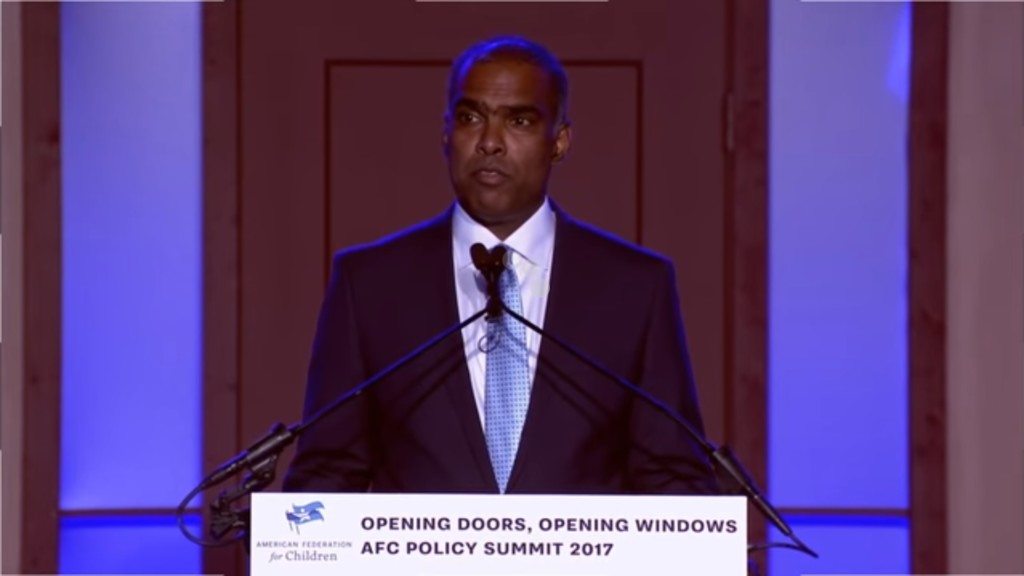
Sajan George, the founder of Matchbook Learning, gives the closing address at the American Federation for Children's annual policy summit.
Educators and policymakers at the American Federation of Children's annual summit in Indianapolis this week were all speaking in unison about a shift in the classroom that they believe will improve student achievement: personalizing learning to meet the needs of individual students, allowing them to learn at their own pace.
A week earlier, at a separate event, the New Schools Venture Fund Summit sounded a similar theme.
Personalized learning has been a talking point in education policy circles for years. Some skeptics argue that what some people call "personalization," is really just a new-fangled buzzword for plain good teaching that takes students' individual needs and abilities into account.
Still, the buzz coming out of education conferences shows how personalized learning has become a focal point for philanthropists and practitioners. During a time of growing ideological division, it is one of the few concepts that still unites disparate wings of the education reform movement.
At the ACF summit, former Florida Gov. Jeb Bush said customizing learning and considering the “uniqueness” of each student is a critical step in the future of education.
“Students learn in different ways,” he said.
Bush said only one-third of the country’s children are college or career ready — a statistic he said illustrates the urgency of improving education for every child. (more…)

