Emerging Minds Montessori Academy school officials say low-income students fare better with a Montessori education.
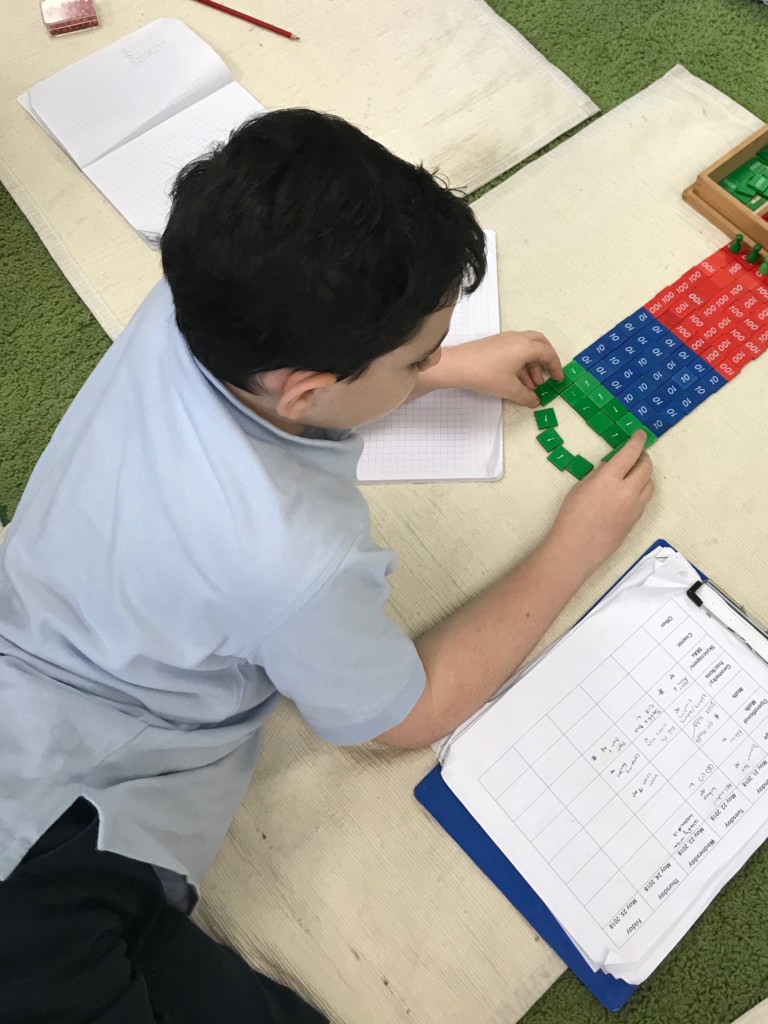
Sitting on the floor cross-legged with his hands to his sides, the student was focused. He had a long division problem to solve.
But he was not going to solve it the conventional way, with a pad of paper and a pen.
The student took several squares with numbers on them and arranged them physically on the floor, so he could count them out and visually come to the answer. The multi-colored squares each represented different numbers: 1000s, 100s and 10s.
Rows of squares lined the floor vertically and horizontally as the student worked through the problem 4518 divided by 6, coming to the answer: 753.
He grinned. Other students around him were also sitting on the ground solving their own math problems. In another classroom, students were having a book discussion, and in another, they were learning to write essays. Teachers served as facilitators, while students took ownership of their learning by choosing the lessons they wanted to learn. They worked independently.
Students of all backgrounds can excel at Emerging Minds Montessori School in Boca Raton, Fla. The school groups children ages 3-6 grouped together, as well as 6-9-year-olds and 9-to-12-year olds. School officials say they focus on the needs of the whole child. They emphasize hands-on-activities and self-directed learning. When students arrive at the school behind academically, they often catch up in a few years' time. A study released by the University of Virginia showed that Montessori schools help keep pace with their peers — where, with other educational models, they often fall behind.
“In my opinion, because children who come from lower income families don’t have the same family support the student needs a more enriched environment,” said Jeanne Weigel, head of school academics at Emerging Minds. “It is a self-motivating curriculum that allows the children to follow their already holistic needs.” (more…)

