Recently Andy Rotherham tweeted and then wrote about the below image. Our own Travis Pillow then noted that both charter schools and ESAs were doing great in Florida at the same time. By the way, the character labeled “Republicans” could have just as easily been called “Families.”
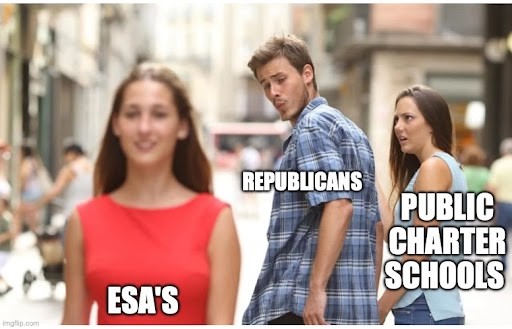
Your humble author is member of the “all of the above!” choice tribe, and thus wants to see progress for charters, vouchers, open-enrollment policies, home-schooling, tuition tax credits, you name it. The growth in the charter movement however has stalled:
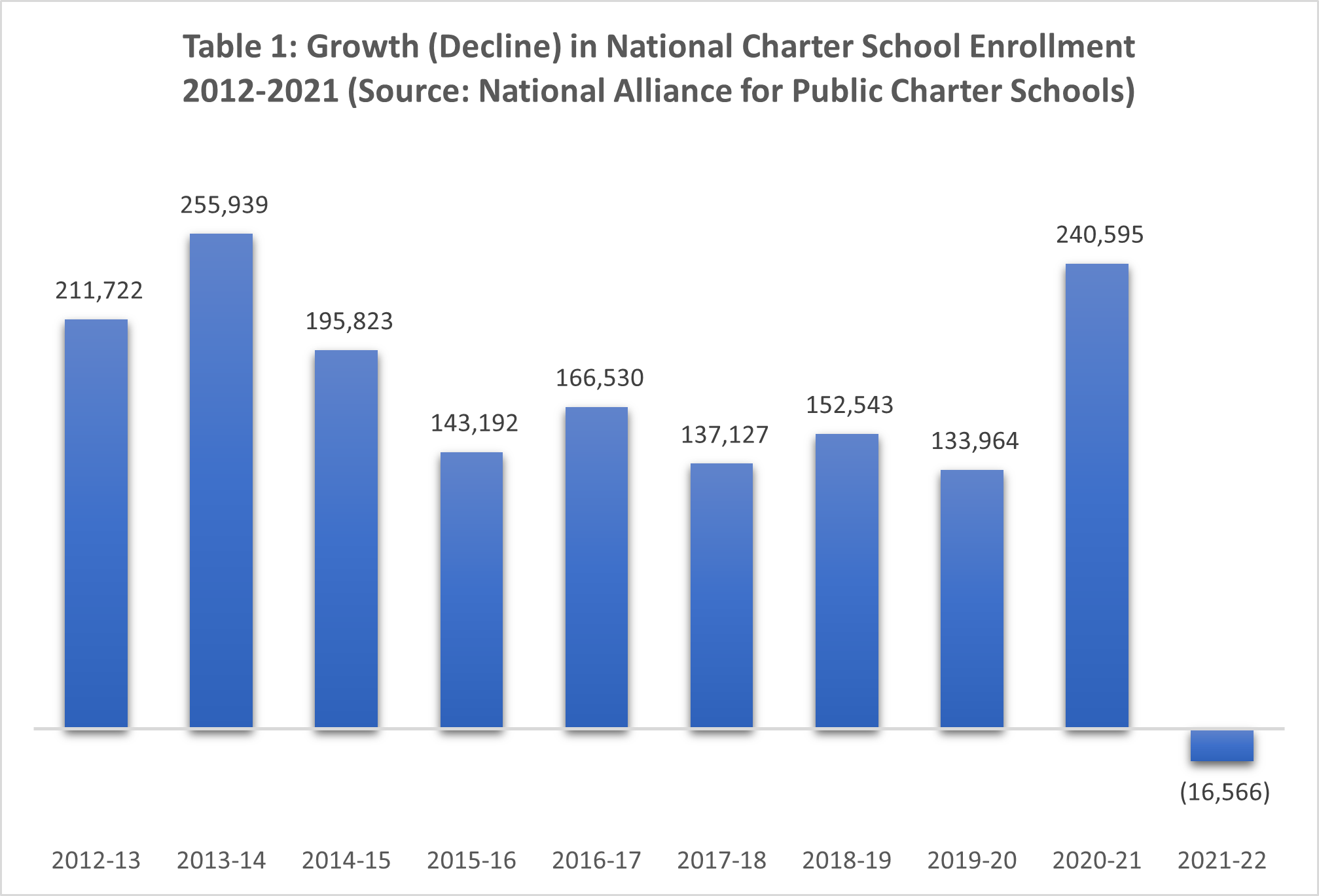
Mind you that FIVE new charter school laws passed during the period covered in the above chart. None of them however resulted in very many “charter schools” opening (insert standing Dr. Malcolm joke about here). The enrollment reduction in 2021-22 may have been the first in charter school history, time will tell if it was an COVID anomaly or a start of a worrisome trend.
What clearly is already a worrying trend is the decline in the opening of new charter schools- again despite multiple state laws debuting during the period covered by the below chart.
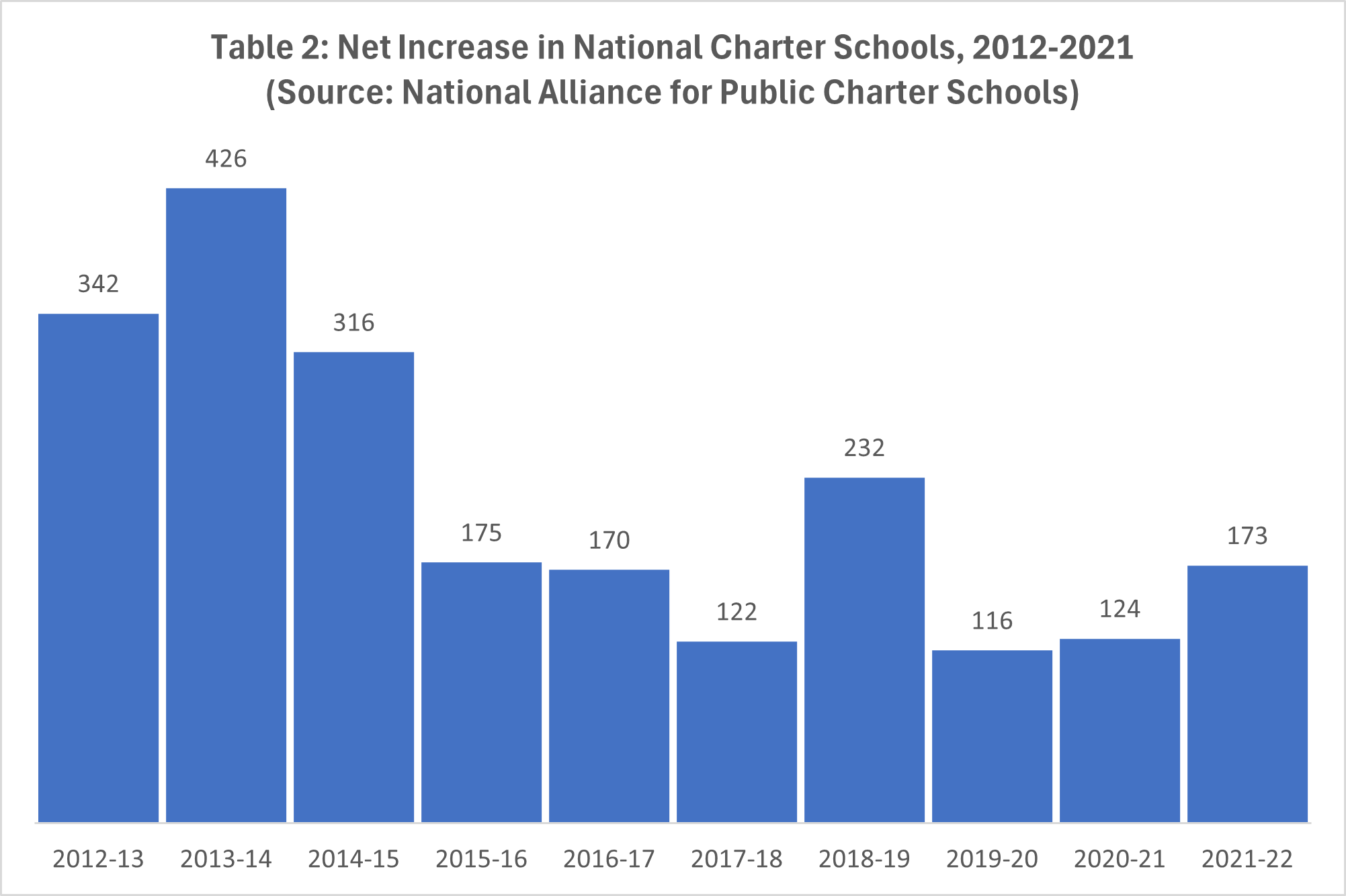
Earlier posts posited a heat death of the charter school universe due to a Baptist and Bootlegger problem whereby incumbent charters (the Bootleggers) team up with charter opponents to limit competition- 900 page application requirements that a large CMO can have their legal department cut and paste from previous applications seem transparently designed to keep mom and pop operators out.

The National Alliance for Public Charter Schools has a new President in Starlee Coleman. With luck and God’s help, perhaps she can get the charter school movement from dying of ennui like some character in a 1980s French existential film of the sort that Americans now have the good sense not to watch.
Put me down as rooting for Starlee and doing my best to provide constructive criticism. Not to be too complacent, the private school choice movement needs to beware of the Baptist and Bootlegger problem as well.
More on that next week.
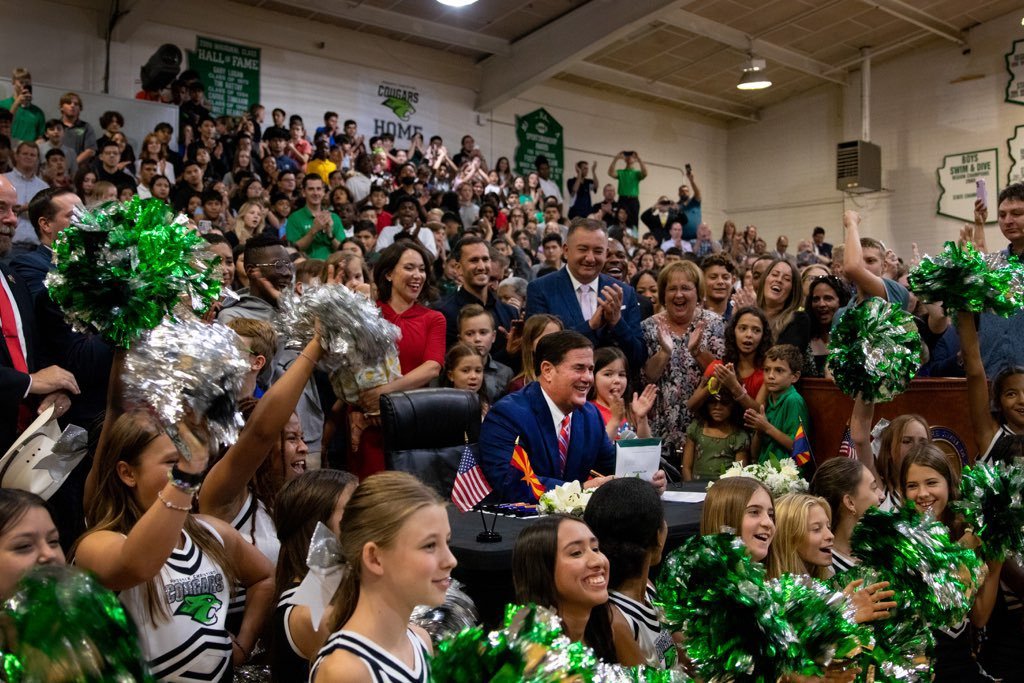
Arizona Gov. Doug Ducey joins students and families to celebrate historic legislation establishing education savings accounts for all students in the state. Photo courtesy of the Governor's Office
Editor's note: The following is a news release from the Arizona Governor's Office
Arizona Gov. Doug Ducey on Tuesday joined families, educators and community leaders to celebrate Arizona’s successful effort to ensure every Arizona student can attend any school of their choosing.
“Arizona is now the gold standard for educational freedom in America,” Ducey said in a news release. “Our kids will no longer be stuck in under-performing schools. We’re unlocking their educational potential and advancing a bold new era of learning opportunities. Parents and teachers know there is no one-size-fits-all model to education. Kids and families should be able to access the school or learning program that best fits their unique needs — regardless of income or where they live. In Arizona, we’re making sure they have that choice.”
The governor spoke today at Phoenix Christian Preparatory School alongside parents and their kids who have benefitted from Arizona’s Empowerment Scholarship Accounts (ESA), as he signed a bill that opens the scholarship program to every K-12 student in Arizona.
The legislation, sponsored by Rep. Ben Toma, has been lauded as the most expansive school choice initiative in the nation.
“I was proud to continue the Arizona tradition of leading on school choice and bring educational freedom to more than 1.1 million students,” said Toma, the House majority leader. “By opening Empowerment Scholarship Accounts to every K-12 student, we will improve outcomes and make choice a reality for all students. This session, we stood together to get this done for Arizona students and parents. Governor Ducey has been an invaluable partner in transforming school choice in our state, leading the way in unlocking the schoolhouse door.”
With ESAs open to all students, Arizona solidified its position as the gold standard for educational freedom. In a story published today, Chris Rufo, senior fellow at the Manhattan Institute, said “universal school choice has long been the Holy Grail for conservative education reformers. Governor Ducey has achieved it.”
The ceremony at Phoenix Christian was highlighted by elementary schoolers singing a welcome song and stories from Arizona families of how school choice has unlocked their children’s full potential.
One of those parents is Jenny Clark, who, after her own children’s positive experience with ESAs, has helped other parents take the opportunity the program presents.
“Arizona’s Empowerment Scholarship Account program is truly life-changing for so many of our state’s children,” Clark said. “My five children have benefitted from ESAs and I can’t help but think how many kids don’t get the help they need. Now, they will. Every child in Arizona will have the same opportunities and ability to get the education tailored to their needs. Governor Ducey has led on this issue, expanding school choice to every family.”
Parent Annie Meade has seen firsthand how Arizona’s education options can impact a child’s education. Her four children have had a combination of homeschool, microschool and public education. Universal ESAs stand to bring new opportunities to her kids, who are now all eligible. Meade spoke about her enthusiasm for the education savings accounts at the ceremony today.
“Kids deserve to be in the education environment in which they can thrive, but so many families have been limited by their income, or zip code,” said Meade. “The Empowerment Scholarship Account program was something that I learned about from other friends who had qualified, but unfortunately, our family never had access to the scholarship, until now. The passage and signing of H.B. 2853 means that now every Arizona family will have the freedom, the choice, and the opportunity to choose an ESA for their child’s education…Thank you again, Rep. Ben Toma, and Governor Doug Ducey, for making this scholarship a reality for families like mine.”
The students at Phoenix Christian are no strangers to the benefits of education savings accounts. Jeff Blake, the school’s superintendent, spoke about the resources and one-on-one learning students receive at his school.
“At Phoenix Christian Preparatory, we are proud to have 31 students on Empowerment Scholarship Accounts,” Blake said. “This funding has helped our school serve many students in need and bring them an education that best suits them. With universal school choice, we’ll be able to serve more students with an exceptional education. We’re grateful for the foresight and leadership of Governor Ducey and the Arizona Legislature for prioritizing every K-12 student.”
Drew Anderson, senior pastor of First Watch Ministries and Legacy Christian Center in South Phoenix has worked with kids in his South Phoenix community to achieve academic success.
“Education is the great equalizer in America,” he said. “If we are able to give our lower-income families and minorities with better education, we’re unlocking the doors to success for so many who are often left behind. As a pastor I’ve seen too many of our black and brown children struggling, just looking for some guidance on homework. I’m grateful to Governor Ducey and the Legislature for saving our kids.”
Arizona families who participate in ESAs would receive more than $6,500 per year per child for private school, homeschooling, microschools, tutoring, or any other kinds of educational service that helps meet the needs of their students outside the traditional public school system.
Janelle Wood, founder of the Black Mothers Forum, spoke about the partnership she formed with Governor Ducey starting in 2020 to “fight to make sure our black children have an opportunity to live and breathe in a safe and supportive community whether that be a learning community, in their living community or in their homes.”
Wood continued, “As a concerned black mother, I want to make sure that we are heard loud and clear from this day forth. We matter, our children matter and we’re not going anywhere. We’re going to keep speaking to each system that holds our families back and our children back.”
Arizona’s universal education savings accounts now serve as the model for the rest of the nation to follow. Education choice advocate Corey DeAngelis, a senior fellow at the American Federation for Children, called the monumental legislation “the biggest school choice victory, not just in Arizona, but in U.S. history.”
Of the unprecedented school choice initiative, DeAngelis said, “This is how you truly empower parents and truly secure parental rights in education. I want to thank Governor Ducey for empowering every single family in the state of Arizona. This is a national model.”
He then led the crowd of students, parents and community members in a chant: “Arizona will now fund students not systems.”
Two important legislators in funding students were Senate President Karen Fann and House Speaker Rusty Bowers.
“Every parent wants nothing more than to see their child succeed,” Fann said. “This session, we committed to expanding educational opportunity. Working with Governor Ducey and the Arizona House, we delivered. Each and every Arizona student has access to an education environment that will suit their needs. The Empowerment Scholarship Account will transform education in our state and bring unlocked potential to our kids.”
“In Arizona, we fund students, not systems,” Bowers said. “One size does not fit all when it comes to education. Universal Empowerment Scholarship Accounts will ensure the money follows the children as they are enabled to attend the school environment that works best for them. The Arizona House of Representatives has worked collaboratively with Governor Ducey for years to expand school choice for every student. Today, we celebrate the empowerment of 1.1 million students and their parents to choose the learning environment they need.”

ReSchool Colorado would serve up to 200,000 Denver students, covering the cost of museum trips, summer camps, tutoring and more.
Two Denver-based non-profits are working to expand learning experiences outside classroom walls.
ReSchool Colorado is partnering with the Donnell-Kay Foundation on a state ballot initiative that would establish a state-funded out-of-school learning program for low-income students.
Initial plans call for $300 million in state funding over six years to serve up 200,000 students. The initiative, which the organizations hope to place on the 2020 ballot, could cover costs of museum trips, summer camps, tutoring and music programs, among other learning activities.
Tony Lewis, the chairman of ReSchool Colorado’s board who also serves on Donnell-Kay’s board of trustees, sees the potential program as critically important.
“Students learn everywhere, all the time,” Lewis said.
He and Amy Anderson, executive director of ReSchool Colorado, said they believe that much of what students learn comes from outside the classroom, and that those experiences can help students develop unknown talents and increase their interest in learning.
Lewis said the program would be administered similarly to how Florida manages the Gardiner Scholarship for students with certain special needs. The state funded-Gardiner program was established in 2014 and served nearly 12,000 students in 2018-19.
(The Gardiner Scholarship is managed by Step Up For Students, which hosts this blog.)
“This isn’t a slam dunk,” Lewis said. “There’s no non-profit that currently exists that could run this.”
ReSchool Colorado was formed by Donnell-Kay in 2013 to help families navigate a changing educational landscape and identify out-of-school learning opportunities.
Donnell-Kay works to improve public education in Colorado by focusing on research and policy issues; the foundation invests in projects and programs to strengthen learning experiences for students “from birth to career,” according to its website.
ReSchool Colorado focuses on lower-income families, many of whom aren’t as exposed to information about out-of-school opportunities – or have the means to afford them – as more affluent families.
“If you have resources, you can get the best for your kids in and out of school,” Anderson said. “You can do things over the summer and after school. Other families don’t have those resources or access to those experiences.”
Last year, ReSchool Colorado partnered with Blueprint4, a St. Louis, Mo., organization that developed a website to help lower-income families in the St. Louis area learn about out-of-school educational opportunities. Similarly, Blueprint4SummerCO helps lower-income families around Denver access thousands of summer activities and learning opportunities.
To further assist families, ReSchool Colorado partners with two local hospitals to offer “learner advocates” as an employee benefit. Advocates help parents and students “navigate their educational journey and build a more purposeful path,” Anderson said.
The organization has also worked with entities such as the Boulder Housing Authority to help lower-income families access information about out-of-school learning opportunities in that area.
“We’re operating in a place where you’re not competing but enhancing education and exploring different outcomes,” Anderson said. “We’re working with parents and students to try new concepts. It’s rethinking education.”
Lewis acknowledged that the ballot initiative plan is ambitious. Under Colorado law, 124,632 valid signatures are needed to place the measure on the 2020 ballot.
“That essentially means one has to collect approximately 200,000 signatures given that a percentage are usually invalid for a variety of reasons,” Lewis said.
“This would be a revolutionary step,” Lewis said, because those kinds of programs are usually established through a state’s Legislature. “Our intent is to show the state that people will choose wisely how to spend the money.”
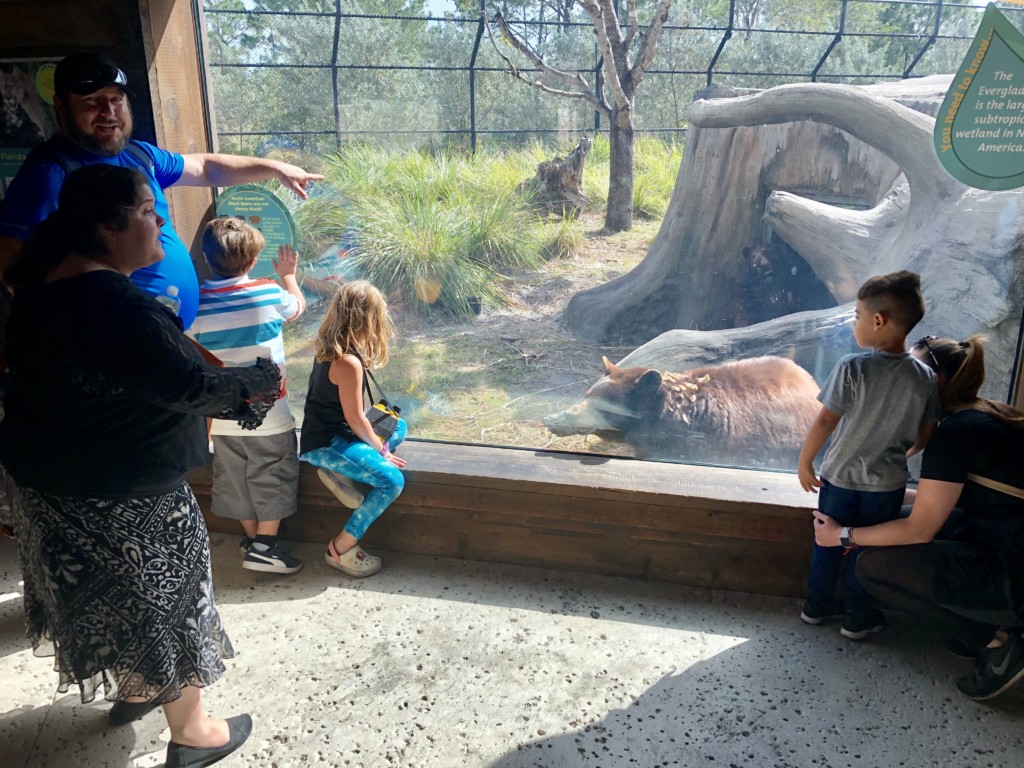
Ana Garcia’s home education cluster includes a total of seven students, including five with autism who use the Gardiner Scholarship, an education savings account in Florida for students with special needs. Joining Garcia (at front left) on a field trip to Zoo Miami last month was, from left to right, her husband Daniel; her son Kevin, 9; her daughter Khloe, 7; Angelo, 6; and Briana, a paraprofessional.
MIAMI – “Guys! Choo-choo formation!” At Ana Garcia’s command, a loose knot of people near the turnstiles at Zoo Miami – three adults, five kids – lined up, put their hands on the back shoulders of the person in front of them, and merged into something less locomotive than caterpillar. Sixteen feet proceeded on a motley ramble. Crocodiles awaited in the Everglades section, along with plenty of carefully guided learning.
So it goes on the education frontier.
Over the next few hours, Garcia, a public-school teacher turned pioneer, subtly steered her students toward goals in their personalized education plans. Project-based learning for one. Ecology for another. Speech therapy for another. She put special focus on the three with autism, including her 9-year-old son, Kevin.
Those students, and two others not in attendance, benefit from a learning option that is revolutionary but under the radar: a state-funded education savings account. It’s ESAs that make Garcia’s home education cluster – and perhaps, someday, a never-ending array of other clusters – possible. Without them, the landscapers, Uber drivers and Dollar Tree clerks who’ve entrusted Garcia with the education of their children would be limited to schools that don’t work for their children.
Garcia knows what that’s like. She endured a nightmare school experience with Kevin before getting an ESA for students with special needs. She says it changed his life – and hers.
“Parents don’t have to fear any more that they only have one choice,” Garcia said.
Neither do teachers.
* * *
 Ana Garcia has a little Mary Poppins about her, no-nonsense but upbeat, with a drive to stoke curiosity that borders on fantastic. Walt Disney is her hero. Some saw swamp; he saw magic kingdom. Garcia feels that about the landscape in education. Her great-grandmother was a teacher in Cuba. Her aunts were teachers. As a kid, her playroom was furnished with a blackboard and old textbooks, and her dolls were her class. Now when she switches into teacher mode, she decelerates her … rapid … fire … speech … until she’s sure her student is catching on.
“My favorite thing to hear,” she said, “is, ‘Wow miss, no one has ever taught me the way you have, or explained things the way you do.’ “
Garcia loved teaching in district schools. But over the course of a decade, the passion ebbed. Too many mandates. Too much violence. Too little help, in her view, for students with disabilities.
Frustrations began to mount for Garcia the mom, too.
In Pre-K, Kevin was happy and learning in his neighborhood school, in a class with five kids and two teachers. But for kindergarten, he was assigned to an inclusion class with 25 kids, one teacher and one “floating” teacher who toggled between multiple classrooms. Garcia said Kevin’s clothes weren’t being changed when he soiled himself. He wasn’t being fed.
Then Kevin began escaping from class and, somehow, running all the way to a parking lot before being stopped. The first time, Garcia was frightened. The second time, shocked. The third time, angry.
In 2014, after 12 years as a middle school English teacher, curriculum specialist and school-level director for accountability and instruction, Garcia called it quits.
* * *
But this is a story about education in Florida. So that’s not where it ends.
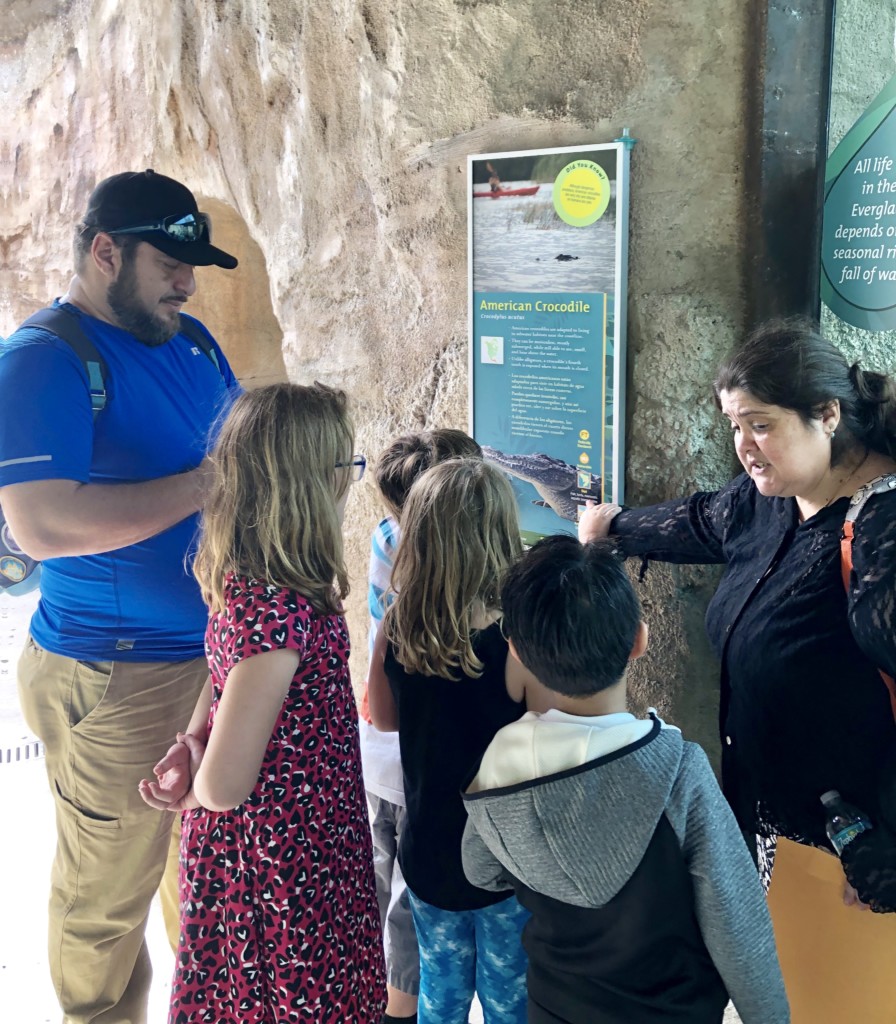
Each of Ana Garcia’s home education students has a personalized education plan, which she’s aligned with the state of Florida’s education standards. Garcia worked in public schools for 12 years as a middle school English teacher, curriculum specialist and school-level director for accountability and instruction.
At the zoo, Garcia’s 11-year-old, Gabriella, took photos of black bears and gopher tortoises so she could create a brochure. Her 7-year-old, Khloe, immersed herself in geography. Kevin collected data from exhibit signs, focusing on adaptive traits like bioluminescence.
Garcia knows where each student stands with their learning plans, which she has aligned with Florida education standards. She nudged each towards their targets.
At the Gator Hole, she shifted attention to Angelo, who is 6 and mostly non-verbal. She pointed to a blue crayfish. “What is that Angelo?” she said.
“A crab,” he said.
Not quite, but close enough. And another step for a boy whose gentle face belies a kid once prone to fighting and biting.
Garcia left the district, but she didn’t leave teaching. She just joined the mutiny.
Her cluster isn’t quite sustainable yet, but education savings accounts gives her hope it can be. The main one in Florida (and biggest in the country) is the Gardiner Scholarship. Created by the Florida Legislature in 2014, it now serves 11,276 students with special needs such as autism and Down syndrome, with nearly 1,900 more on a waiting list. (It’s administered by nonprofits like Step Up For Students, which hosts this blog.) Each scholarship is worth about $10,000 a year, and parents can use it for a wide variety of programs and services, including tuition, therapies, tutors, technology, curriculum – whatever a la carte combination they think best.
Angelo’s mom, Vilma Moran, considered several schools. But all wanted to place him in self-contained special education classes where she didn’t think he’d learn. When Angelo started with Miss Ana, he wasn’t talking, didn’t seem to recognize his mom and dad, and showed no emotion.
Now, Angelo loves dinosaurs and laughs at funny videos. Now he greets people by name.
“When we go somewhere, like the zoo, he’ll say, ‘Let’s go see the elephants,’ ” said Moran, who installs fences for a living. “He wasn’t like that two years ago.”
* * *
Kevin is terrified of thunder.
But as Garcia described in The 74, she used the ESA to ease his anxiety – and learn science in the process.
She worked with Kevin’s therapists and tutor to develop lesson plans around the subject of thunder and lightning. The therapists showed him pictures and videos of lightning, taught him calming techniques, and worked with him on articulating why he was scared. The tutor taught him how clouds form and what causes thunder. Knowledge reduced his fear.
“Sometimes, things need to be micro,” Garcia said. In a school district, “you can’t possibly tailor everything to every child. There needs to be a middle ground somewhere. There needs to be a hybrid.”
Or lots of hybrids.
Off the grid, homeschoolers are DIYing into increasingly sophisticated co-ops and enrichment programs. Micro-schools, whether mini-chains or one-offs, are pushing the limits of what’s possible. In Florida, choice scholarships are giving a more diverse mix of parents the opportunity to go small or go home.
Garcia envisions a micro-school that can also serve home education students who want part-time services, combined with a center for Applied Behavioral Analysis. In the meantime, she’s the mutineer at the heart of her cluster, connected to a blooming constellation of other clusters.
For example, a paraprofessional, training to becoming a registered behavioral therapist, joined Garcia and Garcia’s husband on the zoo trip. The five autistic students in Garcia’s orbit all go to the same ABA center, but each is served by different speech, occupational and physical therapists. Kevin has his own tutor, a certified teacher who executes a plan Garcia designed. But the tutor also works with other students in other settings. Once education is de-coupled from school, the potential matches of students and teachers becomes infinite.
Garcia arranged swimming lessons at the Y for some of her students, biscuit-making at Red Lobster for others. Music and martial arts classes are on tap, along with lessons in table manners at Cracker Barrel.
So it goes on the frontier.
* * *
The Miami-Dade school district has 350,456 students, counting 68,487 in charter schools. Throw in private schools, and Miami-Dade has 425,000 students. Competition between sectors may be the most intense in America. And if test scores and grad rates are any indication, students are benefitting.
But none of those schools, so good for so many, were good for Kevin and Angelo. Garcia’s micro-cluster is.
Will it last? Garcia thinks it can work financially with a few more students. But it’s complicated on the edge, and there is no trail. She said she’ll keep pressing to figure it out, and more pioneers every day will do the same.
“If it’s not me,” she said, “it’ll be somebody else.”

Step Up For Students President Doug Tuthill writes that Education Savings Accounts (ESAs) provide the best opportunity for turning public education into an effective and efficient market
Markets are like gravity. They are everywhere.
Markets are where supply meets demand. They are how we access the things we need and want, including food, clothing, housing, friends, media, health care, romantic partners, entertainment, and education. Even those needing kidney transplants are dependent on well-designed markets.
Public education also is a market -- unfortunately, a poorly functioning one, especially for low-income and minority children, and most teachers.
I’ve been working to improve public education for 42 years. My primary lesson learned is that a well-designed market is a necessary condition before improvements can be systemic, sustainable, effective, and efficient.
Effective and efficient markets invite people to challenge themselves, to take risks, to develop their strengths, to help others, and to contribute to the public good.
Effective markets share some common traits:
Public education has few of the characteristics of an effective market:
Over the last 30-plus years, the gradual expansion of education choice has begun to turn some sectors of public education into slightly more effective markets. Magnet schools, charter schools, dual-enrollment programs, virtual schools, and open-enrollment programs are providing public school students with more choices. Unfortunately, these choices are highly regulated and generally resistant to innovation. Tax credit scholarships and vouchers are giving more students access to private schools, which is enabling more educators to open new schools. But while private schools are less regulated, they are usually underfunded and incapable of investing in the staff, technology, and training necessary to create and sustain effective innovations.
Education Savings Accounts (ESAs) are the latest entry in the education choice space and provide the best opportunity for turning public education into an effective and efficient market. The nation’s largest ESA is Florida’s Gardiner Scholarship for students with unique abilities, which our nonprofit, Step Up For Students (SUFS), helps administer. Most Gardiner students are on the autism spectrum. The average Gardiner ESA is about $10,000. (Editor's Note: Step Up For Students publishes this blog.)
Once a child qualifies for the Gardiner ESA, state government transfers the appropriate funds to SUFS, which we then deposit into a family-specific bank account. Families may spend these funds on an array of state-authorized education products and services, including physical therapy, occupational therapy, tutoring, curriculum materials, education hardware and software, and schools. Gardiner families may purchase services from district, charter, virtual, home, and private schools.
Families are using their ESA funds to customize their children’s education. Entrepreneurial educators are responding by creating a plethora of flexible, innovative education programs that Gardiner families are purchasing. On any given day, a Gardiner ESA student may, for example, receive instruction from a magnet school, an occupational therapist, a tutor, a virtual school, math manipulatives, and education software.
ESAs are beginning to introduce some healthy market features into Florida’s public education system. Because families have the public funds to purchase services directly from educators, the barriers to entry for new providers are lowering. Parents are purchasing afterschool and summer remediation and enrichment services directly from classroom teachers, charter and district schools are customizing programs for struggling readers using a new reading ESA for public school students, and parents are able to afford a variety of customized services from physical and occupational therapists.
A huge challenge -- and opportunity -- moving forward will be helping families access the information they need to make good purchasing decisions with their ESA funds. A market’s effectiveness and efficiency are, in part, dependent on the quality of the choices consumers make. If parents are consistently making good choices on behalf of their children, the providers will respond by creating increasingly better educational products and services. If parents are not making good choices, providers do not spend resources on innovation and continual improvement.
SUFS has raised several million dollars from foundations and individuals to build an online infrastructure to facilitate the implementation of ESAs. A key feature will be helping families access the information they need to make the best possible decisions for their children.
Because U.S. public education has never been a healthy market, the infrastructure necessary to support effective and efficient choices must be created from scratch. We’ve begun that process.
Parents of children with special needs are more likely to face challenges in choosing a school for their child, according to a new report.
 As the range of educational choices available to students becomes increasingly diverse, parents have to deal with issues they didn't encounter when children were simply assigned to schools based on where they lived - issues that the report from the Center on Reinventing Public Education says can create barriers to true school choice.
Parents have to grapple with questions, which can often be most difficult for the parents of the most disadvantaged students: What schools are my children eligible to attend? Which school is the best fit? Is transportation available? Who provides it?
For all students to access choice options, the report says, "Leaders need a broader understanding of what’s actually happening where school choice has moved from the margins to the mainstream, including the opportunities and challenges choice brings and under what conditions."
Researchers surveyed 4,000 parents at eight urban school districts around the country where a majority of parents actively choose their schools. They found the most common barriers for parents in those cities were finding out what schools their child was eligible to attend, finding transportation and getting information about schools.
All of those barriers were more pronounced for parents of children with special needs.
Parents of children with special needs were 33 percent more likely to struggle to understand whether their child was eligible to attend a school, 18 percent more likely to cite transportation as a barrier, and 36 percent more likely to find it difficult to get information to make a good choice compared to parents of general education students. Parents of children with special needs were also more likely to identify other issues as barriers, with 20 percent citing confusing paperwork, 21 percent identifying the large number of applications, and 24 percent citing different application deadlines.
The researchers also looked at 35 high-choice cities around the country, and found "city school systems are often governed by a patchwork of school districts, charter authorizers, and charter school operators. This state of affairs makes it difficult for city leaders to address crosscutting issues (such as parent information systems or transportation) that affect everyone but are no one’s responsibility."

Arizona: A former school teacher criticizes the state superintendent of public instruction for his support of Common Core and school choice (East Valley Tribune). The Sierra Vista Herald editorial board says the state superintendent's support of ESAs hurts public schools. Applications for Empowerment Scholarship Accounts doubles (Heartlander). The Arizona Republic editorial board opposes allowing public funding to go to private schools, especially now that the state support for ESAs exceeds the state support for public schools (note: the editorial board's calculation excludes local support for public schools). A consultant at a scholarship organization is indicted for stealing $529,000 in scholarship money (Arizona Republic).
California: Vanila Singh, a professor and physician at Stanford University and congressional candidate, says school choice is the key to student success (Mercury News). The California Charter Schools Association has sued the West Contra Costa School District for withholding tax revenue intended to fund charter schools (Contra Costa Times). Charter schools struggle with online assessments (FSRN Radio).
D.C.: Two charter schools allegedly under federal investigation for possible discrimination say they have never received a complaint from a student or parent (Washington Post). President Obama sends his daughters to Sidwell Friends, an elite private school that refuses to release information on student course completion and graduation rates (Washington Post).
Florida: The tax-credit scholarship expansion will allow the program to serve higher-income families (Education Week, Tampa Tribune, WJHG TV). More low-income families will benefit from the tax-credit scholarship program if the Governor signs the bill into law (Florida Times-Union). The state passes the nation's second education savings account program (Foundation for Excellence in Education). Daphne Cambell (D-Miami-Dade) says she voted to expand the program because giving poor kids more options is the right thing to do (Miami Herald). The Tampa Tribune editorial board says the scholarship expansion is justified because every student deserves to find a school that works well for them. Brian Tilson, owner of a communications firm in Boca Raton, says the scholarships are unpopular and are hurting public schools (Gainesville Sun). Ron Matus, the editor of redefinED, says more progressive Democrats support parental choice (Gainesville Sun). The scholarship program helps families afford Jewish day schools (Chabad News). State Impact talks with Sen. John Legg about the legislative session including the passage of the scholarship bill. Marc Yacht, a retired physician, say charter schools should be more regulated and held to the same standards and rules as traditional public schools (Sun Sentinel).
Georgia: The Southern Education Foundation helps file a suit to overturn the state's tax-credit scholarship program (Watchdog). A former reporter sends her daughter to a charter school and says each school is so different it is difficult to compare them to each other let alone public schools, and that is a good thing (Atlanta Journal Constitution). (more…)
Arizona: The Tucson Diocese School Board says parents can be trusted to decide on the education for their own children (Arizona Daily Star). Gov. Jan Brewer signs a bill to expedite the approval process for parents seeking Empowerment Scholarship Accounts (Associated Press). The state superintendent of public instruction will increase scholarship amounts to 90 percent of the funding for charter schools after the state legislature declines to clarify the voucher funding limits (Capitol Media Service). The Jewish Tuition Organization raises $2.9 million to fund scholarships for seven Jewish day schools in the state (Jewish News).
Colorado: The Coloradan chronicles the six charter schools of Fort Collins.
Connecticut: Charter schools in the state receive about $3,000 less per pupil (New Haven Register). Education leaders in Bridgeport and Stamford consider taking legal action to stop more charter schools from opening in the cities (Connecticut Post, Associated Press). Education reform groups representing many different interests, including charter schools and school choice, work to shape education policy in the state (Middletown Press News).
Florida: A bill to expand the tax-credit scholarship program and create an education savings accounts program stalls on Thursday (Associated Press, Politifix) but passes out of the Senate and House the next day (Associated Press, redefinED, Tampa Bay Times, WFSU, Florida Current, News Service of Florida, South Florida CBS 6, Miami Herald, Jaypgreene.com). State Sen. Dwight Bullard, D-Miami, an opponent of the scholarship expansion, accuses Step Up For Students of bribery but refuses to offer proof and apologizes for his comments (Palm Beach Post, Orlando Sentinel). (Step Up administers the program and co-hosts this blog.) Opponents rallied to try and defeat the bill (Orlando Sentinel).
A lot of back-and-forth on whether tax credit scholarships are good for English language learners (Voxxi, Tampa Bay Times). Kate Wallace with the Foundation for Florida's Future says school choice helps students and is only a threat to adults worried about keeping their jobs (Context Florida). Educators in both public and private schools say school choice is beneficial to students (redefinED). Valerie Strauss argues "accountability" means everyone should follow the exact same rules, regulations, curriculum and take the same exact tests (Washington Post). John Romano, a columnist for the Tampa Bay Times, calls lawmakers hypocrites for not requiring private schools to follow the same accountability rules as public schools.
The state legislature cuts charter school capital funding support from $91 million to $75 million (Tampa Bay Tribune, redefinED). Charter schools receive less money than traditional district schools (State Impact). The Florida League of Women Voters discuss its study on charter schools on WJCT radio. A school district explores allowing students access to other public schools through open enrollment (Ocala Star Banner). (more…)

Arizona: A bill to allow children of military service members killed in action to become eligible for Empowerment Scholarship Accounts passes into law (Watchdog). Gov. Jan Brewer vetoes a bill to allow owners of S-Corps to receive individual tax credits for donations to scholarship funding organizations, but signs two bills related to Empowerment Scholarship Accounts (Arizona Republic, Associated Press).
California: Two Democrats battle for leadership of California's K-12 system: one backed by the establishment and the other backed by education reformers (Reuters).
Colorado: The school choice oriented school board in Jefferson County looks to provide more equity for charter school funding (Denver Post). Fewer students get their first choice in Denver's public school choice program (Chalkbeat).
D.C.: The D.C.Public Charter School Board hears proposals for eight new charter schools (Washington Post).
Delaware: A charter school principal says charter schools were meant to help improve the quality of public education but not intended to simply duplicate public schools (The News Journal).
Florida: The senate revives a plan to expand the tax-credit scholarship program, but the senate's version is less ambitious than the House version (Education Week, Tampa Bay Times, Florida Current, The Ledger, WFSU, Palm Beach Post, Naples News, Highlands Today, GTN News, St. Augustine Record, redefinED). William Mattox, an education researcher at the James Madison Institute, argues that private schools already face greater accountability because parents, and donors, can leave at any time (Daytona Beach News-Journal). A local public school PTA president favors school choice and says the legislature should expand options, not deny them (Tampa Tribune). The Palm Beach Post editorial board opposes expanding tax-credit scholarship eligibility from 230 percent of poverty to 260 percent because that now represents the middle class. The Orlando Sentinel editorial board opposes expanding the tax-credit scholarships without more accountability, which the editorial board defines as taking the exact same test as public school students. The Tampa Bay Times editorial board believes it is hypocritical to require the FCAT of public schools and students but not of private school students on scholarship. A private school principal says she supports school choice in all its forms because schools that work for one child may not work well for another (Context Florida). A tax-credit scholarship mom says she is thankful for a program that helps build a future for her children and others (Daytona Beach News-Journal). (more…)
Alabama: The Alabama Education Association, which opposes a new tax-credit scholarship program, says former Gov. Bob Riley has personally banked up to $1 million from it (he has made $0) (AL.com). The AEA is spending hundreds of thousands of dollars to back Republican and Democrat candidates to run against lawmakers that support school choice. (AL.com).
Arizona: A bill to expand the education savings accounts program advances in the Senate (Arizona Capitol Times, Associated Press) but is defeated after nine Republicans vote no (Arizona Republic, Arizona Daily Star, Associated Press). Laurie Roberts, a columnist for the Arizona Republic, describes the Empowerment Scholarship Accounts expansion as a bill designed to weaken public schools. The accounts allow families access to special needs funds in order to customize the learning options for their children (Wall Street Journal, Jay P. Greene Blog). The editorial board for the Daily Courier says school choice should remain limited to public schools, including public charters. The accounts allow parents to save money for use in future education, including higher education, and David Saifer, a columnist for Tucson Weekly, seems to think saving money is a terrible idea. So do public education officials (Arizona Capitol Times). A Democrat campaign manager says the accounts will destroy public education (Maricopa.com).
Delaware: State officials approve four new charter schools (The News Journal).
Florida: Steve Knellinger, an administrator at St. Petersburg Christian School, says tax-credit scholarships create more options and help improve student achievement (Tampa Bay Times). A mother of two tax-credit scholarship students is mad the PTA is fighting thel scholarships (Florida Times-Union). James Herzog, director of education for the Florida Conference of Catholic Bishops, says there is good evidence to prove school choice expansion is needed (Palm Beach Post). Gov. Rick Scott is noncommittal on whether private schools accepting scholarship students should take the same state assessment as public schools (State Impact). The Florida Citizens for Science want private schools that accept tax-credit scholarships and vouchers to teach evolution by state standards (Tallahassee Democrat). A former Republican lawmaker says public schools should be fully funded before allowing voucher programs to expand (The Ledger). Frank Cerabino, a columnist with the Palm Beach Post, says school choice has been around for a long time for those who can afford it. The Florida Times-Union editorial board says education achievement is getting better and solving poverty is a better solution to improving schools than attempting school choice. Eileen Roy, a school board member in Alachua County, thinks vouchers will destroy public schools (Gainesville Sun). Former state Senator Al Lawson says tax-credit scholarships serve some of the most disadvantaged students in the state and the program deserves to be expanded (Florida Today).
Democratic lawmakers blame charter schools for a decrease in state appropriated capital funding for public schools (Creative Loafing). Charter school critics claim charters get the lion's share of capital funds but the critics disregard local revenue sources (redefinED). Six single-gender charter schools will open over the next few years in the Jacksonville area (Florida Times-Union). (more…)

