
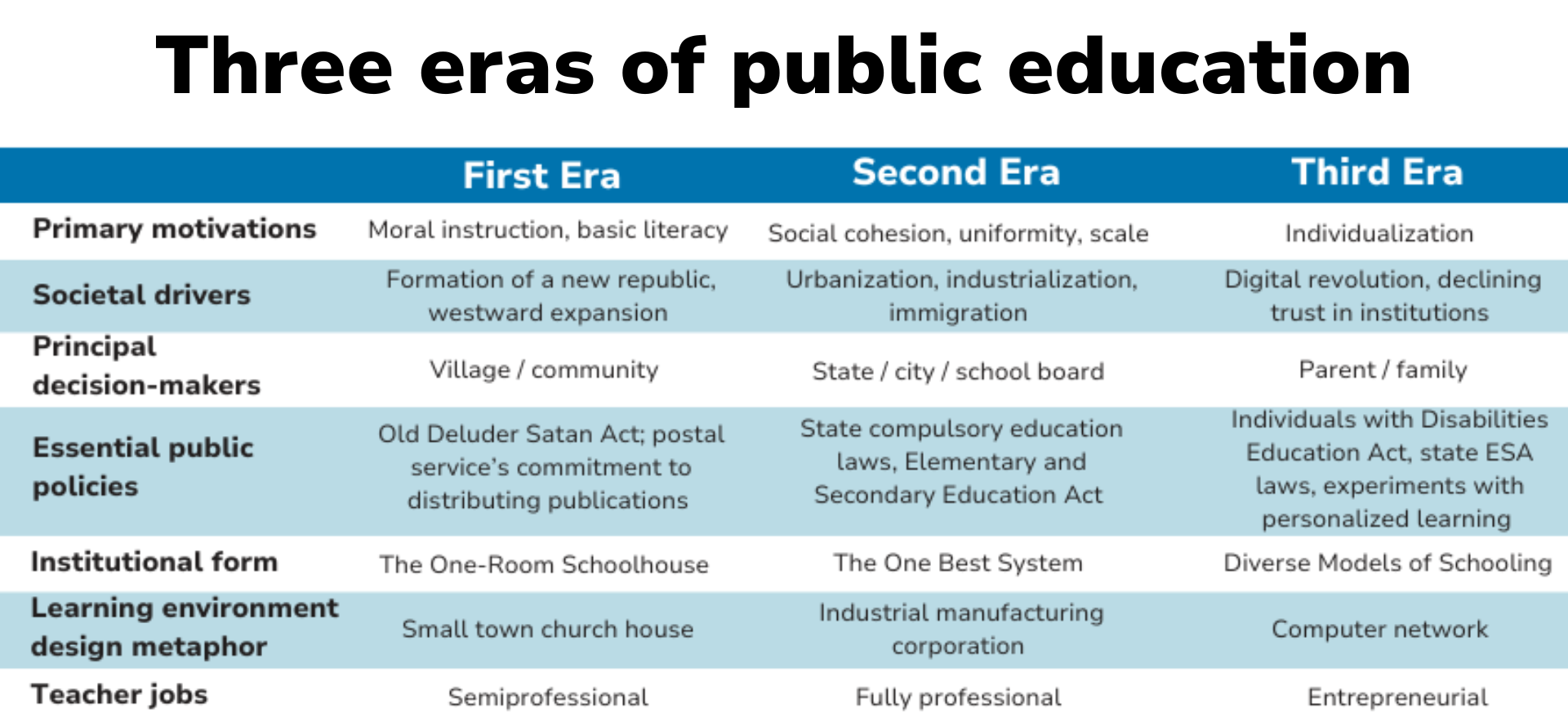
Public education in the United States is transitioning from its second to third paradigm.
Paradigm shifts in public education occur when larger societal changes force public education to change to meet these new conditions. Current technological advances and the accompanying social changes are pushing public education into a new paradigm and a third era.
To best meet society’s current and future needs, this third paradigm aspires to provide every child with an effective and efficient customized education through an effective and efficient public education market.
A paradigm: The lens through which communities do their work
In his 1962 book, “The Structure of Scientific Revolutions,” Thomas Kuhn described a paradigm as the lens through which a community’s members perceive, understand, implement, and evaluate their work. A paradigm includes a set of assumptions and associated methodologies that guide how communities construct meaning and determine what is true and false and right and wrong.
A paradigm shift occurs when inconsistencies, which Kuhn called anomalies, begin to occur, and some community members begin to question their paradigm’s veracity and effectiveness. As these anomalies accumulate, community members begin proposing new ways of understanding and implementing their work and a prolonged contest emerges between the existing paradigm and proposed new paradigms. If a majority of the community ultimately decides a new paradigm enables them to resolve the anomalies and better understand their discipline, this new paradigm is adopted. In scientific communities, Kuhn calls these paradigm shifts scientific revolutions.
Paradigm shifts are disruptive and revolutionary because they require community members to reinterpret all their previous work and adopt new ways of conducting and evaluating their future work. Senior community members are particularly resistant to changing paradigms because their status comes from applying the existing paradigm over many years. Consequently, paradigm changes are rare and require several decades to complete.
Albert Einstein’s General Theory of Relativity (GTR) was a new physics paradigm that challenged Newtonian mechanics and Newton’s law of universal gravitation (i.e., the dominant physics paradigm at the time). It took over 40 years before GTR gained wide acceptance among physicists. Einstein never won a Nobel Prize for GTR because the Swedish physicists on the Nobel committee refused to accept his new paradigm.
Although Kuhn’s work focused on the role of paradigms in scientific communities, his description of how paradigms function and change is relevant for all communities, including public education. The struggle in U.S. colonial times to transition from a monarchy to a democracy was a paradigm shift. It was a revolutionary change in how government works, was fiercely resisted by those in power, and took decades to complete.
Public education’s first paradigm
Public education’s first paradigm began before the United States was a country, when the Massachusetts Bay Colony enacted the “Old Deluder Satan Act” to ensure the colony’s young people learned scripture. As the name of that early legislation implies, this first era prioritized basic literacy and religious instruction. Most children were homeschooled, and formal instruction tended to be ad hoc, improvised, and organized around the agricultural calendar.
Religious organizations provided most of the structured instruction outside the home in the 1700s and early 1800s. Children and adults attended Sunday schools, and communities organized what today we would call homeschool co-ops, which allowed rural children to receive instruction when their chores permitted.
The federal government supported public education through the U.S. Postal Service by subsidizing the distribution of magazines, pamphlets, books, almanacs, and newspapers, and establishing post offices in rural communities. By 1822, the U.S. had more newspaper readers than any other country.
Public education’s first paradigm started failing in the early 1800s as innovations in transportation and communications began connecting the country and promoting more industrialization and urbanization. About 90% of Americans lived on farms in 1800, 65% in 1850, and 38% in 1900.
This transition from rural to urban created childcare needs. Increased industrialization necessitated a more highly skilled workforce. And concerns about social cohesion grew as the growing country welcomed immigrants from Ireland and later from Southern and Eastern Europe. These were demands the informal, decentralized, and family-driven first public education paradigm was ill-equipped to meet.
Public education’s second paradigm
In 1852, Massachusetts passed the nation’s first mandatory school attendance law. This accelerated public education’s shift from its first to second paradigm.
The massive influx of European immigrants beginning in the 1830s was a primary reason Massachusetts decided to make school attendance mandatory. The U.S. experienced a 600% increase in immigration from 1840 to 1860 compared to the prior 20 years. Most of these immigrants were illiterate, low-income, and Catholic. Massachusetts’ mandatory school attendance law was intended to help turn these new immigrants into “good” Americans, meaning they needed to be literate, financially self-sufficient, and well-versed in Protestant theology.
Protestant hostility toward Catholic education in the U.S. continued deep into the following century and included the infamous Blaine Amendments that many states adopted in the late 1800s to forbid public funding of Catholic schools, and the 1922 constitutional amendment in Oregon that required all students to attend Protestant-controlled government schools.
The U.S. Supreme Court ruled the Oregon amendment unconstitutional in its 1925 decision Pierce v. Society of Sisters, ensuring every American family had the right to choose public or private schools for their children. This ruling would later help make public education’s transition to its third paradigm possible.
By 1900, 31 states had passed mandatory school attendance laws. While these laws were not initially well enforced, they did significantly increase school attendance, which created management challenges.
As David Tyack chronicles in “The One Best System,” a history of how this first paradigm shift unfolded in America's cities, a new class of professional administrators, known as schoolmen, set out to modernize public education practice and infrastructure. One-room schoolhouses serving students were no longer adequate, so public education began adopting the mass production processes that enabled industrial manufacturers to create large numbers of products at lower costs. The most famous example was the assembly line that Henry Ford created to mass produce affordable Model Ts.
This new industrial model of public education replaced multi-age grouped students with age-specific grade levels that functioned like assembly line workstations. Just as Ford’s assembly line workers were taught the skills necessary for their workstations, public school teachers were trained to teach the skills associated with their assigned grade level, and children were moved annually from one grade level to the next en masse.
Mississippi became the last state to pass a mandatory school attendance law in 1918. By then the bulk of multi-aged one-room schools were being replaced with larger schools that reflected the best practices of 19th century industrial management. This was the paradigm through which government, educators, families, and the public were now seeing and understanding public education. This change marked U.S. public education’s second paradigm.
Ford famously told customers they could have any color of Model T they wanted provided it was black. Public education adopted this one-size-fits-all approach to increase efficiency. Car consumers began demanding more diverse options over the next several decades, and so did public education consumers. The auto industry diversified its offerings much quicker than public education because it faced competitive pressures the public education monopoly did not. But in 1975, President Gerald Ford signed the Education for All Handicapped Children Act, which required all school districts to begin adapting instruction to serve special needs students. This was the first instance of government requiring public education to provide a large group of students with customized instruction.
Public education’s third paradigm
This expansion of instructional diversity accelerated in the late 1970s and early 80s as school districts started creating magnet schools to encourage voluntary school desegregation. The school district in Alum Rock, California even experimented with a short-lived voucher program that fostered an ecosystem of small, specialized learning environments that today would be called microschools.
Most of the beneficiaries of early magnet schools were white middle-class and upper middle-class families who were attracted by the additional resources and high-quality specialized instruction. But magnet schools created for desegregation could serve only a limited number of students. In response to political pressure from influential constituents, school districts began creating magnet schools unrelated to desegregation, which expanded and normalized specialization and parental choice within school districts and accelerated the transition to public education’s third era.
Florida added significant momentum to this transition with the passage of its 1996 charter school law, the founding of the Florida Virtual School in 1997, and the 2001 creation of the nation’s largest tax credit scholarship program.
Two decades later, the COVID-19 pandemic further hastened public education’s current paradigm shift. Magnet schools, virtual schools, charter schools, homeschooling, open enrollment, homeschool co-ops, and tax credit scholarship programs were already expanding nationally when COVID arrived in March 2020. The pandemic turbo charged the growth of these options and newer options such as microschools, hybrid schools, and education savings accounts (ESAs).
Just as 19th century innovations in communications, transportation and manufacturing led to public education’s first paradigm shift, the rise of digital networks, mobile computing, and artificial intelligence are transforming all aspects of our lives, including where and how we work, communicate, consume media, and educate our children. These technical and societal changes are driving a decline of trust in institutions that no longer enjoy a monopoly on public information. They are also driving increased demand for flexibility to determine when, where, and with whom teaching and learning happen. Public education has begun to adopt a paradigm more aligned to 21st century demands, which include parents gaining more power to decide how their children learn.
Government’s changing role
Government’s role in public education will be impacted by a new public education paradigm that reflects these ongoing technical and cultural changes. Under the second paradigm, government had a near-monopoly in the public education market. This quasi-monopoly undermined public education’s effectiveness and efficiency because it failed to take full advantage of the knowledge, skills and creativity of students, families and educators.
In public education’s third era, government will regulate health and safety and help facilitate support services for families and educators but will no longer be the dominant provider of publicly-funded instruction. This regulatory and support function is like the role government currently plays in the food, housing, health care, and transportation markets. Most of the responsibility for how children are educated will shift from government to families and the instructional providers families hire with their children’s public education dollars.
Shifting government’s primary role from instructional monopoly to market regulator and supporter will require operational changes. Families will be able to choose from a plethora of instructional options and will need access to information that allows them to make informed decisions, as well as education advisers who can help them evaluate their child’s needs and develop and implement customized education plans to meet these needs. Government will need to ensure data accuracy and truth in labeling – much as it currently ensures food labels accurately describe what’s in the package.
Third paradigm issues
Providing each child with a high-quality customized education through a more effective and efficient public education market will require public education’s stakeholders to rethink all aspects of how it operates. Here are some issues we will need to address.
Public education’s third paradigm has old roots
In 1791, Thomas Paine proposed an ESA-type program for lower-income children in “The Rights of Man.”
“Public schools do not answer the general purpose of the poor. They are chiefly in corporation towns, from which the country towns and villages are excluded; or if admitted, the distance occasions a great loss of time. Education, to be useful to the poor, should be on the spot; and the best method, I believe, to accomplish this, is to enable the parents to pay the [sic] expence themselves.”
Paine’s recommended funding method was, “To allow for each of those children ten shillings a year for the expence of schooling, for six years each, which will give them six months schooling each year, and half a crown a year for paper and spelling books.”
Over 150 years after Paine’s proposal, Milton Friedman proposed a similar but more comprehensive plan in 1955. Many of the third paradigm’s core ideas existed in the 1700s prior to the industrial revolution. But they were not technically or politically feasible.
Thanks to modern technology and a growing acceptance of families’ rights to direct their children’s education, these ideas are viable today. We can now provide every student with an effective and efficient customized public education. While all students will benefit from customized instruction in a more effective and efficient public education market, lower-income students will benefit the most because they have historically been the most underserved by the current government monopoly. Underserved groups always benefit greatly when the markets they rely on for essential goods and services are more effective and efficient.
Public education’s transition to its third paradigm is happening faster in Florida than in other states. Over 500,000 students using ESAs is rapidly improving Florida’s public education market. Floridians are seeing in real time the creation of a virtuous cycle between supply and demand. More families using ESAs is encouraging educators to create more innovative learning options, which in turn is causing even more families to use ESAs, which in turn is causing even more educators to create more learning options. These rapidly expanding options increase the probability that all students, but especially lower-income students, can find and access learning environments that best meet their needs.
Public education’s first paradigm shift took about 100 years to complete (1830-1930). This second transition began around 1975 and will likely also take about 100 years to complete nationally. Like all paradigm changes, this one is proving to be a long slog. But larger societal changes will help ensure this transition’s success.
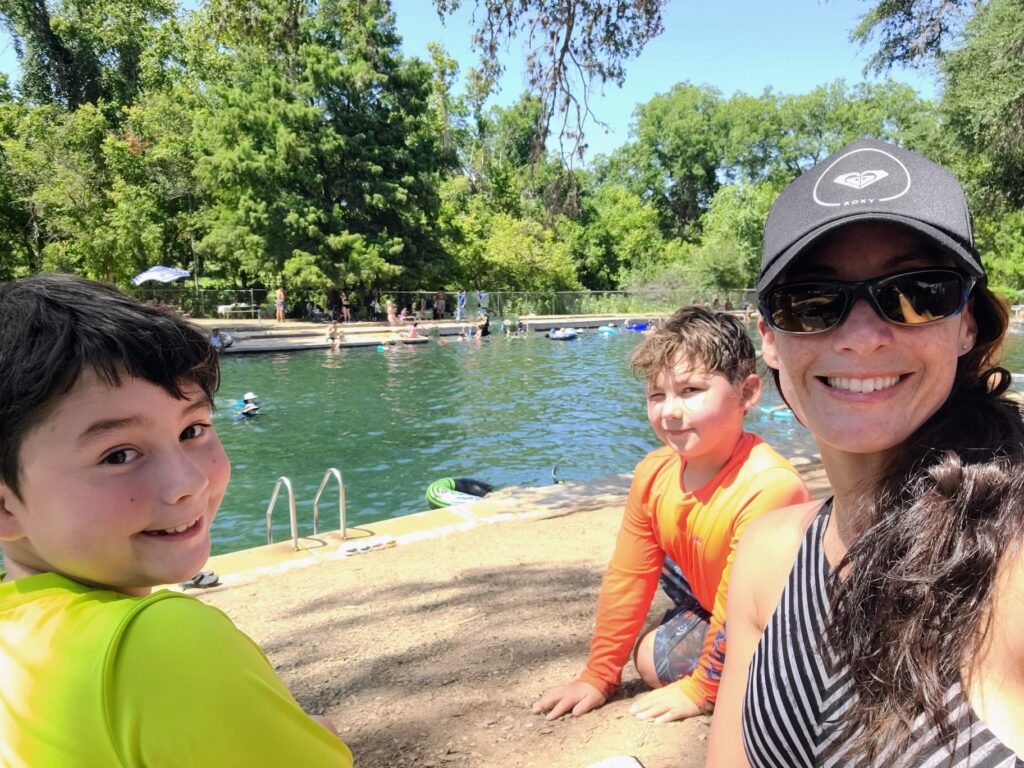
Kassandra Rodriguez uses the Florida Family Empowerment Scholarship for Unique Abilities, an education savings account program, to create customized learning programs for her sons, Zachary, left, and Cameron. They are visiting a park to learn the science behind natural springs. They have also gleaned for mangoes, gone on nature hikes and participated in virtual classes.
Editor's note: This post provides a parent's perspective to supplement our recent white paper, "A Taste of À La Carte Learning," which spotlights the rise of unconventional learning options in Florida. Thousands of Sunshine State parents are now using state-supported education savings accounts to create unique learning programs for their children.
STUART, Fla. — Kassandra Rodriguez thought she could teach her son Zachary to become a better writer, but no. She gave him prompts she thought would spark his creativity – like, If you could make up any flavor of ice cream, what would it be? – only to get one-sentence responses.
Both of Rodriguez’s children, Zachary, 11, and Cameron, 8, have special needs that qualify them for the Family Empowerment Scholarship for Unique Abilities. That ESA, created by the state 10 years ago, gives families the flexibility to direct funding to various educational programs and providers. On average, each one is worth about $10,000 a year.
After doing some research, Rodriguez found a writing teacher on an online platform, Outschool. The teacher lives in Canada. Only three other students attended the one-hour-a-week slot (including, amazingly, another ESA kid from Florida). And Zachary loved it. Sometimes the teacher would kick things off by reading from a graphic children’s novel – say, “Wings of Fire” – then engaging students in a conversation.
“That seemed to get the juices moving,” Rodriguez said.
Soon, Zach was writing inspired, two- to three-page essays. Even better, he could take the class in the car while Rodriguez drove him and Cam to other educational activities.
Stretch that one example to more than a dozen other providers for Rodriguez’s sons, and you begin to see what’s possible with ESAs and a la carte learning.
Florida is on the cutting edge of what’s coming.
Last year, the Sunshine State moved to universal education choice. But even before that historic shift, thousands of parents were customizing their child’s education, using ESAs to mix and match from a growing universe of providers. Together, these parents and providers are pioneering new approaches to teaching and learning that bypass traditional schools. Homeschoolers have been doing that for decades. But now, with state support, even more families can give it a go, in numbers big enough to ripple through the entire system.
With ESAs, “You can make whatever education program you want,” Rodriguez said. “After meeting more people, and seeing what’s out there, I realized I can make things happen. I can have what I want for my boys.”
What Rodriguez wants includes two of the la carte providers featured in our new white paper, “A Taste of A La Carte Learning.” Both Surf Skate Science and Eye of a Scientist offer popular and hands-on approaches to science instruction.
But the family’s a la carte adventure hardly ends there.
Zachary is diagnosed with dyslexia, ADHD, and a speech disorder. Cameron also has a speech disorder.
Before the family moved to Florida from Iowa in 2020, Zachary had been enrolled in a private school, where he experienced bullying and fell behind academically. That experience is what led Rodriguez to try homeschooling.
Rodriguez uses her sons’ ESAs to pay for speech therapy from the same therapist they used in Iowa, only now they access the services online. Ditto for Zach’s dyslexia tutor. Both of those individuals have credentials that make them eligible for Florida ESA funding.
Rodriguez is also using the ESA to “unbundle” individual classes at nearby schools.
ESA enthusiasts have been talking up this possibility for years. In Florida, thousands of schools, including public schools, could unbundle their services if they wanted. A few examples of that are happening here and here.
Rodriguez asked several microschools if they’d let her boys take a few classes instead of enrolling full time. Some rejected the idea. But a couple said, “Yeah, we can do that.”
At one, both boys took several classes, including “simple machines” for Zach and “collaborative building” for Cam. Both involved science and engineering instruction. At the other, both boys took art and theater. The latter class met weekly for two hours for a semester, and it culminated in a community production of “Aladdin.”
There’s more. The ESA pays for Zach’s membership on a competitive traveling LEGO robotics team. And for both boys, it’ll soon pay for recreational league lacrosse and piano lessons with a music teacher.
Rodriguez uses the ESAs for art supplies, science kits, a book club, and BitsBox, a subscription service that teaches computer coding. She’s also purchased a variety of home education curricula and supports, including Power Homeschool, All About Reading, Singapore Math, and Story of the World.
“I overlap some curriculum because I’m afraid I’m leaving something out,” she said.
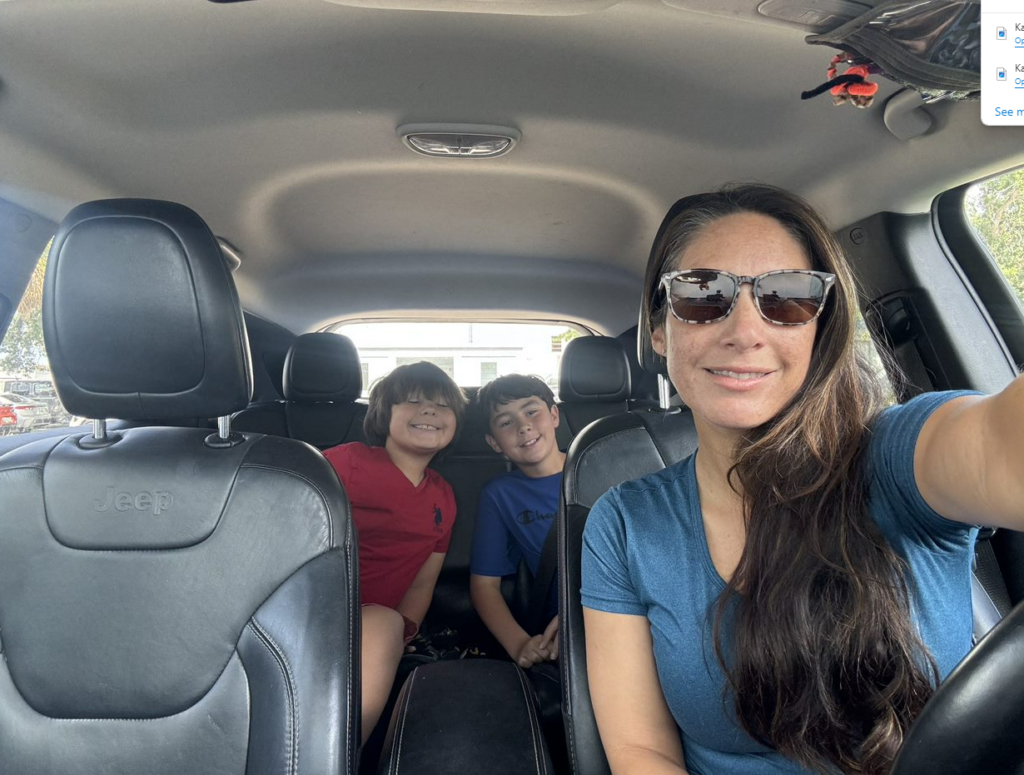
Kassandra Rodriguez and her sons are often on the go. One program allows Zachary to learn while she drives the boys to other activities that make up their customized learning programs.
The ESAs, Rodriguez said, incentivize bargain hunting. For example, she considered enrolling her boys in a writing class at a third microschool. But the classes cost $70 an hour, while the Outschool course was $14 an hour. She and the boys also tried out another writing teacher – this one in England – but they didn’t think she was as engaging as the one in Canada.
Blazing trails on the choice frontier isn’t easy.
Zach and Cam’s schedule requires a lot of time and mileage. Their programs and providers are scattered across three counties. Some are an hour from their house.
Rodriguez is a stay-at-home mom, in part because a traffic accident a decade ago resulted in long-term injuries that keep her from working. But it’s a mixed blessing, because the situation has allowed her to devote more time to her kids’ educational needs. Also, Rodriguez’s husband is a surgeon. She knows her family can pay upfront for educational expenses and await reimbursement from the ESA in ways that some families can’t.
Still, Florida’s increasingly choice-driven education system is moving toward greater equity. Every year, more families, particularly those disadvantaged by poverty or disability, gain more power to direct education dollars the way they think is best.
Rodriguez has no doubt this approach works for her family.
She frequently gives her sons tests, and they often showcase their knowledge with projects and presentations. Rodriguez also recently used ESA funds for her boys to take the Iowa Test of Basic Skills, a common standardized test. She said she wants to know how they’re doing relative to students their age and whether her approach is working.
Florida law does not require students like Zach and Cam, who are using the FESUA scholarship, to take a standardized norm-referenced test in reading and math. However, such testing is required for students using the Florida Tax Credit Scholarship, the Family Empowerment Scholarship for Educational Options, and the Personalized Educational Program scholarship. The latter is a new ESA, created in 2023, for students not enrolled full-time in public or private schools and whose parents are customizing their education programming.
Rodriguez said she knows from other assessments that Zach is now reading in the 80th percentile for his age, far ahead of where he was in his prior school.
“I like that we can learn what we want – and at our own pace,” she said. “I saw Zachary struggle a lot with his dyslexia. Now he’s right where he’s supposed to be.”
Being able to access what Zach needed, when he needed it, was big. “Whatever it is, we can nip it in the bud,” Rodriguez said. “We don’t have to wait. It’s instant. We can just get a tutor and go.”
Flexibility has other benefits.
Last year, the family made multiple trips to Texas to see Rodriguez’s father before he passed away. Each time, they stayed a week or two, quickly making arrangements that might have been more difficult for a family tied to traditional schooling.
Rodriguez has told her boys they can go to a traditional school, and she’s shown them some possibilities. But so far, they have shown no interest. Truth be told, they think some of the traditional schools look like jails.
“With the amount of freedom and the amount of things we’ve gotten to do,” she said, “I don’t think we could go back.”
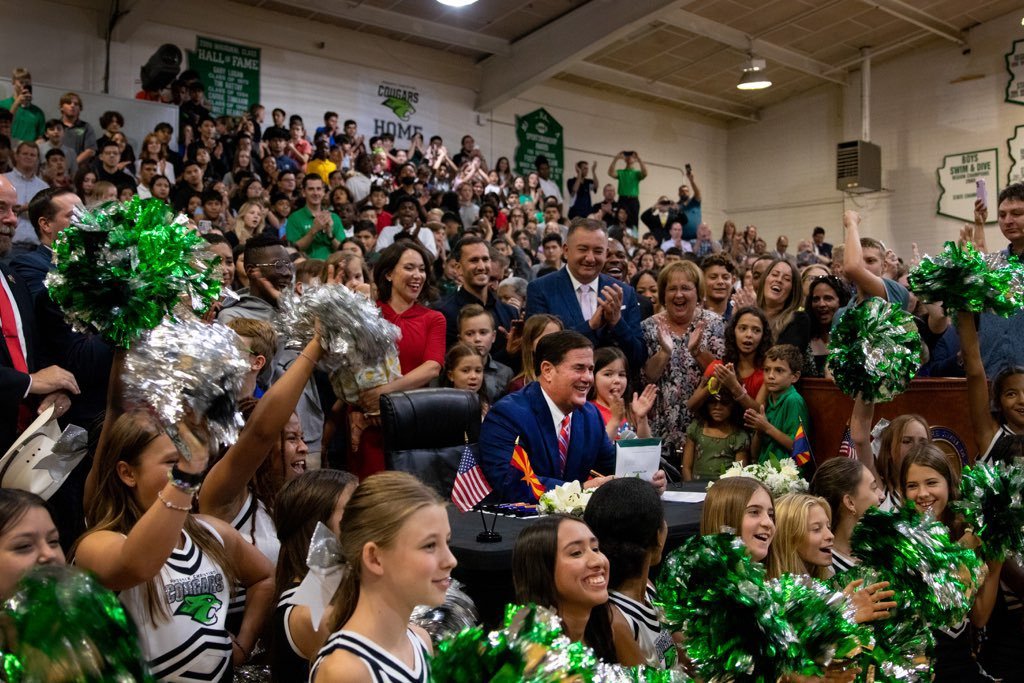
Arizona Gov. Doug Ducey joins students and families to celebrate historic legislation establishing education savings accounts for all students in the state. Photo courtesy of the Governor's Office
Editor's note: The following is a news release from the Arizona Governor's Office
Arizona Gov. Doug Ducey on Tuesday joined families, educators and community leaders to celebrate Arizona’s successful effort to ensure every Arizona student can attend any school of their choosing.
“Arizona is now the gold standard for educational freedom in America,” Ducey said in a news release. “Our kids will no longer be stuck in under-performing schools. We’re unlocking their educational potential and advancing a bold new era of learning opportunities. Parents and teachers know there is no one-size-fits-all model to education. Kids and families should be able to access the school or learning program that best fits their unique needs — regardless of income or where they live. In Arizona, we’re making sure they have that choice.”
The governor spoke today at Phoenix Christian Preparatory School alongside parents and their kids who have benefitted from Arizona’s Empowerment Scholarship Accounts (ESA), as he signed a bill that opens the scholarship program to every K-12 student in Arizona.
The legislation, sponsored by Rep. Ben Toma, has been lauded as the most expansive school choice initiative in the nation.
“I was proud to continue the Arizona tradition of leading on school choice and bring educational freedom to more than 1.1 million students,” said Toma, the House majority leader. “By opening Empowerment Scholarship Accounts to every K-12 student, we will improve outcomes and make choice a reality for all students. This session, we stood together to get this done for Arizona students and parents. Governor Ducey has been an invaluable partner in transforming school choice in our state, leading the way in unlocking the schoolhouse door.”
With ESAs open to all students, Arizona solidified its position as the gold standard for educational freedom. In a story published today, Chris Rufo, senior fellow at the Manhattan Institute, said “universal school choice has long been the Holy Grail for conservative education reformers. Governor Ducey has achieved it.”
The ceremony at Phoenix Christian was highlighted by elementary schoolers singing a welcome song and stories from Arizona families of how school choice has unlocked their children’s full potential.
One of those parents is Jenny Clark, who, after her own children’s positive experience with ESAs, has helped other parents take the opportunity the program presents.
“Arizona’s Empowerment Scholarship Account program is truly life-changing for so many of our state’s children,” Clark said. “My five children have benefitted from ESAs and I can’t help but think how many kids don’t get the help they need. Now, they will. Every child in Arizona will have the same opportunities and ability to get the education tailored to their needs. Governor Ducey has led on this issue, expanding school choice to every family.”
Parent Annie Meade has seen firsthand how Arizona’s education options can impact a child’s education. Her four children have had a combination of homeschool, microschool and public education. Universal ESAs stand to bring new opportunities to her kids, who are now all eligible. Meade spoke about her enthusiasm for the education savings accounts at the ceremony today.
“Kids deserve to be in the education environment in which they can thrive, but so many families have been limited by their income, or zip code,” said Meade. “The Empowerment Scholarship Account program was something that I learned about from other friends who had qualified, but unfortunately, our family never had access to the scholarship, until now. The passage and signing of H.B. 2853 means that now every Arizona family will have the freedom, the choice, and the opportunity to choose an ESA for their child’s education…Thank you again, Rep. Ben Toma, and Governor Doug Ducey, for making this scholarship a reality for families like mine.”
The students at Phoenix Christian are no strangers to the benefits of education savings accounts. Jeff Blake, the school’s superintendent, spoke about the resources and one-on-one learning students receive at his school.
“At Phoenix Christian Preparatory, we are proud to have 31 students on Empowerment Scholarship Accounts,” Blake said. “This funding has helped our school serve many students in need and bring them an education that best suits them. With universal school choice, we’ll be able to serve more students with an exceptional education. We’re grateful for the foresight and leadership of Governor Ducey and the Arizona Legislature for prioritizing every K-12 student.”
Drew Anderson, senior pastor of First Watch Ministries and Legacy Christian Center in South Phoenix has worked with kids in his South Phoenix community to achieve academic success.
“Education is the great equalizer in America,” he said. “If we are able to give our lower-income families and minorities with better education, we’re unlocking the doors to success for so many who are often left behind. As a pastor I’ve seen too many of our black and brown children struggling, just looking for some guidance on homework. I’m grateful to Governor Ducey and the Legislature for saving our kids.”
Arizona families who participate in ESAs would receive more than $6,500 per year per child for private school, homeschooling, microschools, tutoring, or any other kinds of educational service that helps meet the needs of their students outside the traditional public school system.
Janelle Wood, founder of the Black Mothers Forum, spoke about the partnership she formed with Governor Ducey starting in 2020 to “fight to make sure our black children have an opportunity to live and breathe in a safe and supportive community whether that be a learning community, in their living community or in their homes.”
Wood continued, “As a concerned black mother, I want to make sure that we are heard loud and clear from this day forth. We matter, our children matter and we’re not going anywhere. We’re going to keep speaking to each system that holds our families back and our children back.”
Arizona’s universal education savings accounts now serve as the model for the rest of the nation to follow. Education choice advocate Corey DeAngelis, a senior fellow at the American Federation for Children, called the monumental legislation “the biggest school choice victory, not just in Arizona, but in U.S. history.”
Of the unprecedented school choice initiative, DeAngelis said, “This is how you truly empower parents and truly secure parental rights in education. I want to thank Governor Ducey for empowering every single family in the state of Arizona. This is a national model.”
He then led the crowd of students, parents and community members in a chant: “Arizona will now fund students not systems.”
Two important legislators in funding students were Senate President Karen Fann and House Speaker Rusty Bowers.
“Every parent wants nothing more than to see their child succeed,” Fann said. “This session, we committed to expanding educational opportunity. Working with Governor Ducey and the Arizona House, we delivered. Each and every Arizona student has access to an education environment that will suit their needs. The Empowerment Scholarship Account will transform education in our state and bring unlocked potential to our kids.”
“In Arizona, we fund students, not systems,” Bowers said. “One size does not fit all when it comes to education. Universal Empowerment Scholarship Accounts will ensure the money follows the children as they are enabled to attend the school environment that works best for them. The Arizona House of Representatives has worked collaboratively with Governor Ducey for years to expand school choice for every student. Today, we celebrate the empowerment of 1.1 million students and their parents to choose the learning environment they need.”
 Two findings related to education savings accounts have emerged from a recent poll conducted by EdChoice as the education reform organization continues to track COVID-19-related trends.
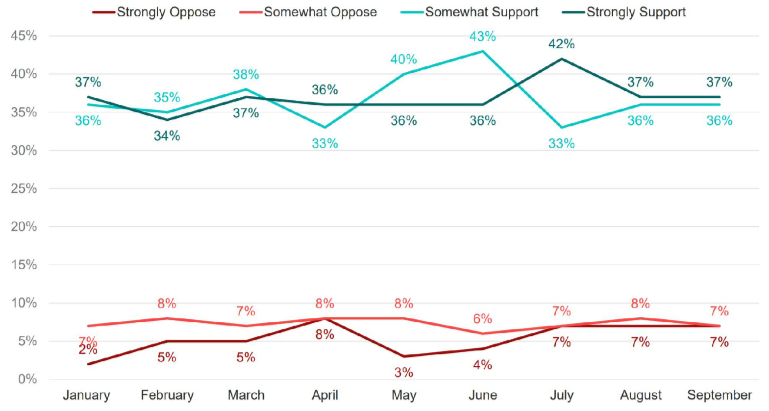
The first: Support for ESAs, which allow parents to withdraw their children from public district or charter schools and receive a deposit of public funds in government-authorized savings accounts with restricted but multiple education uses, has remained steady throughout 2020.
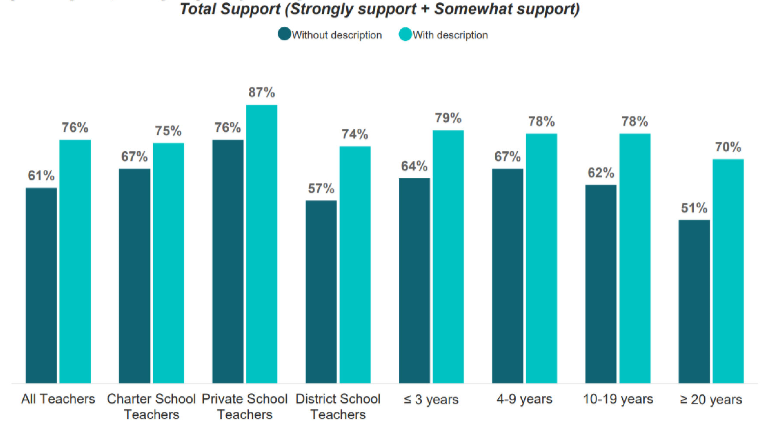
The second: Support for ESAs among teachers in all education settings – district, charter and private – increases when information about ESAs is provided.
The number of parents indicating strong support for ESAs held steady at 36% through the spring and early summer, rose to 42% in July and tapered back to 37% as the new academic year got underway. The number who indicated some support for ESAs fluctuated between 33% and 40% in the spring, peaked at 43% in June and settled at 36% in September.
Since January, the number of parents who either strongly opposed or somewhat opposed ESAs has hovered between 2% and 8%.
Parental support for education savings accounts
 When asked their opinion of ESAs in K-12 education based on what they know or have heard from others, 61% of teachers overall indicated support. That figure rose to 76% when a description of ESAs was provided. The level of ESA support among district teachers rose from 57% to 74% once a description was provided, while support among charter school teachers rose from 67% to 75%.
Private school teachers indicated the greatest level of support both before and after hearing a description of ESAs, 76% and 87%, respectively.
Teacher support for education savings accounts, before and after a description
 Other poll questions queried respondents on learning pods, teacher morale and in-person versus remote learning. Full results are available at https://www.edchoice.org/engage/edchoice-public-opinion-tracker-top-takeaways-september-2020/.

