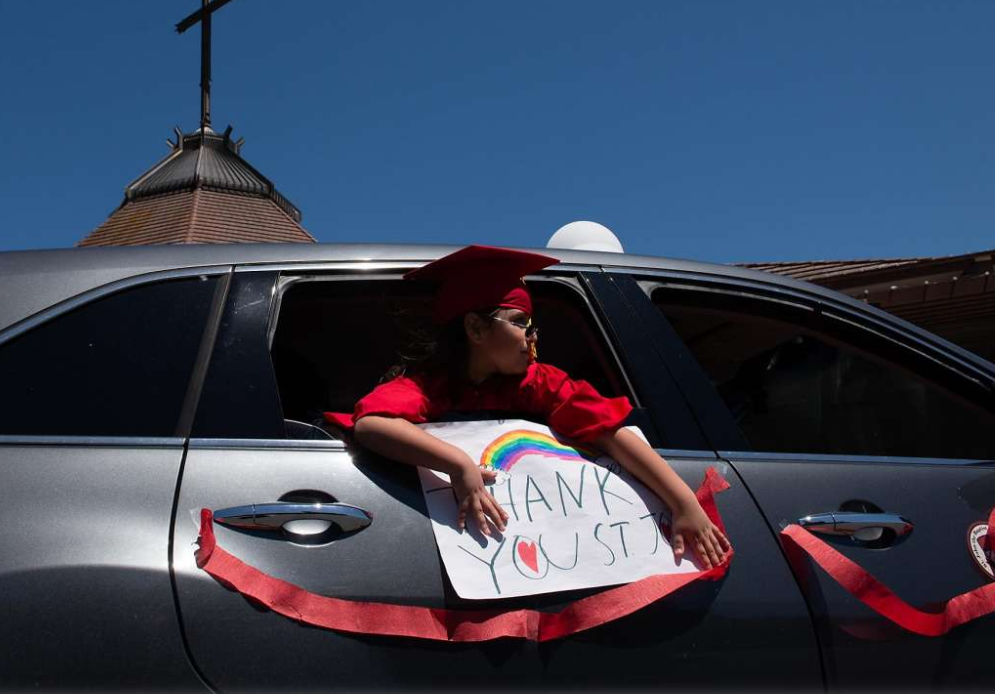
Kindergartner Sofia Ascencio wears her graduation gown to a farewell parade at St. John the Baptist Catholic School in Napa, which is closing after 108 years due to declining enrollment and the coronavirus pandemic.
We can always use more examples of teamwork. Public-school officials have such an opportunity before them as schools prepare to re-open and should to seize it – and resist calls to resort to turf warfare.
In March, Washington provided additional resources through the CARES Act so that school districts can help their schools and private schools with COVID-19-related needs. Federal officials began distributing the money just as some public-school officials objected to federal guidance on how school administrators were to use the spending.
Before taking sides, an honest—perhaps generous, in some places—assessment of school district activities during the pandemic is that school responses across the U.S. were uneven. When school buildings closed, some public officials either waited weeks to deliver any instruction to students quarantined at home or failed to do so at all. Those who observers say responded quickly, such as the ones in Miami-Dade and charter schools in low income areas in Philadelphia and Arizona, deserve credit, but by the middle of May, reports indicated that more than two-dozen large districts across the U.S. had made online work meaningless by not grading students.
The lackluster response helps to explain why recent polls have found that 40-60 percent of parents are considering homeschooling this fall. Fear over another outbreak after students are back in close quarters may also be on parents’ minds, but school districts that failed to follow through during the pandemic has some parents wondering if they could do better themselves.
School districts have another chance to earn the confidence of families, though. In April, Education Secretary Betsy DeVos said that districts should use CARES spending to provide services to private schools based on a private school’s total enrollment, not just the number of students in need attending private schools.
Things get technical quickly with this provision, but the usual suspects in unions ignored the details and said districts should ignore the guidance, claiming “this funnels more money to private schools.”
In reality, the main federal education law, now called the Every Student Succeeds Act, says that low-performing private school students in low-income areas can get help from public schools. This part of the law, called “equitable services,” includes tutoring and summer school. Private school officials must work with public school leaders to determine how the help will be delivered.
With the new COVID-19 spending, the Education Department said that equitable services should help all students—public and private—not just struggling students. Why? Because CARES Act money is emergency spending, not annual spending for students in low income areas.
Just as with the delivery of traditional equitable services, private school leaders and students will make these plans with local district schools—giving traditional schools the chance to show private school families that public schools can help them.
Districts have another reason to make the most of equitable services now: As groups such as Ed Choice have explained, if private schools close, taxpayers could see K-12 costs increase during the recession.
We are still plumbing the depths of a financial crisis, and smart districts are already cutting costs to prepare for next year. Larger classes at a time of limited services will not appeal to parents.
Indiana and Maine have said they will not abide by the guidance. Private schools in Pennsylvania and Colorado are challenging their state agencies’ interpretations, which are also limiting access for private school students.
Meanwhile, South Carolina Superintendent of Education Molly Spearman said the state will follow the federal guidance. In a letter to private school educators, she said, “Public and private school leaders working together can address the true needs of South Carolina’s education system caused by COVID-19.” Florida officials have said they will also follow the department’s interpretation. Secretary DeVos said her office is working on an official rule.
Public schools should not view equitable services during the pandemic as a new front in some perceived brawl. All students and schools need help now, so public schools have a chance to be the hero. Perhaps district actions in good faith here could be used to sway public opinion during a recession should districts try to appeal to state taxpayers for more resources.
But if not, and should districts leave private schools to wither, expect more polls showing parents are ready to keep students home—even if private schools close.
Explain that to taxpayers.
 State's ESSA plan rapped: Florida's plan to comply with the federal Every Student Succeeds Act is the worst in the country in identifying persistently underperforming schools and working to improve student outcomes, according to a review of every state's plan by 24 independent education advocates and leaders of both political parties. Eight components of the plans were reviewed, and Florida received a rating of "weak" in six areas. State officials disagree with the review. The 74. Education Week.
Safe spots blocked: Most of the designated safe spots in classroom corners at Marjory Stoneman Douglas High School were inaccessible when a gunman opened fire Feb. 14 because they were blocked by furniture, according to testimony Wednesday before the state commission investigating the massacre. Seventeen people died in the attack. Creating the so-called "hard corners" was recommended during training of Stoneman Douglas staff in December 2017 and again in January. The panel's meeting continues through Friday. Politico Florida. Miami Herald. Sun-Sentinel. (more…)
School rebuilding proposed: Hillsborough County school officials say they want to rebuild the historic Lee Elementary School in Tampa, which was severely damaged by a fire in September 2017. If the school board approves the plan, contractors will preserve the brick exterior but redesign the interior to conform to modern standards. As long as the district rebuilds, insurance will cover the full cost for construction. If it doesn't rebuild, the district would receive just 10 percent of the insurance to cover classroom materials and equipment. Tampa Bay Times.
Sports officiating classes: Two Collier County high schools now offer sports officiating classes in an effort to ease a shortage of officials for school sporting events. Students at Palmetto Ridge and Golden Gate high schools will be trained in the sport or two of their choice, and will be offered tests to become certified as officials. “This class provides our students another opportunity to get a certification, and potentially a career in officiating," says Superintendent Kamela Patton. "Partnering with our local officials association, the Great Naples Officials Association, and the Florida High School Athletic Association fulfills a community need while producing our own qualified officials to help boost our school athletics programs.” Naples Daily News.
ESSA criticism: U.S. Education Secretary Betsy DeVos' approval of Florida's plan to comply with the Every Student Succeeds Act is called a "disappointment" by advocates who wanted the state to test English language-learners in their native languages and to have those students' results included into the state's larger accountability system. More than 10 percent of the state's K-12 students are considered English-learners, and in some parts of the state the percentage is as high as 25 percent. Education Week. Gradebook.
Use of restraints: The number of times restraints have been used on students with special needs by the Hernando County School District has soared from 19 in the 2014-2015 school year to 153 in 2017-2018, according to district records. Cathy Dofka, the head of the district’s Exceptional Student Education department, had planned to cut the use in half two years ago. She blames the lack of qualified special education teachers for the increase. According to the state, Hernando ranks in the middle of Florida's districts in the use of restraints. Tampa Bay Times. (more…)
ESSA plan approved: Florida's plan to comply with the federal Every Student Succeeds Act finally has won the approval of the U.S. Education Department. The state submitted five revisions of the accountability plan, including one this week, before Education Secretary Betsy DeVos gave her approval in a letter to Florida Education Commissioner Pam Stewart. Florida had resisted some ESSA requirements, such as assessments of English language learners and math testing for advanced students in middle schools. Florida's was the last of the 50 states to have its plan approved. Gradebook. Education Week.
Medical marijuana: School boards in Orange, Volusia and Clay counties are moving forward with policies that will permit students with prescriptions to receive medical marijuana treatments at schools from parents or caregivers, but not school personnel. The Orange County School Board approved the policy this week, and the Clay and Volusia boards will take final vote in October and November, respectively. Broward and Santa Rosa counties have adopted similar policies. Orlando Sentinel. Daytona Beach News-Journal. Clay Today. Orlando Weekly. (more…)
ESSA questions: Florida's latest plan to comply with the federal Every Student Succeeds Act is drawing questions from the U.S. Education Department. Specifically, federal officials want more details on how the state calculates math achievement and proficiency, how schools that need support for improvement are identified by the state, how schools can get out of the turnaround program, and how schools with a single D grade fit in the requirements for improvement. The state has until Oct. 4 to respond. Florida is the only state whose ESSA plan has not been approved. Gradebook.
Alarming false alarms: False fire alarms and emergency drills are causing trauma to students who were at Marjory Stoneman Douglas High School during the shootings Feb. 14 that left 17 dead, they say. “They’re hearing the same sound that brought them all into the hallway where the shooting really started taking place,” says Dr. Nicole Mavrides, director of the child psychiatry program at the University of Miami’s Miller School of Medicine. “It can really bring out symptoms of post-traumatic stress.” The Parkland school has had one active shooter drill, two fire drills and five false alarms since school began Aug. 15. Students are responsible for three of the false alarms. Sun-Sentinel. Miami Herald. (more…)
Florida's ESSA plan: Florida has filed its fourth plan to comply with the federal Every Student Succeeds Act. The first three were rejected because they didn't meet the standards of the school accountability system. The latest attempt, filed Aug. 24, calls for the continuation of an exemption from grade-level math exams to students in high school who successfully completed the courses in middle school. The state also is declining to give tests in languages other than English, and does not want to change the way it sets proficiency standards for students still learning the language or how it reports the academic performance of demographic subgroups. In Gov. Rick Scott's letter to Education Secretary Betsy DeVos, he writes that "Florida's expectations is that our state is treated fairly and given full flexibility to provide the greatest return to our students." Florida is the only state whose plan has not been approved by the U.S. Department of Education. Gradebook. Education Week.
District's computers hacked: A cyberattack forces the Monroe County School District to shut down its computer systems this week. Officials say the hacker used ransomware called "GandCrab," with the goal of encrypting files in the system and then demanding a payment to unlock them. The district’s Internet security provider, Symantec, took the system down Sunday after the threat was detected and created a patch that was applied Tuesday. But the problems persisted and the system was shut down again. Keynoter. Key West Citizen. WLRN. (more…)

