 What happens to the mind of the school child who each day dwells in the land of Charles Darwin, focused solely upon what becomes of matter and the ever-evolving elements of natural life, never asking how this stuff came to be in the first place?
Darwin’s own mind simply withdrew from that question, settling at last into an airy atheism. For him, the stuff of this universe was the only reality, thus the mind’s departure into metaphysics or religion but a wasteful diversion into nothing at all.
Hence, there is no point in telling the student about anything but matter and the course of its ever-evolving reality. There is simply no story to be told about the world’s coming to be. It just is, and that’s all that matters.
Tenth-grader Joe finds the details of evolution fascinating, as do most of us. It is quite easy to engage the mind, young or old, in the gorgeous reality of physical stuff. It’s fun. But, viewed as Darwin saw things, that fun is not endless. Like the butterfly, and even the redwood, we die.
That’s the only story young Joe is allowed to hear at P.S. 99. What, then, becomes of Joe’s capacity even to ask himself that nagging question that Darwin ducked: Did a non-existent physical world simply make itself out of nothing? Even to ask the question seems juvenile; from nothing comes what … ?
But, back to school. What is the effect upon young Joe of this classic shunning of the greatest of all questions?
My own observation of its probably lasing influence on the learner is drawn from daily discourse with mostly adult human beings. They are generally lovable, but seem too frequently out of touch with, and incoherent on, the question of all questions. Most are obviously uncomfortable at its emergence in the occasional but unavoidable exchange that implicates the “meaning of life” – and whether there is one.
In my own experience, this verbal inefficacy becomes most evident in expressions of shared grief at the death of a loved one. The genuinely caring friend can find himself “so sorry,” but from there on, has difficulty in finding words of hope beyond the assurance that “she will be remembered” or “she was so kind and good.” Many warm-hearted and generous mourners seem uneducated in the language of hope – of faith, and of love.
This near incoherence on the occasion of death is replicated in many another context that hints at the transcendental. Politics is a rich example. Religious belief or the lack (or feigning) of it is always a matter of public interest, but the discourse on that issue is too often juvenile. The typical American mind and the media that serve it seem to find simple discourse about God/no God an effort.
Where does this stammering of ours about the transcendental have its genesis? What is it about the divine that strikes so may of us dumb? Its sources are complex, and its subsequent history even more so.
Paradoxically, it began in the 19th century as an intended protection of American culture from false religion and the imposition of a monopoly for true belief in the classrooms of the new public system, compulsory for un-monied immigrant families. This religious behemoth was, of course, fated to fall prey to its very opposite as the new “realists” of the secular elite gained control.
The Supreme Court, in due course, made the exclusion of God from the curriculum a matter of civic faith. For good or ill, the narrowing of young Joe’s vision and ventilation was a simple sequitur.
Editor's note: This is a sidebar to Monday's profile post about Daniel and Suzette Dean, a Tampa, Fla. couple whose private school is at the heart of their community development vision.
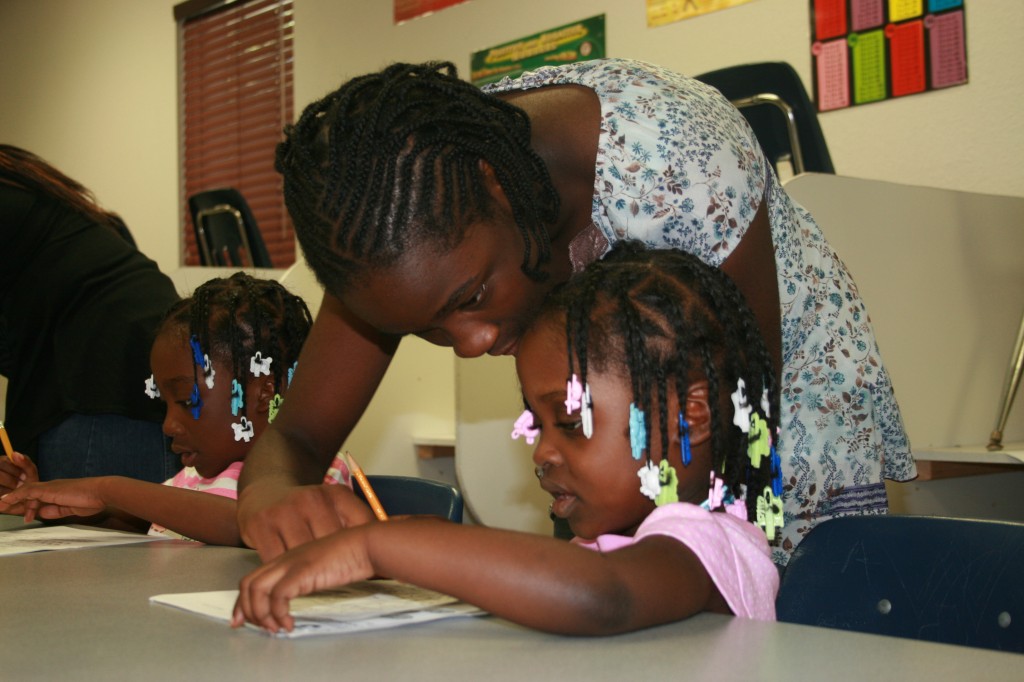
At Bible Truth school, Lizzie Bilogo-Nguema, 12, helps 3-year-old Delilah Prevot with math. The school features a lot of interaction between students of different ages.
The big girl scooched the little one gently back to the center of the chair, then pointed to the work sheet on the table. Today’s topic: kindergarten math. Can you count the elephants in the first clump, Lizzie, 12, asked Delilah, 3. Now in the second clump? Now can you add them? Beneath the rainbow of clasps in her braids, Delilah correctly counted the answers out loud.
“Good job. You got it,” Lizzie smiled. “Do you know how to write a 10?”
Scenes like this play out all the time at Bible Truth Ministries Academy. The tiny private school in Tampa, Fla. often goes out of its way to put students of different ages together and frequently to have older kids teach younger ones. That kind of multi-age, multi-grade set-up isn’t unheard of – it’s a fundamental part of Montessori schools, for example – but in the case of Bible Truth, the origin of the idea is noteworthy.
A think tank called the Evolution Institute recommended it. Bible Truth followed up. And the fact that the entities have a warm relationship is a sign that bridge-building is possible even in that tense place where schools, faith and science collide.
“We get so caught up in the vessel. It doesn’t matter to me” where good ideas come from, said Daniel Dean, who co-founded Bible Truth school with wife Suzette. “If it makes sense, it makes sense.”
“It starts with, what do they want for the children and the families? – which is what I want,” said Jerry Lieberman, who co-founded the institute and has known the Deans for seven years. “We both want them to have an excellent education, and we both want to remove obstacles that stand in their way.”
The school doesn’t teach evolution. Lieberman doesn’t dwell on it.
But as its name suggests, the little institute with a board full of top-notch scientists is big on it. Its mission is to use evolutionary science to solve real-world problems. In education, that translates, in its view, into classroom practices that echo the way children have adapted to learn – in mixed-group settings, with lots of physical movement, with an emphasis on self-directed play.
The group’s co-founder and president, David Sloan Wilson, an internationally respected evolutionary biologist, carved out “10 simple truths” about childhood education from an evolutionary perspective. A lot of it hinges on choice, community, cooperation. In the Binghamton, N.Y. school district a few years ago, the 10 points were converted into classroom practices and tested in a year-long program for at-risk 9th and 10th graders. The result: Students in the program outperformed their peers in a control group. They had less absenteeism, higher standardized test performance – and a 30-point jump in the scores behind school grades.
The institute is hoping to secure funding to test the program in other school districts, and in both public and private schools.
In the meantime, it’s been working informally with Bible Truth. (more…)
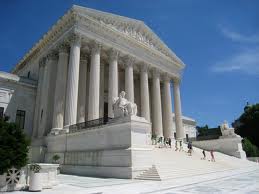 The Orlando Sentinel recently published a blog entry about a new website that opposes students using publicly-funded vouchers to attend private schools that teach creationism. The site asserts, “Teaching creationism with public money is unconstitutional. It violates the First Amendment of the U.S. Constitution which lays out a clear separation of church and state.”
I’m fine with citizens opposing the teaching of creationism. I would not send my child to a school that taught creationism in lieu of evolution, but the assertion that it’s unconstitutional is false.
In the 1925 Pierce v. Society of Sisters decision, the U.S. Supreme Court ruled parents are responsible for determining how and what their children are taught. And in the 2002 Zelman v. Simmons-Harris decision, the court ruled parents may use public money to pay for tuition at faith-based schools provided their choice is genuinely independent, and the funds go first to the parents and then to the school.
Florida’s school voucher programs all adhere to the Zelman requirement that funds go first to the parent and then the school, which is why using publicly-funded vouchers to attend faith-based schools is an exercise of the First Amendment’s freedom of religion clause, and not a violation of the Establishment Clause. (By the way, the term “separation of church and state” does not appear in the U.S. Constitution. That phrase was used by President Thomas Jefferson in a January 1, 1802 letter he wrote to the Danbury Baptist Association of Connecticut, reassuring them that he opposed the government interfering with their religious practices.)
The Sentinel wrote that some state officials think tax credit scholarships are more constitutional than vouchers because tax credit funds never touch the state treasury, but, again, the key to the Zelman decision is the path the funds travel to arrive at a faith-based school. Once public funds are given to the parents, they become less public and more private, which is why their expenditure is an exercise of religious freedom and not government-supported religion. (more…)
 EdWeek’s Politics K-12 blog offers an intriguing list of possible education secretaries in a Romney administration, including one prominent Floridian: Jeb Bush. But the otherwise great list overlooked another Floridian: Eric J. Smith, the state's former ed commissioner.
Smith, nudged out last year by Gov. Rick Scott, was hired by the state Board of Education in late 2007 and immediately found himself on a high-wire: Shepherding the state’s proposed new science standards, which for the first time included the teaching of evolution, through public hearings and a divided state board. Ultimately, the board approved them 4-3.
Smith led the way on Florida’s Race to the Top application and was a strong supporter of legislation that changed the way Florida teachers are evaluated and paid. Like Indiana’s Tony Bennett, he was an original member of Chiefs for Change and enjoyed strong backing from Bush’s Foundation for Excellence in Education. One Bush ally, T. Willard Fair, was so upset by Smith's ouster that he resigned from the BOE in protest.
"Dr. Eric Smith would make an outstanding U.S. Secretary of Education,” Roberto Martinez, another board member, told redefinED via email. “When he was Florida's Commissioner of Education he proved himself to be best in the nation. During his tenure he led Florida to the top of the nation in achieving several significant educational benchmarks. He is a successful reformer because as a former hands-on teacher, principal, and superintendent he knows what works in the classroom.”
Smith’s is now a fellow in education policy at the George W. Bush Institute. His successor as commish, Gerard Robinson, is stepping down at the end of this month.
Editor's note: Due to technical difficulties with the blog, many redefinED readers were unable to read this post when it was originally published Friday. Thanks to those of you who notified us. Thanks to all for your patience.
 It’s old news that many religious schools teach creationism and intelligent design – and that some of those schools accept students with vouchers and tax credit scholarships. But the recent New York Times piece on tax credit scholarships gave school choice critics fresh excuse to pick up and hurl. Teachers union president Randi Weingarten immediately tweeted, “Public money being funneled to creationist, anti-science religious schools.” A few days later, a left-of-center think tank in North Carolina, out to stop a legislative proposal for tax credit scholarships in that state, described the Times story as concluding that “redirected public money” is being used to “spread fundamentalist religious theology like creationism.”
I’m in the science tribe. The evolution-is-fact tribe. But I don’t share their outrage. During my own evolution on school choice, I’ve had to grapple with the fact that many private schools are at odds with what the vast majority of scientists consider good science.
I’ve come to this conclusion: Even if we disagree about creationism, we shouldn’t be so blinded that we forget all the other lessons these children receive in all the other classes they take, in all the years they attend school. We should not overlook whether these children are learning to read and write and succeed in life. I'm hoping that people who do value scientific literacy would be more likely to look at the issue with a sober analytical eye. I’m hoping they might even be willing to place scientific learning in a broader societal context, where many public school students are suffering in part because they lack the foundational learning skills that also handicap them in the arena of science.
The fact is, not many traditional public school students are doing well right now in science. It pains me to say this, because I had amazing biology, chemistry and physics teachers in my public high school. What I learned from them has benefited me personally and professionally. But the facts are informative. In 2009, 21 percent of high school seniors scored at proficient or above on the National Assessment of Educational Progress in science. Break those numbers down into subgroups, and depressing morphs into apocalyptic. Only 8 percent of low-income and Hispanic students reached that bar. Only 4 percent of black students did.
In Florida, the state I know best, only 27 percent of low-income students scored at grade level or above on the state’s high school science test in 2011. To be fair, that’s up from 19 percent in 2006 – and many talented people worked hard to move the needle even that much. But it’s nowhere near high enough or fast enough. (more…)

