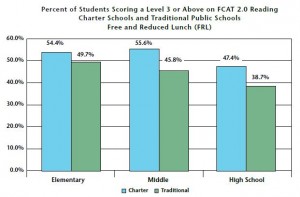
 Florida charter school students are out-scoring and out-gaining their traditional public school counterparts in more than 150 comparisons on the state’s standardized tests, according to a state-mandated report released by the Florida Department of Education Thursday.
In 156 of 177 comparisons, charter school students scored higher, made bigger gains and had smaller achievement gaps.
The department compared the two sectors by looking at students overall, and by comparing white, black, Hispanic, high-poverty and disabled students, as well as English language learners. It broke down results into elementary, middle and high school categories.
The state based its analysis on more than three million scores from last year's reading, math and science FCAT tests and Algebra I end-of-course exam. Only students who attended traditional public schools or charter schools for the entire year were included. The report did not break down results by district.
Charters did particularly well with low-income middle schoolers. In reading, 55.6 percent of FRL kids in charter middle schools scored at grade level or above, compared to 45.8 percent for their traditional school peers. In math, the corresponding percentages were 54.8 and 44.5.
DOE press release here. Initial coverage from Gradebook and South Florida Sun Sentinel.
Editor’s note: Florida Agriculture Commissioner Adam Putnam was a late arrival and one of the last speakers at Wednesday’s education summit on Common Core in Orlando. But he delivered some of the most memorable lines, stressing better communication with parents about education reform and school choice. Here’s a transcript of his remarks.
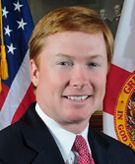
Putnam
This is all our responsibility. Making sure that our kids can compete in a global workforce. Our piece of the puzzle may be school nutrition. And working with Sen. Montford and MaryEllen (Elia) in Hillsborough and others. We’re going to be in Pinellas tomorrow kicking off a breakfast program. We know kids can’t do well on the FCAT (if they’re hungry). I know back when we took the HSCT 25 years ago, the home ec teacher made sure every kid had a glass of orange juice and a ham biscuit.
But as a parent of four public school students – my wife’s president of the PTA, Jean (to Jean Hovey with the Florida PTA). She has a spring fling planning meeting today. We need to raise $15,000 at the carnival. But the biggest challenge I think we face as we continue to push Florida where Florida is capable of going, is managing the expectations and preparing parents for what we are asking of them. Because as a guy who is amazed at the homework my kids have, and how technology has transformed their world – my daughter stayed home yesterday sick, she was devastated. She was ruining her perfect attendance record, which is not a guilt I was ever burdened with. As she felt better during the day, she got on the computer and had almost no make-up work because so much of her work was computer-based. It was easily accessible. It was web-based. It was already there. She could email her teacher on Edmodo and all these other things. My 5-year-old’s excited about the points he’s accumulated on Accelerated Reader.
I have parents, when we’re sitting around at Beef O Brady’s after a T-ball game, who may be concerned about the rate of reform, the rate of transformation in education. But they don’t realize they’re on the cutting edge of that transformation. You know, they got a daughter who’s about to graduate from high school with an AA, because she’s also been taking dual enrollment at the community college. They don’t realize that’s an extraordinary transformation in how we’re preparing a new work force in partnership with our state colleges. Or someone who has the opportunity to take PE online as a band member, on the computer, through the virtual school. Or any number of other things where they’re not going about the traditional method.
Parents are of course experts on education because they went to school, right? It’s the same thing in the Legislature. The two things that everybody is an expert on: ethics and election issues, and education issues. Because they all got elected, and they all went to school somewhere. It’s a very dangerous thing.
But parents are the same way. They think this is not what I did when I was your age, therefore, we’re trying to do too much. I didn’t have to pass Algebra to graduate from high school, therefore, we’re doing too much. We have to have champions, in the business community and in public life, who are constantly painting the picture. We’re not breaking through mediocrity. We’re celebrating greatness. We’re the sixth best in the country and continuing to do better. We’re closing the minority achievement gap, and continuing to do better. But here’s why it’s important. Here’s why your kids are doing things you weren’t doing in third grade. Here’s why they’re going to have to hit certain milestones you didn’t have to hit to graduate from high school. Because you weren’t competing against Bangalore and Beijing to get a job.
But nobody’s reminded them of that. And nobody’s reminded them of all the options their kids have that they didn’t have. (more…)
At the EdFly Blog today, former Orlando Sentinel columnist Mike Thomas asks a reasonable question: Why isn't the Florida teachers union trumpeting the dramatic gains of Florida teachers? This morning's Education Week ranking is just the latest in a long string of credible reports that finds Florida making steady academic progress. Shouldn't Florida teachers, doing more with less and under enormous pressure to produce results, get credit from those who portray themselves as their biggest supporters? Here's Thomas:
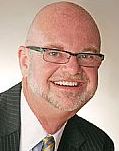
FEA President Andy Ford
Florida scored another impressive victory with the state finishing sixth in the Education Week “Quality Counts’’ rankings.
This follows news from last month that Florida fourth graders finished second in the world on international reading assessments. In October, Miami-Dade won the prestigious Broad Prize for urban school districts because of progress in closing the achievement gap. Florida kids ranked second in the nation in learning gains dating back to the 1990s. I could go on.
Alas, Florida’s good news is not celebrated by all, even by its own teachers’ union. The Florida Education Association has been silent on all of the above, even though its teachers are on the front lines of these successes. Repentant reformer Diane Ravitch actually compared student achievement in Florida and Massachusetts. Of course Massachusetts kids perform better. Look at the student demographic and income data, Diane. Are you serious?
The reason for this denial is that Florida did not achieve its success by acceptable means. By that, I mean if the state had achieved these results by tripling education spending and eliminating its accountability provisions and school choice options, the above victories would have been trumpeted from the rooftops by the FEA and Diane as well.
Continue reading Thomas' post here.
Race-based achievement goals. Florida voters don’t like them, according to a new Quinnipiac poll, but … how much of that is based on widely circulated misinformation about them? Coverage from The Buzz, Orlando Sentinel, Palm Beach Post, News Service of Florida, StateImpact Florida.
 Newtown plus doomsday. Prominent Tampa attorney Barry Cohen sparks a feud with the elite Berkeley Preparatory School over what he sees as shortcomings in security, reports the Tampa Bay Times. The state needs to better fund school resource officers, Leon County Superintendent Jackie Pons tells Gov. Rick Scott, reports Gradebook. Mayan calendar doomsday fears add to Newtown jitters at schools across the country, reports the New York Times. Lots of rumors and fears in Florida: Miami Herald, Orlando Sentinel. A gun instructor in southwest Florida offers free gun training to any interested teacher, reports the Fort Myers News Press.
Charter school funding. Don’t force school districts to subsidize charter schools, editorializes the Palm Beach Post.
Class size penalties in Duval. Superintendent Nikolai Vitti says the $7.4 million penalty – the highest in the state - should be dropped on appeal, reports the Florida Times Union.
High school grades due out this morning. SchoolZone.
Trying to compete with teachers unions for influence. The Miami Herald looks at growing political contributions from charter and virtual school interests, and frames the story this way: “Some observers say the big dollars foreshadow the next chapter of a fierce fight in Tallahassee: the privatization of public education.” Last Friday on redefinED, Doug Tuthill argued that the term “privatization,” as typically used in ed debates, is misleading.
 Florida Supreme Court and vouchers. Two separate columns in recent days cited the Florida Supreme Court’s 2006 decision to overturn vouchers as a reason behind efforts to convince voters to deny the retention of three justices. South Florida Sun-Sentinel columnist Michael Mayo here. UF law professor Joe Little in the Tallahassee Democrat here.
State Board of Education is wrong. So says the Tampa Bay Times, in this editorial about the board’s decision to set race-based achievement goals that include steeper rates of progress for low-income and minority students. More coverage in the Orlando Sentinel here.
Complaints about private school in Pasco. WTSP-Ch. 10 talks to parents who say officials are doctoring tests and report cards at Zephyrhills Christian Academy, a private school that accepts McKay vouchers for disabled students.
Superintendents and tax-credit scholarships. St. Johns County Superintendent Joe Joyner relays his concerns to the Florida Times Union.
New teacher evals cause angst in Pinellas. Tampa Bay Times story here.
Voucher tsunami. (This story from the Topeka Capital-Journal is a couple weeks old, but I didn’t see it until this weekend.) A leading state lawmaker in Kansas, Rep. Marc Rhoades, says vouchers are on their way to the Sunflower State, and he references programs in Milwaukee and Florida: “In my opinion, it’s like a tidal wave that’s coming, and I don’t know that the education establishment can withstand it forever.”
 Editor's note: Julio Fuentes, president of the Hispanic Council for Reform and Educational Options, sent this email blast out earlier today.
Governor Rick Scott made the right call in declaring "unacceptable" the race-based achievement goals outlined in the Florida Board of Education's recently released five-year strategic plan.
The Hispanic Council for Reform and Education Options (HCREO) believes that the Board's plan is not merely unacceptable; it is insulting and counterproductive to the education needs of all Florida children. Just as politics should not drive our education system, race and ethnicity should not determine the expectations we set for our students. Education reform - including the choices we give to students and their parents - is about the capacity of our youth to achieve when given the proper classroom tools and instruction.
The state's plan outlines that by 2018, 90 percent of Asian students, 88 percent of white students, 81 percent of Hispanic students and 74 percent of black students should be reading at or above grade level. For math, the goals are set at having proficiency levels of 92 percent for Asian students, 86 percent for white students, 80 percent for Hispanic students, and 74 percent for black students.
To set these different bars for students is to say, effectively, that we believe one group is capable of achieving more simply because of their skin color and ethnic background. That approach might have reigned back in the days of segregated classrooms, but it has no place in today's classrooms.
In case the Board of Education isn't aware: We are living in 2012. The nation's first black President is running for re-election. Louisiana's governor is Indian. The mayor of San Antonio, Texas made history this summer when he became the first Hispanic to give the keynote address at the Democratic National Convention. These successful leaders did not achieve because of, or in spite of, the skin color and families into which they were born. They succeeded because they had education and support from teachers and others who believed in their abilities.
Every student in every Florida classroom today deserves the same. (more…)

Students at Franklin Middle School in Tampa.
Vouchers need more accountability. So say David R. Colburn, director of the Askew Institute at the University of Florida, and Brian Dassler, chief academic officer for the New Orleans Center for Creative Arts, in this exclusive op-ed for the Tampa Bay Times. Response here from the Heartland Institute, which says parental satisfaction is “a more effective form of accountability than extending mindless bureaucratic oversight to the private sector.”
New charter school to focus on “Latin and logic.” Tampa Bay Times story here. The applicant for the school is Anne Corcoran, the wife of state Rep. Richard Corcoran. He’s a future House speaker and a strong proponent of private school choice, too.
Threats to single-gender learning options. U.S. Sens. Kay Bailey Hutchison and Barbara Mikulski are considered to be on opposite ends of the political spectrum, but in this op-ed for the Wall Street Journal they unite in defense of single-gender options in public schools. (They single out Florida as one of the states where such options have been under legal fire.) It’s worth noting that in our own backyard, old lines of division have also faded over this issue. Last year, John Kirtley, who chairs Step Up For Students, donated $100,000 to the Hillsborough County School District to support single-gender academies at two public middle schools. The Walton Family Foundation kicked in another $100,000.
More on race-based achievement goals. The New York Times writes today about the state Board of Education’s decision last week to set different academic achievement targets for black, white, Hispanic and other subgroups. The targets incorporate steeper rates of improvement for groups with lower proficiency rates, but they have nonetheless caused a ruckus. The parents group Fund Education Now weighs in. So does Naples Daily News columnist Brent Batten, who hears from Collier County education officials that this is “much ado about nothing.”
 Florida’s next education commissioner will inherit a job that makes juggling chainsaws look easy. He or she must get under the hood of a complicated accountability system, ride herd on a historic shake-up of public education, dodge slings and arrows while walking a political tight rope and leap tall buildings in a single bound.
And yet, the job remains so compelling. Florida is the nation’s most promising bridge to an education system that can more fully give teachers and parents real power to help kids live out their dreams. In the last 10 to 15 years, no state has focused more on the low-income and minority students who are now a majority in Florida public schools. Simultaneously, no state has opened the door more to alternative learning options – options that have both empowered parents and multiplied the potential for educators to innovate. The result has been both dramatic and nowhere near enough. The next commissioner must find ways to continue the momentum.
To that end, we hope he or she can nimbly rotate hats long enough to also assume the role of explainer-in-chief. We know this won’t be easy; education reformers in Florida operate in an environment that is particularly tense and, in the past couple of years, has become downright ugly. But we can’t help but think that maybe, just maybe, the temperature will drop a few degrees if fair-minded people can be persuaded that not every education idea and not every education reform is a zero-sum proposition. Sometimes, they really can work in harmony with the other parts.
This is especially true with school choice. The sincere goal here isn’t “privatization,” it’s personalization. It’s about expanding options so more kids can be matched with settings that maximize their potential, and yes that includes private and faith-based options.
There’s no reason, and so far in Florida no demonstration, that these options have to come at the expense of traditional schools. It’s entirely possible – and many of us think it’s absolutely necessary – to support traditional public schools at the same time we push for additional options that, for individual students, may work better. (more…)
 It does sound nefarious: The people who back accountability for Florida public schools, the argument goes, are really out to mine huge sums of money from their degradation and demise. In a weekend op-ed for the Orlando Sentinel, Florida teachers union president Andy Ford (pictured here) mashed the privatization button hard in panning the state’s “flawed and punitive” ed reforms. The accountability system, he wrote, has been “endlessly promoted by legislators who favor for-profit schools, and the Florida Chamber of Commerce.” The state’s standardized test has been “abused by politicians and those wanting to make a profit off public schools and students.” The job of state education commissioner has “devolved into one solely focused on implementing the marching orders of Jeb Bush and the corporate community.”
Yikes! But if all of those folks really were out to make public schools look awful (so profiteers could swoop to the rescue with charter schools and vouchers) they’ve done a miserable job. As we’ve noted before, one key indicator after another and one credible, independent report after another has found Florida’s public school students – especially its poor and minority students – have, over the past 10 to 15 years, improved as fast as students in just about any other state. Matthew Ladner, a researcher at the Foundation for Excellence in Education, has more on this point today at Jay P. Greene’s Blog:
Notice that the “good ole days” in Florida (pre-reform) were a disaster for low-income children. A whopping 37% of Florida’s low-income 4th graders had learned to read according to NAEP’s standards in 1998. A lack of transparency and accountability may have suited the FEA fine, but it was nothing less than catastrophic for Florida’s low-income children. Thirteen years into the “flawed” system, that figure was up to 62 percent. The goal of Florida policymakers should clearly be to accelerate this impressive progress rather than to go back to the failed practices of the past.
Put another way, if Mr. Ford considers this system “flawed” then Florida lawmakers should quickly implement something that he would judge to be “catastrophically flawed.”
 Education reform, for some of us, is full of tough calls. And for some of us, there can be particular agony in the gray area where race, poverty and both types of accountability – parental choice and regulatory – intersect.
Last week, the school board in Pinellas County, Fla., voted 4-3 against their superintendent’s recommendation to begin the process of closing a charter school in the city of St. Petersburg. The Imagine elementary school, serving predominantly low-income, African-American kids, had just earned its third F grade in four years of operation because of painfully low standardized test scores. Only 29 percent of its students were reading at grade level, according to the state test; only 13 percent were reaching the bar in math. Only one school in the district had performed worse – another charter – and the board had already voted to shutter it.
In the case of Imagine, the board was knotted by a a number of entangling factors, including a vote two months ago – before the release of school grades – to renew the school’s contract. Before the second vote, nearly 20 parents, teachers, administrators and company officials pleaded with the board to keep the school open. They were passionate, thoughtful, respectful – and collectively powerful. We thought their comments were worth sharing, and we excerpted a number of them below. (You can see the speakers on this video here; their presentations begin just before the 41 minute mark. The board debate begins at 3:18:39).
As you weigh the pros and cons, a few points to keep to mind: Black students in Pinellas perform worse than black students in every other urban district in Florida. The number of charter schools has grown rapidly in Pinellas, but not in neighborhoods with large numbers of low-income families of color. The district still isn’t home to a known quantity like KIPP or YES Prep with a record of success with minority kids. And the school board, like many of its counterparts across Florida, recently passed a resolution critical of standardized testing.
Here are the excerpts, edited for length:
Qiana Scott, parent: “You can’t make a decision to close down an institution that is there for the kids based on a standardized test. Because all of our kids are not standard. Kids learn differently. They are taught differently. And at Imagine, that is something that is definitely recognized. So the teachers take that extra time and the extra care to say, “You learn this way, I will teach you the way that you learn best.” So therefore, our kids are learning. It definitely hurts a lot of the parents and a lot of the staff because everybody has worked so hard all year, and to hear that Imagine could possibly be closed down – that’s like splitting up a family. And that’s what we are at Imagine. We are family.“ (more…)

