Editor’s note: Florida Agriculture Commissioner Adam Putnam was a late arrival and one of the last speakers at Wednesday’s education summit on Common Core in Orlando. But he delivered some of the most memorable lines, stressing better communication with parents about education reform and school choice. Here’s a transcript of his remarks.
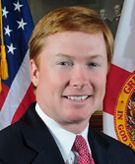
Putnam
This is all our responsibility. Making sure that our kids can compete in a global workforce. Our piece of the puzzle may be school nutrition. And working with Sen. Montford and MaryEllen (Elia) in Hillsborough and others. We’re going to be in Pinellas tomorrow kicking off a breakfast program. We know kids can’t do well on the FCAT (if they’re hungry). I know back when we took the HSCT 25 years ago, the home ec teacher made sure every kid had a glass of orange juice and a ham biscuit.
But as a parent of four public school students – my wife’s president of the PTA, Jean (to Jean Hovey with the Florida PTA). She has a spring fling planning meeting today. We need to raise $15,000 at the carnival. But the biggest challenge I think we face as we continue to push Florida where Florida is capable of going, is managing the expectations and preparing parents for what we are asking of them. Because as a guy who is amazed at the homework my kids have, and how technology has transformed their world – my daughter stayed home yesterday sick, she was devastated. She was ruining her perfect attendance record, which is not a guilt I was ever burdened with. As she felt better during the day, she got on the computer and had almost no make-up work because so much of her work was computer-based. It was easily accessible. It was web-based. It was already there. She could email her teacher on Edmodo and all these other things. My 5-year-old’s excited about the points he’s accumulated on Accelerated Reader.
I have parents, when we’re sitting around at Beef O Brady’s after a T-ball game, who may be concerned about the rate of reform, the rate of transformation in education. But they don’t realize they’re on the cutting edge of that transformation. You know, they got a daughter who’s about to graduate from high school with an AA, because she’s also been taking dual enrollment at the community college. They don’t realize that’s an extraordinary transformation in how we’re preparing a new work force in partnership with our state colleges. Or someone who has the opportunity to take PE online as a band member, on the computer, through the virtual school. Or any number of other things where they’re not going about the traditional method.
Parents are of course experts on education because they went to school, right? It’s the same thing in the Legislature. The two things that everybody is an expert on: ethics and election issues, and education issues. Because they all got elected, and they all went to school somewhere. It’s a very dangerous thing.
But parents are the same way. They think this is not what I did when I was your age, therefore, we’re trying to do too much. I didn’t have to pass Algebra to graduate from high school, therefore, we’re doing too much. We have to have champions, in the business community and in public life, who are constantly painting the picture. We’re not breaking through mediocrity. We’re celebrating greatness. We’re the sixth best in the country and continuing to do better. We’re closing the minority achievement gap, and continuing to do better. But here’s why it’s important. Here’s why your kids are doing things you weren’t doing in third grade. Here’s why they’re going to have to hit certain milestones you didn’t have to hit to graduate from high school. Because you weren’t competing against Bangalore and Beijing to get a job.
But nobody’s reminded them of that. And nobody’s reminded them of all the options their kids have that they didn’t have. (more…)
I am grateful to Rebecca Sibilia and Sean Gill for their thoughtful response to my blog post encouraging Michelle Rhee to replace her failing schools model of school choice with an approach based on equal opportunity.
Rebecca and Sean defended StudentsFirst’s support of the failing schools model on pragmatic grounds. They wrote: “When state resources are limited or the existing supply of desirable private schools is limited, it also makes sense to prioritize vouchers or scholarships for those low-income children attending a low-performing school or living in low-performing school districts.”
Every community suffers from an insufficient supply of effective schools for low-income students. But in Florida we’ve learned that increasing demand - not limiting demand - is the best way to increase supply.
Access to Florida’s tax credit scholarship program for low-income students, which I help administer, is limited by a state-imposed cap. But our demand is not limited, so it often exceeds supply. This excess demand has not had a negative effect on students or the program. Instead, it has generated political pressure on the state Legislature to allow our cap to rise to meet this additional demand.
In 2010, as a result of excessive demand, the Florida Legislature voted to allow our program to grow 25 percent every year the demand hits or exceeds 90 percent of supply. The result has been extraordinary growth of supply and demand. While we have been awarding scholarships since 2002, 34 percent of our growth has occurred in just the last two years. This school year we added 10,000 more students to the program and had more than 12,000 students add their names to our waiting list after we hit our cap.
We’ve also been adding about 100 new private schools per year to the program, and some have started to expand their physical capacity to serve more students. Had we adopted the StudentsFirst approach of limiting demand when faced with limited supply, this extraordinary growth would not have occurred.
Today, more than 43 percent of Florida’s preK-12 students attend a school other than their assigned district school. Charter schools, magnet schools, virtual schools, career academies, dual enrollment and homeschooling are all growing dramatically. Private schools are already struggling to maintain their market share given all these choices. If we were to limit our scholarships to low-income students in state-designated failing schools, then many private schools serving low-income students might be forced to close - to everyone’s detriment. (more…)
More Rubio vouchers. U.S. Sen. Marco Rubio needs a Florida-style coalition - meaning some Democratic lawmakers who see the value in expanded school choice - to get his plan for federal tax credit scholarships off the ground, writes Adam Emerson at the Choice Words blog. Education Week logs it in.
 More tutoring oversight. In light of abuses, the state-mandated program - which allows low-income parents to choose and access private tutors - should be scrapped, editorializes the Tampa Bay Times. The Miami Herald editorial board offers a more measured response, calling for better oversight and more regulatory accountability but acknowledging the predicament of low-income parents.
More parent trigger. Florida Times Union. FCIR.
Wall of shame. At Jefferson High in Tampa, teachers keep tabs on embarrassing questions from students with a "Wall of Shame" in the teachers' lounge. Tampa Bay Times.
School safety. A 14-year-old is arrested for allegedly molesting an 8-year-old at a school for special needs students in Clearwater. Tampa Bay Times.
Charter schools. Teachers need more options, too, says Senate President Don Gaetz, reports StateImpact Florida. A growing number of charters in Palm Beach County increasingly pits independent charters against charter networks, reports the Palm Beach Post.
Magnet schools. Palm Beach district officials hope they can land a federal grant to create and bolster magnets at three underutilized schools. Palm Beach Post.
Dual enrollment. Growing numbers of students are taking the classes, raising concerns about state college costs and high school curriculum. Tampa Bay Times. (more…)
 Words such as voucher, privatization, profit and corporation are often used as weapons by individuals and groups who oppose parental empowerment and school choice. Using words as weapons is especially common during periods of significant social change - we all do it - but the practice undermines civic discourse and makes finding common ground more difficult.
“Market” is another term school choice opponents use to connote evil, but our way of life is largely based on markets, and public education is increasingly embracing market processes as customized teaching and learning become more common. Our challenge moving forward is regulating public education markets in ways that maximizes their effectiveness and efficiency.
People access products and services in one of two ways. Either their government assigns them, or they choose for themselves. In the United States, we have historically allowed citizens to choose, and this system of provider and consumer choice is a “market.”
In a goods and services market, providers decide which goods and services they want to sell, and consumers choose those they want to buy. Markets, when implemented properly, are preferable to assignment systems because they better utilize people’s knowledge, skills and motivation. Citizens are allowed to use their own experiences and judgments when making selling and purchasing decisions, and this citizen empowerment maximizes the universe of ideas from which improvement and innovation derive.
When governments assign products and services to their citizens, they rely on a small group of people to decide what to offer. This top-down approach is less open, transparent and effective than the decision-making that occurs in markets, and it discourages creativity. This is why most improvements in goods and services emerge from market systems rather than government assignment systems.
Markets allow providers to learn from consumers. When governments dictate to consumers what goods and services they may have, their citizens’ true wants and needs are not fully considered. The voice of the customer is silent. But when consumers are empowered to choose for themselves, providers learn from these choices and adjust accordingly. In markets, this necessity to meet customers’ needs drives innovation and continuous improvement. (more…)
Editor's note: This is the second installment of "A Choice Conversation," an ongoing dialogue between Doug Tuthill, president of Step Up for Students and a redefinED host, and John Wilson, a former NEA leader who writes the Unleashed blog at Education Week.
 Doug Tuthill: John, in our last exchange you called “for a new contracting arrangement for providers to serve the unique educational needs of targeted student populations and innovation.”
Floridians have heeded your advice and are expanding options for educators and families through innovative public-private partnerships. For example, the Okaloosa school district contracted with Embry-Riddle Aeronautical University to run Florida’s best aeronautics high school institutes. The Florida Virtual School contracts with Connections Academy to operate its K-5 program, and last year the Duval County school district contracted with local churches to implement programs for suspended students. The Pinellas County teachers union has a corporate subsidiary that contracts with its school board to tutor students; career academies throughout Florida contract for services from a plethora of businesses and trade associations; and the state’s charter schools, Voluntary Pre-K program, McKay Scholarships and tax credit scholarships are all implemented through public-private partnerships, as are many magnet schools.
Managing all these public-private partnerships is challenging, and you’ve suggested using the “institution of public schools” as the oversight entity. I’m curious what you mean by the term “institution of public schools.” I’m also interested in your criteria for distinguishing between acceptable and unacceptable public-private contracts.
John Wilson: Doug, I guess you could say I am a traditionalist when it comes to describing the institution of public schools, but I am an innovator when it comes to expanding the providers of customized education for targeted students and innovation.
I see the district board of education as the "traffic cop" for assuring that all providers, whether charters, private, or public-private, operate within a contract signed by the board of education and the provider. The "traffic cop" should assure that providers meet their fiduciary responsibility, improve student achievement, and adhere to the relevant laws and regulations as well as the contract that was signed with the board of education. I think the community needs to know these arrangements are cost-efficient and effective with their tax dollars and that their children are receiving a high-quality education. Let me add that I am not so naive as to know that we will need to build, and in some cases rebuild, trust and a shared vision with all parties that provide education opportunities. (more…)
Some of us at redefinED will be at the American Federation for Children summit tomorrow and Friday, where there will be lots of discussion about school choice and education reform. As good a time as any, we thought, to offer a snapshot of where Florida stands. Check out these numbers, which Doug Tuthill, the president of Step Up for Students and a redefinED host, shared last week with business leaders at a Leadership Florida event:
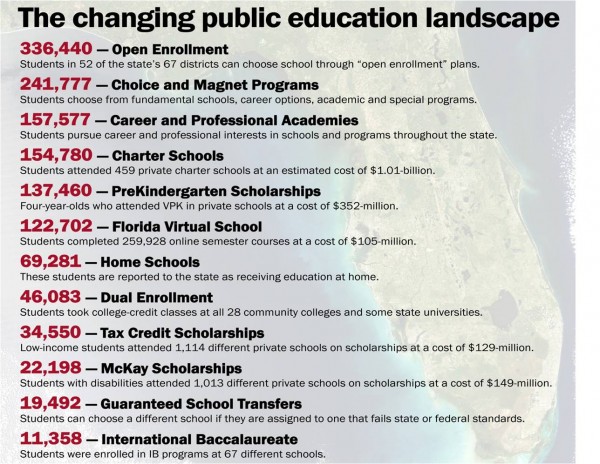
The numbers (carefully compiled by Jon East, vice president for policy & public affairs at Step Up) are from 2010-11 and we know in many cases the current figures are even higher. Charter school enrollment, for example, topped 175,000 this year, and the tax credit scholarship program serves more than 39,000 students. Altogether, the numbers underscore two things we emphasize at redefinED: School choice - the kind that allows parents to go beyond their neighborhood school - is becoming mainstream in Florida. And the lines between "public" and "private" are more blurred here than in any other state.
The AFC conference agenda includes Louisiana Gov. Bobby Jindal, New Jersey Gov. Chris Christie, Newark Mayor Cory Booker and an all-star line up of choice experts and advocates. We're hoping to have a little time to update you on what's going on with blog posts and tweets. For the latter, follow us at @redefinEDonline.

