 Following disappointing results from the National Assessment of Educational Progress, released in October, the Florida Department of Education remained optimistic about the state’s future during a recent presentation of its strategic plan for 2020-25.
No. 2 on its list of four goals presented at the November Board of Education meeting: improving access to quality schools and schools of choice.
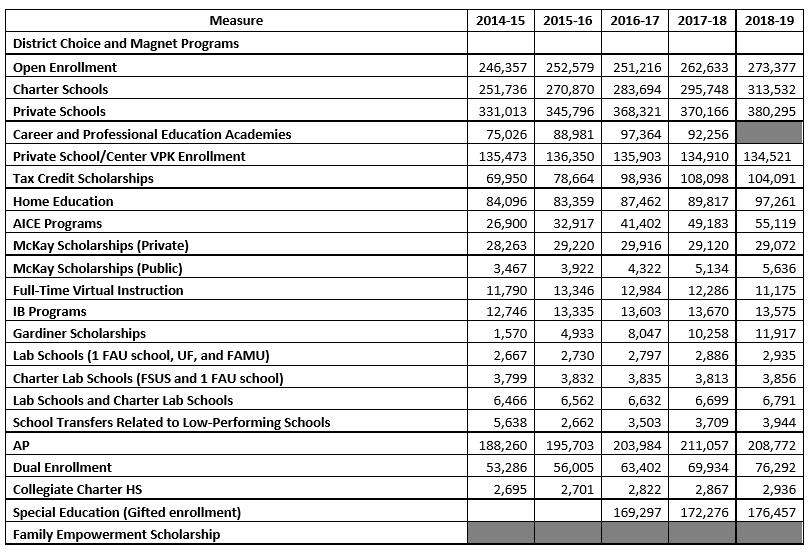
Department officials expressed interest in seeing more students exercise choice options including open enrollment, dual enrollment, charter schools, career and professional academies, IB programs, lab schools and private schools through the state’s various scholarship programs, with an overall goal of making Florida No 1 in the nation on this and other metrics by 2025.
That was good news for Katie Swingle, mother of four children, including two with special needs. One son utilizes the McKay Scholarship and the other the Gardiner Scholarship. Both programs are administered by the nonprofit Step Up For Students, which hosts this blog.
Swingle had seen the board notice about the strategic plan and drove from her home in Winter Haven to express “how important and amazing Florida is in the world of education options.”
“I’m so proud to live here,” she told board members.
A chart related to this goal included an array of choice options and participation rates from 2014-15 to 2018-19, including Tax Credit Scholarships, McKay Scholarships and Gardiner Scholarships.
Other goals identified by the board were improving student achievement and reducing the achievement gap; creating a skilled workforce; and measuring quality and efficiency of services through national rankings.
To focus on achievement, the DOE identified more than two dozen metrics from prekindergarten through high school graduation that include improving kindergarten readiness, reducing the number of low-quality Voluntary Pre-K providers and improving test scores on reading, math and science.
To create a skilled workforce, department officials want to see more students complete secondary education by 2025 and realize a larger percentage passing Advanced Placement, IB and career or vocational exams.
Finally, as a way to improve on national rankings , the board specified a focus on the National Assessment of Educational Progress, Education Week’s Quality Count’s report, the Center for Education Reform’s “Parent Power Index,” EdCHoice’s rankings on spending on choice options and the share of choice options.
“I love that this plan is data driven,” said BOE vice chair Marva Johnson, adding that the focus on measurements can “give us early warning.”
But board member Tom Grady expressed concern about the complexity of the plan’s numerous measurements. “If you have too many metrics you have none,” he said.
For Grady, the most important metric is the state’s high school graduation rate.
“It flows all the way down to Pre-K. It flows all the way upstream to that high school graduation,” he said. “If we get things wrong in third-grade reading, it’s ultimately going to be reflected in that high school graduation rate.”
Board chairman Andy Tuck applauded the DOE’s plan but said he’d like to see rural districts focus on more choice offerings, including dual enrollment, as well as more funding for choice options.
The board approved the strategic plan unanimously.
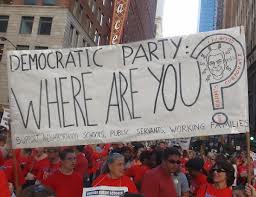 Chicago: Expansion of charter schools, which tend to employ non-unionized teachers, is a big undercurrent in the teachers union strike (New York Times). Media coverage of the strike puts charter schools in a positive light (redefinED). (Image from aei-ideas.org)
Florida: Khan Academy and Step Up For Students are partnering to bring cutting-edge technology to private schools that accept tax-credit scholarships (redefinED). The new chair of the state Board of Education says "the train has left the station" when it comes to expanding school choice (redefinED).
New Jersey: State lawmakers to take a closer look at online education. (NJSpotlight)
Rhode Island: The superintendent of the Providence school district and the president of the teachers union are working together to promote district-operated charter schools (Boston.com). State education leaders disagree about whether to close a low-performing charter school (Providence Journal).
Nevada: Lawmakers may consider parent trigger legislation in the wake of the Won't Back Down movie. (Las Vegas Sun)
Louisiana: In the wake of the state's new voucher program, the state's top education official offers a plan for closer scrutiny of private schools (New Orleans Times Picayune). About 5,000 students enroll in the new voucher program (New Orleans Times Picayune). A spokesman for a Louisiana teachers unions tries to explain why the group said a black school choice group supports "KKK vouchers" (Daily Caller).
New Hampshire: A Q&A with the head of the state's first tax credit scholarship funding organization. (Concord Monitor)

