 What does Rick Scott want? Orlando Sentinel columnist Beth Kassab on the possibility of Tony Bennett coming to Florida: “Indiana's loss could be Florida's gain. Then again, it will all depend on whether the state board and the governor are looking for somebody to push Florida forward or somebody to soften Scott's image on education reform. There are worrisome signs that Scott is looking for the latter.” Two knocks don’t make a pattern, but this is the second time in a month Scott has been criticized from the reform side.
Joining the chorus. Miami Herald columnist Leonard Pitts says the state Board of Education lowered the bar for minority students when it adopted short-term achievement goals that called for steeper rates of improvement for those students.
Tax credit scholarships and religious schools. The Orlando Sentinel takes a look at a long-established fact - the majority of students receiving tax-credit scholarships attend religious schools – and critics recycle myths about funding and accountability.
State settles with Christian college. From the News Service of Florida: “Settling a federal lawsuit that involved questions about the school's "secular purpose," state education officials will allow students at a Central Florida Christian college to be eligible for a popular grant program.” Complaint here. Settlement here.
Charter school analysis. News outlets continue to highlight UCF Professor Stanley D. Smith’s analysis, which finds that as a group, charter schools in Florida under perform traditional public schools. Smith writes an op-ed for the Tampa Bay Times. The St. Augustine Record uses his findings as a basis for this editorial. (more…)
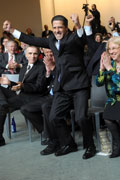
Miami-Dade Superintendent Alberto Carvalho reacts to the award announcement.
More Broad Prize coverage. As we noted yesterday, the Miami-Dade school district won this year’s Broad Prize, which goes to the urban district with the most academic progress. More from the Orlando Sentinel, Christian Science Monitor, Associated Press, Education Week. The Palm Beach school district was a finalist, which is also impressive. All this is more reason to routinely compare achievement data district by district in Florida. Also worth noting: Miami-Dade is a poster child for the new definition of public education, with a broad menu of learning options and huge numbers of parents embracing them.
Charter school issues in Volusia. The Volusia school board approves improvement plans for two F-rated charter schools, reports the Daytona Beach News Journal.
PTA doesn’t like it. The Florida PTA pans the Board of Education’s decision to set steeper improvement goals for low-income and minority students, reports the Gradebook blog.
More on Amendment 8. The Tampa Bay Times gets credit for going into detail about the legal case that’s at issue here – a case that has nothing to do with vouchers. ICYMI, our take on Amendment 8 here and here.
So the Democrat supports vouchers? In this state senate race in Central Florida, yes, notes the Orlando Sentinel.
 For the Miami-Dade school district, the fifth time's the charm. After being a finalist four other times, Florida's biggest school system finally won the Broad Prize in education today, given to the urban district making the most progress in student achievement. "Miracles are possible, even when you have to wait five years," Superintendent Alberto Carvalho said as he accepted the award, according to the Miami Herald.
The prize is well deserved. Miami-Dade has a greater percentage of low-income and minority students than any big district in Florida. And yet, as we've noted many times on redefinED (like here and here), no big district has made bigger gains over the past decade. The judges at the Broad Foundation took note. So did U.S. Secretary of Education Arne Duncan: "I commend the entire Miami-Dade community for establishing a district-wide culture of results that empowers teachers and students, puts more resources into helping children in the lowest-performing schools, and is helping narrow the opportunity gap."
Carvalho listed a number of strategies to explain the district's success, including a focus on teacher quality and struggling schools, and an expansion of learning options. All of those reforms together helped lift the kids in Miami-Dade. All of Florida should be proud.
 Florida’s next education commissioner will inherit a job that makes juggling chainsaws look easy. He or she must get under the hood of a complicated accountability system, ride herd on a historic shake-up of public education, dodge slings and arrows while walking a political tight rope and leap tall buildings in a single bound.
And yet, the job remains so compelling. Florida is the nation’s most promising bridge to an education system that can more fully give teachers and parents real power to help kids live out their dreams. In the last 10 to 15 years, no state has focused more on the low-income and minority students who are now a majority in Florida public schools. Simultaneously, no state has opened the door more to alternative learning options – options that have both empowered parents and multiplied the potential for educators to innovate. The result has been both dramatic and nowhere near enough. The next commissioner must find ways to continue the momentum.
To that end, we hope he or she can nimbly rotate hats long enough to also assume the role of explainer-in-chief. We know this won’t be easy; education reformers in Florida operate in an environment that is particularly tense and, in the past couple of years, has become downright ugly. But we can’t help but think that maybe, just maybe, the temperature will drop a few degrees if fair-minded people can be persuaded that not every education idea and not every education reform is a zero-sum proposition. Sometimes, they really can work in harmony with the other parts.
This is especially true with school choice. The sincere goal here isn’t “privatization,” it’s personalization. It’s about expanding options so more kids can be matched with settings that maximize their potential, and yes that includes private and faith-based options.
There’s no reason, and so far in Florida no demonstration, that these options have to come at the expense of traditional schools. It’s entirely possible – and many of us think it’s absolutely necessary – to support traditional public schools at the same time we push for additional options that, for individual students, may work better. (more…)
 It does sound nefarious: The people who back accountability for Florida public schools, the argument goes, are really out to mine huge sums of money from their degradation and demise. In a weekend op-ed for the Orlando Sentinel, Florida teachers union president Andy Ford (pictured here) mashed the privatization button hard in panning the state’s “flawed and punitive” ed reforms. The accountability system, he wrote, has been “endlessly promoted by legislators who favor for-profit schools, and the Florida Chamber of Commerce.” The state’s standardized test has been “abused by politicians and those wanting to make a profit off public schools and students.” The job of state education commissioner has “devolved into one solely focused on implementing the marching orders of Jeb Bush and the corporate community.”
Yikes! But if all of those folks really were out to make public schools look awful (so profiteers could swoop to the rescue with charter schools and vouchers) they’ve done a miserable job. As we’ve noted before, one key indicator after another and one credible, independent report after another has found Florida’s public school students – especially its poor and minority students – have, over the past 10 to 15 years, improved as fast as students in just about any other state. Matthew Ladner, a researcher at the Foundation for Excellence in Education, has more on this point today at Jay P. Greene’s Blog:
Notice that the “good ole days” in Florida (pre-reform) were a disaster for low-income children. A whopping 37% of Florida’s low-income 4th graders had learned to read according to NAEP’s standards in 1998. A lack of transparency and accountability may have suited the FEA fine, but it was nothing less than catastrophic for Florida’s low-income children. Thirteen years into the “flawed” system, that figure was up to 62 percent. The goal of Florida policymakers should clearly be to accelerate this impressive progress rather than to go back to the failed practices of the past.
Put another way, if Mr. Ford considers this system “flawed” then Florida lawmakers should quickly implement something that he would judge to be “catastrophically flawed.”

