The future of education is happening now. In Florida. And public school districts are pushing into new frontiers by making it possible for all students, including those on education choice scholarships, to access the best they have to offer on a part-time basis.
That was the message Keith Jacobs, director of provider development at Step Up For Students, delivered on Excel in Education’s “Policy Changes Lives” podcast A former public school teacher and administrator, Jacobs has spent the past year helping school districts expand learning options for students who receive funding through education savings accounts. These accounts allow parents to use funds for tuition, curriculum, therapies, and other pre-approved educational expenses. That includes services by approved district and charter schools.
“So, what makes Florida so unique is that we have done something that five, 10, even, you know, further down the line, 20 years ago, you would have never thought would have happened,” Jacobs said during a discussion with podcast host Ben DeGrow.
Jacobs explained how the process works:
“I’m a home education student and I want to be an engineer, and the high school up the street has a remarkable engineering professor. I can contract with the school district and pay out of my education savings account for that engineering course at that school.
“It’s something that was in theory for so long, but now it’s in practice here in Florida.”
It is also becoming more widespread in an environment supercharged by the passage of House Bill 1 in 2023, which made all K-12 students in Florida eligible for education choice scholarships regardless of family income. According to Jacobs, more than 50% of the state’s 67 school districts, including Miami-Dade, Orange, Hillsborough and Duval, are either already approved or have applied to be contracted providers.
That’s a welcome addition in Florida, where more than 500,000 students are using state K-12 scholarship programs and 51% of all students are using some form of choice.
Jacobs said district leaders’ questions have centered on the logistics of participating, such as how the funding process works, how to document attendance and handle grades.
Once the basics are established, Jacobs wants to help districts find ways to remove barriers to part-time students’ participation. Those could include offering courses outside of the traditional school day or setting up classes that serve only those students.
Jacobs said he expects demand for public school services to grow as Florida families look for more ways to customize their children’s education. That will lead to more opportunities for public schools to benefit and change the narrative that education is an adversarial, zero-sum game to one where everyone wins.
“So, basically, the money is following the child and not funding a specific system. So, when you shift that narrative from ‘you're losing public school kids’ to ‘families are empowered to use their money for public school services,’ it really shifts that narrative on what's happening here, specifically in Florida.”
Jacobs expects other states to emulate Florida as their own programs and the newly passed federal tax credit program give families more money to spend on customized learning. He foresees greater freedom for teachers to become entrepreneurs and districts to become even more innovative.
“There is a nationwide appetite for education choice and families right now…We have over 18 states who have adopted some form of education savings accounts in their state. So, the message to states outside of Florida is to listen to what the demands of families are.”
A generation ago, Florida’s school districts could safely assume that most students would board a yellow bus (or perhaps walk less than two miles) to a public school they operated.
 A few wealthy students might head to a private school. A handful of students from each neighborhood might board a different yellow bus to a local magnet or charter school. But these were marginal deviations from the norm.
Now, those deviations are the norm.
Close to half a million Sunshine State students use a scholarship program to access a learning option of their choice. More than 400,000 students attend charter schools that aren’t operated by districts. All told, roughly half the state’s 3.4 million K-12 students attend a learning option other than their zoned public school.
There are unsung heroes in this story of expanding options: Florida’s 67 school districts.
With all the growth of charters and scholarship programs, district-operated options, — including open enrollment, magnet schools, career academies, and more — still account for the single-largest swath of school choice in the state.
Thanks to all these options growing at the same time, no school can take a student’s enrollment for granted. Every school has to earn the trust of every student or family who walks through their doors.
A survey by the national advocacy group 50CAN found 76% of Florida parents feel they have a choice in where they’re child goes to school.

Source: 50CAN Education Opportunity Survey
That means that while half of Florida’s students attend a “school of choice,” half the remainder attend a local public school by choice, having considered other available options.
I’ve now experienced this change firsthand. I’m in the process of finding the right Pre-K for my daughter. After searching for miles and visiting private, charter, and district public schools, my wife and I landed on a clear favorite: Goldsboro Elementary, a magnet school operated by Seminole County Public Schools.
My daughter was enchanted by the astronomy lab. And of all the schools we spoke to, Goldsboro’s teachers had the clearest plan for ensuring our daughter, who currently reads on a first-grade level, will continue to be challenged academically.
Districts are stepping up their game. Competition from other options is certainly a factor.
But in recent months, I’ve had the chance to talk to district leaders across the state who are exploring a new frontier of educational options: They are looking for ways to offer individual courses and services to students using K-12 education choice scholarships.
These aren’t the stodgy bureaucrats that advocates and reformers sometimes cast as their foils in battles over the future of education. These are problem-solvers who hear the demand for new and different learning opportunities from their communities. They are working to respond.
In a future where every Florida student has access to abundant education opportunities, districts will play an essential role.
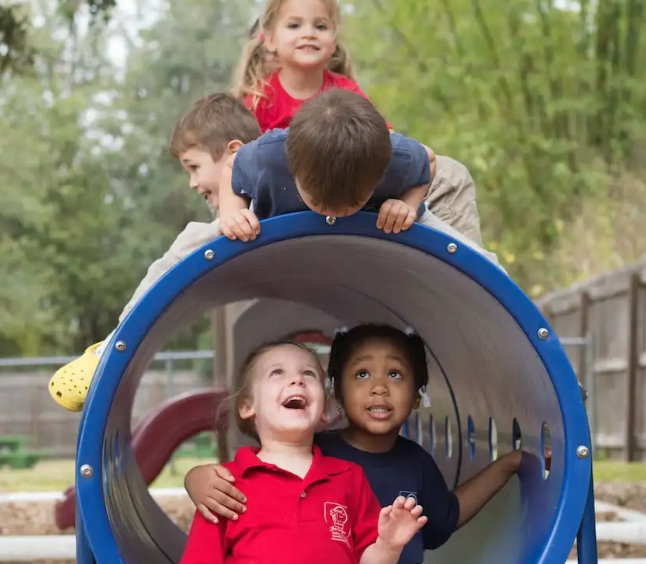
The Montessori Academy of Carrollwood, one of a number of private Montessori schools in the Tampa Bay area, is dedicated to creating nurturing environments that meet every child’s developmental needs, where each child fosters and expands natural curiosity.
Montessori schools, associated for decades with private schools and well-to-do suburban dwellers, are becoming more accessible to lower-income children as more public schools expand education choice and create magnet programs using this model of student-directed learning.
Though state education choice scholarships have opened up seats at private Montessori schools in Florida and other states where lawmakers have passed similar programs, students in other states have had less access, and even in education choice states, public systems have started Montessori magnets to boost or maintain enrollments.
The latest school district to make a foray into Montessori education is the Hillsborough County School District in Tampa, Florida. With an enrollment of 218,943 students at 303 schools, it is the sixth-largest school district in the United States.
Officials there recently announced the opening of the district’s first Montessori magnet program at Essrig Elementary School, which boasts an enrollment of 549 students in pre-kindergarten through fifth grade. About 68% percent of Essrig’s students are eligible for free or reduced-price lunch, an indicator of socio-economic level.
Set to begin in August, the program will be open to 54 students ages 3 and 4 and those entering kindergarten. More grade levels are expected to be added. Eligibility will be based on a lottery.
"This is all about individualized development," Superintendent Addison Davis said during a news conference. "There's a lot of concentrated private institutions that offer Montessori, and we want to be an option for our parents as well, where they choose Hillsborough County Public Schools."
According to the American Montessori Society's website, a dozen private Montessori schools currently operate in Hillsborough County. Davis said the tuition can often be too expensive for some families and waiting lists at the schools are long.
The district's program will be open to families throughout the county.
"Education has been revolutionized, and our industry has changed, and we've got to continue to change with the growing needs of our parents," Davis said.
District leaders say the program will included mixed age groups and let students learn at their own pace.
“We might have a 5-year-old who is progressing at the same age level as a 7-year-old or a 3-year-old who is progressing beyond a 4-year-old or a 5-year-old,” said Kay Bays, chief of innovation at Hillsborough County Public Schools. “The point is to put them together so they can grow at their own pace and at their own speed.”
A national study showed surging interest in Montessori programs in at least the past 15 years. The National Center for Montessori in the Public Sector estimates that more than 300 new programs have opened since 2000, with a total of 635 that have been opened since 1975.
Much of the recent growth has been evenly split between charter and district magnet schools. (Florida is among the states with the highest numbers of public Montessori schools with 158, including 30 public programs, according to the report.) Like the school opening at Essrig Elementary, most operate as schools within larger schools. In South Carolina, 83% of all Montessori programs function within larger schools.
You can see a national census of Montessori programs here.
According to a 2019 article in Forbes, the expansion of school choice has expanded the number of Montessori programs to about 500 public school programs. That has helped improve access to lower-income families, but as demand rises, these families find themselves competing with middle-income families for seats.
The Montessori model was developed in 1906. Italian physician and educator Dr. Maria Montessori pioneered the child-centered approach, which is student-led and self-paced but guided, assessed, and enriched by caring and knowledgeable teachers, the leadership of classroom peers and an environment that encourages discovery.
Classrooms include students of different ages with students mentoring one another. Montessori experts say this freedom allows children to learn more deeply, make connections and develop creativity and critical thinking skills.
Montessori, who graduated from the medical school at the University of Rome, based her methods on scientific observations and started her first school to educate lower-income students. As the model took home and became more popular, wealthier families embraced it and sent their children to private schools that offered it.
To critics who express concerns it causes chaos, supporters say the opposite is true, and that the Socratic method that teachers use encourages student to expand their learning.
“Contrary to some who believe that Montessori classrooms are chaotic and nonstructured, where students can do whatever they want with no responsibility, nothing could be further from the truth,” wrote longtime Montessori principal Judy Dempsey in her 2016 book, “Turning Education Inside Out: Confessions of a Montessori Principal.”
“Students are expected to be responsible community members, finish the work that they choose, and return it to the shelf so that someone else can use it.”
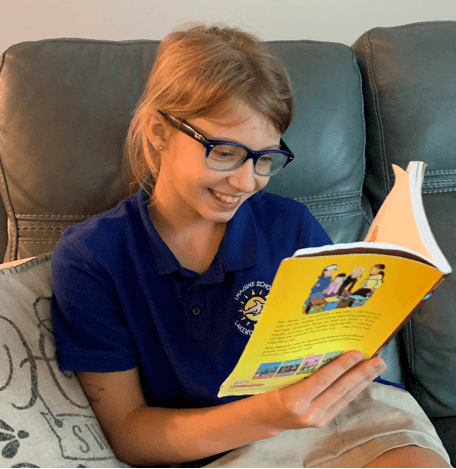
Samantha Pawlishen, a fourth-grader at Imagine School Lakewood Ranch in Manatee County, Florida, has improved her reading scores and expanded her love of reading with a Florida Reading Scholarship.
Editor's note: This feature appeared recently on Step Up For Students' marketing blog.
Lindsey Pawlishen was so confident she would pass her love of reading to her daughter that she asked for and received children’s books instead of traditional gifts at the baby shower. She began reading to Samantha when Samantha was an infant expecting to instill that love of reading.
But Samantha didn’t love reading.
“I didn’t understand it,” Lindsey said, “because everybody said if you read to your kids as soon as they are born, they’re going to be readers, but that didn’t work.”
It would turn out that Samantha’s lack of interest had something to do with the fact she struggled to read. She scored low on the English Language Arts section of the Florida Standards Assessments as a third grader during the 2020-21 school year.
That made her eligible for Florida’s Reading Scholarship, managed by Step Up For Students, which hosts this blog.
The scholarship was created to help public school students in third through fifth grade who struggle with reading. Those who scored a 1 or 2 on the third- or fourth-grade English Language Arts section of the Florida Standards Assessments in the prior year are eligible.
To continue reading, click here.
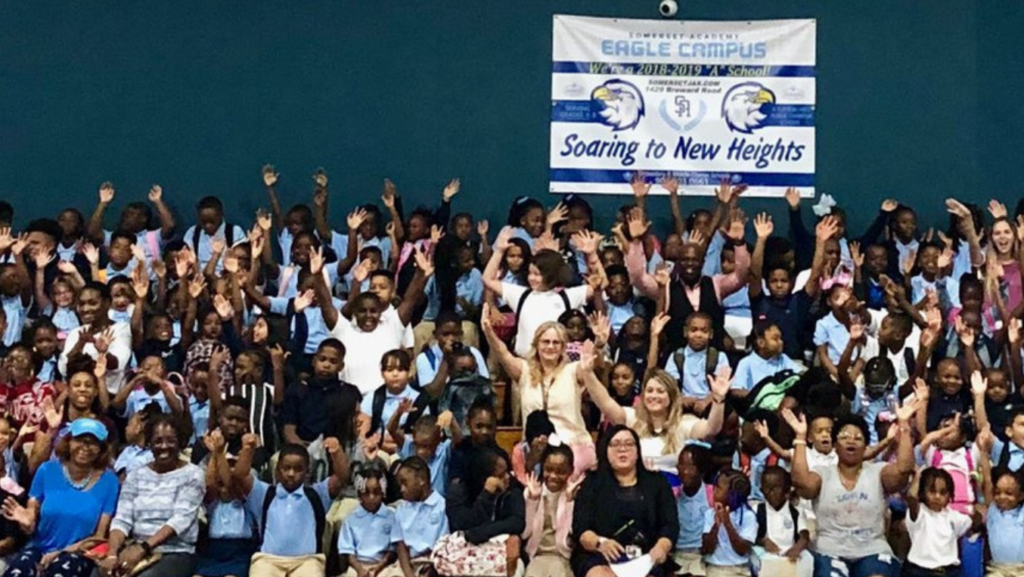
Somerset Academy Eagle Middle School, a public charter school in Jacksonville, Fla., has launched two initiatives collectively called “Somerset Eagles SOAR,” which stands for Seizing Opportunities to Support Academics and Real-world Explorations, to address the academic and social needs of Somerset students.
Editor’s note: This opinion piece from Tunji Williams, principal of Somerset Academy Eagle Campus in Jacksonville, Fla., appeared this morning on jacksonville.com.
In a recent column, U.S. Rep. Kathy Castor from Tampa bemoaned the rise of public charter schools in Florida, claiming they undermine traditional district schools.
I understand her fears. Back in the late 1990s, when charter schools were new in Florida thanks to legislation signed into law by Gov. Lawton Chiles, I was also concerned. I didn’t understand them.
But then I educated myself. I visited charter schools and saw the good they are doing. And now we have two decades of evidence showing charters benefit families and often help strengthen district schools.
A decade ago, I became principal of a charter school: Somerset Academy Eagle Campus. We serve a low-income, minority-majority population. About 90% of our 586 students are Black and zoned to attend Title I district schools. Our K-5 elementary school earned an A grade from the state prior to the pandemic, and the middle school received a B.
Families choose our school because we meet kids where they are. We build strong relationships with our students and give them the extra attention they need. Students come to us and blossom, achieving higher than they did in their assigned district school. Charters excel at adapting instruction to the needs of each child. And we enthusiastically celebrate every success.
To continue reading, click here.

