 It’s only fitting: Florida, a trailblazer in expanding school choice, will be among the busiest states during National School Choice Week.
This year’s celebration, which officially begins Sunday, is by far the largest ever, with more than 3,500 events in 50 states, up from 406 last year. Florida has at least 134 events on the schedule.
One of the highlights will be here in Tampa - a panel discussion featuring two nationally recognized education leaders. One is new Education Commissioner Tony Bennett. The other is MaryEllen Elia, superintendent of Hillsborough County Public Schools, the third largest school district in Florida and eighth largest in the country.
The pair will join other panelists representing the charter, magnet, private, virtual and home-schooling sectors. The event is set for Tuesday at 3:30 p.m., at the Boys Preparatory Academy at Franklin Middle Magnet School, one of the state’s first single-gendered public middle schools.
Other speakers include selected students, parents and teachers who will talk about the need to provide all children with more access to educational options. The event is sponsored by the Florida Alliance for Choices in Education, a group of school choice advocates that includes Step Up For Students, the nonprofit that oversees Florida’s tax credit scholarship program and co-hosts this blog.
Organizers are calling this year’s National School Choice Week “the world’s largest celebration of education reform.” The idea behind it is to raise awareness about the value of school choice, the need for more of it and the broad coalition that backs it.
“A quality education can be the ticket to the American dream for children across America,” Andrew Campanella, president of National School Choice Week, said in a prepared statement. “We must fight to ensure that every child has the ability to go to a great school.”
Ryan Wallace left his big, cliquish high school last spring for The Foundation Academy, a non-denominational Christian school with vegetable gardens and an aquaponic farm. “I wanted a chance to try something new,’’ said Ryan, now a 17-year-old junior planning a dodge-ball fundraiser for his class president campaign.

Boys in Aaron Unthank's single-gendered fifth- and sixth-grade class learn from each other, too. The setup gives Unthank more freedom to cater classes to meet boys' learning styles.
Twelve-year-old Marc’Anthony Acevedo came to the academy as a second-grader after being bullied at his old school. This year, he’s part of a single-gendered class of fifth- and sixth-grade boys. “Sometimes we have arguments, but we get over it,” he said. “We’re all friends.’’
For Cori Hudson, the Foundation was his last shot at a diploma. He messed up at the school district’s option of last resort. “I come to school every day now,’’ said the 16-year-old. “I feel like school is the most important thing to me.’’
These transformations are exactly what principal Nadia Hionides hoped for when she started the academy near Jacksonville Beach, Fla. nearly 25 years ago.
With a style that’s part Montessori, part Waldorf, the Foundation offers hands-on, project-based learning with a college-preparatory curriculum based on the philosophy that everyone learns differently.
The school has 280 students in kindergarten through 12th grade; 100 are in high school. They share a 23-acre campus that Hionides and her husband, a ship deck builder and painter, bought in 2008 for $600,000. The couple spent another $5 million for eight, prefabricated steel structures, which include a front-office foyer where the floor is made from vinyl records.
Tuition starts at $6,000 a year. But 81 students receive tuition assistance from Step Up For Students, the nonprofit that administers Florida’s tax-credit scholarship program for low-income kids and co-hosts this blog.
The academy separates students into groups of two grade levels - kindergarten and first-graders, second- and third-graders, etc.
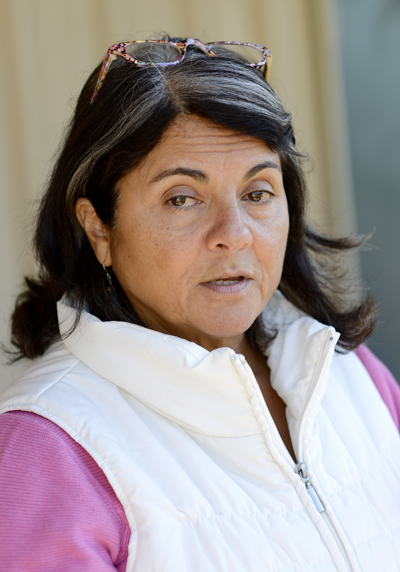
Hionides
“Because that’s real life,’’ Hionides said. Also, “they push each other to shine.’’
It seems to work in the fifth- and sixth-grade boys’ class – for the students and their teacher.
“It’s fantastic,’’ said Aaron Unthank, a longtime private school music teacher and baseball coach. “There’s a different kind of camaraderie as a class and there’s a lot more freedom I have as a teacher to talk about guy things.’’
The younger boys learn from the older boys, and the older boys gain confidence, Unthank said. He paraphrased Einstein: “You don’t know a thing well enough unless you can talk about it.” (more…)

Students at Franklin Middle School in Tampa.
Vouchers need more accountability. So say David R. Colburn, director of the Askew Institute at the University of Florida, and Brian Dassler, chief academic officer for the New Orleans Center for Creative Arts, in this exclusive op-ed for the Tampa Bay Times. Response here from the Heartland Institute, which says parental satisfaction is “a more effective form of accountability than extending mindless bureaucratic oversight to the private sector.”
New charter school to focus on “Latin and logic.” Tampa Bay Times story here. The applicant for the school is Anne Corcoran, the wife of state Rep. Richard Corcoran. He’s a future House speaker and a strong proponent of private school choice, too.
Threats to single-gender learning options. U.S. Sens. Kay Bailey Hutchison and Barbara Mikulski are considered to be on opposite ends of the political spectrum, but in this op-ed for the Wall Street Journal they unite in defense of single-gender options in public schools. (They single out Florida as one of the states where such options have been under legal fire.) It’s worth noting that in our own backyard, old lines of division have also faded over this issue. Last year, John Kirtley, who chairs Step Up For Students, donated $100,000 to the Hillsborough County School District to support single-gender academies at two public middle schools. The Walton Family Foundation kicked in another $100,000.
More on race-based achievement goals. The New York Times writes today about the state Board of Education’s decision last week to set different academic achievement targets for black, white, Hispanic and other subgroups. The targets incorporate steeper rates of improvement for groups with lower proficiency rates, but they have nonetheless caused a ruckus. The parents group Fund Education Now weighs in. So does Naples Daily News columnist Brent Batten, who hears from Collier County education officials that this is “much ado about nothing.”

