
Editor’s note: Former Florida Gov. Jeb Bush, chairman and founder of the Foundation for Florida’s Future, issued the following statement in response to the filing of HB 1. The bill would significantly expand eligibility for education choice options to all K-12 students in Florida.
“The right to a publicly funded education is a promise our state makes to every student and yesterday, Speaker Paul Renner and members of the legislature took bold steps to ensure each and every Florida student can access the education of their choice.
“Florida stands on the monumental verge of restoring the original intent of publicly funding education – by funding individual students – so each child can reach their God-given potential. HB1 is a forward thinking and important move toward ensuring Florida remains the nation’s leader in student-centered solutions. I applaud Speaker Renner and the Florida House for their vision and leadership in creating this unmatched opportunity for Florida students and families.”
House Bill 1, released by Speaker Paul Renner and sponsored by Rep. Kaylee Tuck, will significantly expand school choice options for all Florida K-12 students.
You can read the full test of the bill here.

Peyton Williams was born with a heart defect that weakened her immune system. She is on the autism spectrum, has attention-deficit/hyperactivity disorder and obsessive-compulsive disorder, and has “false vocal cords,” which means she can speak barely above a whisper.
OKEECHOBEE – Peyton Williams entered this world with a damaged heart, a damaged airway and hardly any hope from doctors who examined her the day she was born. They told her mother her baby wouldn’t survive her first 24 hours. Then she was told Peyton wouldn’t live to her first birthday.
Peyton celebrated her 12th birthday two days before Christmas.
She has scars on her chest from three open heart surgeries, the first when she was six days old, but no visible marks on her throat from the nine years she wore a tracheal tube. Her mom, Le-Ann Williams, said Peyton has endured 98 surgeries and spent more than half her life in hospitals.
“She’s a walking miracle,” Le-Ann said.
Doctors said Peyton wouldn’t walk or talk or run. Peyton does all those things, and she also swims, fishes, camps, cooks, plays the violin, and makes her own videos that she posts on YouTube.
“She has overcome everything they told us she wouldn’t overcome,” Le-Ann said.
It wouldn’t have been possible without some help from Florida’s Family Empowerment Scholarship for Students with Unique Abilities (FES-UA) managed by Step Up For Students.
To continue reading, click here.
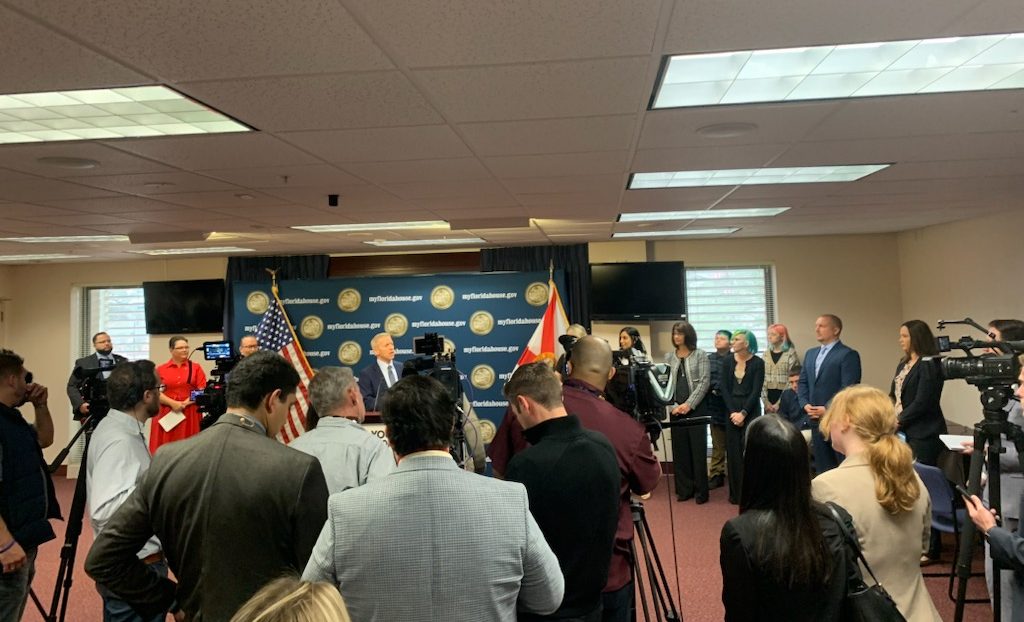
Florida House Speaker Paul Renner answers questions about newly filed landmark legislation that would greatly expand customized education choice options to every K-12 student. Photo by Amy Graham
A bill that Florida leaders are calling “transformational” would greatly expand the state’s 21-year-old education choice scholarship program by opening eligibility to all K-12 students in the Sunshine State and empowering parents to customize their children’s learning.
“Florida is about expanding freedom and opportunity,” said House Speaker Paul Renner, R — Palm Coast, who stood in front of a lectern with the sign, “Your Kids, Your Choice” during a news conference to introduce the bill. “Today, we empower parents and children to choose the education that best fits their needs.”
HB 1, which was filed Thursday morning, would remove income limits from all the state’s two major income-based programs, the Florida Tax Credit Scholarship Program, and the Family Empowerment Scholarship for Education Options. The bill also would convert traditional scholarships, in which money goes directly to a private school for tuition and fees, to education savings accounts. Also known as ESAs, these funds allow parents to direct funds toward other approved uses such as private tutoring, instructional material, including digital and internet resources, curriculum, a virtual program or online course that meets state requirements, or tuition and fees associated with homeschooling. (The number of homeschooled students using the formerly income-based programs will be capped and increased each year until 2027.) The law allows “choice navigators” to help parents sort through options and choose the best fit for their child. The expanded programs would be administered by state-approved scholarship funding organizations. (Step Up For Students, which hosts this blog, is one of two nonprofit organizations that manages these programs.)
Current law limits eligibility to lower- and middle-income families and students who meet certain criteria such as children of active-duty military members, law enforcement officers and children who are in out-of-home or foster care.
The bill also would eliminate the wait list for the Family Empowerment Scholarship Program for students with Unique Abilities. That program is already operates on an education savings account model. It places no limits on household income but restricts participation to students with certain special needs. More than 9,000 students are currently waiting to receive those scholarships.
“It is a tragic thing to have to say no to these children,” Renner said. This bill will completely eliminate the wait list for our children with unique abilities.”
The bill’s sponsor, Rep. Kaylee Tuck, R — Lake Placid, thanked the House leadership for allowing her to steer it through the legislative process.
“I think it’s clear to us that nobody, absolutely nobody, knows the needs and abilities of their child better than a parent,” said Tuck, who recently published a commentary on foxnews.com outlining how education choice works well in rural areas. “HB 1 empowers every parent to choose the customized and tailored system that fits best for their students…Florida is committed, has always been committed and will always be committed to providing the best education system possible.”
For Rep. Susan Plascencia, R — Winter Park, and Rep. Jenna Persons-Mulicka, R — Fort Myers, the bill was personal. Plascencia’s three children received education choice scholarships, and Persons-Mulicka’s son, Charlie, attends a private program for students with autism spectrum disorder that has allowed him to thrive.
“Within days and weeks, we could see the change and metamorphosis in our son,” Persons-Mulicka said. “We’re able to give our Charlie an opportunity, and it’s amazing we’ll be able to empower all our parents to give their children the same opportunity.”
Plascencia, who co-sponsored HB 1, said her children are now “leading productive, successful lives” and are happy in their chosen fields.
The bill is now in the House Choice and Innovation Subcommittee and is expected to be heard next week. From there it will go the PreK-12 Education Appropriations Subcommittee and then to Education and Employment Committee. A companion bill has not been filed in the Senate. The 2023 legislation session begins March 7.
“I think we’re going to see bipartisan support for this bill,” Renner said. “I think people will realize more and more how powerful (education choice) can be.”
The bill filing comes after two decades of support for education choice programs in Florida, which the Heritage Foundation named No. 1 in the nation last year for education freedom. Other states have recently followed Florida’s lead in establishing or expanding choice programs.
In 2021, West Virginia approved an education savings accounts program that was described at the time as the broadest expansions in the nation. That program will go into effect during the 2023-24 school year. Last year, Arizona enacted one of the most expansive education choice laws in the United States. The Arizona law allows any child who is not enrolled in a public or charter school to receive more than $6,500 per year per child to use toward private school, homeschooling, microschools, tutoring or any other form of education that does not fall under traditional public schooling. The law survived a challenge from opponents, who failed to gather enough signatures to put measure on the 2024 election ballot as allowed by the state constitution. However, newly elected Arizona Gov. Katie Hobbs has sought to block the expansion by not including the necessary funding in her proposed budget.
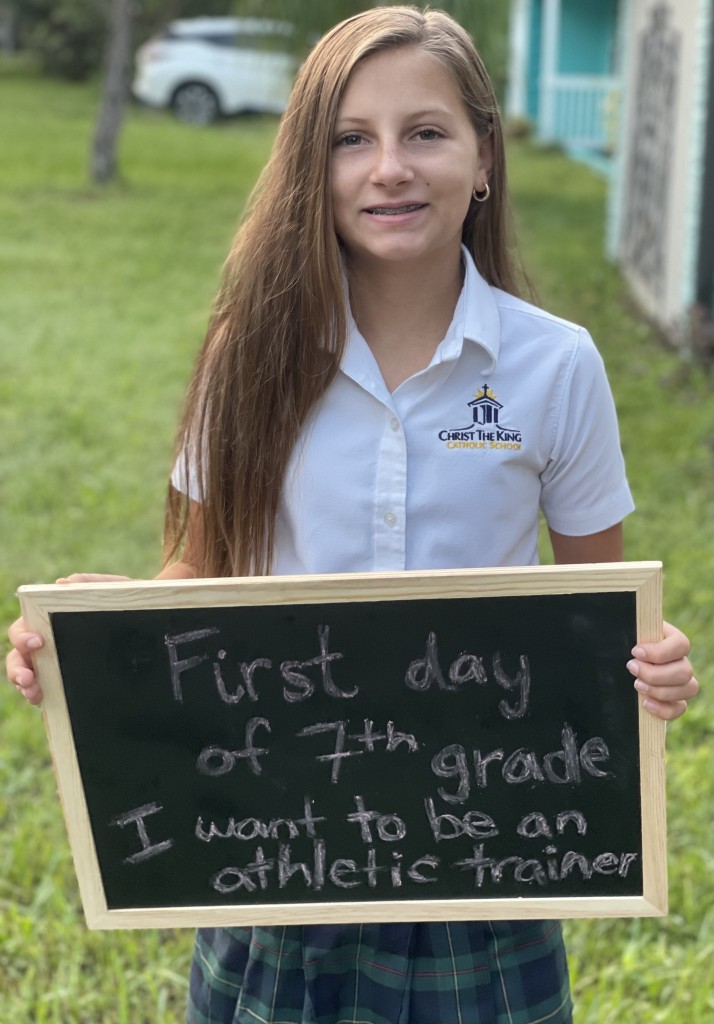
Ayla Hale
On this episode, senior writer Lisa Buie talks with Kristin Hale of Jacksonville, Florida. Hale chose Christ the King Catholic School for her daughter, Ayla, the school she herself attended and where she teachers language arts and reading.
Until she got married last year, Hale had been a single mom to Ayla, 12, who attends her private school on a Florida Tax Credit Scholarship. The Florida Legislature established the program in 2001 to provide an income tax credit for corporations that contribute money to nonprofit scholarship funding organizations that award scholarships to students from families with limited financial resources.
The program has been expanded to include several other credits related to various industries such as insurance, oil and gas, and alcoholic beverages. Step Up For Students, which hosts this blog, is the state’s largest administrator of the FTC Scholarship Program.
Hale said she learned about the program while teaching at a private school that served students living in the inner city. Being a single parent and a teacher, she applied, thinking her income might be low enough to qualify Ayla for a scholarship.
She had to take out loans to pay for the wrap-around care her daughter needed to supplement the state’s subsidized voluntary prekindergarten program and knew it would be nearly impossible to send Ayla to Christ the King without financial help.
Fortunately for Hale and Ayla, they were approved on the first try. Ayla has been attending the K-8 school ever since. Not only did the scholarship allow her the opportunity to provide a high-quality private education in a safe environment, Hale said; the money she saved made it possible for her to become a homeowner and to welcome Scarlett, a golden retriever, who has brought the family much joy.
“We were so much more free to have a decent life," Hale said. "I knew her academic future would so much brighter.”
As much as the scholarship has changed their lives, l said spending flexibility in the form of education savings accounts could help even more, as the funds could be used for Ayla’s extracurricular activities such as volleyball. Hale said ESAs could also help families with more than one child, ensuring that each would benefit from the best possible educational fit.
EPISODE DETAILS:
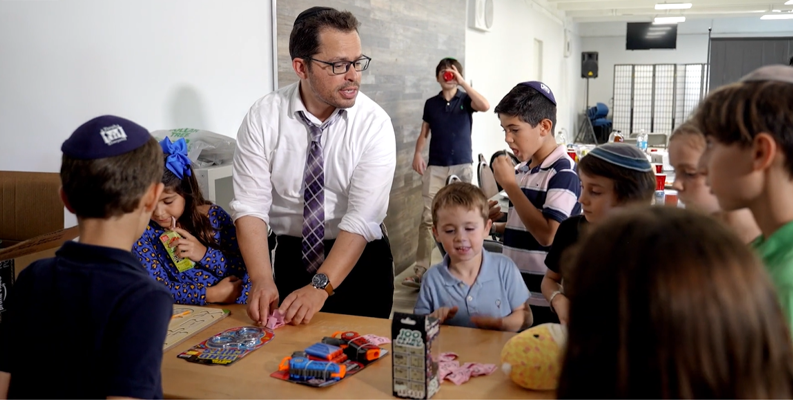
Educator and entrepreneur Rabbi Isaac Melnick, with support from The Drexel Fund, will open a new elementary school that is an outgrowth of more than two decades of strong secular and Jewish education leadership.
Rabbi Isaac Melnick thinks learning should be fun. As a young teacher in a Hebrew dual-language charter school in South Florida, he ran a lively after-school program that taught Torah to students who wanted to receive Judaic instruction. He called the program Torah 4 Everyone. He also ran Camp Cooluna, a summer camp that offered water slides, crafts and costumes alongside instruction in Jewish scriptures.
When the after-school program was forced to go all virtual during the pandemic, Melnick didn’t miss a beat. He started Jewish American Zoom, which offered Judaic teaching in an atmosphere of entertainment, wacky competitions and prizes that included Amazon gift cards and massive Hershey’s Kisses.
The program, which Melnick called JAZ, was such a hit that some kids lamented it only operated Monday through Thursday.
Now, with more than a decade of experience launching and managing extra-curricular programs, Melnick wants to open a full-fledged Jewish day school. Shorashim Academy is slated to open for the 2023-24 school year in the Hallandale, Florida area.
He’s garnered support from The Drexel Fund, a national philanthropic nonprofit that aids entrepreneurs who want to start private schools that offer greater access to underserved populations and have the potential for replication.
Melnick was recently accepted into the organization’s Founders Program, which is providing him with a year’s salary as well as an opportunity to obtain seed money for startup costs. The fellowship program also offers training on such topics as school governance and budgeting.
As a fellow, Melnick will visit high-performing schools across the country and work with mentors who will help him develop a business plan for the new school.
Melnick and his school were a natural fit for the program according to Eric Oglesbee, director of Drexel’s founder’s program and a Drexel alum who founded River Montessori High School in Indiana.
“At the Drexel Fund, we are attracted to entrepreneurs with a clear and compelling vision for serving underserved populations in their local communities,” Oglesbee said. “Additionally, we are focused on supporting the development of financially sustainable, replicable models that from first principles are likely to produce outstanding academic results and deep character formation.”
What makes Melnick’s vision compelling, Oglesbee said, is his passion paired with his expertise and connections.
“We felt what he needed from us was the opportunity to have an entire year where he could devote 100 percent of his energies toward opening Shorashim Academy and to engage in a customized learning plan with a cohort of other first-time school founders to help him have a strong launch into a sustainable school,” Oglesbee said.
One unique feature of Shorashim Academy is that it will cater to a Jewish population that is more casually observant than those who attend the rapidly growing surrounding day schools in South Florida, which are primarily Orthodox.
“They may celebrate major holidays like Yom Kippur and Passover,” Melnick said. “They may have special meals and traditions and observe some form of Shabbat and occasionally visit the synagogue,” but their lives look more like the surrounding secular culture.
Melnick explained his target families fall into two groups: low-income families for whom a private education is financially unthinkable and middle-income families for whom private school might be possible but would require extreme sacrifices that would force them to forgo vacations and other aspects of a typical middle-class lifestyle.
“These are people who otherwise would not send their children to Jewish day schools,” he said.
Despite the challenges, members of the Orthodox community are required to provide their kids with a Jewish education regardless of the cost.
“I would sell my house,” said Melnick, a husband and father of four who is Orthodox. “Not all families are willing to do that.”
Melnick says Shorashim Academy is needed because Jewish students who don’t attend Jewish schools are at risk of losing their connections to their Jewish identity and Israeli heritage when they become adults. He’s seen that happen to former students from the non-religious Hebrew language charter school who attended his after-school Judaic program.
“Some of these kids are in their 20s, and they are struggling with it,” he said.
That’s why he believes an immersion program is critical. The academy’s name – Shorashim, from the Hebrew word for roots – reflects its purpose.
The school will initially be open to about 30 first and second graders. More grades will be added each year until the school serves students in preschool through 12th grade.
Upper grades are part of the long-range plan, which Melnick expects will take 12 to 15 years to implement.
Each day will begin and end with prayer. Two periods will focus on religious instruction, including fostering of an awareness and appreciation of Israeli culture, with the rest used for academics. Melnick hopes to offer evening Judaic classes for parents.
To make the school accessible to students regardless of income, Melnick plans to accept state K-12 education choice scholarships. He said the Florida Legislature’s recent expansion of state scholarship programs has placed private education within financial reach of more families.
As an example, Melnick explained that a family of six like his can qualify with a household income of up to $148,600. (Step Up For Students, which hosts this blog, manages state K-12 scholarship programs. You can find out more about scholarship programs and the latest eligibility rules here.)
“We’re very grateful for the scholarship program,” he said. “I’m very impressed with how powerful these scholarships are.”
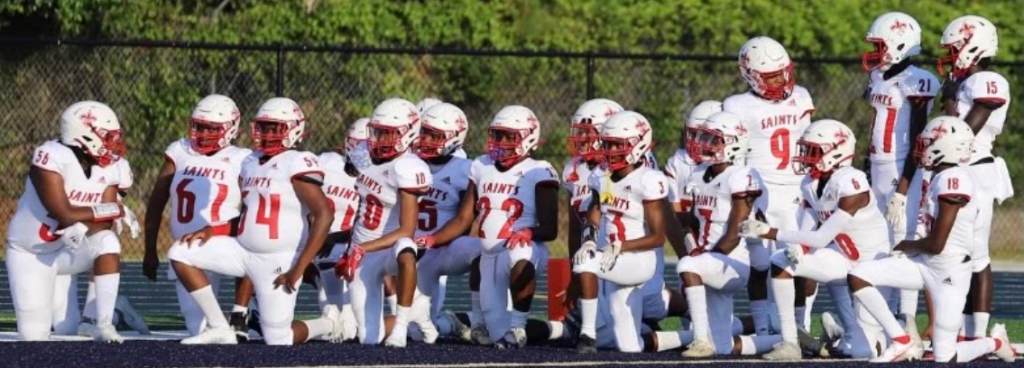
Palm Beach Christian Preparatory School’s mission is to guide and support students to become men who are proficient both academically and extracurricularly, open to growth, intellectually competent, religious, loving, and committed to doing justice so they can work as leaders for the promotion of justice in a multicultural society.
Just now, the news Palm Beach Christian Preparatory School is making belongs on the sports pages — which is what you would expect when a bunch of coaches launches a private school.
Not that there’s anything wrong with that.
To its enormous credit, PBCPS embraces vigorous competition as one of its ideals, and for all the right reasons. Pursued appropriately, high school sports teach responsibility, reliability, the value of doing your job, time management, homework, sacrifice, and teamwork.
There’s also this, which must not be underestimated: The Saints of PBCPS learn about the joy of rewards earned, not given. Because of this, expect the news made by Palm Beach Christian Prep graduates to be splendid and widely worthy of note.
“Our principles,” says PBCPS founder Willie Snead III, “are built around biblical principles that tie into athletics, academics, and just being responsible — being a servant to your community, being a light in your own family.”
An ordained minister, Snead carries the titles of senior pastor of Palm Beach Christian Ministries and headmaster of PBCPS. But athletics is in his blood: All-Palm Beach County and All-Academic wide receiver for Glades Central High School; four-year letterman in college (two each at the universities of Virginia and Florida); pro football stops with the New York Jets, Toronto Argonauts, and Saskatchewan Roughriders; and successful high school football coach (state championships in Florida and Michigan).
Everywhere, he saw youngsters who were just one wrong turn, one instant from being in the wrong place at the wrong time, from seeing their promise vanish in a heartbeat.
Snead saw and he knew, because he remembered being 8 years old, home in bed from trick-or-treating on Halloween night, and hearing that pop-pop-pop out on the street. Firecrackers, he thought, drifting off.
The news, engraved in his memory, came on the morning of All Saints Day: There had been a shooting in the neighborhood, and his dad, Willie Snead Jr., a bystander, was in the wrong place at the wrong time.
A tragedy like that changes a person. Makes them or breaks them.
Willie Snead III went to work, pushed by his widowed mom, who finished school at night, became a bookkeeper, and for the next 34 years never was without a paycheck.
Snead chased rabbits and raccoons through the muck around Lake Okeechobee, getting stronger and faster, because that’s what kids did if they wanted out of Belle Glade. But all through the years and long into adulthood, he never forgot those friends and teammates who couldn’t keep pace.

Willie and Sofia Snead
About four years ago, while waiting for a plane to take him home from a coaching clinic in Muskegon, Mich., and wondering what would come next, Snead experienced an epiphany. Flanked by wife Sofia, a regional sales manager for cosmetics-packaging giant SeaCliff, and son Willie Snead IV, then and now an NFL wide receiver, he leaned into a story on an overhead television about the education initiative in Akron, Ohio, being driven by NBA star LeBron James.
James’ efforts had culminated in the I Promise School, a public school that does revolutionary things for students in difficult circumstances. And there it was, the answer to a prayer the Sneads scarcely knew they’d whispered, as though the Almighty himself was reaching through the screen.
“We could do that,” Willie III said. “We have to do that,” Willie IV replied. Sofia hugged them both.
Set back a year by the COVID-19 pandemic, Palm Beach Christian Preparatory School opened in August 2021 in a modest block building in Greenacres, Fla., practically in the shadow of John Leonard High, the largest public school in Palm Beach County.
Fifteen months later, this little David of an educational miracle continues to gather its flock, paying scant attention to the Goliath up the street.
Most of the original Saints had run into trouble typical of their neighborhoods. Substance abuse, getting high, drinking, ditching school. The difference, Snead says: “They said that they wanted help. We offered them that help. And a lot of them gave up those other devices. They stopped smoking and they found that someone truly cared about them.”
Consider the encouraging parallel experiences of Jadarius Patterson and Grant Turner, both 16 and both from tough neighborhoods in beach towns south of Lake Worth. Adults in their lives had reason to fret over the youngsters’ futures if their courses remained unaltered.
Now, delivered daily into the care of Pastor Snead and his team by the school’s small fleet of buses, hope burns brightly for both.
Some aspects of PBCPS borrow from learning centers and microschools such as KaiPod, Outschool, and My Tech High, each of which blends the flexibility of online study with immediate access to learning coaches in the room.
Having unearthed an affinity for algebra and hands-on chemistry, Turner ponders life as a veterinarian, never mind how much school is involved. You’d never know he arrived at Palm Beach Christian Prep as a 10th-grader groaning under road-to-nowhere baggage: a hyperactivity discipline problem with truancy issues.
Now he’s an honor roll student.
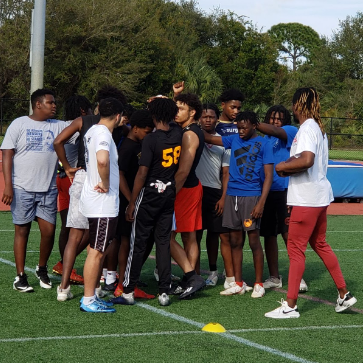
PBCP operates on the belief that learning extends beyond the classroom, to the chapel and the athletic field.
“It's actually better than if we were at a public [school] environment,” Turner says, “because [at PBCPS], they’re always on top of you. They're always going to make sure that you're doing the right thing. And they're going to keep you around more good things so you won't do bad.
“When you're in a public environment … nobody cares what you do. … It’s more structured when you're around people who care.”
That caring involves the sorts of adult intervention that teens often describe as meddling. Be on time. Do your homework. Are you studying? Pay attention. Who are you hanging out with? Rather than bristle, successful Saints regard all this as love expressed.
"To me,” Patterson says, “them being in our business is like them being a father figure toward us. Of course, they're going to be on us because they are our coaches and stuff, but it's more like a father figure.
“You're doing stuff you don't have any business doing. They're going to make you own up. … You're going to have to take accountability for your actions.”
Being a Saint doesn’t necessarily mean being saintly. But it does mean striving for goals revered by — among others — St. Basil the Great, the master of self-discipline.
Patterson is on the path.
“Being here … taught me how to think things through,” Patterson says, “not, you know, do things before I think. It taught me how to calm down.”

Willie Snead IV
Hearing this self-report brings glad tidings to Willie IV, who personally recruited Patterson for PBCPA. Not solely because, as the scouts say, he could play, but because, for all his athletic skills, his path out of the neighborhood was not certain.
“JD is the kind of kid we built our school up for,” Willie IV says. Minus support from the Saints network, “Jadarius probably would have gone in a whole different direction.
“The environment that he lives in, it's so easy for him to be on the corner or to be in a park smoking or whatever. … It's so easy for them to do that because that's all they have around them.”
Instead, the men of Palm Beach Christian Prep are constant mentors to provide nurture and encouragement. Not just during school hours or at practice, but all the time. Every student has phone numbers for their coaches, Pastor Snead, and their favorite 49er.
And call they do.
They pick up the phone, Willie IV says, “when they might be struggling with something, or they might need direction about something and don’t want to make that decision on their own.
“I know kids look up to me,” he says. “And I just tell them, like, look, regardless of what your situation is, man, you are always in control.”
Jonathan King, Pastor Snead’s longtime colleague and friend, serves the school as head football coach and athletic director and also teaches daily Bible classes. Attend PBCPS and you’ll pray at least three times a day, he says. Go to practice, and it’ll be six, minimum.
“It's not easy, because you're trying to change mindsets of young men who have never seen this side of individuals talking to them about Christianity on an everyday basis,” King says. “But the overall is how to become one closer with God and closer to God.”
Palm Beach Christian Ministries, the organizing group headed by Pastor Snead that founded and guides the school, was PBCPS’s principal source of financial support in its first year. Fortunately for the backers’ bank accounts, there were just 12 students. Not that 12 is to be dismissed as insignificant, especially for a school rooted in the Bible’s New Testament.
Disciples in their own right, the original dozen helped grow the student population to 25 in Year 2. Also on the bright side, because of PBCPS’s partnership with Step Up For Students, Snead and his team are having to leverage far less of the funding.
But the needs and the opportunities are equally great, Snead says. Because more must be done, more is being done.
Nearby, a 5-acre piece of land is being developed into a campus with state-of-the-art classrooms, a 6,000-square-foot training facility, a chapel, and a hybrid student union and community center, a place, Snead says, “where the boys can congregate and read or study, and just kind of relax. We want it to be an environment where they're protected, where they can be true to who they are, and let the true nature of their personalities come out.”
Ultimately, Pastor Snead imagines a place effervescing with the honest ambitions of 500 student Saints, each one eager to deliver good news.
And leading them as headmaster will be Willie IV, who won’t have to look for a job when he finishes with the NFL, where he’s been a gritty, move-the-chains journeyman pass catcher for eight seasons (Saints, Ravens, Raiders, Panthers, 49ers).
An undrafted free agent from Ball State, Headmaster Willie IV will present walking-around proof there’s more to success than off-the-charts talent. There’s all that stuff team sports can teach, plus faith in something larger than yourself.
Living examples make compelling guides. With Team Snead on the job, Palm Beach Christian Prep surely will deliver its message of rewards earned, not given.
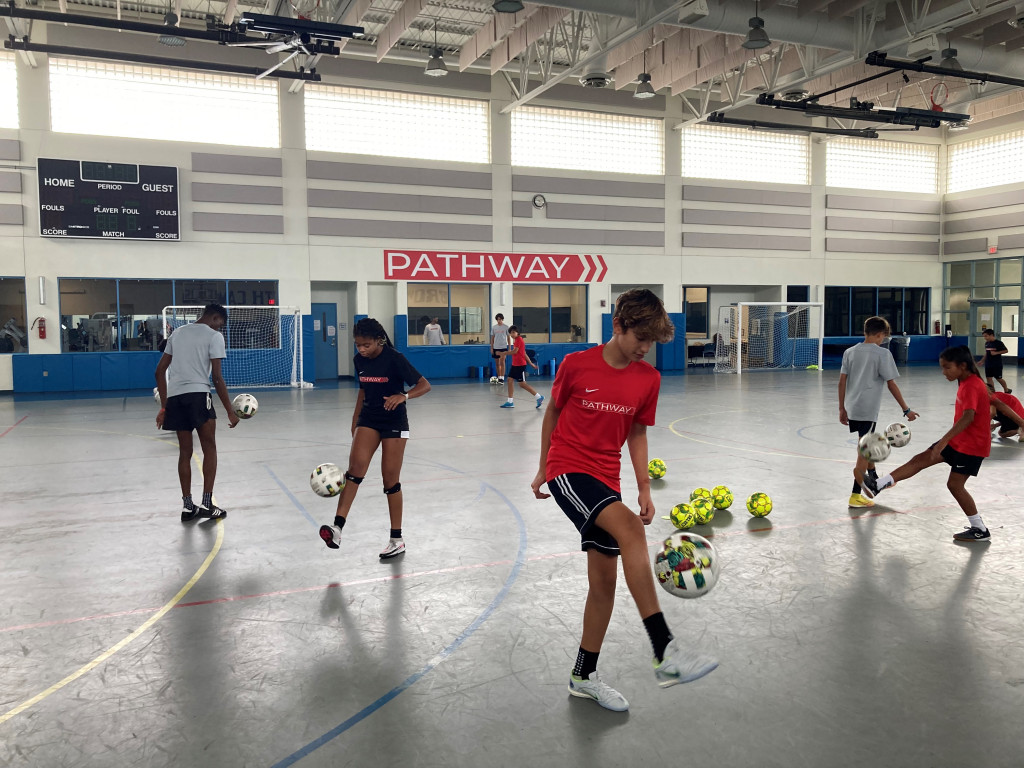
Sixteen of the 24 students who attend Pathway Schools’ Pembroke Pines site in Broward County, Florida, use income-based school choice scholarships. The other two campuses hope to accept scholarship students next year.
PEMBROKE PINES, Fla. – Danny Villegas knew that if South Florida wanted to develop the kind of elite soccer talent found in Europe, it would have to offer more than the usual part-time coaching and training – and reach more than just the kids from wealthier families.
So five years ago, he joined his friend Djems “DJ” Lima, who had come up with a concept that, in this era of increasingly customized education, is still surprisingly kind of rare: A K-12 school for athletes.
At the soccer-focused Pathway Schools, “We’re making better humans, better students, and better players,” said Villegas, a high school soccer star in Miami who went on to play professional soccer in Mexico, Brazil and the U.S.
The idea for Pathway “came out of me realizing I can’t develop a high-level athlete without working on all the components,” said Lima, who played soccer in college and earned a degree in business management. “With eight hours in a focused environment, we can really cater to the kids’ needs. Not just the athletic aspect, but the academic aspect and the mental aspect.”
A school for athletes can take promising young players to the next level.
School choice can help ensure even more promising young players have that opportunity.
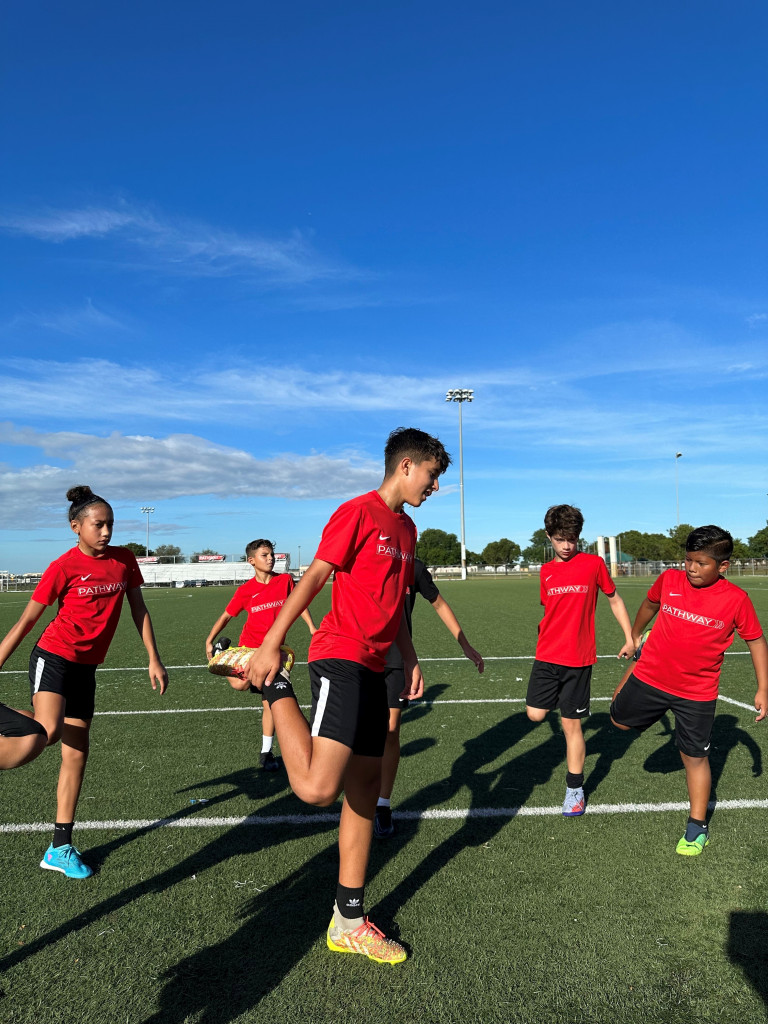
Pathway Schools students start their day with soccer training followed by four hours of academics, then participate in more soccer training in the afternoon.
Pathway has three campuses in South Florida that share the brand but have separate owners. Altogether, they serve about 75 students, most of them in middle and high school.
Villegas owns the one in the city of Pembroke Pines, in the vast patchwork of semi-tropical suburbia that is Broward County. It’s hard to imagine how he could have secured a better facility.
Pathway rents space on the south campus of Broward College, a state college that decided in 2020 to end its athletic programs. Pathway students have access to the college’s academic and athletic facilities, including its gym, locker rooms and soccer field.
Thanks to school choice, Pathway Schools will be financially accessible to a broad range of students.
Sixteen of the 24 students at the Pembroke site use income-based school choice scholarships. (Those scholarships are administered by nonprofits such as Step Up For Students, which hosts this blog.) The other two campuses are in the process of meeting state regulations for educational facilities so they can accept scholarship students next year.
Having those students “will make our impact that much greater,” Villegas said. “Some of the most talented soccer kids often don’t have the money.”
Marilyn Hawthorne said without a choice scholarship, she probably wouldn’t have been able to enroll her 16-year-old son, Emerson Butcher. Hawthorne is a nurse and single mom with two other children, both of them in college.
Pathway is perfect for Emerson, she said, and not only because he’s getting expert coaching. The 11th-grader is also getting the preparation and motivation he needs to excel academically, something he wasn’t doing at his prior school.
“My son is very bright, but he didn’t have much interest in school,” Hawthorne said. Pathway turned out to be “the right place at the right time. He has 100 percent turned it around.”
For its core academic curriculum, Pathway relies on Florida Virtual School. FLVS is the nation’s largest state-run virtual school, and it has long enjoyed an excellent reputation for academic quality. Pathway supplements FLVS with a team of on-site instructors who can offer one-on-one help.
The typical day’s schedule is soccer training in the morning, followed by four hours of academics, followed by soccer training in the afternoon. The school does not field its own club or travel teams – “We’re club neutral,” Villegas said – but all of its students play on top teams in soccer-rich South Florida.
The goal for Pathway students is to play at least at the college level – and to earn college scholarships in order to do that. To that end, Pathway students can’t participate in soccer training unless they maintain As and Bs in every class.
“When they’re motivated by what they love, which is soccer, they’ll do what they need to do,” Villegas said. “They realize, ‘Whoa, they’re holding me accountable.’ We’re a soccer school. But grades are important.”
Pathway Schools also put a lot of focus on non-academic skills, including self-discipline, emotional maturity, and mental toughness. At his campus in another Broward city, Coconut Creek, Lima has his students read Angela Duckworth’s “Grit,” about resolve and resilience, and the motivational business classic “Who Moved My Cheese?”
The schools are not only proving popular with hard-core soccer players in South Florida. They may be a template for education entrepreneurs in Florida and other choice-rich states who want to cater to their own athletic niches.
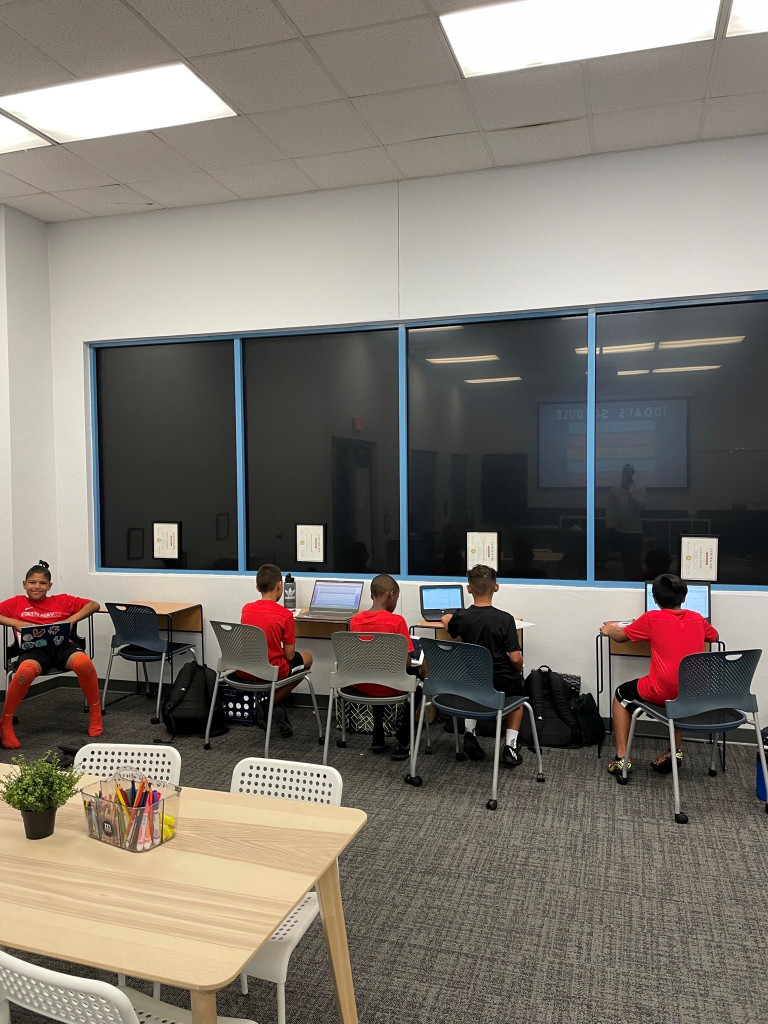
Pathway Schools evolved from the philosophy that developing high-level athletes requires a focus on academics as well as athletics. Pathway relies on Florida Virtual School for its core academic curriculum.
“When we meet kids where they’re at, and we align with their passions, it’s their dream school,” Villegas said. “They never thought this could be a reality.”
Eleventh-grader Zoe Burger was in a traditional private school before she enrolled in Pathway last year. She recently traveled to Peru after getting an invitation to play with the 17-year-old-and-younger Peruvian national team. She has also traveled to Europe to watch top-tier soccer there. She said she loves the training and competition at Pathway, and the flexibility that comes with FLVS.
“I don’t have to stress about assignments being done the same day,” Zoe said. “If I was in a regular school, I would get kicked out.” (To be clear, Zoe is no slacker. She’s already taken two Advanced Placement classes and plans to take more her senior year.)
Ninth-grader Madison Stewart was in a district school two years ago, and in FLVS full time last year. The latter was good academically but left a void. “I missed the social aspect,” she said. “It was hard doing school alone.”
When her mom told her about Pathway, Madison thought it was too good to be true. “I want to go as far with soccer as I can,” she said. “If there’s a school for it, why would I not go there?”
Emerson Butcher said the atmosphere at Pathway has been especially good for him.
His grades weren’t the best in his prior public school, he said. But now he has no choice but to make A’s and B’s.
“I’m going to be honest: I’m a class clown. But here, I’m more focused,” Emerson said. “There’s a lot of motivation because I love playing soccer.”
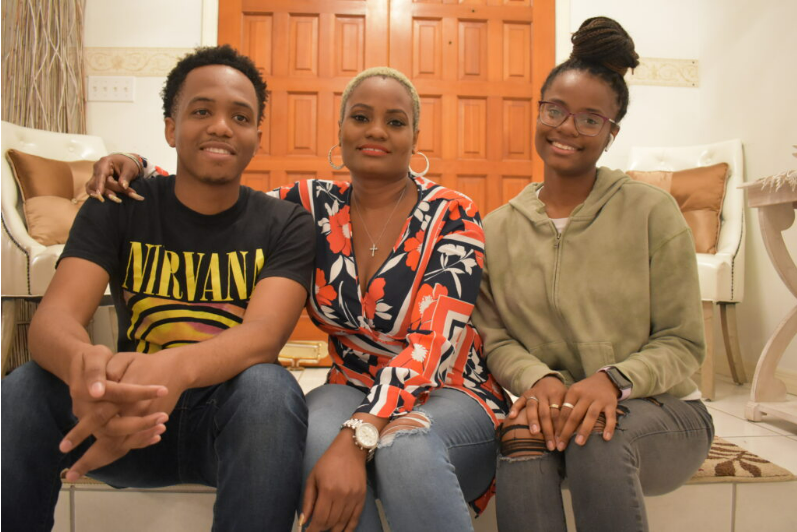
Louise Janvier, center, applied for and received Florida Tax Credit Scholarships for her nephew, Guycelo Robert, and her daughter, Jahiara Jones.
MIAMI – Louise Janvier uses the word “environment” often when talking about education choice and how it can rescue a child.
“Sometimes, when a kid is going to go through things in life, they have to be in the right environment in order to pull through,” she said. “Some of them don’t pull through because they weren’t in the right environment and didn’t have the right support.”
As examples, Louise offers her daughter, Jahiara Jones, and her nephew, Guycelo Robert. Both found themselves surrounded by peers who were leading them away from the values they were taught at home. Both, Louise thought, where in danger of making decisions that could have a negative impact on their future.
They needed to be in the right environment.
With the help of a Florida Tax Credit Scholarship made possible by corporate donations to Step Up For Students, Jahiara and Guycelo were able to land in that environment at Greater Miami Academy (GMA), a pre-K through 12 private school not far from their Miami home.
“I’m grateful for it, because without it, I’d probably would not have been at GMA,” Jahiara said. “The school introduced me to many different opportunities and allowed me to develop more as a person.”
Guycelo, who graduated from GMA in 2020, graduated last spring from Miami Dade College as a member of the Dean’s List while carrying a 4.0 GPA. A computer science major, Guycelo is entering his first semester at Florida International University. He plans on a career in coding.
To continue reading, click here.
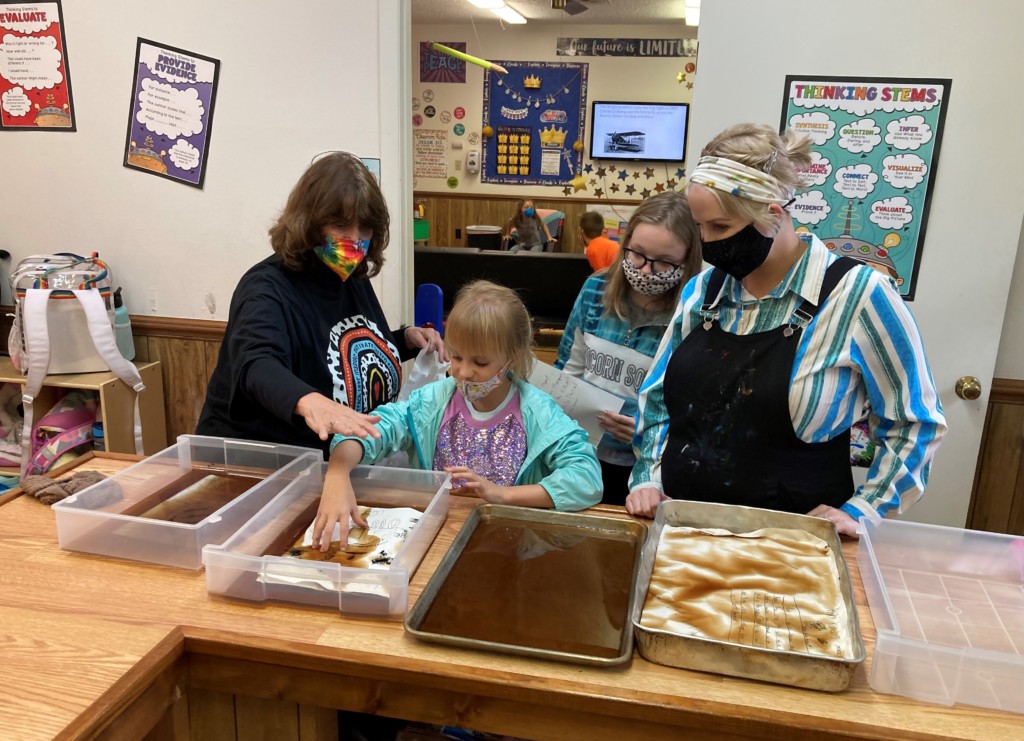
CREATE Conservatory celebrated the 101st day of school with a “101 Dalmatians” theme featuring lesson plans that tied the arts to historical happenings 101 years ago. Students made their own newspapers to show what they learned, soaking the papers in pans of tea to give them the look and feel of old newsprint. The school will move to the site of a former minigolf center after Thanksgiving.
Once in a great while, the hook for an article — that is, the thing that caught the journalist’s eye in the first place — winds up being the least compelling aspect of the entire story.
This does not mean that the hook in this case is any less cool. At a glance, what’s better than a private school in rural central Florida moving its campus seven miles to the site of the former Adventure Cove, a derelict miniature golf course?
Or that the school’s founder intends to preserve at least a couple of the holes for student recreation as well as on-campus festivals and fundraisers.
“You know, make a hole-in-one, win a car?” says Nicole Duslak, a former Orange County public school teacher and the dynamo founder behind CREATE Conservatory. Meaningful pause. Eyebrow raised. “Know anybody who’d like to donate a brand-new car?”
But it’s what CREATE does and has been doing with rousing success since opening to students in Leesburg (about an hour’s drive north of Disney World) in 2020 that steals this show: The K-8 nonprofit employs arts integration to teach STEM subjects. And it sounds like Leonardo da Vinci-level genius.
Ever get a song stuck in your head in an endless loop? Who hasn’t? Silly brains. But suppose instead of driving you batty, that annoying tune taught you the periodic table of the elements? Or the arrangement of bones in the human skeleton? Or the order of mathematic operations, so you no longer got stumped by your friends’ annoying what’s-the-answer posts?
“We hear a song at a wedding or in the elevator or a department store, and we pick it up without really trying,” Duslak said. “It’s still a part of us decades later. We all do that, so we’re teaching science that way, a way that it becomes part of our students.”
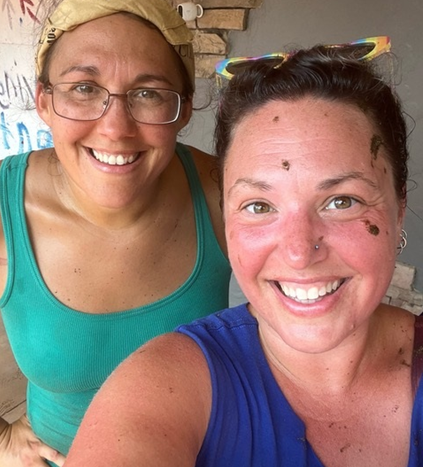
CREATE Conservatory founder Nicole Duslak, front, with parent Candi DeMers
It’s not just singing — although the idea of a school as a real-life musical has its charms. CREATE introduces concepts through crafts, art, model-building, clay-molding, dancing, script- and narrative-writing, drafting graphic novels, and acting … to name a few of the school’s arts-immersive activities.
CREATE’s curriculum can’t be bought off the rack or downloaded from a website. Instead, Duslak and her staff of five are constantly writing it, and rewriting it, drawing inspiration from “Schoolhouse Rock!,” the Saturday morning series of short videos that musically covered themes including grammar, science, mathematics, history, and civics. (Admit it: You’re humming “Conjunction Junction” right now.)
Creativity rules the academic day. State standards ensure rigor.
Terri Harper, a mental health counselor and Duslak’s longtime friend, sends sons Levi, 10, and Landon, 8, to CREATE on a Florida Tax Credit Scholarship and a Family Empowerment Scholarship for Students with Unique Abilities. Both are administered by Step Up For Students, which hosts this blog. She is amazed and gratified by the changes in both.
“My kids, who have never really been too into art,” she says, “now they’re asking for sketch books and sketching pencils and things like that, because they're discovering this whole different side of themselves. Wow. Yeah, it's great, it's really great.”
Kim Levine, a Leesburg-based partner with Core Legal Concepts — a graphic design shop for lawyers — became CREATE’s first corporate sponsor four years ago, well before the school opened its doors.
“She draws people in,” Levine says, "and I think that's great. Maybe the parents feel that, or the perspective parents, when they go on a tour, and they meet Nicky and hear her talk.
“She's got a ton of experience and assorted degrees, so she's got credibility, but she's so warm and loving, and she's so committed to this idea.”
Meeting Duslak and a few of her key allies for the first time at a reception designed to recruit community and corporate support (Levine was the only visitor), it wasn’t long before Levine felt like a billionaire panelist on “Shark Tank” blown away by the contestant’s pitch. “I love this idea,” she said. “Let’s do something together.”
That something became two full scholarships, worth about $6,500 each — one named for Stuart Levine, Kim’s late husband — and graphic arts support from Core Legal.
“One of the first things I thought was, I wish I'd had the school when I was a kid,” Levine says, “because I needed that sort of simulation. … Yeah, I just love it. I just thought,” This is perfect, I want to be involved.”
Duslak’s methods may sound exotic. They certainly are mold-busting. But wait.
“The modern education system has told our bravest and most creative thinkers to sit down and be quiet,” Duslak said. “And that's problematic, right? … I don’t want to sit still for eight hours a day in a desk, and I’m a fully grown adult who has complete control over my functioning.”
CREATE students do not sit at desks. Because there are no desks. Instead, there are beanbags and bounce-on exercise balls and couches and ample floor space. And windows. Oh, so many windows.
“Occasionally,” Duslak said, “I'll have a kid out to go over and just stand and look out the window, and I'll think, ‘There is no way they have any clue what's going on right now.’ Then I'll call on them and they're right with me; they just have to move to think. … They just have to look at something else.”
This is no free-for-all, Duslak said. “It's just about fostering an environment where kids can be themselves and we can honor everything about them that makes them, them.
“We have a lot of structure. … It's about slow down and get to know them and appreciate them for who they are as people.”
If a chef’s proof is in the pudding, an educator’s proof is in the testing. And the CREATE Conservatory students are crushing it: Youngsters have arrived testing nearly two years behind grade level on the Iowa Test of Basic Skills and finished their first academic year testing three years above grade level.
Area parents are taking note. From seven students when CREATE opened to 28 and a waiting list in two years is the stuff of dreams-in-the-making.
So, about the miniature golf course, the conversion and partial preservation of which brought Duslak to our attention. It’s not
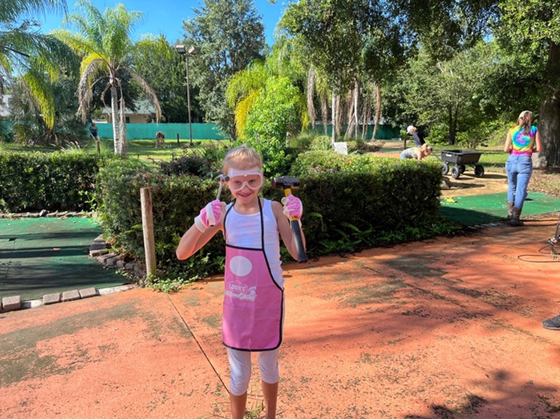
CREATE Conservatory student Amalie Weaver
exactly like a shut-down putt-putt course screams, Put a school here! There are bridges and boulders shaped from concrete, after all. And streams and a jungle temple that once had a waterfall running through it and a downed airplane stuck in one corner.
Those are a lot of attractive nuisances to demolish and haul away, at substantial expense, even with teams of volunteers swinging sledge hammers and loading wheelbarrows — $16,000 for the temple and airplane alone.
But Duslak had a best friend in her brother, David Slocum, a resort golf club professional who was working toward PGA status when he died in 2002.
“David has been and continues to be a huge motivator in my life, even though he's not here anymore,” Duslak said. “So, when we found this property and when all this came to be, I just sort of felt like that was his way of being involved in the process.”
Preserving a hole or two will honor both Slocum and the happy memories of Adventure Cove nostalgics. “It’ll be sort of an homage to what the property was,” Duslak says.
The 2.5 acres will be nice for Duslak’s long-range plans. She hopes to add a high school, and a theater for performing arts. For the moment, however, she’s happy to be moving into the attractive Key West-style two-story bungalow that once housed the business’ offices, storage, and concessions. The plan is to be fully relocated after Thanksgiving break.
The going, just now, is financially difficult, as the early days often are for many startups and pioneering entrepreneurs. But Duslak is dug in.
“I will be the greeter person at Walmart on my nights and weekends, if that's what I have to do,” she said, “because I will not let this fail.”
That’s the best hook of all.
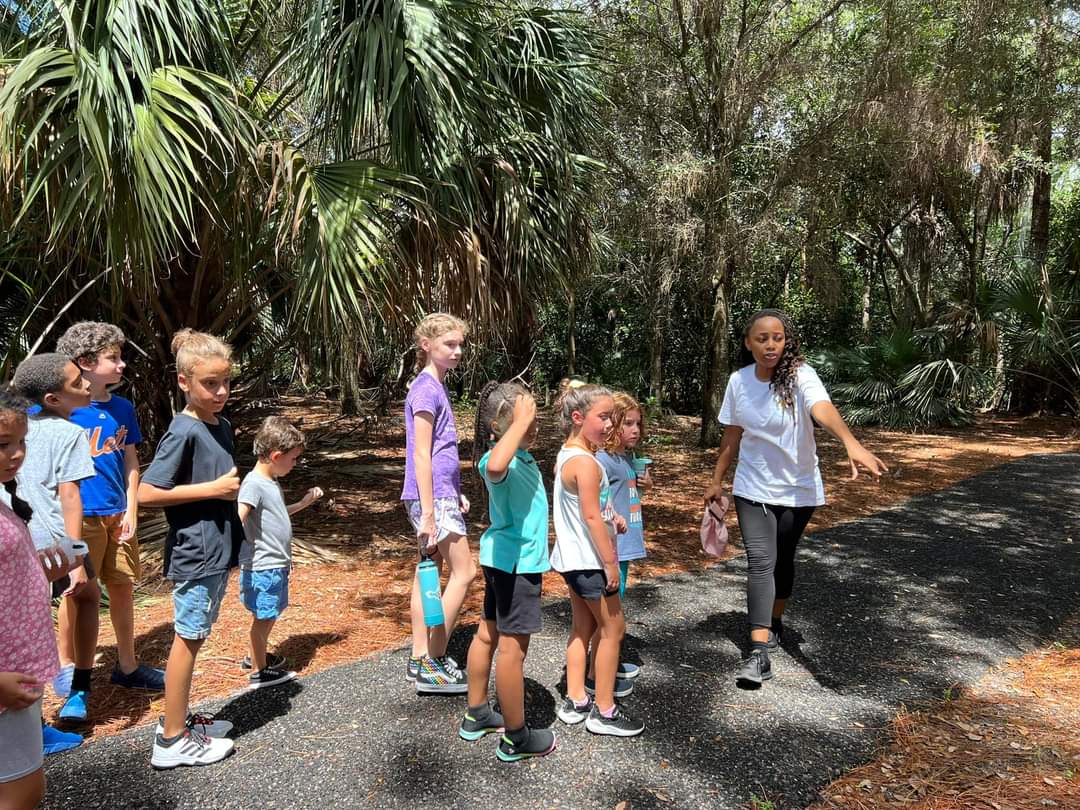
Iman Alleyne, right, launched Kind Academy in 2016 after a four-year evolution. The school offers in-person, hybrid and online options with a progressive curriculum model, project based learning and community focused experiences.
Editor’s note: Kind Academy in Coral Springs, Florida, is one of 32 innovative programs chosen as semifinalists for the Yass Prize for educational excellence. Seven finalists and a $1 million grand prize winner will be announced in December. You can find a list of winners here.
Iman Alleyne decided to pursue a career in education for the same reasons many people do: her kids.
A pharmacy employee at the time, Alleyne saw education as a rewarding path that would let her help students while allowing her to spend more time with her son. So, she went back to school and earned a master’s degree in school counseling.
The allure of a daytime, Monday through Friday schedule and summers off soon faded when she saw how high stakes standardized testing had changed the profession.
“They really used us as testing coordinators,” Alleyne said. “I quickly realized that I wouldn’t be able to counsel. That made me sad. I didn’t want to be a testing coordinator. I wanted to counsel and connect with students.”
She noticed that children with special needs were more likely to get in trouble and be referred to guidance counselors, so she got certified in special education so she could work one on one with more kids. Those interactions, along with shrinking recess times and forced silent lunches, opened her eyes. Not liking what she saw, she launched a part-time nature class for moms of toddlers.
Meanwhile, Alleyne’s oldest son hated pre-kindergarten so much that he cried every morning and begged her to let him stay home.
“It was horrible, and it broke my heart every day,” she said. “By the end of the school year, I pulled him out and decided to start homeschooling him.”
That’s the origin story of Kind Academy, a hybrid homeschool and microschool for elementary age students that got its official start in 2016 after a four-year evolution. The name was inspired by the values Alleyne wanted to impart: kindness to self, kindness to others, and kindness to the world.
That’s one of the reasons the school day includes a lot outdoor learning, though the environmental aspect was originally rooted in convenience.
“I had three boys, so it was crazy,” she said. “It was easier to spend a lot of time outside.”
The program quickly grew after other parents found out what Alleyne was doing and asked if their kids could join.
Today, Kind Academy serves 25 students who come for in-person instruction. Options include attendance two, three or five days a week, although most students are part-timers who are homeschooled. The school also offers an online alternative to homeschool parents or those seeking enrichment opportunities for their kids.
The day begins with 10 to 20 minutes of social emotional learning, or SEL – the process of developing the self-awareness, self-control, and interpersonal skills that are vital for school, work, and life success – akin to “circle time.” Then groups of eight to 10 students do individual work at their own pace with help from tutors.
The program is competency-based, with no traditional grades. Instead, students produce portfolios to show they have mastered the material. This method allows student to move ahead in some subjects while taking more time in others.
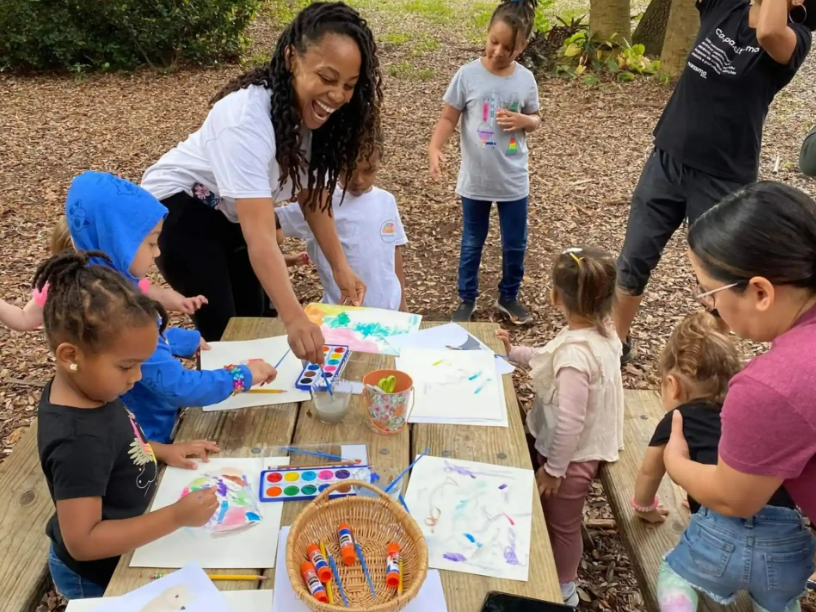
Alleyne hopes that Florida legislators will consider creating a universal education savings account in the state so that more students can have access to high-quality, innovative programs.
“We call it Montessori 2.0 or modern Montessori,” Alleyne said, referring to an education model that takes into account the whole child, including physical, emotional, mental, spiritual and social ways of being. Students also participate in project-based learning focusing on a weekly theme, such as marine biology, before they head to lunch. After lunch, they spend the afternoon outside, playing and learning.
“We call it more chances for SEL,” said Alleyne, who witnesses plenty of opportunities for learning and problem-solving, skills students will need as adults. She recently noticed some students engaged in a dispute over a game of tag. They asked her to settle it. Instead, Alleyne encouraged them to work it out themselves, which they did.
Another aspect of Kind Academy’s culture is acceptance of all people, a value made clear in a gender-affirming statement on the school’s website. Alleyne said her students are diverse and include some who are transgender and have experienced bullying.
“I have had parents who called me and were crying,” she said. “Those students come in and feel comfortable saying ‘This is who I am.’ These kids feel valued here. It just makes my teacher heart and my parent heart happy.”
Though Kind Academy is a private school, Alleyne works to keep it accessible to all students regardless of income. She said about 50% of her students come from low-income households. She accepts the Family Empowerment Scholarship for Students with Unique Abilities. But only students with certain special needs qualify for it.
Alleyne hopes that Florida legislators will convert the Family Empowerment Scholarship for Educational Options to an education savings account model so that more students can have access to high-quality, innovative programs.
“So many families go to public schools because they can’t afford something like what we do,” she said. “If we could access the (FES-EO scholarship program), it would put our program within reach for so many families who want flexibility and personalized learning. We could really grow.”
Growth is definitely on Alleyne’s agenda. It could come sooner rather than later thanks to her school’s inclusion on a list of 32 semifinalists for the coveted Yass Prize, a $1 million award given to a program judged to offer the nation’s best education that is “sustainable, transformational, outstanding and permissionless.”
Kind and the other semifinalists have been awarded $200,000 grants. Alleyne plans to put her grant toward her goal of opening 100 schools in 10 years. She has her sights set on West Palm Beach and Miami.
“Hopefully, we’ll have seven schools in the next two to three years,” she said.
She also plans to offer training to other “edu-preneurs.” Her goal? To encourage more teachers to exercise the freedom to create their own schools. And to answer a request she receives frequently: Please tell me how you did that.

