TALLAHASSEE, Fla. — Parents, students, and education leaders who gathered at the Florida Capitol on Thursday had a message for the Florida Education Association, the teachers union that filed a lawsuit to end K-12 education choice scholarship programs used by nearly 540,000 children, as well as all charter schools.
Just drop it.
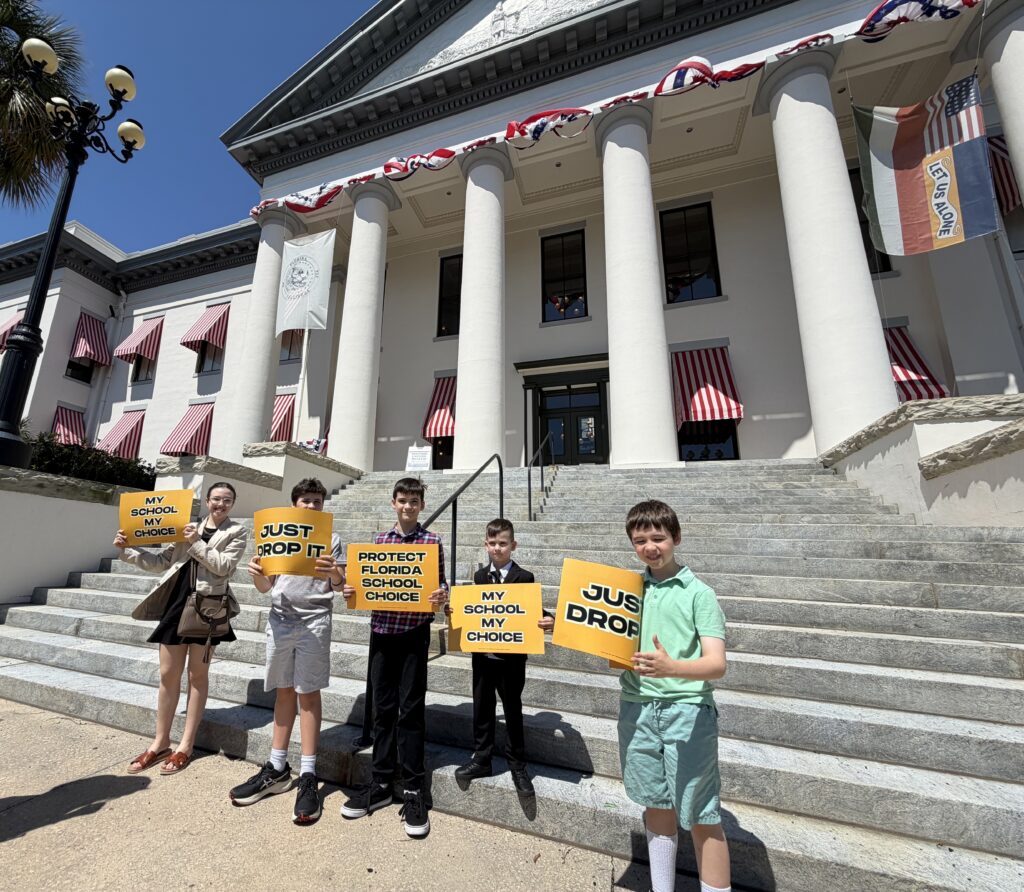
That was just one of the messages on the signs that supporters held up as they stood on the steps of the Old State Capitol building, as advocates proclaimed how education choice scholarships changed lives for the better. “My School My Choice” and “Protect Florida School Choice” could also be seen on the bright yellow signs. Former Gov. Jeb Bush’s Foundation for Florida’s Future organized the news conference. Bush launched the private school choice movement in 1999, right after he became governor.
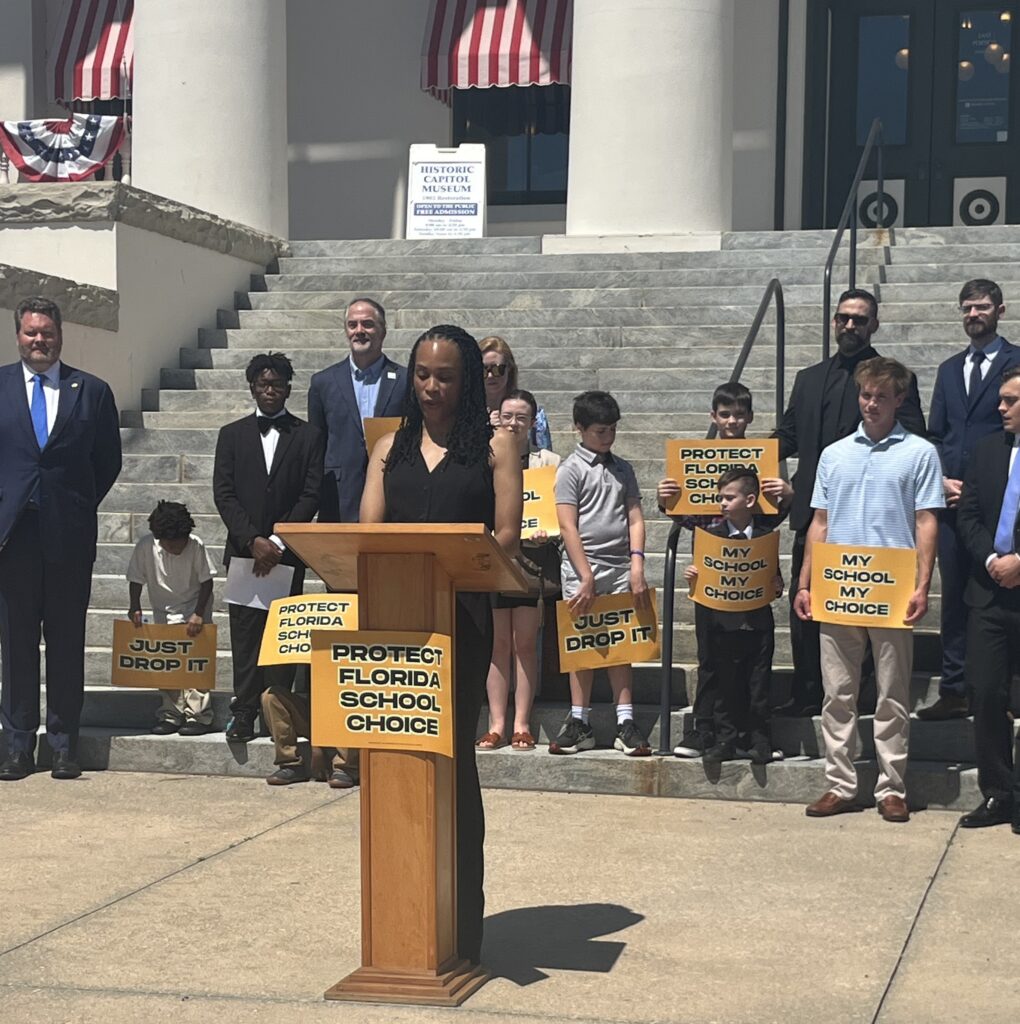
“The scholarships are VERY important to me,” said Kiteka Walker, whose son, Rashad, is in seventh grade at Dixon School for Arts & Sciences in Pensacola. After attending previous schools and homeschooling Rashad, he asked to return to school. She sent him to Dixon because it was the right fit, offering Rashad opportunities to participate in student government, the robotics team, and other enriching activities. The Florida Family Empowerment Scholarship he received made it affordable for him to attend the private school while his two younger brothers attended a private elementary school. If the lawsuit succeeds in eliminating the scholarships, Walker said she would have to homeschool him again because she could not afford private school for three children.
“Parents choose where we send our children to daycare, we choose where to go to college. Why can’t we do the same with K-12 schools?”
Rashad Walker, who traveled to the event with his family, shared how he is thriving at the school his mother chose for him.
“Dixon has been the perfect fit for me. It has a lot of culture and provides a bunch of opportunities in band, art, singing, technology, and media,” he said.
Rashad, who also participates in robotics and serves on the student council, said the school encourages him to try new things, like playing a piano that had been gathering dust at home for years.
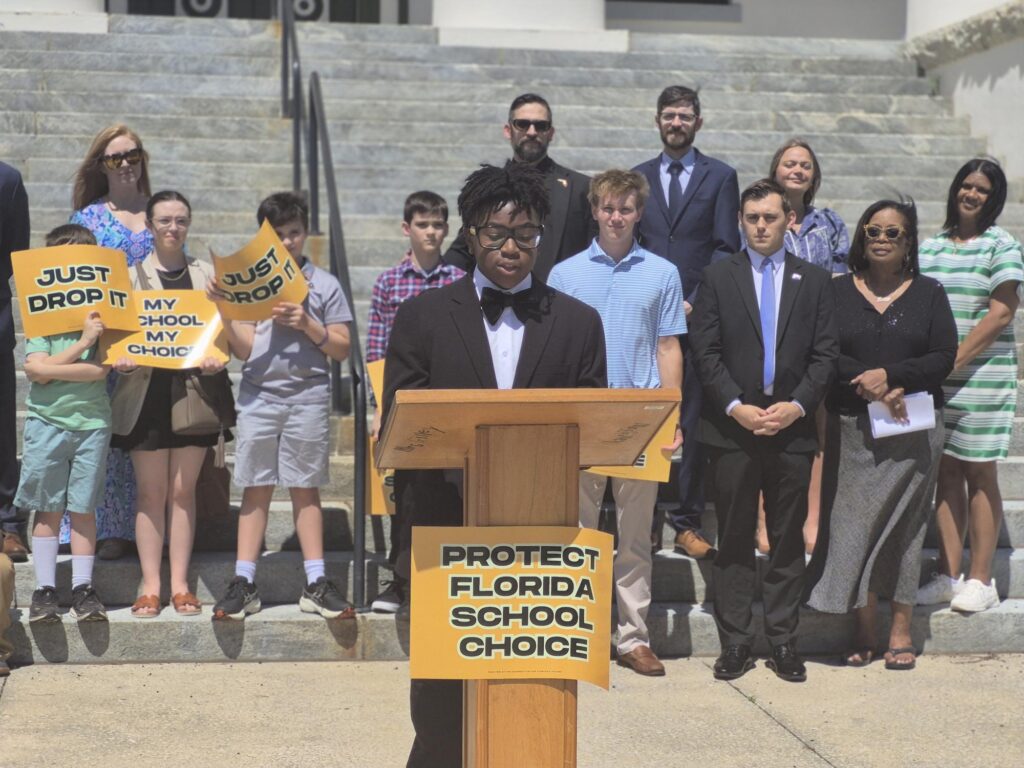
“Dixon inspired me to teach myself to play the piano. I practice every day on that piano at home. No more dust,” he said.
Last fall, when he was hospitalized for three weeks following knee surgery, Rashad created craft kits called DUCK bags that help kids combat boredom. He sold the kits at business fairs and is making some to donate to children’s hospitals.
None of that would have happened if it weren’t for Dixon, he said. And Dixon wouldn’t have happened if it weren’t for the scholarship.

“That’s why I don’t understand this lawsuit,” Rashad said. “Why get rid of something that is life-changing for other people? That helps them achieve better things in life?”
Rita Brown can see proof that education choice changes lives every day at Brownsville Preparatory Institute in Tallahassee, a private school she founded more than 20 years ago.
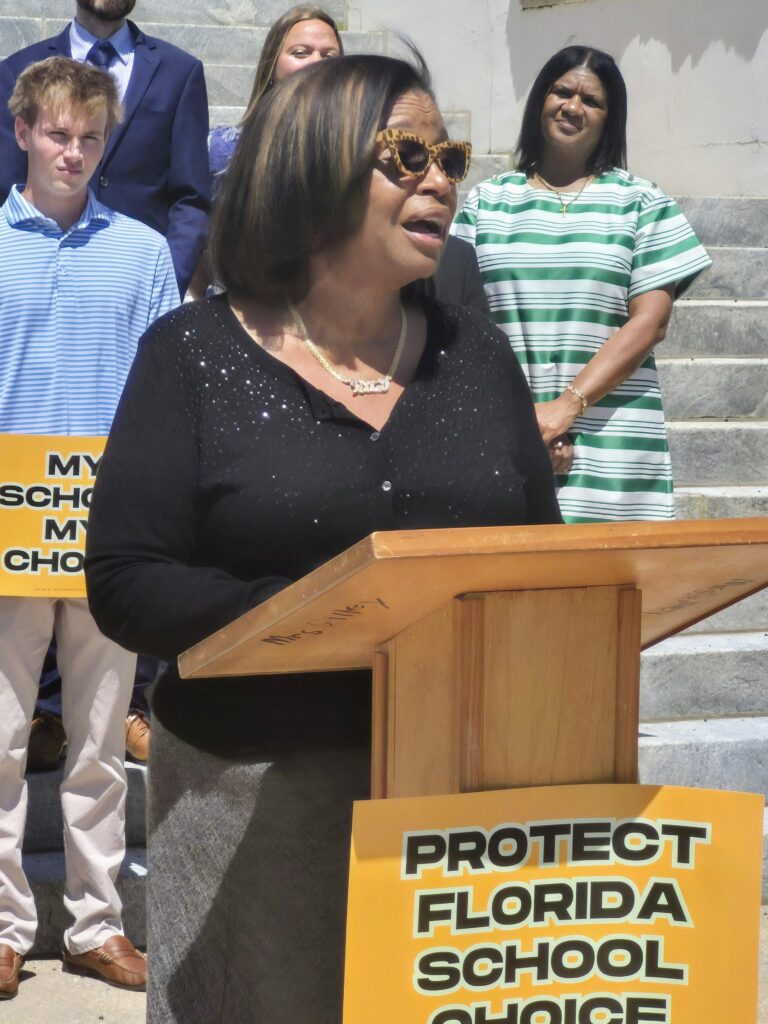
The school began as a pre-kindergarten and now serves 95 students through third grade. Brownsville is in a low-income community. Most parents can’t afford private education after their 4-year-olds complete the state-subsidized pre-kindergarten program.
The scholarships, Brown said, changed that.
It allowed her to add grades. Today, Brownsville students typically learn to read at age 3 and are adding, subtracting, writing, and learning cursive.
“We are the best school in our neighborhood,” she said. “Florida’s education choice scholarships have been a vital part of that.”
If the teachers union wins in court, Brown said, the school would lose most of its school-age children.
“That K-3 program would probably die. It would be devastating for our parents. We have all these students doing amazing things, but they would be forced to go to schools that don’t meet their needs. “
She called the lawsuit “frivolous” and “an attempt to turn back the clock.” But Florida is too embedded in education choice to return to a bygone era.
“At the end of the day, we need to be collaborative in educating all students,” Brown said.
The event inspired a lawmaker to attend to voice his opposition to the lawsuit.
State Sen. Jonathan Martin, R-Fort Myers, said empowering parents to choose the best options for their children does not take away resources from other students and makes America “the light on the hill that Ronald Reagan talked about.”
Florida’s robust scholarship programs have led the way and “will continue to make sure our light stays the brightest, not just in this country but around the world.”
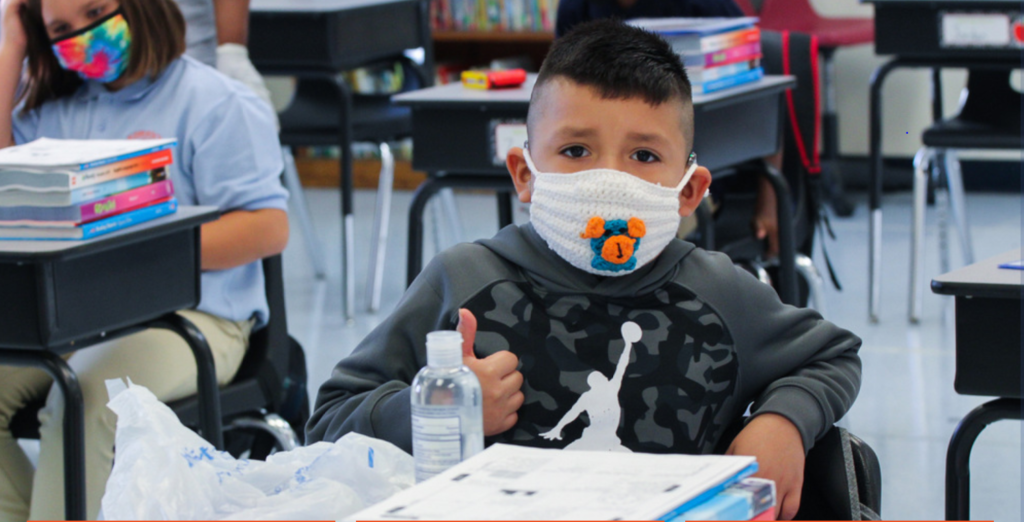
Somerset Academy, Florida’s largest charter school network, has been serving Florida families for 20 years. Since 2017, the network has been working to turn around three struggling district schools in Jefferson County, Florida.
 Editor’s note: Today’s post is the final installment in redefinED’s salute to National School Choice Week. In case you missed our other posts, you can read them here, here, here, here and here.
In the charter school universe, the possibilities are endless.
Want to learn a new language? There’s a charter for that. Want to hone your STEM skills? There’s a charter for that. How about a concentration on art, music or theater? There’s a charter for that, too.
These days there even are charter schools to prepare students for careers in fields such as firefighting and law enforcement.
“The parent in Florida is a savvy education consumer,” said Lynn Norman-Teck, executive director for the Florida Charter School Alliance, which represents charter schools statewide, from independent schools to those run by national networks. “The choice movement is strong in this state not because of a particular governor or the Legislature, though we appreciate their support and help, but it’s really driven by the parent.”
Department of Education figures show charter school popularity is continuing to soar. During the 2019-20 school year, 329,216 K-12 students attended 673 Florida charter schools. That represents more than a 6% jump from 2018-19, when 309,730 students attended 658 charter schools. The increase is particularly impressive since the earlier figures include pre-kindergarten students and the more recent ones do not.
What accounts for charter school popularity?
Some would say it’s because charter schools combine the best of private and district schools. Charters, like district schools, operate with tax dollars and therefore do not charge tuition. But like private schools, they are privately operated, allowing for more innovation and flexibility because they’re free from many regulations governing district schools.
That advantage became evident in March when the coronavirus pandemic shook the world. While some district schools struggled to pivot to distance learning, many charter schools were able to seamlessly transition.
“They are smaller than a district and can make quick decisions,” Norman-Teck said. “They got (electronic) devices in kids’ hands and made sure families had connectivity at home.”
Florida’s foray into charter schools began in 1996, when Urban League of Greater Miami president T. Willard Fair teamed up with then-gubernatorial hopeful Jeb Bush to open the state’s first charter school in Liberty City, an area of South Florida known for its high poverty rate and concentration of minority residents. Though the school closed in 2008 after losing a legal dispute with its landlord over a roof damaged during Hurricane Katrina, the movement it sparked took off, with charter schools opening all over Florida and in many other areas across the United States.
The rapid growth of charter schools is one facet of charter school controversy. Though the schools are non-profit, some turn to for-profit companies to provide certain services such as human resources. Some of the strongest opposition to charter schools has come from district school boards, which argue that charter schools strip district schools of operating funds.
That’s a myth, said Norman-Teck, who explains that Florida law funds schools through a formula based on the number of students enrolled. Students who attend charters don’t put financial burdens on their zoned schools. (You can view a list of character school myths here.)
And in at least one high-profile case, a charter school company was the saving grace for a trio of failing schools North Florida. In 2017, the Florida Board of Education took the unprecedented action of handing control of the district to a charter school network. Somerset Academy, Inc. is set to return Jefferson County’s three district schools to district control next year when its contract ends.
Last year, new doors opened for charter schools when the Florida Legislature won a three-year court battle over a 2017 education law that makes it easier to open charter schools, which had in some cases encountered resistance from their local school districts.
The law also established a “schools of hope” program that allows high-performing charter schools to open within a 5-mile radius of a long-time, low-performing district school as an alternative for families as well as to spur the district school to improvement.
So, what does the future hold for charter schools?
Norman-Teck thinks it looks a lot like the future of public education overall, with more unbundling of services as parents seek even greater customization for their children.
“It’s about the child,” she said. “Schools have to understand the children they serve and be flexible.”
 Stewart resigns: Pam Stewart, Florida's education commissioner, submits her resignation effective Jan. 8 as rumors swirl around Tallahassee that former House Speaker Richard Corcoran is Gov.-elect Ron DeSantis' choice to replace her. Stewart has been education commissioner since 2013. She announced last year that she would retire when Gov. Rick Scott left office. But two months ago, the Florida Board of Education asked her to stay another year and she agreed. Tuesday, in her resignation letter, Stewart wrote: "There has never been a better time to be a student in Florida, which makes it a good time to hand over the reins so that someone can take our students to the next level of opportunity and success." News Service of Florida. Orlando Sentinel. Gradebook. Politico Florida. Florida Phoenix.
Superintendent selection: Manatee County School Board members are interested in erasing the word interim from the title of Superintendent Cynthia Saunders. They say they've been impressed with how Saunders has handled several crises since stepping in for the departed Diana Greene, and will draft a contract extension for her that they hope to vote on Dec. 11. Bradenton Herald. Sarasota Herald-Tribune. (more…)
Amendment 8 off ballot: A judge's decision that proposed constitutional Amendment 8 should be removed from the Nov. 6 ballot is upheld in a 4-3 vote by the Florida Supreme Court. A Leon County judge had ruled that the amendment is misleading and fails to inform voters of its “chief purpose and effect.” The amendment, put forward by the Constitution Revision Commission, would have created an entity other than local school boards that can approve charter and public schools, set term limits for school board members and required civics education in schools. The League of Women Voters challenged the constitutionality of the amendment, with president Patricia Brigham saying “the backers of this proposal on the CRC went to great lengths to hide the ball because they realized that Floridians would never knowingly forfeit their right to local control over their local public schools.” Associated Press. News Service of Florida. Tampa Bay Times. Miami Herald. Orlando Sentinel. Florida Phoenix. Florida Politics. Washington Post. Watchdog.org.
Scott rejected again: Legislative leaders officially deny Gov. Rick Scott's request to release $58 million from the armed school guardian fund to districts to help them pay for more security at schools. In a letter to the governor Friday, incoming Senate President Bill Galvano, R-Bradenton, said, "For the guardian program to truly be vetted and ultimately embraced, I believe the program should maintain its own funding rather than having its funds commingled with other funds available for school safety. I respectfully disagree with your statement that the $58 million in available funding will go to waste if the proposed budget amendment is not adopted." Galvano did say he would be open to reviewing the program in the near future. Only $9 million of the $67 million set aside for guardians was claimed by districts, which preferred having school resource officers to arming school employees. Associated Press. (more…)
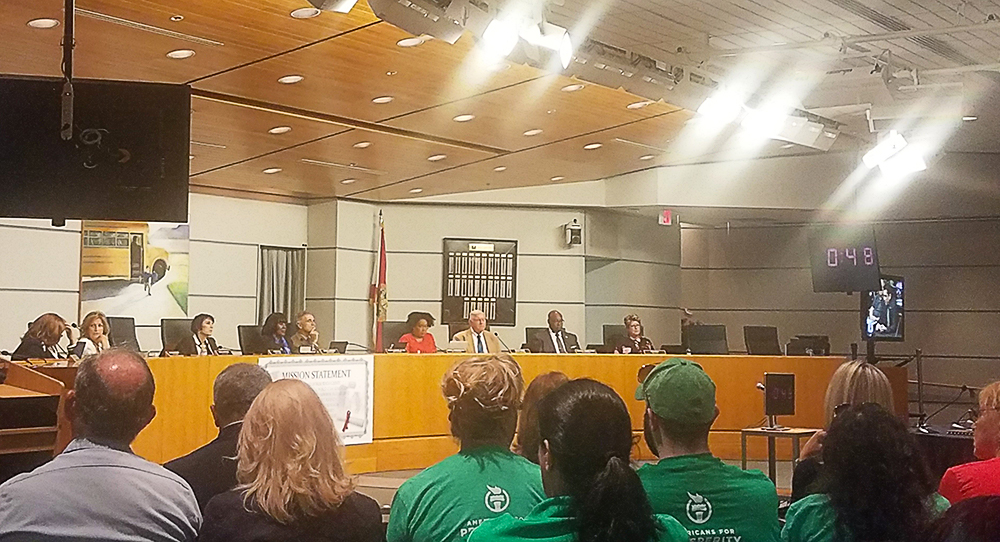
The Palm Beach County School Board unanimously votes to put a tax referendum on the ballot, leaving out charters.
The Palm Beach County School Board voted unanimously Wednesday night for a proposed tax referendum expected to generate approximately $200 million a year for traditional public schools – and none for charter schools.
The decision followed a hearing attended by roughly 20 charter school parents, teachers and leaders who argued that charter schools should be entitled to their fair share of the tax money. (more…)
Help for failing schools: Ninety-three failing Florida schools can apply to the state for up to $2,000 more per student to fund such services as after-school programs and community partnerships, the Department of Education announces. The schools are eligible through the "schools of hope" provision of H.B. 7069 because they have received grades below a C from the state for the past two years. They have less than a month to apply, and only 25 will get the money because of a cap limiting payouts to $58 million of the $140 million set aside by the law. The rest will go to charter schools that set up within 5 miles of the failing schools. Miami Herald.
H.B. 7069 suit: The Palm Beach County School Board votes unanimously to support a proposal to sue the state over the new education law, H.B. 7069. Board attorneys were directed to research the best way to challenge the law, which increases money for charter schools at the expense of traditional public schools and limits local districts' authority over charters. Board members say they may not join a proposed lawsuit by Broward and St. Lucie counties. Board member Frank Barbieri says separate suits could make a defense harder for the state. “If we are going to sue, which we certainly should, we should make it as difficult and painful for the state Legislature as they have made it for us to operate this school district, the highest performing large urban school district in Florida,” he said. Palm Beach Post. Sun Sentinel. The Florida Charter School Alliance says Palm Beach County Superintendent Robert Avossa signaled an intention to "wage war" on charter schools when he urged the school board to join the lawsuit. Lynn Norman-Teck, executive director of the alliance, says the board should remember that charter schools and their students are in the public school system. Palm Beach Post.
Duval may join suit: Duval County School Board members ask Jacksonville's city attorney to investigate how much it would cost to sue the state over H.B. 7069 or join the current movement toward a suit by Broward and St. Lucie counties, the likelihood of success, and whether the city would join the board in the suit. At least six Duval schools are in danger of being closed or turned over to charter companies under the new law. Other districts that have discussed joining the suit are Pinellas, Palm Beach, Sarasota, Manatee and Alachua. Florida Times-Union. WJCT. WJXT.
(more…)
K-12 funding: The Senate Budget Committee proposes a boost of $790 million in spending in the next school year for Florida's K-12 public schools. Almost 68 percent of that would come through higher property taxes for local districts. Gov. Rick Scott has proposed an $815 million increase for K-12 schools, also with 68 percent of the boost coming from local property taxes. House leaders, who have said they won't accept any tax increase, propose an increase of $251.3 million. The House budget's chief priority is $200 million to attract charter school networks into areas where traditional public schools have struggled. News Service of Florida. Politico Florida. Politico Florida. Florida Politics.
Recess bill: The Florida House K-12 Innovation Subcommittee makes significant changes to the mandatory recess bill, then passes it. The original bill called for at least 20 minutes of unstructured but supervised recess every day for the state's elementary school students. The amended bill changes the daily requirement to at least twice a week, lets schools count recess time toward physical education requirements, and removes the recess requirement for fourth- and fifth-graders. Miami Herald. Sunshine State News.
School choice: The House Education Appropriations Subcommittee approves a bill that would increase the money students can receive through the state's tax credit scholarship program. But removed from the bill was an expansion of eligibility and triple the money for Gardiner scholarships for students with disabilities. Step Up For Students, which publishes this blog, helps administer both programs. The subcommittee also stripped the bill of a provision that would have allowed McKay scholarships for students with special needs even if they hadn't attended a public school for an entire school year. redefinED. News Service of Florida.
Charter schools: The House PreK-12 Innovation Subcommittee approves a bill that could make it easier for high-performing charter schools to expand, give charter networks the ability to received federal funding directly, allow school districts an extra 30 days to review charter applications, and make public schools accountable for the academic performance of students who transfer to private or alternative charter schools. Ralph Arza of the Florida Charter School Alliance says his group supports nearly all the bill, but said alternative charters should be held responsible for students who transfer from traditional schools. redefinED. The committee also approves a bill that would require school districts to proportionately split local property tax revenues with charter schools after the money districts set aside for construction debts is deducted. The state’s 556 charter schools would receive about $148 million, or nearly double what they now get. redefinED. (more…)
When members of the Florida School Boards Association started pulling into the Costa D'Este Beach Resort for a gathering in Vero Beach last week, some three dozen parents, private school teachers and school choice advocates were there to greet them.
They lined the sidewalk, holding signs: "My Child, My Choice." "No lawsuits against Step Up."
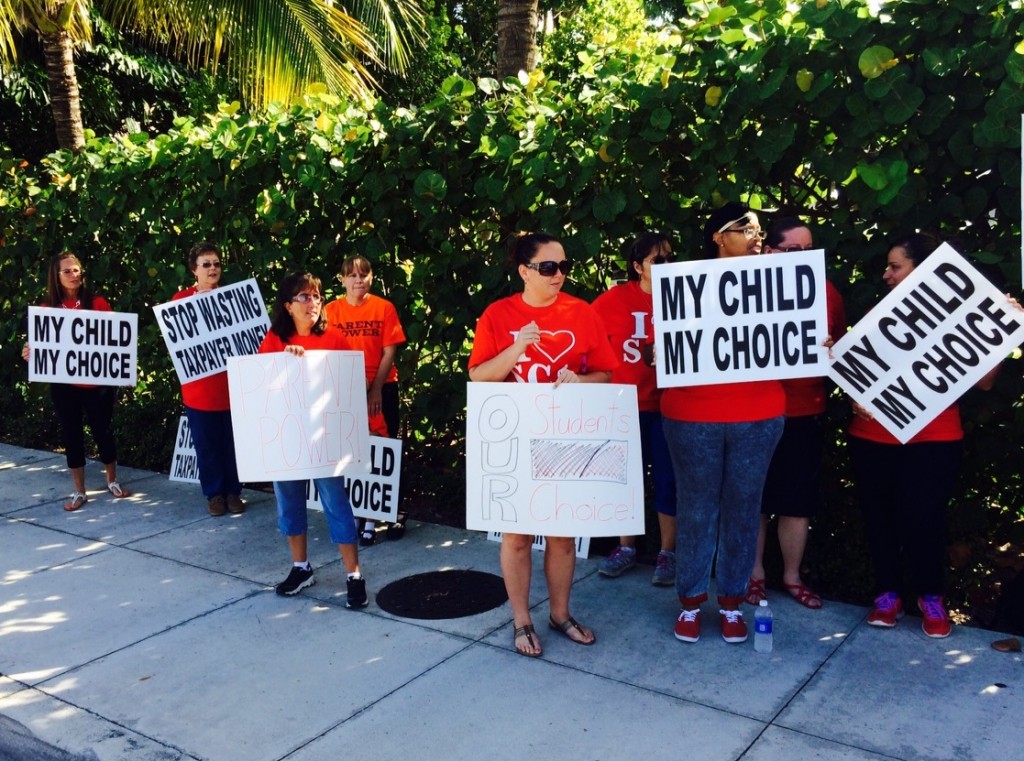
Parents line sidewalks in Vero Beach during a Florida School Boards Association meeting to protest a lawsuit against tax credit scholarships.
The pro-school choice contingent was smaller than expected - a bus broke down en route from Jacksonville. But it was large enough to fill the sidewalk without antagonizing the police in the sleepy beach-side town.
Catherine Durkin Robinson, director of Florida Voices For Choices, told the parents they'd be able to say they were with the movement from the beginning.
"Having the right school and the right environment for your kid - that's just a choice that people need to have," said Susan Montogmery, a Vero Beach local who had come to support her fellow parents.
Her son, Ryne, is beginning his freshman year at Johnson University Florida, a college in Kissimmee, something the mother of six said would not be possible if he had not received a scholarship to attend Master's Academy, a private school in Vero.
Voices for Choices is a new advocacy group started with the goal of organizing parents to ensure they have the same rights as Montgomery - to choose the educational environment that works best for their children.
The new group grew out of some preliminary organizing efforts by Step Up For Students, which co-hosts this blog. Robinson is a former Step Up employee. And Step Up board chair John Kirtley chairs Voices for Choices. But the new group is funded privately and has a separate staff. (more…)
A new report finds more Florida charter schools operating in the red, but it’s not necessarily a sign they’re in trouble.
Released this month, the annual report from the Florida Auditor General shows 12 percent of the 499 charter schools reviewed in the audit ended the 2012 fiscal year with a deficit, up from six percent of 445 schools the previous year.
The bulk of charter schools flagged were in Broward and Miami-Dade counties, which have the largest number of charters in the state. In Broward, 17 of 73 charters closed the year with a deficit. In Miami-Dade, it was 16 of 109 charters.
“It certainly is something we are aware of and paying attention to,’’ said Adam Miller, who oversees charters and school choice for the Florida Department of Education.
But the report looked at a particularly difficult year for both charter and traditional public schools, Miller noted. Lawmakers slashed $1 billion from the education budget in 2011, significantly reducing per-student funding and other dollars to charters and traditional public schools.
Another factor: a third of the charters audited were less than three years old. That’s important to note, Miller said, because new charters take some time to build reserves. They don’t receive as much public funding as district schools. And since most of them don’t get facilities funding, they have to dip into operation dollars to pay for buildings and other capital needs. (more…)
Former state Rep. Trey Traviesa says Florida is a national leader when it comes to its support for charter schools.
And the 2013 legislative session offered plenty of examples – from extra facility dollars to legislative language that included charters in teacher pay raises and school safety funds, to revamping charter applications and contracts to make them more uniform from district to district.
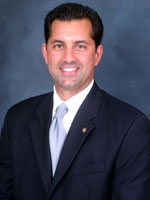
Trey Traviesa
But there’s plenty more work to do, Traviesa said today during an online town hall meeting organized by the Florida Alliance for Charter Schools.
“Funding needs to be stronger,’’ he said. “Policy can be better.’’
With those two objectives in mind, the alliance and its band of former legislators-turned-lobbyists already are setting the stage for next year’s charter school agenda. The group plans to meet with operators, parents and other supporters across the state within the next few months.
In Florida, there are 203,000 children attending 579 charter schools. One of the biggest issues for the charter industry has been getting organized and developing a unified mission, alliance leaders said.
“We as a movement have to be able to stick together as one voice,’’ said Ralph Arza, another former state representative who now lobbies for the two-year-old Fort Lauderdale-based nonprofit. “That is the importance of our advocacy, to make sure that charters are front and center … and treated equally on the funding side and the policy side.’’
That “Herculean effort’’ really came together this year, said Arza, noting that the benefits for charter schools this legislative session were beyond the allinace's expectations.
Among the highlights:
Charter schools also will get more leeway in submitting applications before the Aug. 1 state deadline, and have a quicker turnaround in the district review process – from 60 days to 30 days. Other changes include requiring districts to report to the state annually the number of charter applications they receive, and how many they accept or deny.
“We just wanted to make sure things are moving along quickly and as close to the timeline as possible,’’ said Mike Kooi, executive director of Florida’s school choice office.
The session brought “a lot of victories for charter schools in terms of polices and funding,’’ Kooi said. “And, hopefully, it will continue.’’

