The increased scrutiny over shuttered charter schools have state lawmakers looking for ways to ensure that the people who apply to open and run new schools are up to the task.
Charter school closures aren't always bad things, but a recent investigation by the Naples Daily News found dozens of charters have closed "amid poor financial management, accounting and oversight." Those are the kind of closures lawmakers — as well as charter school advocates — hope to prevent.
A new article in Education Next suggests the responsibility for those sorts of problems lies squarely with charter school boards, the non-profits, municipalities or other organizations that oversee the schools and in some cases hire management companies that run their day-to-day operations.
Whose responsibility is it when a charter school gets into trouble—when its students aren’t learning or it misses its enrollment targets or money runs short or it closes?
Everyone I asked gave the same answer. “I’d point right to the board,” said Mark Lerner, who sits on the board of Washington Latin charter school. “The failure of a charter is the failure of the board,” said Tom Keane, who directs strategic initiatives at AppleTree, an early-learning charter with six D.C. campuses. “Every closure ultimately can get traced back to the board not doing the job,” added Marci Cornell-Feist, a Massachusetts-based education consultant and entrepreneur.
Charter legislation passed last week by the Florida House and up for a committee vote later this week in the Senate would bring charter school boards under greater scrutiny before they open new schools. SB 1552 and HB 7037 would require charter schools to disclose the names of governing board members, as well as the financial and performance history of any charter schools they may be associated with, when they pply to local school boards.
The article looks at the push by organizations like BoardOnTrack and Charter Board Partners to find qualified people and train them for positions on charter school boards in places like Washington, D.C. They also hold boot camps where recruits practice mock board meetings and learn about leadership evaluation and bone up on the nuts and bolts of corporate governance. In short, they prepare future board members to help lead what are, in effect, multi-million dollar startups.
Author June Kronholz says she repeatedly heard the number of charter school closures will decline as the sector becomes more mature "In part," she writes, "that’s because authorizers, bankers, and donors are paying increasing attention to how well the schools are governed."
Patrick Gibbons contributed to this post.
 Broward County School District
Robert Runcie, the superintendent of the Broward County School District, wanted to help low-performing charter schools by partnering them with high-quality charter operators. He and his staff brought the idea to the school board and helped secure a $3.3 million grant from the state. But Runcie's bosses on the school board opted to turn the grant down. The reason defies logic.
“It’s not our job,” said board member Laurie Rich Levinson. Board member Patricia Good didn’t want to help either because, according to the Sun-Sentinel she believed, “it was up to individual schools to bring up their own grades.”

Laurie Rich Levinson
The apathetic approach to helping students in underperforming charter schools isn’t surprising given the Board’s history with charters. Repeated constantly by the Sun-Sentinel, board members claim charters are “easy to open but difficult to shutter if they fail,” and that this is entirely the state's fault.
Reality is more complicated. Broward shuts down a lot of charter schools. It also approves a lot of charters. According to the 2014 Authorizers Report, Broward recently approved 22 new charter schools, more than any other district in the state.
District staff say they are understaffed for charter school oversight, and the board grumbles about the proliferation of of poor-performing charter schools. But now the board is refusing money to help on both accounts.
Julian Vasquez Heilig, associate professor, University of Texas, AustinI am not sure whether Julian Vasquez Heilig wanted readers to laugh or cry when he published his latest brief on voucher research.
Vasquez Heilig sets up his paper by describing the attitudes, beliefs and motivations of voucher supporters. So who does he cite to provide a fair and accurate description of the beliefs of voucher supporters? None other than the National Education Association, the nation’s single largest voucher opponent (this is the actual citation).
To build a case against vouchers, he tries to show consensus among researchers, yet he provides few academic citations. The sources he does cite are over a decade old or inexplicably limited in scope. He even allows a blogger at an advocacy organization to summarize voucher research … twice. Interestingly, that blogger doesn’t have a single citation to back up her own single sentence summation.
 Padding the support for his own argument is bad enough, but Vasquez Heilig ignores whole swaths of voucher research, claiming much of the research was either not published in peer-reviewed academic journals, or was funded by pro-voucher groups.
Of course, Vasquez Heilig publishes this claim in a non-peer-reviewed outlet in the same week he tweets about his NEA Foundation trip to China. It is also worth noting he’s a research fellow for the union-backed National Education Policy Center and, contrary to his accusations of corporate influence corrupting research, lists himself on his resume as a former Bill and Melinda Gates Foundation Young Researcher.
 Charter schools in Orange County, Fla. are increasing racial and economic segregation, or so say state Rep. Geraldine Thompson and Orange County School Board Chair Bill Sublette.
They make this accusation after finding a handful of charter schools with demographics at odds with the district-wide average. But averages mask extremes on one end or the other, so comparing a single school, or even a handful of schools, to the average of a large district is not only unfair but inappropriate.
According to data from the Florida Department of Education, district schools in Orange County range from 26 percent to 100 percent minority. Charter schools range from 24 percent to 100 percent minority. Not much difference.
The same is true for economic segregation. District schools run from 7 percent free- and reduced-price lunch (FRL) eligible to 100 percent. The charters run from 0 percent to 93 percent.
It is worth noting that district-run schools seem more likely than charters to have extreme concentrations of minority or low-income students. Forty-four district schools in Orange – nearly a quarter of all schools - are 90-percent-plus minority, while 40 schools have a student body that is 100 percent FRL eligible.
Charter schools in Orange are drawing students from local neighborhoods much in the same way as district schools. Rather than pointing fingers at the 19 charters where students voluntarily enroll, Thompson and Sublette might want to scrutinize the 183 district schools where students are zoned.
Des Moines Independent Community School DistrictSchool districts aren’t allowed to base enrollment policies on race anymore. So, to achieve “racial balance,” the Des Moines Independent Community School District’s diversity plan allows it to base admissions and enrollment decisions on socioeconomic status.
The district looks at whether students are eligible for the free and reduced priced lunch (FRL). Eligible students are then designated as “minority students” (not kidding).
If a transfer request into the district, out of the district, or between schools within the district, causes the percentage of “minority students” within a school to tip 10 percentage points below or above the district average, the district will deny the transfer. According to The Des Moines Register, the district has already denied 245 of 386 open-enrollment requests for the upcoming school year.
Of course, basing racial balance on the demographic average of an arbitrarily drawn geographic boundary may be silly when you look at the big picture:
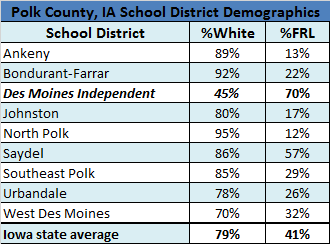
*data from the Iowa Department of Education
Des Moines Independent is surrounded by whiter, wealthier districts, making the effort to ensure racial balance within the district an exercise in futility. If one truly wanted more racial balance in schools, the quickest and easiest way would be to shut down Des Moines Independent and have it absorbed by neighboring districts.
Of course, the transfer denials could really just be about keeping $6,300 of state support per student within the district …
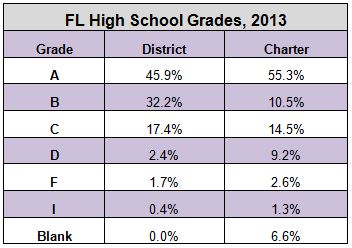
Like their elementary and middle school counterparts, Florida charter high schools earned higher concentrations of both A and F grades than district schools, according to the state’s latest school grades report.
Just how much higher depends on how you slice it. Bear with us.
The latest report, released Dec. 18, shows 63 percent of charter high schools earning A’s for the 2012-13 school year, compared to 46 percent of district high schools. But there’s a caveat.
The December report excluded at least 31 high schools (most of them charter schools) because the grades were reported last summer with the elementary and middle school grades. According to Cheryl Etters, a spokeswoman for the Florida Department of Education, some high schools were graded on an 800-point scale because the school was missing one or more data points for a complete evaluation. For example, a charter school without a senior class would not be able to calculate a graduation rate. Such a school would be unfairly treated under the full 1600-1700 point evaluation for high schools.
When combining high schools from the DOE’s two databases, the percentage of A charter high schools drops from 63 to 55. When A and B grades are combined, district high schools lead 78 percent to 66 percent.
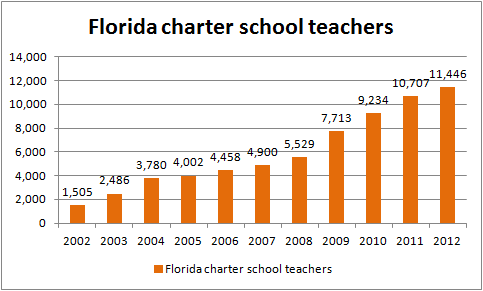
It’s no surprise, given rocketing growth in Florida charter school enrollment, that the number of charter school teachers is on the rise, too. But the trend lines are still worth an update.
Last year, the number of instructional personnel in Florida charter schools reached 11,446, according to the most recent data from the Florida Department of Education. That’s up 7 percent from fall 2011, when the number topped 10,000 for the first time. (The number of instructional personnel in all Florida public schools is up 2.2 percent.) Charter teachers now account for 5.9 percent of Florida’s entire teacher corps.
We’ll try to corral the 2013-14 numbers once they’re available in a month or so. In the meantime, check out this spreadsheet from DOE. It shows the number of charter school employees by category, and offers a district-by-district breakdown.
Charter schools: Miami-Dade County school officials sign off on a $4.3 billion budget that for the first time includes $300 million for charter schools. Miami Herald.
 Holocaust studies: For Broward and Palm Beach county students who face bullying, peer pressure and prejudice in school, learning about the Holocaust is becoming increasingly relevant. Sun Sentinel.
Ben Carson: The nationally renowned doctor turned public speaker shares his story of resilience and success with students of all ages at Lake Wales High School. The Ledger.
Tax credit scholarships: About half of the students in Flagler County's private schools use Florida tax-credit scholarships to pay tuition; so do a quarter of the students in Volusia County's private schools. Daytona Beach News-Journal.
Teacher pay: Pinellas County schools and the local teachers union tentatively agree to a 5.6 percent average raise for teachers and a bump in starting teacher salaries. Tampa Bay Times. Salary negotiations hit a snag as officials look at tutoring vs. teaching. Tampa Bay Times.
Report cards: Palm Beach County second-graders will get new report cards without the traditional A through F grades. Sun Sentinel.
Common Core: Hernando County School Board members share concerns about the new standards, including the fear of losing local control, financial constraints and the possibility of excessive testing. Tampa Bay Times.
City post: Annmarie Kent-Willette, who teaches communications at Jacksonville University, is Jacksonville's new education commissioner. Florida Times-Union.
 Florida charter schools didn’t benefit as much as district schools from the school grades “safety net” that state education officials continued this summer.
According to Florida Department of Education data, 14.2 percent of the charter schools that have been graded so far would have dropped more than one letter grade had it not been for the safety net, which prevented schools from falling more than one letter grade. That compares to 21.7 percent of district schools.
In raw numbers, that’s 54 of 381 charter schools and 495 of 2,278 district schools. The numbers do not include school grades that are pending or incomplete.
Last month, the Florida Board of Education voted 4-3 to continue the safety net, which had been used in 2012, after superintendents complained that lower grades brought on by tougher standards would give the public a distorted view of student achievement. Tony Bennett, then the state education commissioner, initially expressed concerns about the safety net but later relented, saying it would help ease the transition to Common Core standards.
Bennett resigned two weeks later after news stories suggested he abruptly changed the school grades formula in Indiana to benefit a politically connected charter school.
As we reported last month, Florida charter schools again earned both A and F grades at higher rates than district schools.
 We reported last month that Florida’s private school enrollment numbers are rising again. And that’s true. But trend lines beneath the surface suggest the modest rebound is tied more to publicly funded options than to private-paying students.
Here’s the thing: McKay scholarships for disabled students and tax credit scholarships for low-income students are making up a fast-growing share of private school enrollment – from 8.5 percent in 2002-03 to 28.4 percent last year. When those students are excluded from enrollment totals, it’s clear privately funded, private school enrollment continues to drop at a steady pace.
What does that mean? It may show private schools are still suffering the effects of a long and jobless economic recovery, which leaves fewer families able to afford an education option they used to choose. It may reflect that some private-school parents have chosen a different option, charter schools, that barely existed in the first year of our chart and enrolled 203,199 students last year (we have little data, unfortunately, on how many of these students previously attended private school). It may mean the basic economics of private school have changed for many middle-class families, either because tuition has risen too fast or incomes are declining in a more systemic way.
This is an intriguing, and possibly troubling, trend. But we’ll have more on that at another time. For now, here's a simple spreadsheet with more numbers, all from Florida Department of Education reports. And here's a few charts with the highlights: (more…)
When parents in Smyrna, Ga., wanted to open a charter school last year, they didn’t have a big management company to take on start-up costs. So they got creative and turned to gofundme, a crowdfunding site that helps people quickly raise money for projects. Within four months, the Smyrna Academy of Excellence collected $10,000.
Jimmy Arispe
“We went at it pretty hard,’’ said principal and board chairman Jimmy Arispe, who described the process as quick and easy compared to applying for grants and knocking on foundations doors. “You can send a link to anybody.’’
Crowdfunding is a fairly new concept in education, but the fundraising platform appears to be gaining fans – especially among charter schools. The idea is simple. Put a project or goal on one of the online fundraising sites and ask people from all over the world to help with costs. Typical donations range from 20 bucks to thousands of dollars.
Chicago’s Academy for Global Citizenship charter school has raised $50,000 so far in an ongoing $30 million campaign on indiegogo, an international crowdfunding site. The Cesar Chavez Public Charter Schools in Washington, D.C., raised $11,179 for a new gym this past spring during a three-month drive on StartSomeGood.
And a 60-day “Open the Doors’’ campaign on Fundly, which caters to nonprofits, garnered $88,000 for the Urban Montessori Charter School in Oakland, Calif.

Parker Thomas
“It’s a really cool idea overall,’’ said Parker Thomas, who, along with another of the school’s co-founders, headlined a crowdfunding seminar in March at a California Charter Schools Association conference.
No one, including the California association, really knows how many schools are crowdfunding.
“We just have a sense that they’re like most organizations or nonprofits and public schools,’’ said the Los Angeles-based group’s spokeswoman, Dannie Tillman. “Crowdfunding is just one of the methods in their fundraising toolbox.’’
Charter schools are public schools that operate independently from districts. They receive state dollars, but not as much as their district counterparts, noted Eric Paisner of the National Alliance of Public Charter Schools. So that has many charter schools raising money, he said. (more…)

