The Florida Board of Education announced its finalists for education commissioner today, with a list of three candidates including Indiana's outgoing education chief Tony Bennett.
Bennett, who gained national acclaim and criticism for pushing Florida-style education reforms in his home state, lost his re-election bid last month. That immediately sparked rumors that the Chiefs of Change leader might come to the Sunshine State.
The other finalists culled from 53 applications are:
Charles Hokanson Jr. A consultant and former president of the Alliance for School Choice, he also served as a deputy assistant secretary at the U.S. Department of Education, appointed by former President George W. Bush. According to the Orlando Sentinel, Hokanson said he worked on state reform efforts at the alliance, including those pushed in Florida by former Gov. Jeb Bush.
Randy Dunn. Murray State University president and a former Illinois state superintendent of education.
The board will interview the finalists during its Dec. 11 meeting in Tampa.
The new education commissioner will replace Gerard Robinson, who left at the end of August. Robinson, who only took the job a year earlier, said at the time that being apart from his family in Virginia proved too challenging. He also received sharp criticism surrounding changes to the Florida Comprehensive Assessment Test that resulted in test scores dropping statewide.
Pam Stewart, the interim education commissioner, did not submit an application for the permanent post.
They’re one of the first things people notice when they walk inside the new Brooks DeBartolo Collegiate High School in Tampa.
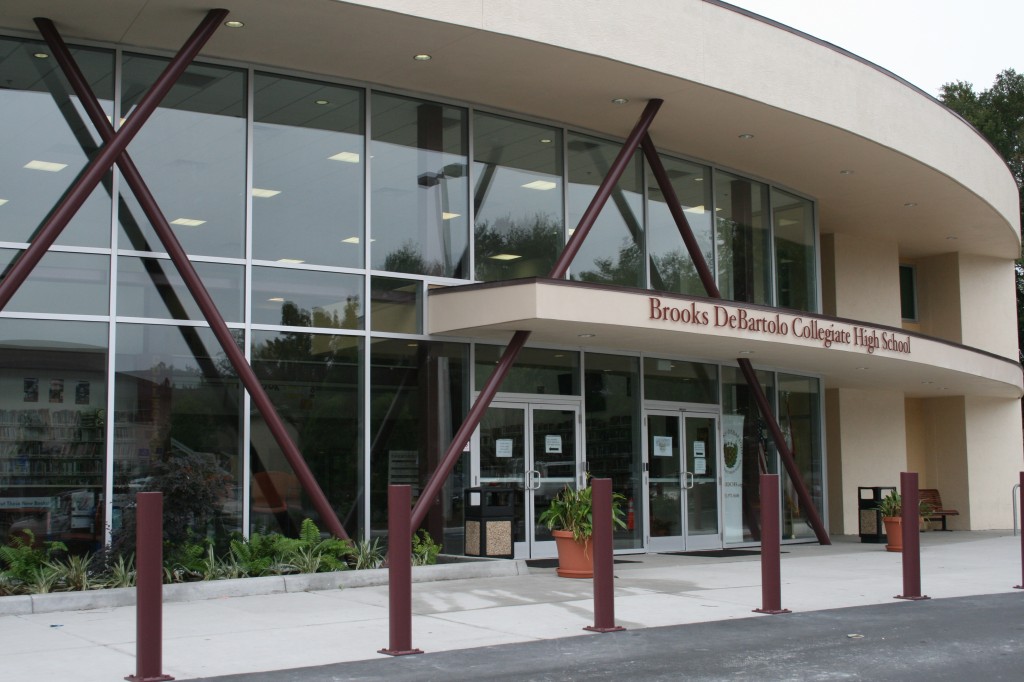
Brooks DeBartolo Collegiate High School
Windows, everywhere.
Inside the 67,000-square-foot renovated building, light pours in through an expansive curved entryway, between the cafeteria and lush outdoor dining area, inside classrooms and even along the second-floor hallway, where students can peer down into the giant gymnasium.
Compared to the charter school’s first digs, a cramped old Circuit City it leased for five years, “this is such a change of environment,’’ said Principal Kristine Bennett.
For its new home, the school’s foundation spent $15 million outfitting a former church with 20 classrooms, two computer labs and a media center. There’s a cafeteria with a LED-powered vending machine offering gluten-free snacks, and a full-sized gym featuring one wall with a painting of a fiery red and orange Phoenix – the school’s mascot.
The striking makeover is fitting for a student body that has undergone its own metamorphosis.
Three years ago, the state gave Brooks DeBartolo a “D’’ grade for academic performance. The school, which garnered a “C’’ the year before, faced losing its charter.
One of the school’s founders and financial backers, Derrick Brooks, the legendary former linebacker for the Tampa Bay Buccaneers, vowed his namesake school would work harder. And it did. The next year, it scored six points higher than the state required for an A grade.
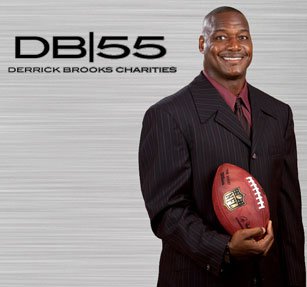
Derrick Brooks
Today, students are attending an “A’’ school for – hopefully, say administrators – the third year in a row. (more…)
As a group, low-income students struggle more than their wealthier peers. But in Florida, poor kids in some districts do a lot better than poor kids in others.
In Seminole County, for example, 56 percent of third graders eligible for free- and reduced-price scored at grade level or above on this year’s FCAT reading test, according to new state Department of Education data. In Duval County, meanwhile, 39 percent did. Among the state’s biggest districts, Seminole has one of the lowest rates of low-income kids. But so does Duval. And the low-income kids in Miami-Dade, which has the highest rate (nearly 20 percentage points higher than Duval), easily outpaced their counterparts in Duval. They did so in every tested grade, by an average of nine percentage points.
So what gives?
I’m not sure. But I think it’s worth a closer look.
We compare schools to each other so we can learn from those that make more progress. Ditto for states. Education Week’s annual Quality Counts report puts states side by side. It’s thoughtful and useful. It’s time for a similar spotlight on Florida school districts, which include some of the nation’s largest urban districts and an average enrollment among the top 10 of 165,000 students. Anybody could take the lead in setting that up – the press, parent groups, researchers, lawmakers, state education officials, maybe even the districts themselves.
Even with state mandates, districts have considerable leeway. Taking a closer look at achievement data district by district would spark more discussion about which ones are employing policies and programs that make the biggest difference for kids. The variation is endless. Some districts put more disability labels on minority students. Some put a premium on career academies. Some focus on principal development. Some have stronger superintendents. Some face more competition from charter schools and tax credit scholarships. How do things like that factor into district-to-district gaps? I’m sure it’s difficult to sort one from another, and impossible to draw definitive conclusions. But we won’t develop better hunches without looking at the data and talking about it.
A deeper dive into FCAT scores is one place to start. Most of the data I’m referring to is posted every year by the DOE, a few months after FCAT scores are released in late spring and early summer. It’s fascinating stuff – a breakdown of scores by district, subject, grade, FCAT level – and by all kinds of subgroups. I’ve talked to enough bona fide researchers about these numbers to know they raise fascinating questions.
Take Duval again. (more…)
A new report on the academic performance of low-income students receiving Tax Credit Scholarships in Florida finds they are making modestly larger gains in reading and math than their counterparts in public school.
That conclusion from 2009-10 test data is encouraging for those of us who work to provide these learning options, which served 34,550 low-income students statewide last year. But the report, released today and written by respected Northwestern University researcher David Figlio, is also a reminder of the inherent complexities of judging whether these programs work.
Figlio has both a brilliant mind and 13,829 test scores with which to work, and yet his report is filled with qualifiers and provisos and cautionary notes. That’s largely because the scholarship program is so different from the typical public education option. In this case, students are attending more than 1,000 private schools where, on average, four of every five students pay their own tuition. The average scholarship enrollment in each school, for 2009-10, was only 28 students.
That kind of school profile tends to serve as an asset to the economically disadvantaged students, but not necessarily for the standard approach to academic oversight. Since these are mostly private-market schools, the state won’t allow them to administer the state test, known as the Florida Comprehensive Assessment Test (FCAT). But the law does appropriately require every scholarship student to take a nationally norm-referenced approved by the state Department of Education, and most students take the well-regarded Stanford Achievement Test.
These tests do allow Figlio to make direct national comparisons, so we know without qualification that the typical scholarship student scored at the 45th percentile in reading and the 46th percentile in math. We also know that their year-to-year gain from 2008-09 to 2009-10 was the same as students of all income levels nationally, which is a solid piece of academic evidence
Where things get more muddled is in trying to compare to low-income students in Florida public schools. As odd as this may sound, the two groups are substantially different. And they are different in ways that tend to be counterintuitive. (more…)

