By Lauren May and Ron Matus
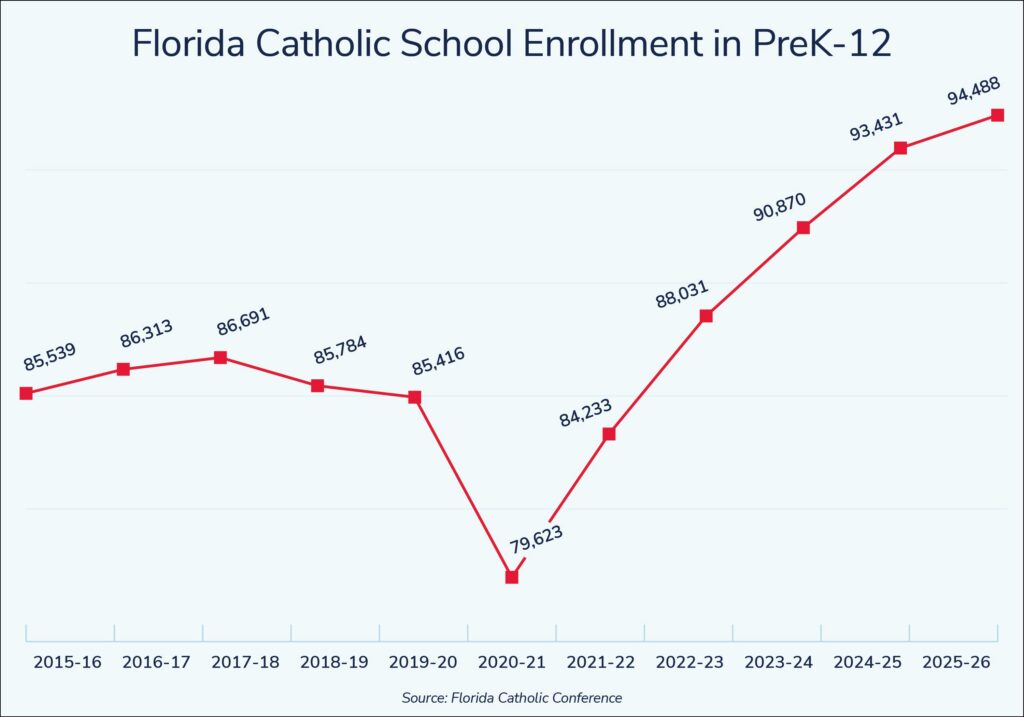
Catholic school enrollment in Florida is up again this year, rising 1.1% to 94,488 students, according to the latest numbers from the Florida Catholic Conference.
The continued growth is likely to bolster Florida’s reputation as the national standout in Catholic schooling. Through last year, Florida Catholic school enrollment was up 12.1% over the past decade. Nationally, it was down 13.2%.
To spotlight the trend lines, we published a special report in 2023, “Why Catholic Schools in Florida Are Growing: 5 Things to Know,” followed by update briefs in 2024 and 2025.
In that spirit, here are five things to know about the 2025-26 numbers:
The trend continues. This year marks five years of consecutive growth. Since 2020-21, when enrollment dipped in the wake of the pandemic, Catholic school enrollment in Florida is up 18.7%.
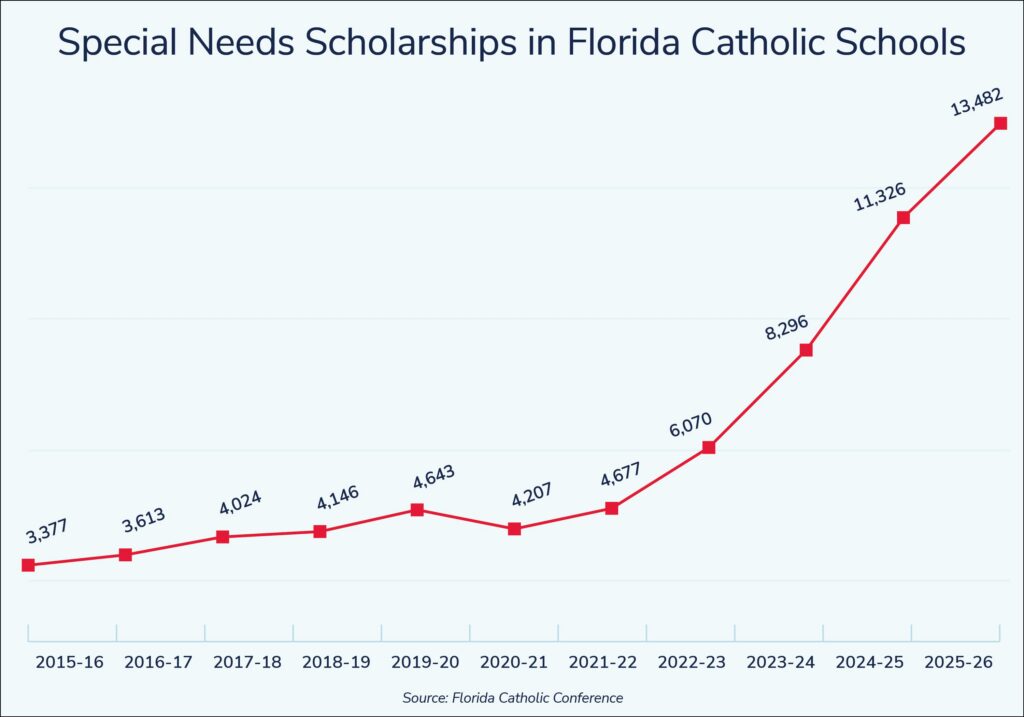
Special needs surge. Students with special needs are a leading factor. This year, Catholic schools in Florida are serving 13,482 students who use the state’s Family Empowerment Scholarship for Students with Unique Abilities. That’s up 19% from last year and triple the number from five years ago. FESUA students now encompass one in seven of all Catholic school students in Florida.
Non-Catholic students. Catholic schools have a long history of serving a diverse array of students. This year, 20% of students in Florida Catholic schools are non-Catholic, up from 14% a decade ago.
Choice scholarships are critical. In 2022-23, the year before choice in Florida became “universal,” 47.2% of all Catholic school students in Florida used choice scholarships. This year, 92.1% use them.
Context for the trend line. This year’s enrollment increase is smaller than any of the past five years. Time will tell whether that’s an anomaly. But it’s worth noting that except for a la carte learning, K-12 enrollment in Florida is slowing all over:
It’s likely that demographic shifts, including falling birth rates and declining immigration, are significant factors here. With private schools, it’s also possible that barriers such as zoning and building codes are preventing supply from better meeting demand. Last year, a Step Up For Students survey of parents who were awarded choice scholarships but didn’t use them found one in three said there were no seats available at the schools they wanted.
One final note: This post, not to mention our reports on Catholic education in Florida, wouldn’t be possible without the Florida Catholic Conference. FCC Director of Accreditation Mary Camp has been carefully tracking the enrollment and scholarship data for years. We are grateful to partner with the FCC and particularly indebted to Mary.
About the authors
Lauren May is Vice President and Head of the Federal Scholarship Tax Credit Program at Step Up for Students and a former Senior Director of Advocacy at Step Up For Students. As a proud graduate
of the University of Florida, she received her bachelor’s degree in special education
and her master's degree in early childhood education. She then completed another
master's degree in educational leadership from Saint Leo University. A former
Catholic school teacher, early childhood director, and principal, she was honored with
University of Florida’s “Outstanding Young Alumni” award in 2018. As a believer
that parents are the first and best educators of their children, Lauren loves working
with families across the state and beyond to ensure they can find and make
use of the best educational options for their children.
Ron Matus is Director, Research & Special Projects, at Step Up For Students. He
joined Step Up in 2012 after more than 20 years as an award-winning journalist,
including eight years as the state education reporter for the Tampa Bay Times, the
state’s biggest and most influential newspaper.
San Jose Catholic School in Jacksonville is one of more than 200 Catholic schools in Florida dedicated to fostering Catholic identity and academic excellence.
Editor’s note: To hear a podcast with Step Up For Students’ president Doug Tuthill and Michael Barrett, click here.
It’s crunch time for Michael Barrett.
 Charged with advocating for the passage of bills that help Florida’s Catholic school students, Barrett has been working long hours during Florida’s 2021 legislative session, which began March 2. His reading material these days is heavy on proposed bills and legislative analysis.
And, quite appropriate for the education representative for the Florida Conference of Catholic Bishops, a book about prayer.
A product of Catholic schools, Barrett represents Catholic education at the state level and coordinates with the U.S. Conference of Catholic Bishops at the federal level. He also represents the Conference with the Florida Association of Academic Nonpublic Schools and maintains relationships with school choice organizations and special needs groups.
After a stint as a teacher with Teach for America, law school and some time in private law practice, he believes he’s in the perfect role.
“My faith always has been important to me, and to have this opportunity was a great way to use my legal and educational background to work in the public policy arena and work for the Church,” he said.
These days, it’s Barrett’s job to do everything he can to make sure bills introduced in the Florida Legislature and championed by his organization don’t fall through the cracks. The former high school basketball point guard and Notre Dame law school graduate, who came to his post about six months ago, has a lot to pay attention to in his rookie year on the job.
With nearly 30,000 of Florida’s roughly 80,000 Catholic students receiving some type of state scholarship, education choice plays a significant role in Florida’s Catholic schools. Which is another reason why the pressure is on for Barrett.
He’s watching a pair of bills that would impact the state’s dual enrollment program, SB 52 and its companion, HB 281, which would fix an 8-year-old glitch in the program that was created when a change in the law shifted the cost of dual enrollment to school districts. Because school districts are state funded, the state picked up the cost. But private schools, which weren’t allowed to pass the cost on to their students, had no alternative but to limit their dual enrollment offerings.
Under Barrett’s watchful eye, the bills have cleared all their committee stops and are headed to the House and Senate floors for approval before the two chambers can begin negotiations on a final bill.
The funding is still in flux, but Barret isn’t sweating it.
“I believe the money will be there in the end,” he said.
Barrett also is watching HB 7045, which would streamline state scholarship programs. Aside from adding simplicity, the bill would help Catholic schools and other private schools by removing a requirement that those applying for the Family Empowerment Scholarship Program must attend a district school the year before receiving the scholarships.
The bill would do the same in 2022 for those who participate in the McKay Scholarship program for students with special needs, which would be managed under the Family Empowerment Scholarship umbrella.
“We have about 1,000 who are not on McKay, but who have some sort of individualized education plan,” he said. “So, more students could gain access to those programs.”
Though the Catholic Church has a specific set of beliefs, Barrett sees Catholic education as a big tent and ideal for anyone seeking “a great education” regardless of religious affiliation because of the overall sense of community Catholic schools offer.
“People understand that it is a Catholic school, but that doesn’t mean you have to be Catholic to enroll there,” he said, adding that Pope Paul VI, who was head of the Catholic Church from 1963 until his death in 1978 and fostered improved ecumenical relations, believed the Church’s mission is to “propose the gospel, not impose the gospel.”
 Again defying national trends, Catholic schools in Florida showed enrollment growth for the second year in a row this year.
Enrollment in PreK-12 reached 84,750, up from 84,258 last year, a modest increase of 0.6 percent, according to data released Monday by the Florida Conference of Catholic Bishops.
Enrollment was at 81,632 two years ago.
By contrast, Catholic school enrollment nationally, on the decline for decades, fell another 1.5 percent last year.
Publicly funded, private school choice programs in Florida are a big reason for the difference. Florida Catholic schools enroll students who use pre-K vouchers, McKay scholarships for students with disabilities and tax credit scholarships for low-income students. (The latter is administered by Step Up For Students, which co-hosts this blog.)
According to the conference, tax credit scholarship students in Florida Catholic schools increased 23 percent last fall, and 46 percent in fall 2012. McKay students jumped by 12 percent and 7 percent over the same span.
The latest numbers come as schools around the country celebrate National School Choice Week and National Catholic Schools Week. For a more detailed look at what's going on with Catholic school enrollment in Florida, check out our story from last year.
Update at 12:10 p.m. on Jan. 28: The Catholic school enrollment numbers in Florida are on the upswing even if you exclude Pre-K. According to the conference, there were 73,714 K-12 students in Florida Catholic schools in 2011-12, 75,969 in 2012-13 and 76,500 in 2013-14. Percentage-wise, the K-12 increase over the past two years is 3 percent and 0.7 percent, respectively.
Florida Education Commissioner Tony Bennett is tweaking policy and looking to enlist school districts and state colleges to remedy a testing headache for thousands of private school students.
The headache is caused by Florida’s end-of-course exams, which are tied to graduation requirements. 
Here’s the problem: If a seventh-grader in a private school completes Algebra I, then becomes a freshman at a public high school, he can’t receive credit for the course until he takes the EOC. But currently, he can’t take the test until he enrolls in public school. So he ends up taking the test two years after completing the class.
As many as 6,000 private school and out-of-state students a year could be affected.
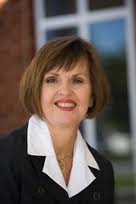
Barbara Hodges
“It’s one of our biggest issues,’’ said Barbara Hodges, executive director of the Florida Council of Independent Schools, which accredits 160 private schools. “It’s really impacting our freshman class this year. We know our students are prepared, but they don’t want to take a test on a class they took two years before.’’
Here’s Bennett’s proposed solution:
First, starting next month when EOC assessments begin, the state Department of Education will allow private school and out-of-state students who plan to attend a Florida public school next fall to take the exams prior to enrollment.
Private school administrators and/or students must contact their local district’s assessment office – not the public school – to schedule a time.
Bennett has “strongly’’ encouraged school districts to offer their future students the opportunity to participate.
“While I certainly understand that testing these students prior to enrollment will result in additional work for school and district staff, allowing these students to test is the right thing to do … ,’’ he wrote to school superintendents earlier this month. (more…)
The call came on the first day of school, first thing in the morning, from another private school a few blocks away. An intruder had just tried to break in. He took off before police arrived.
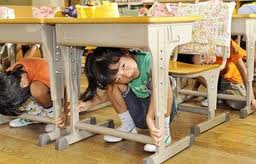
Shouldn't private school be notified, like public schools, in case of emergency situations in the neighborhood?
Mary Staley, the principal of St. Paul Catholic School in Leesburg, Fla., knew she had to err on the side of caution. She ordered her school locked down.
“You have to think worst possible scenario,” Staley said.
Luckily, police caught the guy quickly, and nothing bad happened. But Staley said it would have been far better if police rather than a cautious neighbor had notified her.
In Florida, there is no requirement for emergency response agencies that routinely contact public school districts about major incidents - fires, SWAT team raids, you name it – to do the same with private schools. At a time when the definition of public education is expanding, it’s a reminder of old dividing lines. But bills to change that got their first hearings before House and Senate committees Tuesday, and cleared both.
The identical bills – SB 284 by Sen. Joe Negron, R-Palm City, and HB 369 by Rep. Mike La Rosa, R-St. Cloud - would require emergency agencies that already notify districts to also notify private schools. Only private schools that voluntarily opt in would be affected.
“I think it would be excessive to require emergency personnel to go identify every school,” Negron told the Senate Education Committee. But “if it’s simply a matter of putting them on the list, I don’t think that’s unreasonable so they’re treated with the same parity as public school.”
The committee voted unanimously for the bill. So did the House Choice & Innovation Subcommittee with its counterpart. (more…)
 There are times when it’s appropriate for a journalist to boil down a story into a he-said, she-said. And there are times when it’s just lackluster reporting.
As Jon East has noted in this blog post and this op-ed, Florida’s Amendment 8 – the “religious freedom amendment” – is not about private school vouchers. It’s clear if you look at the legal history for private education options in Florida. It’s clear if you look to see who is and isn’t bankrolling the campaign.
And yet, one news story after another has allowed the Florida Education Association, the Florida School Boards Association and other school choice critics to posit that it is about vouchers – and to let those assertions go unchallenged. Often it’s in terms so deep into an alternate reality, they beg for a little scrutiny. According to the Gainesville Sun, for example, an Alachua County School Board member described Amendment 8 as “the very death of public schools.”
With six weeks left before the vote, statements like these are surfacing in major newspapers nearly every day. Here are a few examples, along with how the story captures the legislative intent of the amendment, the constitutional underpinnings of school vouchers, the lack of a campaign or financial support by school voucher advocates, the factual history of private options in a state that now provides them to more than 200,000 students, or just some form of a statement from those with an opposing view:
From the South Florida Sun Sentinel (Aug. 21):
“Amendment 8 would remove the long-standing restriction in the Florida Constitution that prohibits the expenditure of public funds to support religious programs," the resolution (from the Broward County School Board) reads. "Passage of Amendment 8 could result in state funds being awarded to non-public schools, instead of allocated to support public and charter schools.”
The resolution stops short of saying whether those would be good or bad outcomes, but it was obvious where board members stood.
"We have a limited amount of resources, and you would continue to strain the resources for public and charter schools," board member Robin Bartleman said.
Response from other side: None
Supporting evidence: None
***
From the Daytona Beach News Journal (Sept. 15):
The title and wording of the amendment were the subject of a lawsuit in which Ormond Beach school principal Susan Persis and Palm Coast rabbi Merrill Shapiro were plaintiffs.
They and other representatives of school-related organizations and clergy tried to get the amendment thrown off the ballot, but a judge allowed it to go before voters after Florida Attorney General Pam Bondi rewrote the proposal.
Persis said she fears passage of Amendment 8 would divert money from public schools to religious ones. "This would further reduce funding for public education," said Persis, who's principal of Pine Trail Elementary. "Any further reduction will be devastating to our schools." (more…)

