Editor’s note: Harvard University Program on Education Policy and Governance devoted its annual spring research conference to helping policymakers assess education choice: What is and is not working, the trade-offs involved in different programs, and the long-term effects. John F. Kirtley, the founder and chairman of Step Up For Students, the nation’s largest nonprofit scholarship funding organization, told attendees in a keynote address about his home state of Florida, where 30 years of robust education choice across the district, charter, and private sectors are not only working but have set a national standard for the other states taking their first steps on the journey. His remarks are summarized below. You can read the entire speech here. To learn more about Harvard’s Emerging School Models conference, scheduled for Sept. 17 and 18, go here.
Redefinition of public education
Growth of choice programs
Supply-side developments
Impact on rural and district schools
Educational outcomes and research
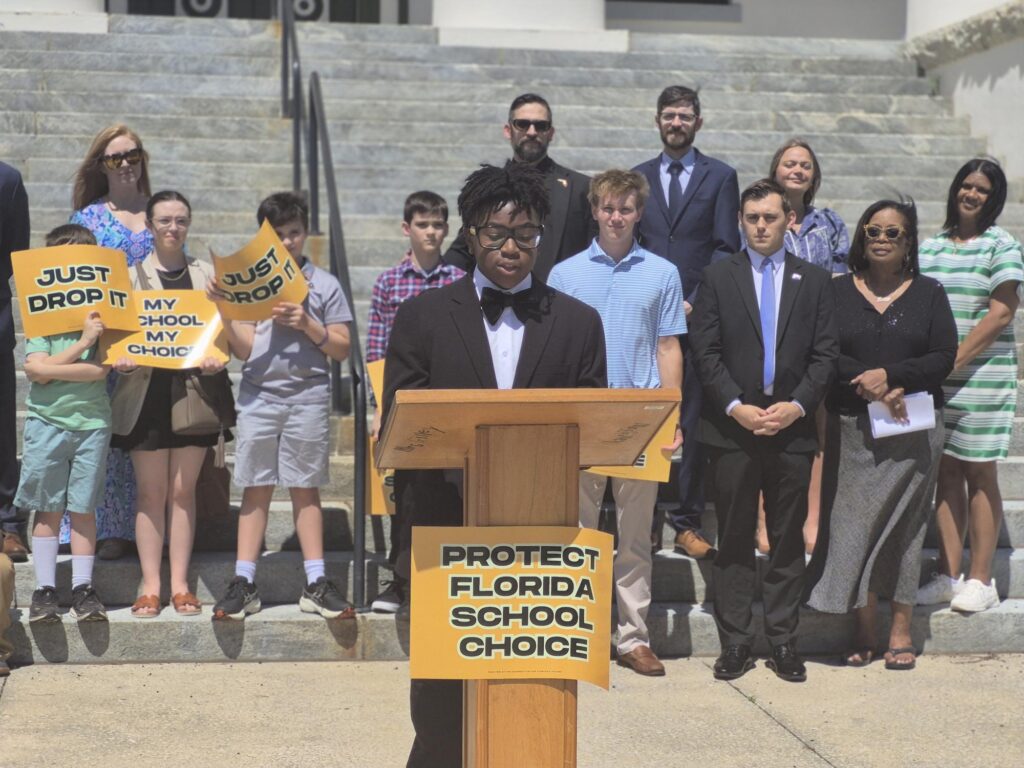
Nine days after the state teachers union sued to strip Florida families of the right to choose their children’s education, the pushback began when supporters of state K-12 scholarships and charter schools gathered in Tallahassee on the steps of Old State Capitol to protest.
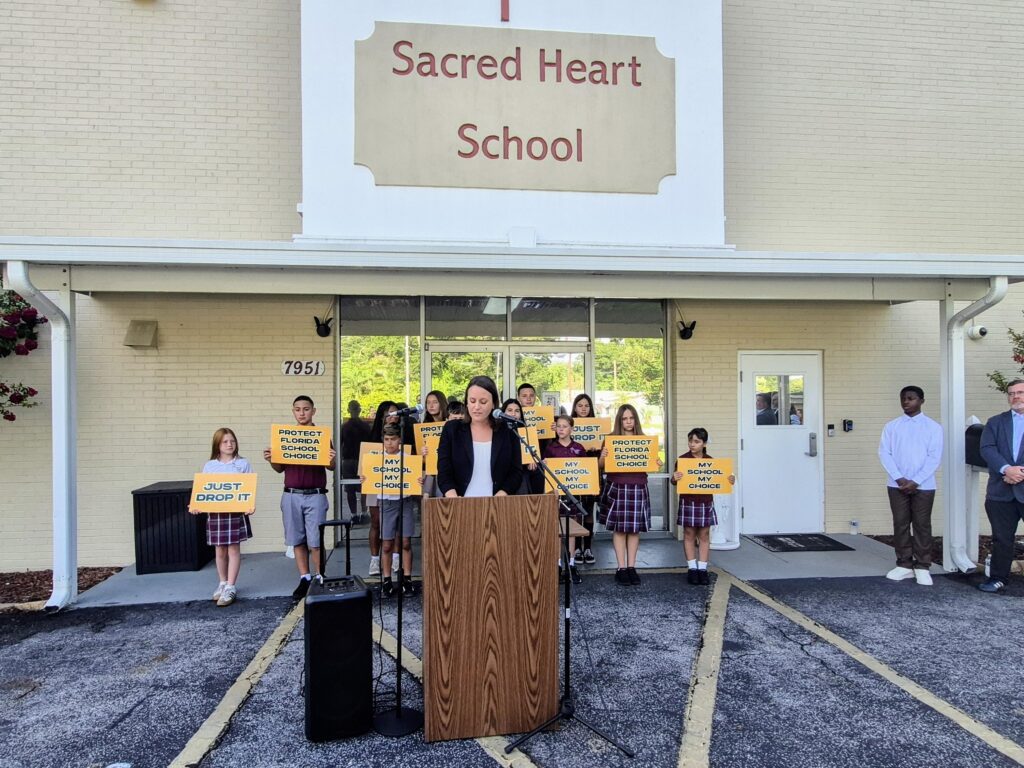
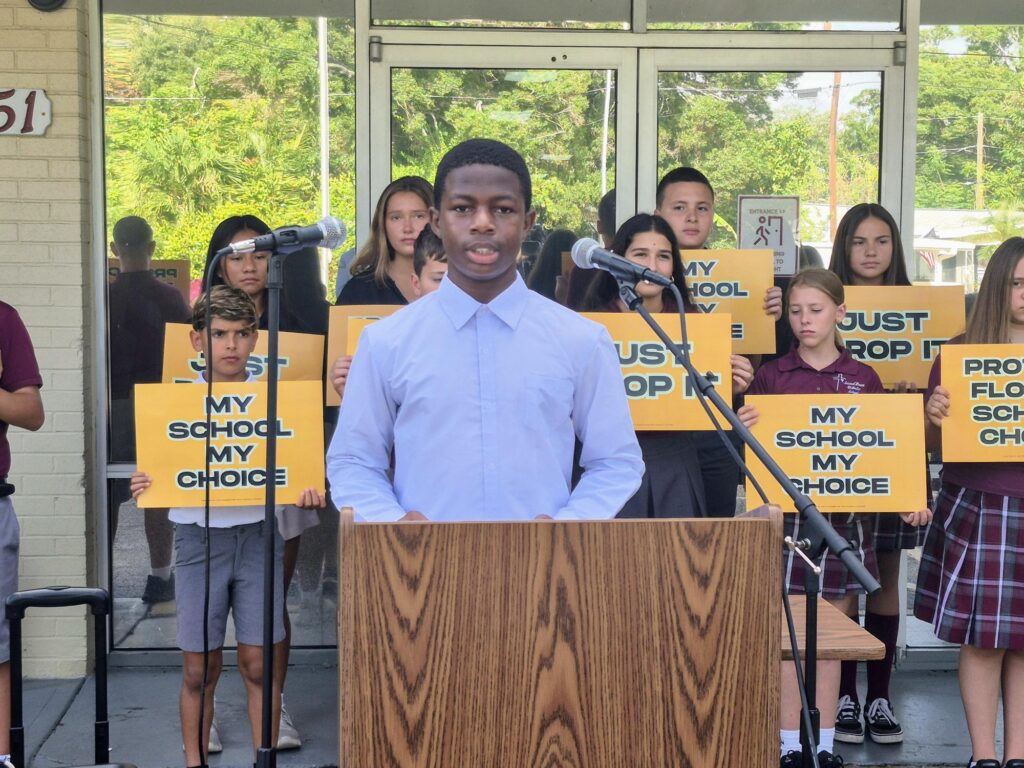
Two weeks later, choice supporters stood outside Sacred Heart Catholic School in the Tampa Bay area holding signs with the slogans, “My Child, My Choice” and “Just Drop It.”
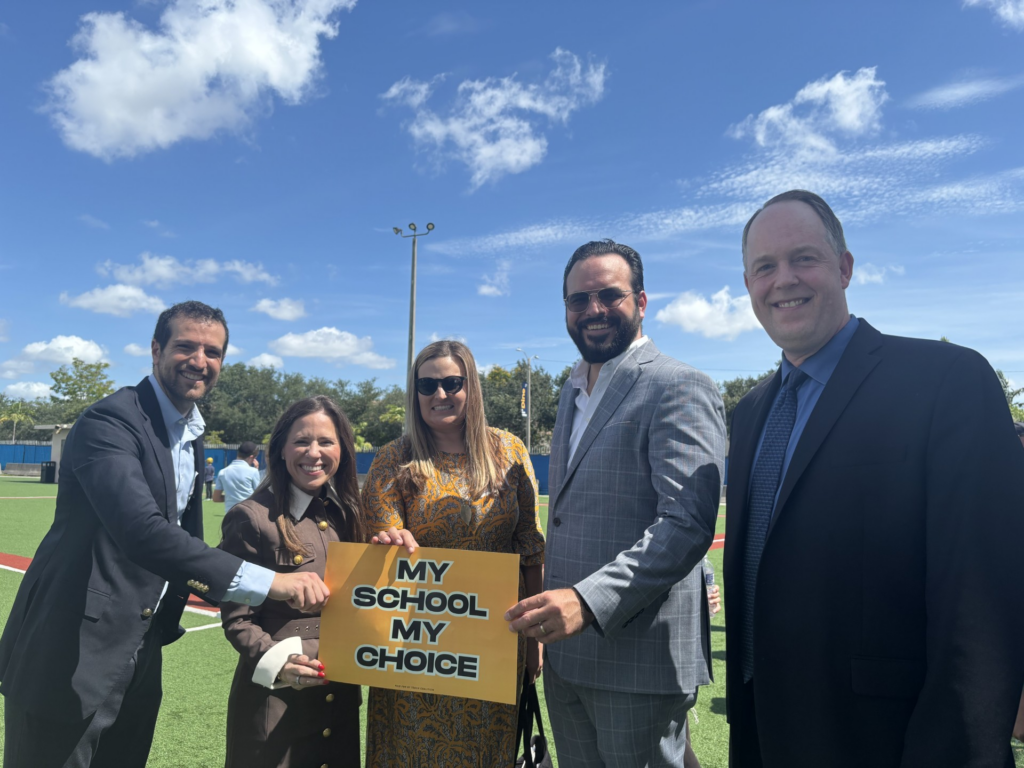
This week, the protests got louder. Students, parents, charter, and private school leaders stood outside Lubavitch Educational Center, the state’s largest Jewish day school, on Thursday and pledged to defend the decades-old policies and programs that have empowered families to choose the best educational fit for their children from a rapidly growing number of options.
“It’s not easy to pay private school tuition,” said Ailyn Weisleder, whose three sons are thriving at a Jewish day school. “But universal school choice has made that possible for our family. It gave us, and thousands of other families across Florida, the ability to choose the education that fits our children, not just the school assigned to us by a ZIP code.”
Audrey Maman Bensoussan said her family can’t afford to give her four children a Jewish education without the scholarships. She said the school feels like “a second home” to her children.

“If this lawsuit succeeds, it will not hurt politicians or special interests. It will hurt families like mine. It will hurt children like mine. It will take opportunities away from parents who simply want the freedom to choose the school that best meets their children's needs.”
Yonah Schwartz, 11, said at the news conference that if the lawsuit succeeds, then he won’t be able to afford to transfer to a school that better suits his learning needs.
“Not every kid learns the same way,” he said. “For me, changing schools means getting the chance to learn in a place that’s a better fit for me.”
The lawsuit, filed May 5, asks a judge to eliminate the state’s education choice scholarship programs based on the Florida Constitution, which says the state “shall make adequate provision for a uniform, efficient, safe, secure, and high-quality system of free public schools.” The lawsuit also seeks to end state funding of charter schools.
Faith leaders, charter school and private school leaders, as well as former Florida Gov. Jeb Bush’s Foundation for Florida’s Future, have supported the news conferences. Step Up For Students, the nation’s largest education choice scholarship funding organization, led the Tampa Bay area event. Teach Florida, a nonprofit school choice advocacy organization for Jewish education, organized and led the Miami event.
“The lawsuit brought by the Florida Education Association threatens everything these programs have made possible,” said Melissa Glaser, Teach Florida’s executive director. “This is about protecting families, protecting opportunity, and protecting a parent’s fundamental right to choose the best educational path for their child.”
She said more than $130 million annually in state scholarship funding helps ensure that Jewish children throughout Florida receive “the education they deserve — in schools that reflect their values and strengthen our communities.”
Their comments echo those made at the previous news conferences, where families described how scholarships had changed their lives. A charter school leader also spoke about how tuition-free charter schools ( which, like district schools, are public) have benefited students, including many from low-income households. Faith leaders also described how their schools uplift communities and welcome students with special needs.
Jim Rigg, superintendent of schools for the Archdiocese of Miami, said the lawsuit could damage “a thriving educational ecosystem in South Florida that attracts people from all over the world.” That includes the 37,000 students who attend Catholic schools in the diocese’s three counties. He said each school is accredited, gives standardized tests, complies with applicable state requirements, and employs highly qualified and certified teachers.
“But at its heart, the issue is not about institutions. It’s about children and families. Everyone wins with meaningful school choice, ultimately making our state the ideal place to raise and educate a child.”
ORLANDO, Fla. — As public education has evolved from a one-size-fits-all system to one where families are empowered to choose the environment that best fits their child, everyone has been a winner: Students, parents, educators, entrepreneurs, and even public school districts.
That was the message of John F. Kirtley, founder and chairman of Step Up For Students, to the roughly 1,000 people who attended the non-profit’s Navigating New Horizons conference this week.
In a closing speech that at the end brought the audience to its feet, Kirtley began by describing the state of education before the 1990s. Everyone paid taxes, and students were assigned to schools by their ZIP codes.
“It was, it could be said, a definition that emphasized ‘uniformity,’” he said, referencing but not naming the state teachers union’s recent lawsuit to eliminate Florida’s robust education choice programs, including all scholarship programs and charter schools.
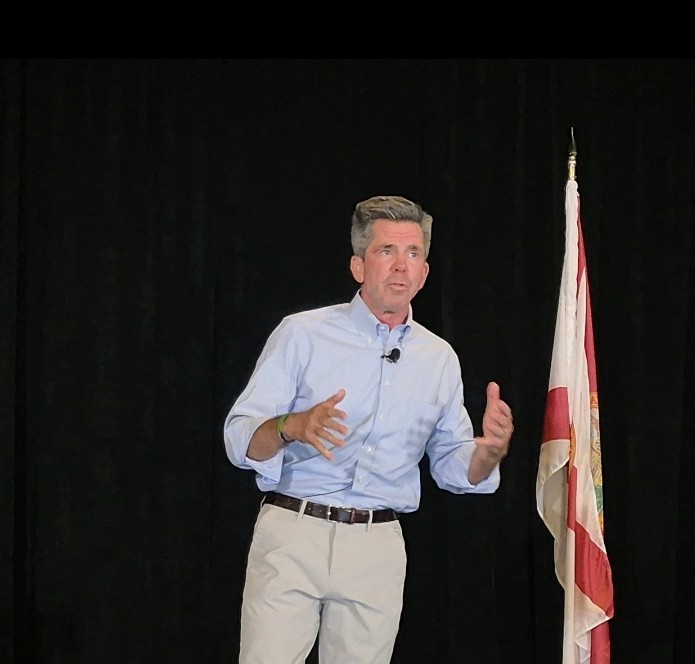
Kirtley said he didn’t realize it at the time, but since overall graduation rates in Florida were, until the mid-1990’s, around 60% overall and less than 40% for black males, it’s likely that many of his friends on the football team who crossed the stage did not get real diplomas. They likely received certificates of completion. The second group probably included a classmate who regularly got in trouble for dozing during early morning courses and was uninspired by classic literature. Yet he could take apart an entire car and rebuild it by himself, when Kirtley couldn’t change his car’s oil.
“But there was no specialized program for him…No, uniformity didn’t serve him well.”
Today, Kirtley said, his classmate could sleep in, take core classes online in his pajamas, then head over to the district automotive technology program in the afternoon, where he would be the star student.
“When he graduated, he’d be hired by the local Mercedes dealer and make over $100,000 two years out of school,” Kirtley said. “So, yeah, he’d be better off.”
Not only are students better off, but so are educators who can start their own schools, including microschools, and even school districts, including many that now offer specialized magnet schools and individual courses to education choice scholarship students who attend school part time.
“I close by saying don’t fear the New Definition. Embrace it. Thrive in it. You can thrive in it whether you are a microschool, an à la carte provider, or one of nation’s largest school districts,” he said. “And when you thrive in the New Definition, all students will thrive along with you. And shouldn’t that really be the ultimate goal?”
His remarks echoed the message given the day before by Gretchen Schoenhaar, Step Up’s chief executive officer, who gave the conference’s opening speech.
“Families today seek learning environments that reflect their children's unique strengths, needs and goals,” Schoenhaar said. “What's really inspiring is how this demand has sparked innovation across the education landscape.”
Schoenhaar said she hoped the two-day event would offer attendees a chance to be “inspired by the conversations you have, encouraged by the stories you hear, and energized by the collective passion in this room.”
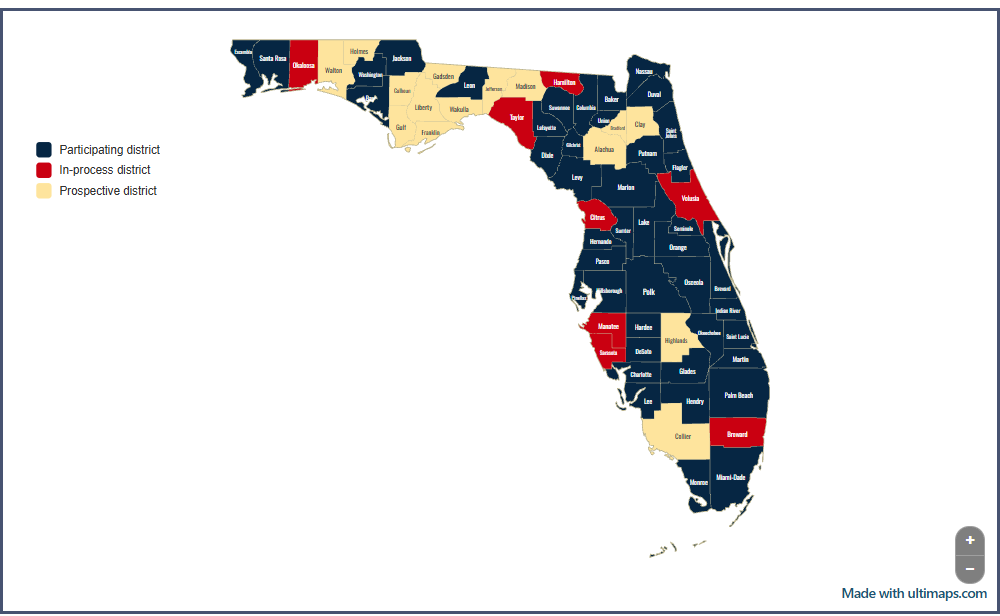
Schoenhaar said Florida is home to the nation's largest parent-directed education marketplace today, with more than half of all K-12 students participating in some form of education choice, including many district schools, private schools, charter schools, homeschools, online schooling, or some combination of those.
“The spirit of innovation and possibility is exactly what this conference is all about,” she said.
The event, whose theme is Facing the Future Together, featured nearly 100 session speakers and 100 exhibitors displaying everything from a la carte learning to transportation options, tutoring, and curriculum.
Organizers said this year’s goal was to provide educators with information and resources based on best practices that also reflect the bigger picture. That included information about the rise of microschools and how to use AI efficiently and responsibly.
“Over the next two days, we hope you'll be inspired by new ideas, meaningful connections and innovative strategies that will help shape the future of education,” Paula Nelson, Step Up’s vice president of school and provider services, told the audience during her welcome.
Breakout session topics included school safety, a la carte education, navigating AI, the future of public education, the benefits of applying for the Yass Prize, how public schools are offering individual courses to scholarship students and how to create and sustain microschools. Four sessions on the upcoming federal Education Freedom Tax Credit program drew standing-room-only crowds.
The federal program, which launches in January 2027, allows individual donors to divert up to $1,700 of federal tax liability to support scholarships for students in public and private schools. The federal government is expected to announce rules that cover program specifics soon. Florida Gov. Ron DeSantis is among the governors who have opted their states into the program.
At the end of the conference, Schoenhaar broke some news: The conference will return June 14 and 15 of 2027.
PINELLAS PARK, Fla. — Surrounded by students in crisp school uniforms, a group of educators, faith leaders, and families urged Florida’s teachers union to drop a lawsuit that seeks to end the nation’s largest K-12 education choice programs.
“I am not anti-public school. Public schools work for many children. But they don’t work for every child, including my sons,” said Leslie Coker, a stay-at-home mom whose two school-age sons have radically different unique abilities and who have benefited from the learning options the programs provide. The scholarships made it possible for a single-income household like hers to afford to send one child to a hybrid school and homeschool the other son full time. Both boys are thriving in learning environments that best fit their individual needs.
“For me, this lawsuit is not political. It is personal. If it succeeds, the impact will hit my family hard, as well as many others," the Bradenton area mom said. We are living proof that education choice is working in Florida. I urge the teachers union to respect our choices and drop the lawsuit.”
Mrs. Coker made her plea on Wednesday at a news conference at Sacred Heart Catholic School, which serves more than 200 students in preschool through eighth grade. Florida Catholic schools have increased their enrollments over the past decade in contrast to their counterparts in other states, which have seen declines. They credit Florida’s robust state scholarship programs, which have made the Sunshine State the national leader in empowering parents to choose the best learning options for their children.
“Ultimately, this debate comes down to one simple question: Who is best equipped to make educational decisions for these children? A bureaucrat sitting in an office hundreds of miles away? Or the parents who know, love, raise and sacrifice for that child every single day?” said Christopher Pastura, schools superintendent for the Diocese of St. Petersburg. He called the lawsuit “misguided and wrong” and urged the union to withdraw it.
“We cannot go backward,” he said.
Supporters began speaking out within weeks after the Florida Education Association and others sued the state on May 5 over its three-decade-old private school scholarship and charter school programs. The latest figures from the Florida Department of Education show that 1 million Florida K-12 students are now educated outside of district schools. A news conference, organized by former Gov. Jeb Bush’s Foundation for Florida’s Future, was held May 14 outside the Old State Capitol in Tallahassee. Step Up For Students, which manages virtually all the state’s K-12 scholarship programs, organized Wednesday’s event.
James Hartman, executive director for IDEA Public Schools in the Tampa Bay area, noted that Florida charter schools, which the law established in 1996, now serve nearly 400,000 students on more than 700 campuses.
“Charter schools are not opposed to public education,” he said. “Charter schools are part of public education.”
Hartman said he hopes that as the lawsuit makes its way through the courts, the focus can stay where it belongs — on students.
For the low-income families who live in the part of Tampa served by Faith Action Ministry Alliance (FAMA), the scholarship programs are not a luxury but a lifeline.
Students who attend the FAMA-owned Grant Park Christian Academy share what they learn at home, said the Rev. Alfred Johnson. That elevates the educational level of an entire community.
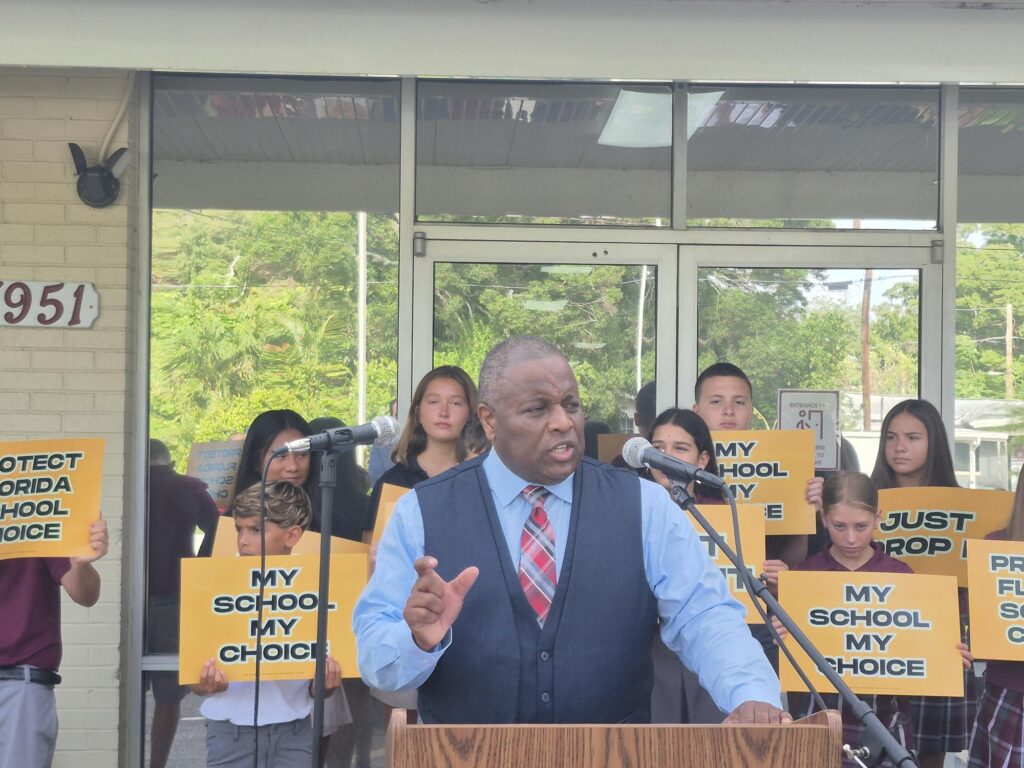
“I remember one mother telling us through tears, ‘My children are learning things at school that we didn’t even know in our home. They’re bringing it back home — and it’s changing our family.’”
Johnson said county commissioners tell him that more programs like his are needed to help those living in low-income communities.
“So how can we say we want to save neighborhoods while simultaneously attacking the very programs helping to save them?” he said. “I urge the teachers union to abandon this lawsuit — so that we do not abandon our children.”
TALLAHASSEE, Fla. — Parents, students, and education leaders who gathered at the Florida Capitol on Thursday had a message for the Florida Education Association, the teachers union that filed a lawsuit to end K-12 education choice scholarship programs used by nearly 540,000 children, as well as all charter schools.
Just drop it.
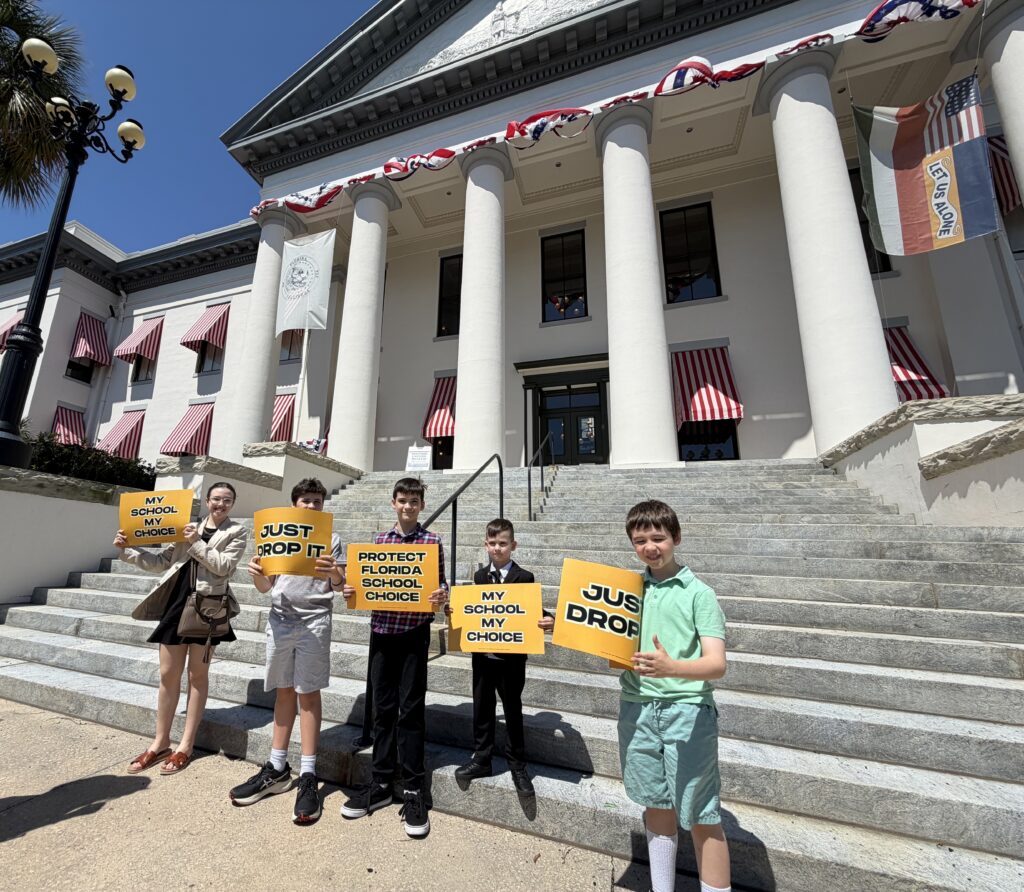
That was just one of the messages on the signs that supporters held up as they stood on the steps of the Old State Capitol building, as advocates proclaimed how education choice scholarships changed lives for the better. “My School My Choice” and “Protect Florida School Choice” could also be seen on the bright yellow signs. Former Gov. Jeb Bush’s Foundation for Florida’s Future organized the news conference. Bush launched the private school choice movement in 1999, right after he became governor.
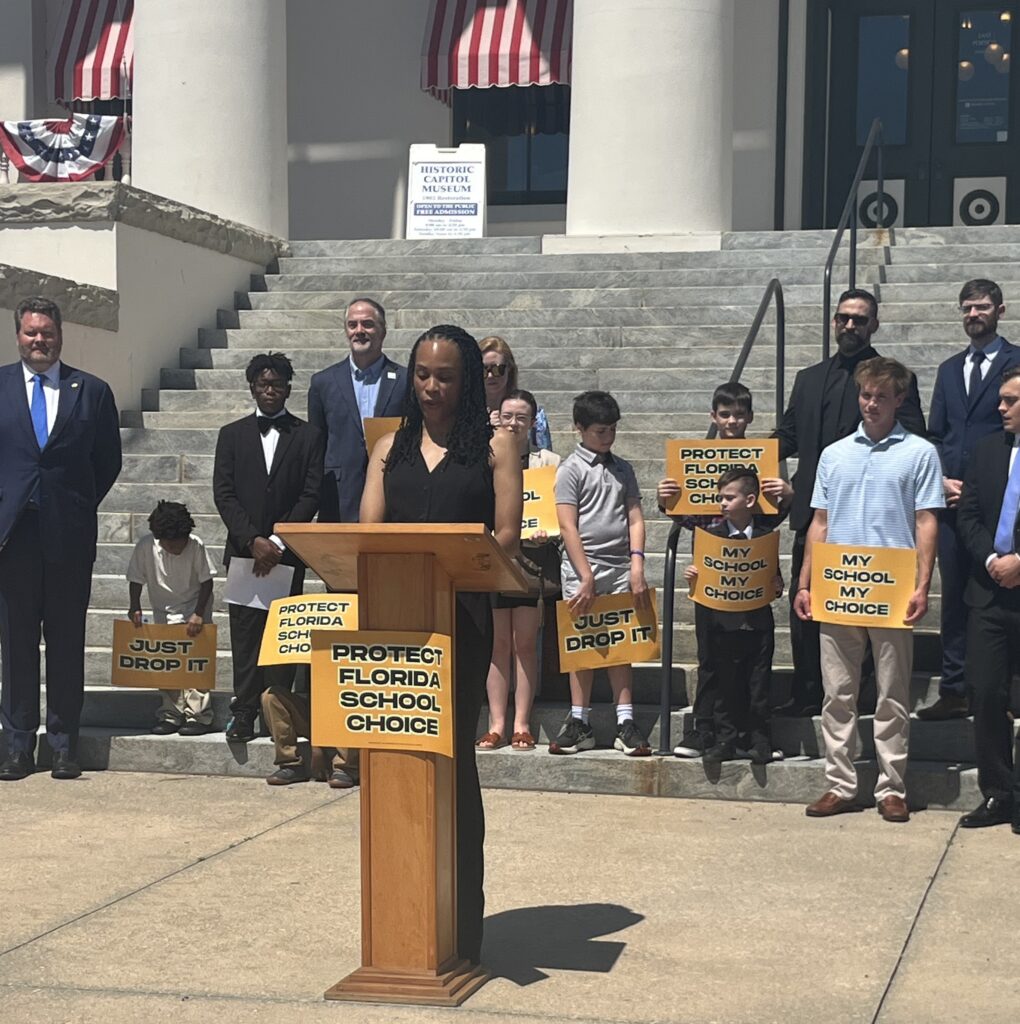
“The scholarships are VERY important to me,” said Kiteka Walker, whose son, Rashad, is in seventh grade at Dixon School for Arts & Sciences in Pensacola. After attending previous schools and homeschooling Rashad, he asked to return to school. She sent him to Dixon because it was the right fit, offering Rashad opportunities to participate in student government, the robotics team, and other enriching activities. The Florida Family Empowerment Scholarship he received made it affordable for him to attend the private school while his two younger brothers attended a private elementary school. If the lawsuit succeeds in eliminating the scholarships, Walker said she would have to homeschool him again because she could not afford private school for three children.
“Parents choose where we send our children to daycare, we choose where to go to college. Why can’t we do the same with K-12 schools?”
Rashad Walker, who traveled to the event with his family, shared how he is thriving at the school his mother chose for him.
“Dixon has been the perfect fit for me. It has a lot of culture and provides a bunch of opportunities in band, art, singing, technology, and media,” he said.
Rashad, who also participates in robotics and serves on the student council, said the school encourages him to try new things, like playing a piano that had been gathering dust at home for years.
“Dixon inspired me to teach myself to play the piano. I practice every day on that piano at home. No more dust,” he said.
Last fall, when he was hospitalized for three weeks following knee surgery, Rashad created craft kits called DUCK bags that help kids combat boredom. He sold the kits at business fairs and is making some to donate to children’s hospitals.
None of that would have happened if it weren’t for Dixon, he said. And Dixon wouldn’t have happened if it weren’t for the scholarship.
“That’s why I don’t understand this lawsuit,” Rashad said. “Why get rid of something that is life-changing for other people? That helps them achieve better things in life?”
Rita Brown can see proof that education choice changes lives every day at Brownsville Preparatory Institute in Tallahassee, a private school she founded more than 20 years ago.
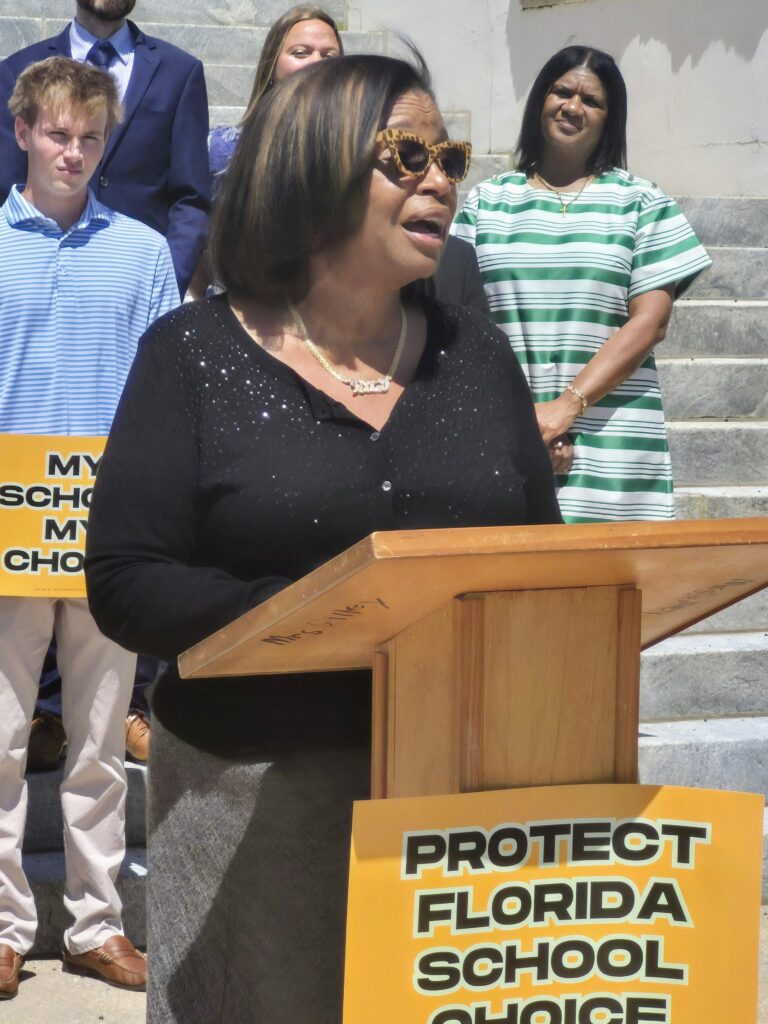
The school began as a pre-kindergarten and now serves 95 students through third grade. Brownsville is in a low-income community. Most parents can’t afford private education after their 4-year-olds complete the state-subsidized pre-kindergarten program.
The scholarships, Brown said, changed that.
It allowed her to add grades. Today, Brownsville students typically learn to read at age 3 and are adding, subtracting, writing, and learning cursive.
“We are the best school in our neighborhood,” she said. “Florida’s education choice scholarships have been a vital part of that.”
If the teachers union wins in court, Brown said, the school would lose most of its school-age children.
“That K-3 program would probably die. It would be devastating for our parents. We have all these students doing amazing things, but they would be forced to go to schools that don’t meet their needs. “
She called the lawsuit “frivolous” and “an attempt to turn back the clock.” But Florida is too embedded in education choice to return to a bygone era.
“At the end of the day, we need to be collaborative in educating all students,” Brown said.
The event inspired a lawmaker to attend to voice his opposition to the lawsuit.
State Sen. Jonathan Martin, R-Fort Myers, said empowering parents to choose the best options for their children does not take away resources from other students and makes America “the light on the hill that Ronald Reagan talked about.”
Florida’s robust scholarship programs have led the way and “will continue to make sure our light stays the brightest, not just in this country but around the world.”
You may have read or seen a story this week about the Florida Education Association, the state's largest teachers union, filing a lawsuit challenging the state’s scholarship programs and its charter schools.
Basically, the union is claiming that because private and charter schools don’t have to follow the same rules as district schools, the funding of these programs violates the Florida state constitution. The state constitution has a provision that Florida must provide a "uniform, efficient, safe, secure, and high-quality system of free public schools".
The union wants the courts to interpret this provision to mean the state can fund nothing but district-run schools, or at least make all schools that receive state funding be “uniform.”
Of course, the whole purpose of education choice is to create alternatives to traditional district schools to meet the needs of Florida’s incredibly diverse students.
Today, over 50% of taxpayer-funded K-12 students in Florida do not attend their zoned district school. In Miami Dade, our largest district, that figure is over 70%. The largest category of choice is district-run choices: magnets, open enrollment, career academies. Districts have admirably responded to competition.
In a ruling from 20 years ago, the state Supreme Court cited this uniformity provision when ruling that a small scholarship program was unconstitutional. The Harvard Law Review called the ruling an “adventurous reading and strained application” of Florida’s constitution. In contrast, a legal challenge to the tax credit scholarship was defeated in 2017.
The justices on the state Supreme Court — and their legal philosophy — is very different than even a decade ago. It would be very difficult to imagine that this court would interpret the uniformity provision in the same way as 20 years ago.
However, it will be very important to demonstrate to everyone how important education choice is.
Step Up led the coalition that defeated the lawsuit the union brought in 2014. This effort was a wonderful opportunity to show the country what choice meant to Florida families. The culmination of this effort: over 10,000 people came to Tallahassee to show their support for choice:
There will be an even stronger coalition this time around.
 Around the state: Some school districts are experiencing fallout after the release of school grades, three teachers sued the state and international teachers are being utilized to help with the teacher shortage. Here are details about those stories and other developments from the state’s districts, private schools, and colleges and universities:
Hillsborough: The school board here on Tuesday approved the appointment of a new principal for Franklin Boys Preparatory School in Tampa. On Jan. 8, Konrad McCree will take the helm at the school. He left the Pinellas county school district in June after leading Bayside High in Clearwater since 2021. He replaces John Haley. Tampa Bay Times.
Escambia: Bellview Middle School will become the third school in Escambia to adopt the Community Partnership Schools model this year with partnership among Children's Home Society of Florida, Community Health Northwest Florida, Escambia County School District and the University of West Florida. "The partnerships are announced as the next step in growing the successful model first implemented in Orlando at Evans High School in 2012 and expanded to more than 40 schools statewide, transforming tens of thousands of lives," Escambia County Public Schools says in a release. In the newly-released school grades for the 2022-23 school year, Bellview received a "D" grade. WEAR.
School grades: Members of the school board in Hillsborough spent time during Tuesday's board meeting responding to this week's disappointing school grades from the state. The grades were released on Monday and show lower than passing levels of proficiency in English and math for the district's 200,000 students. The state changed its standards and testing systems, which made it difficult to compare one year to the next and leaving the statistics bleak in Hillsborough. The county's elementary schools went from having six D schools and one F school in 2022 to 23 D schools and four F schools in 2023. Meanwhile, Pinellas County’s elementary schools had four D’s in 2022 and four D’s in 2023, with no F’s anywhere. In Pasco, the elementary grades improved from six D’s and four F’s to eight D’s and two F’s. Board member Lynn Gray said “there is a silver lining in knowing the realities, where we are, because it motivates us to get better.” In Polk, the schools placed in the lower 15% of school districts statewide. Lakeland Ledger. Tampa Bay Times.
Lawsuit filed: Three teachers in Florida on Wednesday sued the state over its law that prohibits transgender and nonbinary teachers from using their preferred pronouns in school. The teachers say it violates their constitutional rights. The lawsuit was filed in federal court in Tallahassee. Reuters. Axios. Politico. Tampa Bay Times.
Cellphones in schools: A company that producers neoprene pouches to lock up students' cellphones is booming in business, which is a clear sign that the movement to keep phones out of classrooms is spreading across the United States. The 74th.
Teacher shortage: Florida began the year with 7,000 teacher vacancies, according to the Florida Education Association. To help, international teachers are stepping up to fill special education shortages. Professor Jie Yu said bringing in international teachers is actually pretty common. "So I believe hiring international teachers is a very efficient short-term solution to address the teacher shortage in the state," said Yu. WFSU.
Colleges and universities: Jason Pizzo visited a political science class at Nova Southeastern University recently to talk to college students as part of a statewide tour for the Senate minority leader. WLRN. Meanwhile, the president of the American Council on Education, Ted Mitchell, spoke about rights and limits to free speech on college campuses. NPR. With extreme weather events and workforce shortages taking their toll on South Florida farmlands, a new innovation center at Florida Atlantic University is hoping to confront these challenges. FAU will collaborate with Florida International University to establish the Microbiome Innovation Center with help from a four-year, $1 million grant from the U.S. Department of Agriculture. The center also hopes to combat the declining interest among younger workers for careers in agriculture, food and natural resources. WLRN.
Around the state: School grades were released across the state, gender disparities vary across colleges and universities, teachers must get permission from principals to use certain material and parents in Duval are encouraged to fill out a crucial survey. Here are details about those stories and other developments from the state’s districts, private schools, and colleges and universities:
Palm Beach: A bicycling event honored a local man who was a pioneer in the education world. Dr. Joaquin Garcia was honored on Sunday for his contributions to local schools in this county. La Vuelta Palm Beach 2023 was a community event with the first long-distance bike ride to benefit the school named in the late Garcia's honor, which opened this fall. Dozens participated in the event. WPTV. Meanwhile, voters in Palm Beach may be asked to again raise the sales tax in order pay for construction projects at public schools. State requirements for the school district to share money with charter schools and the higher cost of construction has caused a $600 million shortfall in its capital budget of the next 10 years. Palm Beach Post.
Hillsborough: In Brandon, Black and brown students learned hair care through Curls for Queens, a Tallahassee-based hair care organization. Tampa Bay Times.
Duval: To secure federal funding for schools, the school system here is calling on all parents with children enrolled to actively participate in the 2023 Federal Impact Aid Survey. The survey can significantly contribute to funding for educational materials, textbooks and staff support. Parents are strongly encouraged to participate before the deadline, which is Dec. 20. CBS 47. Meanwhile, a new center in Jacksonville will expand the clinical capacity for the diagnostic evaluation, management and treatment of children and adults with neurodevelopmental disorders. It is among 10 new projects that are receiving strategic funding at the University of Florida, according to President Ben Sasse. Linda R. Edwards, M.D., dean of the College of Medicine in Jacksonville, is optimistic that the Precision Autism Center of Excellence will have a significant effect on healthcare outcomes. “We are thrilled to be receiving this opportunity to provide additional support to individuals with autism,” Edwards said. “CBS 47. Yahoo News.
Brevard: In the past, if a teacher saw a chance to step outside the textbook and use a video, poem, art project or word problem in a math class to help students better grasp a concept, they were free to do that. Now, due to HB 1069, which places responsibility of overseeing instructional material on principals, they must get permission before using "supplemental material." The process can take weeks and the consequences could be dire, with one elementary school principal writing to her teachers in an email that if they did not request approval of the use of items like worksheets, websites or coloring pages that were not part of district adopted curriculum, they could face monetary fines, fail time or forfeiture of their teaching certificate and loss of their jobs. The inability to be flexible with lessons through the use of supplemental materials is having a profound impact on students and teachers, said Adam Tritt, an advanced placement English teacher at Bayside High School. "Any time a teachable moment comes up, which I could cover with a poem or an article or a short video, I actually have to get the permission, fill out a form and get permission through the principal, which means it has destroyed the teachable moment," Tritt said. Florida Today.
Sarasota: Attention surrounding Bridget Ziegler's life is the basis of mounting pressure for her to quit her public life with the school board. ABC Action News.
School grades: Long-awaited school grades arrived on Monday for Florida's schools. Results from the state Department of Education showed that the Hillsborough, Pasco, Hernando and Pinellas school districts earned B grades overall. Pinellas Superintendent Kevin Hendrick pointed to “tremendous” results at various campuses, including Tyrone Middle, the district’s only F-rated school last year. Tyrone rose to C, one of 10 middle schools to improve their grades. “These school grades serve as a baseline for districts and provide a starting point for future achievement,” state education commissioner Manny Diaz Jr. said in a statement. Tampa Bay Times. In Alachua County, schools received a B grade. Main Street Daily News. In Miami-Dade, A grades were received. CBS Miami.
Colleges and universities: A cohort for LGBTQ students at the University of South Florida that is part of the school's "living and learning communities" celebrated five years since its creation. "The only agenda that we have here is to love each other, to respect each other, and make friends,” said Trikkha, a psychology major. WUSF. Across most college campuses in the United States, one fact has been consistent for decades: Female students outnumber male ones. The gender disparity is not the same at all Florida campuses, with the gap varying from school to school. Palm Beach Post.
Opinions on schools: The Florida Education Association estimates that there are over 5,000 teacher vacancies in Florida's public schools, which represents a critical shortage. Arthur Harley, South Florida Sun-Sentinel.
 Miami-Dade: More than 20,000 new immigrant students have enrolled in Miami-Dade County public schools this year. Officials say it's a historic increase that's helping the school district grow for the first time in two decades. NPR. Meanwhile, a long-time teacher in Miami is retiring after 40 years on the job. Aldin Everette has been at Miami Edison Senior High since 1983. WPLG.
Duval: The school district here had more A-graded schools and better funding in place when Diana Greene's five-year tenure as superintendent ended on Friday. In addition, it had fewer students in traditional schools and fewer whom state-mandated testing considered proficient in subjects like English, math and science. Greene's replacement will have to weigh those facts in addition to goals from a Duval County School Board strategic plan and new material that includes an ongoing legal review of claims about teacher misconduct. The Florida Times-Union. Some are debating the right way to pronounce the name of Ribault High in Jacksonville. Some say "Ree-balt," while others think it's "Ree-beau." News 4 Jax.
Volusia: As most high-schoolers prepare for a four-year college education, a number of them are trying their hand at old and new skilled trades that are in demand. In Volusia County, Pine Ridge High School has opened its doors to multiple skilled trade options that could lead to six-figure salaries in specific trades. WKMG.
Food support: Local school districts in the bay area are ensuring kids don't go hungry by offering free breakfast and lunch through the Summer Food Service Program for Children. Officials say between 3,000 and 4,000 meals will be prepared daily throughout the summer. "When school is out, kids are still hungry, so this program allows us to provide nutritious breakfast and lunch to any child 18 and under throughout the whole county," said Shani Hall, general manager for student nutrition services in Hillsborough. ABC Action News.
Overdose policies: Naloxone is a medication that rapidly reverse the effects of an opioid overdose. Across the country, schools are working to stock up as the opioid crisis takes a fatal toll on students. According to 2022 study from the Journal of the American Medical Association, adolescent overdose deaths jumped from 492 in 2019 to 1,146 in 2021. Fox 4.
Union dues: Central Florida unions are getting creative when it comes to collecting members dues after a law passed making it illegal to deduct these fees from a person's paycheck. Ron Pollard, local president of the Orange Education Support Professionals Association, says without dues, unions die. Pollard is assisting teachers and support staff sign up for an alternative payment platform called e-dues through the Florida Education Association. Under the new law, 60% of all professionals represented by a union must be enrolled in that union in order for it to operate in Florida. WMFE.
Public schools poll: A new NPR/Ipsos poll dives into the battles that have been playing out in America's public schools this year. WBUR.
University and college news: Students at Florida Gulf Coast University created a Hurricane Ian aftermath website as their capstone project. Ten students were tasked with writing roughly six stories each, putting together audio projects, videos, and capturing photos for the website students created, swflafterian.org. Hurricane Ian made landfall in 2022 in Cayo Costa, a small barrier island west of Fort Myers, as a Category 4 hurricane. Eight months later, the region is still rebuilding. "I'm just really proud of them. They did a lot of good work," said Professor Judd Cribbs said. "I hope that gives them a taste of what the professional world of journalism is gonna be like if they get into it." Ft. Myers News-Press.
Opinions on schools: The window of opportunity for school choice is still open, but it's uncertain for how long. Rick Hess advises advocates on various ways they can take advantage, which include focusing on how school choice solves problems for parents and paying attention to details of how choice policies work for families and educators, explaining how choice policies better serve the public interest and ensuring that choice policies serve all families. Lindsey M. Burke and Jason Bedrick, reimaginED. Young minds need to learn how to think, not what. Teach history, yes. But forcing things — agenda-bending, ideological service and the like — only add another murky veil to already complex material. Let them find the answers. Even middle schoolers do that. Bruce Anderson, The Ledger. Not only will more schools jack up their prices now that they know they can bill taxpayers for hefty chunks, more private schools will set up shop to cash in. Especially because in Florida, it's easy to open a school regardless of whether you're qualified to run one. Fiscal watchdogs and voucher critics predicted this cash grab would occur — that schools would raise tuition, pricing out some of the very families that voucher advocates claimed they were trying to help. Scott Maxwell, Orlando Sentinel. Language matters when it comes to talking about student learning, achievement and accountability. The United States need a K-12 accountability system that focuses on justice, not deficits. Jennifer Randall, The 74th.

