Parent trigger. Sen. Kelli Stargel, R-Lakeland, files a bill similar to last year's, drawing immediate fire from the Florida Democratic Party. News Service of Florida. More from the Tallahassee Democrat.
 More tutoring oversight. The U.S. Department of Education is disturbed by what the Tampa Bay Times found with Florida's state-mandated tutoring program, reports Gradebook. Pinellas Superintendent Mike Grego asks Education Commissioner Tony Bennett to scrap the program completely, Gradebook also reports. The Miami-Dade school district also wants the mandate repealed, reports the Miami Herald. A tutoring company owner in Miami-Dade pleads guilty to 47 counts of fraud and grand theft and is sentenced to five years probation, the Herald also reports.
Charter schools. South Florida Sun Sentinel columnist Michael Mayo writes about the money feud that's pitting the successful Pembroke Pines charter school system against the Broward school district.
More Rubio vouchers. StateImpact Florida logs it in.
Teacher absenteeism. Florida teachers collectively have one of the lowest absentee rates in the country, according to a new Center for American Progress report, notes Gradebook. But with 29.1 percent missing at least 10 days in a 180-day year, it is still high.
Teacher evaluations. The Florida Times Union objects to the Florida Education Association's request to intervene in the newspaper's suit against the Department of Education for withholding teacher eval data. (more…)
Federal vouchers. U.S. Sen. Marco Rubio, R-Fla., proposes what may be the most sweeping school choice legislation in U.S. history - a federal tax credit scholarship program similar to the state program in Florida. redefinED. More from the Miami Herald.
 Tutoring oversight. In response to a Tampa Bay Times investigation, Education Commissioner Tony Bennett promises to take steps to curb fraud and abuse in the state-mandated tutoring program.
Charter schools. The Pinellas school board votes to continue the closing process for the long-troubled Imagine charter school in St. Petersburg, despite more than 100 students showing their support for the school. Gradebook.
Exposed! The response. EdFly Blog notes what should have been in press reports - that In the Public Interest, the group that launched the latest Jeb Bush-corporate-cabal conspiracy theory, is run by Donald Cohen, the former political director of the San Diego-Imperial Counties Labor Council, AFL-CIO. (Gradebook, at least, did note the group's labor ties.)
School grades. A House subcommittee bill would extend grading to small schools. SchoolZone.
School spending. The St. Lucie County school board takes the possibility of four-day weeks off the table, reports TCPalm.com. A divided Volusia County school board votes to begin the process of outsourcing custodial and grounds maintenance jobs, reports the Daytona Beach News Journal. The Brevard school board votes to close three of four schools proposed for shuttering, reports Florida Today. (more…)
Editor's note: This guest post from StudentsFirst is authored by Vice President of Fiscal Strategy Rebecca Sibilia and fiscal policy analyst Sean Gill.
We appreciate Doug Tuthill’s recent redefinED post challenging StudentsFirst to consider supporting voucher or tax-credit scholarship programs that aren’t just limited to what he describes as the “failing schools” model. We agree with his assertion that school choice policies, including private school options, are about empowering parents to select the best school for their child.
It is true that we believe voucher programs should prioritize low-income students in low-performing schools. However, we want to make clear that this position is not based simply on a “politically safe compromise.” Indeed, our entire State Policy Report Card judges not what is politically popular, but rather the laws and policies we believe, through evidence, best practices, and common sense, will deliver the best results for kids.
We think it is important that states focus on more than policies that just provide access to schools; states must prioritize expanding access to high-quality choices for families that traditionally lack them. A Brookings study found that students from low-income households are much more likely to attend low-performing schools than middle or high-income students. This is important because the same study further confirms that low-income kids can actually achieve at high levels when they attend high-performing schools. Unfortunately, as Florida Education Commissioner Tony Bennett has mentioned, low-income families often lack the resources to enroll in potentially higher-performing private schools or to relocate to a school district that offers a better public education.
Policymakers must always consider tradeoffs and unintended consequences when considering how to budget limited resources. Consider if a state adopted a universal voucher program. This would provide the most theoretical choice, but it could also easily have the unintended effect of simply subsidizing the students already enrolled at private schools and those in families who may otherwise be able to afford private school tuition. This would result in few new students being able to attend a high quality school option, and wouldn’t expand access to those who need it the most. Presumably, avoiding this problem is one of the reasons why the Florida Tax Credit Scholarship program is currently limited to low-income children.
Using this logic, we believe that when state resources are limited or the existing supply of desirable private schools is limited, it also makes sense to prioritize vouchers or scholarships for those low-income children attending a low-performing school or living in low-performing school districts. There are practical, administrative considerations that also make targeted programs more effective. For instance, when looking at the state of Tennessee, where Gov. Haslam has proposed a voucher program, we’ve determined that the four districts with the lowest performing schools also have both higher concentrations of low-income families and private schools in their communities.
We find that most voucher and scholarships programs are capped by enrollment or appropriation levels. Given that low-income students can be found in most counties throughout a state, these caps then create an unintended consequence of spreading out scholarship recipients among multiple communities, which would not provide enough demand to create new private school options. (more…)
Tutoring oversight. In the first part of a two-part series on a requirement initially mandated by No Child Left Behind, a Tampa Bay Times investigation finds at least 36 of 456 tutoring companies in Florida are headed by people with criminal records. In part two, the Times traces last year's last-minute legislative push to keep the mandate in place.
Educator oversight. Sarasota Herald Tribune: "As Bradenton police investigate allegations that a Manatee High School assistant football coach groped a female student, they are also trying to determine who knew about the girl's claims and why no one notified law enforcement as required by law."
Teacher bashing? A StateImpact Florida story headlined "Teachers Question Why Proposed Pay Raises Come Before Teacher Evaluations" quotes a single teacher who says, “For a while now we’ve been hearing how bad we are. [That] we need to weed out bad teachers, there’s so many bad teachers.” Ocala Star Banner editorial page editor Brad Rogers writes in this column: "There are so many wildly talented, caring and dedicated teachers in Marion County’s schools that unfairly take abuse and blame and criticism for what is wrong with our schools and our society, when in truth they represent what is most right and bright and promising about our schools and our society."
Teacher pay. Sen. Bill Galvano, chair of the Senate Education Appropriations Committee, suggests Gov. Rick Scott's proposal for across-the-board raises clashes with performance pay, reports the Florida Current. The South Florida Sun Sentinel also writes up the debate over proposals for higher teacher pay.
Strange bedfellows. The Florida Education Association plans to join the Florida Department of Education in fighting the Florida Times-Union's request for teacher evaluation data.
Tony Bennett. He talks to North Florida superintendents about teacher evals and notes he encouraged his daughter to become a teacher: "“I don’t want it written on my headstone: ‘Here lies the man that ruined the career his daughter chose.’ ” Tallahassee Democrat.
Teachers unions. The United Teachers of Dade will elect a new leader this week. Miami Herald. (more…)
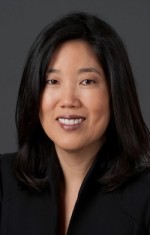
Rhee’s failing schools model for vouchers and tax credit scholarships misinterprets the relationship between students and schools. With rare exceptions, schools are not good or bad independent of the students they serve. Some schools are good for some students and bad for others. A state-designated “A” school can be a terrible match for a particular student, which means for that student the school is a failure.
In recent weeks, Tony Bennett, Florida’s new education commissioner, and Michelle Rhee, the CEO of StudentsFirst, offered conflicting rationales for supporting school choice. Bennett told participants at a National School Choice Week event in Tampa, Fla., that school choice is a necessary condition for equal opportunity and social justice. Low-income children should have access to the same options as the affluent, Bennett said, and this is why he supports providing low-income families with publicly-funded vouchers and scholarships to attend private schools.
StudentsFirst, on the other hand, released a state policy report card that docked Florida a few points for extending school choice to all low-income children. The group favors policies that restrict vouchers and tax credit scholarships to low-income students in state-designated “failing” schools. Within the choice movement, Rhee’s position is called the failing schools model.
Ten years ago, the failing schools model was the most favored, and it’s still popular with state legislators who see it as a politically safe compromise that allows parents to use vouchers only when their assigned district school is “failing.” But school choice, at its core, is about empowering parents to match their children to the schools that best meet their needs. Those judgments don't necessarily align with school-wide standardized test scores.
Rhee’s failing schools model misinterprets the relationship between students and schools. With rare exceptions, schools are not good or bad independent of the students they serve. Some schools are good for some students and bad for others. A state-designated “A” school can be a terrible match for a particular student, which means for that student the school is a failure. Bennett’s approach assumes the relationship between a student and a school is what succeeds or fails, which is why he thinks all parents should be empowered to access the schools that work best for their children.
The failing schools model also tends to inappropriately pit public versus private schools by implying private schools are better, which is not true. (more…)
Editor’s note: Hillsborough Superintendent MaryEllen Elia was also part of the National School Choice Week event in Tampa yesterday that featured Florida Superintendent Tony Bennett, and her remarks at the all-boys magnet school may have been even more noteworthy. Hillsborough is the eighth biggest school district in the nation. Here is the heart of Elia's comments, edited slightly for length and clarity.

Elia
The parents of the young men choose to send their sons here. They want their sons to be here. And I know I’m preaching to the choir when I talk about choice, but I think choice is one of the best things about education and should be embraced by all. Woe to all of us if we have to face a world where everyone is the same. …
So one of the things that I think that’s really important, that most of you probably don’t know, is that Hillsborough County has almost 50,000 students that are in some school by choice. So think about that. We’re about 200,000, so 25 percent of our students have chose another school than what would normally be their assigned school. We think that’s important. Obviously you do, right? And I think one of the things we have to do, in generally in reform in education – and again, I’m probably speaking to the choir here – but I think the concept of choice needs to be an integral part of the reform movements we have. So not only students, but also teachers, have choice in the kinds of approaches they take in the classroom.
I want to give you an example. You might not know this, but I started magnet schools, which were really our first choices in Hillsborough County, in 1989. And I was trying to convince parents that a computer was something their child probably would want to learn how to use. … We did a presentation in Hillsborough High School’s auditorium (about a new magnet school) … and a parent said to me, ‘My child will never have to use a computer. Never. So why would I send them to this little elementary school that is down close to downtown when I don’t live there? ’ And I said, ‘Well, what does your child like?’ And she said, ‘They like dinosaurs.’ I said, ‘If every book your child read for the next three months was about dinosaurs, would he be a better reader?’ And she said, ‘Yeah, he eats and sleeps and talks dinosaurs all the time.’ And I said, ‘You want him to really be a good student, you give them the things that they like. Believe me, kids like technology.’ We filled the school that year, and we have since gone on to have … over 35 magnet schools.
The big issue is, no child’s the same. And we’ve got to make sure that we can meet those needs of children and teachers, and teaching the things and learning the things the way they are going to be most successful. So in my world, interest is a huge, huge push for kids. … (more…)
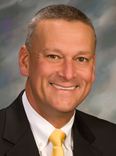
Editor’s note: As we reported last night, Florida Education Commissioner Tony Bennett made newsworthy comments yesterday when he spoke at an all-boys magnet school in Tampa. He suggested school choice wasn't a matter of public vs. private, and credited Florida school districts – Hillsborough’s in particular - for expanding magnets, career academies and other quality choice options. Here are his full remarks, edited slightly for length and clarity.
Bennett
The overview I want to give you about Florida’s choice framework is one that is, in my opinion, a true blueprint for our country. And I want to take you on this little journey. So just bear with me for a moment.
For many years, we said choice was about competition in education. And competition will raise all tides, right? The rising tide of competition will raise all the boats. And I can tell you, Florida has kind of changed that discussion. Again, being from Indiana, being from a state that tried and worked very hard to champion very similar policies, while competition in the educational system is good, the issue of choice here in Florida personifies the importance you put on what I believe to be the most important social justice issue in education. And by that, I want to do a little scenario.
If my wife and I didn’t have grown children, and in December when I was appointed, we would have gotten in our car, we would have driven to Tallahassee, and we would have driven around the community of Tallahassee, and we would have found the school that works best for the Bennett children. And the reason we could do that is frankly we could afford to. We could afford to live anywhere we wanted, send our kids to the school that we thought best fit their needs ...
And my point in this is, Florida is leading the discussion that all parents, regardless of the color of their skin or regardless of how much money they have, should have the same choice as Tony Bennett or MaryEllen (Elia, the Hillsborough superintendent). And that is a very different discussion in choice. And it is a discussion that I see is transcending what I believe can be really the first round of choice. And the first round of choice was frankly privates and charters against the public schools. Virtual schools against the traditional bricks-and-mortar buildings.
And I think MaryEllen in Hillsborough is an example of how we have taken that discussion in a completely different direction. Because this school (Franklin Middle Magnet and its Boys Preparatory Academy) provides a choice for children. This district provides a culture and a climate where choice is accepted and encouraged, and the opportunity that all children should have the same choices that Tony or MaryEllen have. They live that way.
So we’re now talking about choice – not just private schools and charter schools and virtual schools – we’re talking about public school choice. We’re talking about creative leaders like MaryEllen, like the team here, creating educational opportunities for children within the district. And really going to what we all heard was the purpose of choice to begin with, to provide incubation for innovation for our public schools. So I am very encouraged. (more…)
Florida’s new education commissioner is known for his zealous support of charter schools and vouchers and other learning options that some critics see as anti-public school.
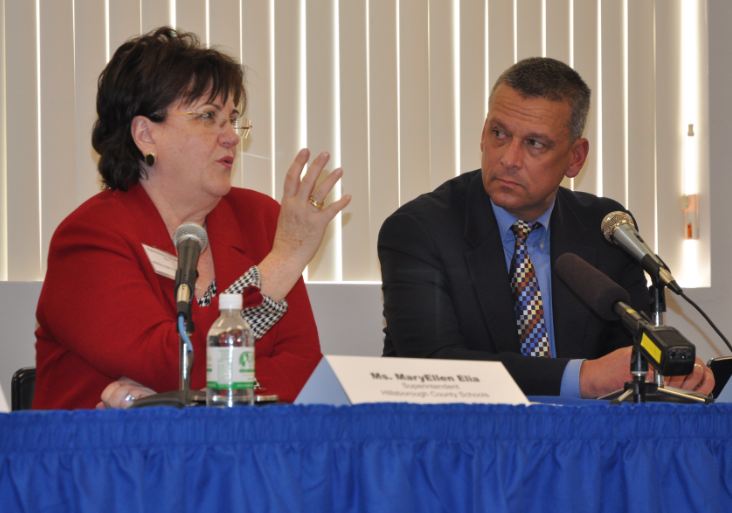
Florida Education Commissioner Tony Bennett and Hillsborough Superintendent MaryEllen Elia were among the panelists at a National School Choice Week event in Tampa. (Photo by Lisa A. Davis/Step Up For Students)
But on Tuesday afternoon, Tony Bennett sat next to Hillsborough County Public Schools Superintendent MaryEllen Elia inside a Tampa magnet school for boys, and praised the growth of choice in district schools across the state.
Florida is transcending the first round of conversations on choice that pit private and charter schools against public schools and virtual schools against “brick and mortar’’ ones, Bennett said during an event marking National School Choice Week. The new conversation, he suggested, isn’t either-or; it’s whatever works to ensure all kids have access to quality choices.
“So we’re now talking about choice – not just private schools and charter schools and virtual schools – we’re talking about public school choice,” he told an audience of about 100 people gathered at the Boys Preparatory Academy. “We’re talking about creative leaders like MaryEllen, like the team here, creating educational opportunities for children within the district - and really going to what we all heard was the purpose of choice to begin with, to provide incubation for innovation for our public schools.”
Tuesday’s event was sponsored by the Florida Alliance for Choices in Education, a coalition that includes a wide swath of school choice groups. Bennett and Elia sat on a panel with representatives from home-schooling, virtual education, magnet schools, career academies, Florida tax credit scholarships and McKay scholarships.
Most were parents who had lived and breathed school choice, starting with their own children. As they shared stories of searching for schools that practiced their faith or fit their child’s academic needs, they offered numbers that shed light on the choice movement’s impact. (more…)
California: The award-winning American Indian Model charter schools face closure after failing to fix problems with financial oversight that resulted in $3.8 million of questionable expenses (The Oakland Tribune).
Wisconsin: Three former state House speakers push for a voucher expansion (Associated Press). School choice options continue to grow with proponents pointing to achievement gains (WisconsinReporter).
Indiana: Ball State University pulls its sponsorship of seven struggling charter schools, likely ensuring their closure (Associated Press). School choice supporters press for an expansion of the state's voucher program (NWI.com).
Texas: A school choice proponent testifies that a tax credit scholarship program would save the state $2 billion a year (Houston Chronicle). More from San Antonio Express News. Waco-area school boards support a resolution opposing any publicly funded private school choice options for the state (Waco Tribune Herald).
Michigan: The legislative path for Gov. Rick Snyder's school choice expansion plans remain murky (MLive.com).
Tennessee: A school board member in Knox County tries unsuccessfully to convince his colleagues that private school vouchers are a good thing (Knoxnews.com). State lawmakers scrutinize Tennessee Virtual Academy, operated by K12 Inc., over poor test results (Tennessee Public Radio). Memphis charter schools are poised to grow - again (Memphis Business Journal). The NAACP pushes for more regulatory accountability for charter schools in the wake of complaints about one in Memphis (Memphis Commercial Appeal). Gov. Bill Haslam is expected to unveil his proposal for a limited statewide voucher in his State of the State speech tonight (News Channel 5).
New York: Twenty-four more Catholic schools in the state will close because they're not financially self-sufficient (New York Times). (more…)
 In 2010, Doug Tuthill took a look around and realized he was living in a new era.
“Florida had this rapidly expanding portfolio of school choice options,” said Tuthill, the president of Step Up For Students, which administers the state’s tax credit scholarship program. “Yet there was little dialogue among the groups representing those choices. We weren’t talking to each other about what was working, what wasn’t, and why.”
Several important players in this bourgeoning movement recognized the need for more collaboration. Florida Virtual School and Step Up For Students, among others, wanted to see the school choice movement united, so they could learn from each other and talk through any differences.
Thus, FACE was born.
Florida Alliance for Choices in Education, or FACE, is comprised of more than 50 members, representing a diverse coalition of organizations dedicated to providing Florida school children with more educational options. Such organizations include National Coalition of Public School Options, Florida Charter School Alliance, Foundation for Florida’s Future, and StudentsFirst - all coming together with the belief that, as the FACE website says, “State policy should enable all parents to be fully engaged in their children’s education and to access those learning options that best meet their children’s needs.”
Step Up For Students (which co-hosts this blog) staffed the initial effort. Three individuals - Wendy Howard, a parent advocate from Tampa; Jim Horne, a former legislator and state education commissioner; and Julie Young, president and CEO of Florida Virtual School - spent a year facilitating outreach and diplomacy, eventually bringing all components of choice together in one organization.
Florida is the first state to do this. (more…)

