Students who leave traditional public schools for alternative charter schools or private providers would still count against their original school's graduation rate under legislation prepared for a Florida House committee.
The draft legislation emerged Friday, days after state education officials said they were investigating whether districts inflated their graduation rates by shifting students into alternative education programs.
Earlier this year, ProPublica reported a Central Florida school district encouraged students to enroll in alternative charter schools, which target academically struggling students and may have helped the district take potential dropouts off its books.
Last year, the Tallahassee Democrat reported a North Florida school district contracted with private online education companies. It counseled struggling high school students to enroll into those programs, where they counted as private school transfers rather than dropouts.
Under Florida's school accountability system, when students leave traditional public schools for district-run alternative schools, their performance is typically factored into the letter grade of the school they left. (more…)
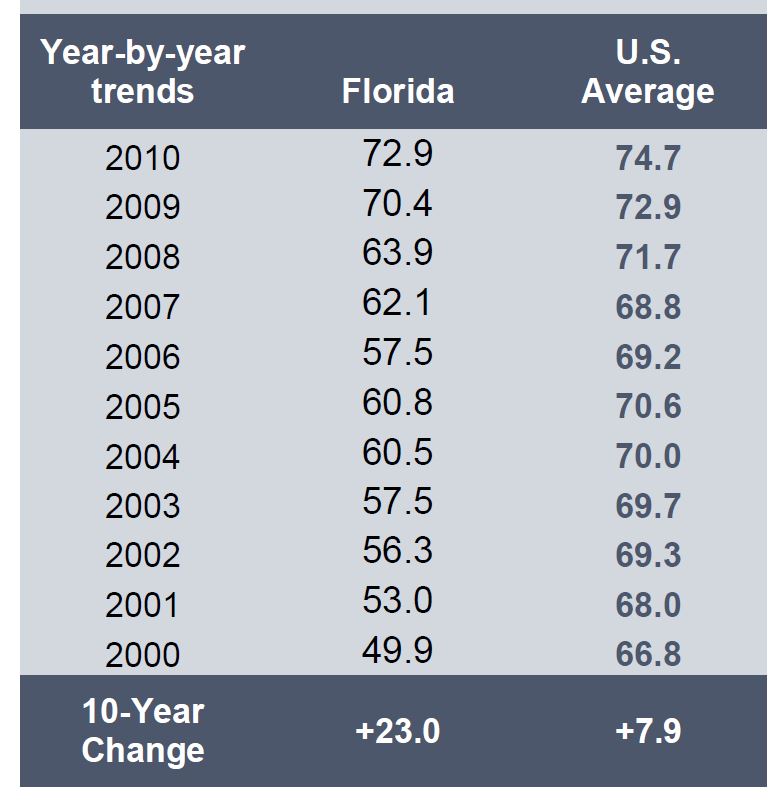
Florida’s high school graduation rate rocketed 23 percentage points to 72.9 percent between 2000 and 2010, putting the Sunshine State at No. 2 among states for progress over that span but still behind the national average, according to a new national report.
From Education Week
Only Tennessee did better, with a 31.5 percentage point gain, shows the annual Diplomas Count report from Education Week. The national rate was up 7.9 percent, to 74.7 percent.
Education Week, the country’s highly respected paper of record for education news, uses its own formula to calculate graduation rates.
Its findings are the latest in a stack from credible, independent sources that show Florida students and teachers are making some of the biggest academic gains in the country under a model distinguished by a tough, top-down accountability system and expanded parental school choice.
Florida ranks No. 44 in the percentage of students eligible for free- and reduced-price lunch (with the ranking going from lowest rate to highest), according to the latest federal figures. But the Education Week data puts it at No. 34 in graduation rates, ahead of states with less challenging student populations - and arguably better academic reputations - like Washington, North Carolina and Utah.
The gains also come despite tougher standards than other states. Among other things, Florida requires more academic credits to graduate than most states (24 to the national average of 21.1) and the passing of an exit exam (only 23 other states do). (more…)
 The 47 percent graduation rate for black males in Florida is among the lowest in the nation, and two major Florida school districts - Pinellas and Duval - have rates far below that, according to a new report released today.
The grad-rate formula used by the Schott Foundation for Public Education has been criticized as simplistic, but the group's findings have nonetheless been cited by school choice supporters in some communities as another pressing reason to expand vouchers, charter schools and other learning options.
“The bottom-line issue about black male achievement," Michael Holzman, the report's author, told Education Week, "is that the schools that most of these students attend are not as good as those attended by their white peers."
The foundation listed a moratorium on out-of-school suspensions, more equitable funding and more learning time among its recommendations for improving the rates. It did not list expanded school choice. Its president and CEO, John H. Jackson, urged a push for what he described as systemic solutions that "help each child, rather than a few."
Using 2009-10 figures, the report found the graduation rate for black males nationally was 52 percent, compared to 78 percent for white males and 58 percent for Hispanic males. The black male rate is up 10 percentage points since 2001-02, but the foundation didn't see cause to celebrate: "This progress has closed the graduation gap between Black male and White, non-Latino males by only three percentage points," the report said. "At this rate, it would take nearly 50 years for Black males to achieve the same high school graduation rates as their White male counterparts."
Florida's rate for black males is 5 percentage points below the national average, according to foundation calculations, putting it in a three-way tie for No. 42 among states. Its rate for white males was 62 percent - 16 percentage points below the national average - and leaving it in a four-way tie for No. 45. (more…)

