 A provision that made Florida a national literacy leader 20 years ago could be repealed in an effort to ease the regulatory burden on Florida’s school districts.
A state Senate panel unveiled a package of proposed deregulation legislation. One proposal would end the requirement that public schools hold back third graders who struggle in reading.
House Bill 1, passed earlier this year, created the largest expansion of education choice in the nation’s history.
The legislation also launched a new deregulation effort, championed by Senate President Kathleen Passidomo, designed to create a more level playing field for school districts. The Senate Education Committee this week reviewed survey responses from more than 2,000 people, most of them parents.
Right now, public schools are required to hold back third graders who score below Level 2 on state reading assessments. Students can still move on to fourth grade if they pass an alternative test, present a portfolio of work, or meet specific exemptions.
The Senate proposal would eliminate those provisions and require school districts to provide “specific supports” for students in kindergarten through third grade who are retained because of a reading deficiency.
Other proposals would overhaul the A-F grading formula, ease the state-mandated turnaround timeline for low-performing public schools, and eliminate must-pass math and English exams for 10th graders.
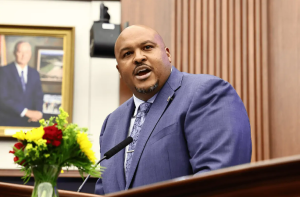
State Sen. Corey Simon
Sen. Corey Simon, R-Tallahassee, and two other senators overseeing the deregulation project did not comment on the proposed legislation, which was outlined at a Senate K-12 Education Committee workshop this week, as well as a separate list of recommendations from the Florida Department of Education that did not include eliminating the retention requirement or other major shakeups of the state accountability system.
Adam Miller, a senior chancellor at the Florida Department of Education, said learning to read well by third grade is critical to success in future grades.
“If we are pushing kids into fourth grade, not only are they struggling in social studies, they struggling in science, and they’re struggling in math, and we’re just putting them on a bad path forward,” Miller told members of the House Education Quality Subcommittee while presenting the department’s recommendations.
A key part of then-Gov. Jeb Bush’s education reform policies, third-grade retention sparked plenty of controversy, with critics saying it would harm children socially and emotionally.
Since it was enacted, Florida’s national reading scores have improved, and about half the nation’s states have adopted similar policies.
As Bush remarked in 2018, “It’s absolutely insidious to suggest that a functionally illiterate kid going from third grade, it’s OK to go to fourth. Really?”
During 2003-04, the initial year of the policy, the state retained 14% of third graders. Six years later, that number dropped 6% as more students met the standard. Martin West, a Harvard Graduate School of Education professor, and other researchers followed 75,000 Florida students who were held back under the law and compared them with students who were near the cutoff score and were promoted as well as classmates now in the same grade as those who were retained. The study showed higher test scores in high school and students taking fewer remedial courses, with no effect on their probability of graduating from high school.
While research on retention policies has shown that middle school retention can raise high school dropout rates, holding younger students back while providing support such as summer school and personalized literacy plans can help them make academic progress.
The proposals from the Florida Department of Education and all three senators will be included in bills to be discussed during the committee’s next meeting on Nov. 15.
Former state Sent. Bill Montford, who is also chief executive officer of the Florida Association of District School Superintendents, praised the deregulation efforts as “music to the ears’ of those who work in district schools.
“Now is the time to make those bold and sometimes controversial decisions that will ensure a level playing field for all choices that parents and students will have,” Montford told the committee “Our traditional neighborhood schools have proven for generations to be highly successful, and the preferred choice of most families, and your efforts can make traditional schools an even better choice for our parents and our students.”
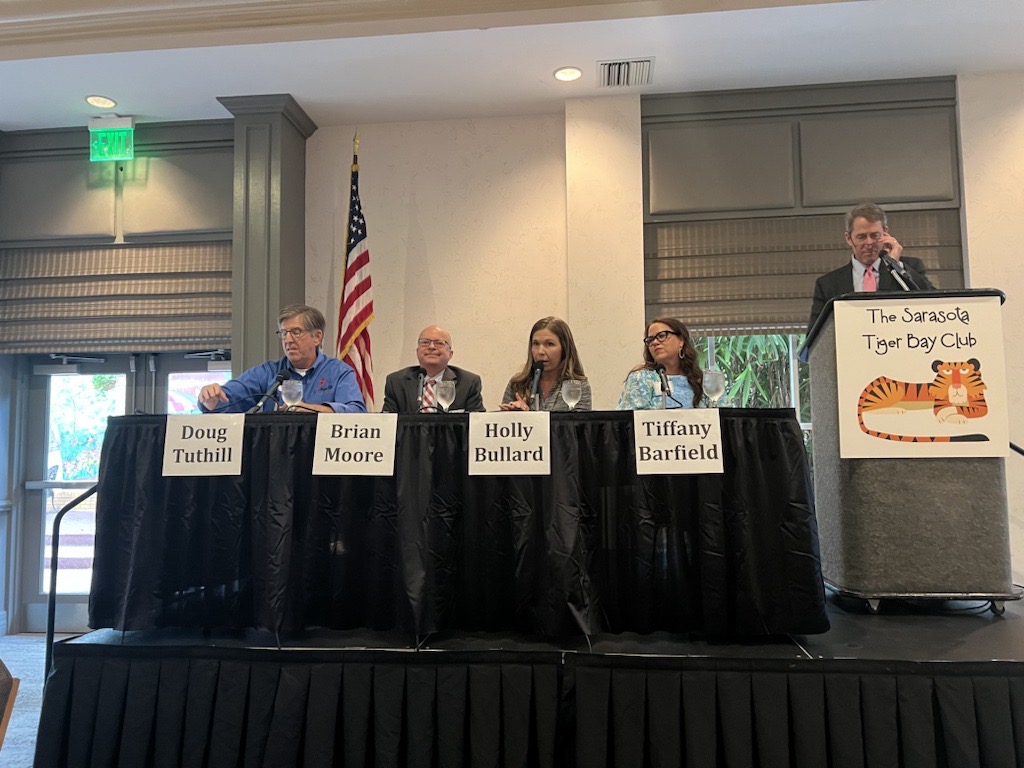
Panelists talk school choice at Sarasota Tiger Bay. Photo credit: Jennifer Vigne with the Sarasota Education Foundation.
Each year, Florida passes dozens of new laws affecting school districts. These, in turn, spawn dozens more administrative rules. While each of those policies may seem sensible in isolation, collectively, the burden adds up.
Brian Moore, the general counsel for the Florida Association of District School Superintendents, helps districts across the state keep track of all these new requirements. During a discussion of universal education choice hosted this week by Sarasota Tiger Bay, he said the need to make sense of this constant stream of new rules and make the operational changes they require hamstrings school districts at a time when new learning environments outside public education are trying innovative new approaches to teaching and learning.
"I think public schools might like to jump and follow, but they can't, because they have to have a school counselor, and this person, and that person, and a salary schedule, and this evaluation system," he said. "You can't be nimble and quick when you have all these extra things tying you down."
That is the spirit behind the current push to ease the regulatory burden on school districts. And it's a spirit embraced by Step Up For Students President Doug Tuthill. (Step Up For Students hosts this blog).
"We have so much talent, so much wisdom in our school districts, and we're just over-regulating them," Tuthill said. He added: "We finally have to liberate our district schools and let them be creative and innovative and let all that fantastic energy manifest itself in the best interest of kids."
When Florida lawmakers debated HB 1 earlier this year, the discussion largely focused on how the legislation would dramatically expand education choice through universal eligibility and flexible spending options for families.
Another part of the bill inspired far less discussion but got the attention of school district leaders across the state: a review of public school regulations.
By Nov. 1, the state Board of Education must develop and recommend “potential repeals and revisions” to the state’s education code “to reduce regulation of public schools.”
“This is a great step towards keeping our public schools competitive” in an era of expanded options, said Bill Montford, a former Democratic state Senator from North Florida who heads the Florida Association of District School Superintendents.
“Traditional, neighborhood public schools have been, and will continue to be, the backbone of our K12 education system,” he

Bill Montford
said. “We want our schools to be the first choice for parents, not the default choice, and to do that we need to reduce some of the outdated, unnecessary, and quite frankly, burdensome regulations that public schools have to abide by,”
Before they propose any changes, state board members must consider feedback from a diverse group that includes teachers, superintendents, administrators, school boards, public and private post-secondary institutions and home educators.
To fulfill that requirement, board members set up a survey link that will accept suggestions through today. A group of superintendents submitted a recommendation list that covers topics that include construction costs, budgets, enrollment, school choice, instructional delivery and accountability. Their pitches included proposals to:
"We’d like for them to recognize all parental choice equally and give school districts the same flexibility and opportunity to innovate provided to other publicly funded options,” said Brian Moore, general counsel for the superintendents association that Montford leads. He added that the superintendents would like to see more cooperation between school districts and the Department of Education.
This effort isn’t the first the state has made to provide school districts with relief from what they see as burdensome regulations. But to some leaders the process seems more like a game of Whac-A-Mole, with new regulations soon replacing the ones that get repealed.
Ten years ago, Gov. Rick Scott signed SB 1096, which repealed some regulations based on the recommendations of a group of superintendents, including Montford. The bill repealed a requirement approved in 2010 that all public schools and universities gather and report statistics showing how much material each had recycled during the year. It also ended a 2002 requirement that schools submit plans for teaching foreign languages to kindergarteners.
Other efforts to ease the regulatory burden have targeted schools that meet certain conditions. Since 2017, schools with strong test scores and consistently high letter grades could be qualified as “Schools of Excellence,” which grants their leaders more flexibility.
Moore said he hopes things work out this time around, but said the key is allowing changes to apply across the board, not to certain schools or districts, and to carefully consider future regulations and their potential effects.

