New research by the American Federation for Children found that scaling Florida’s Tax Credit Scholarship Program over 15 years improved public school student achievement.
The report published March 4 by AFC senior fellow Patrick Graff, a former Florida Catholic school teacher, compared two leading peer-reviewed studies of each approach that used Florida data: a 2023 study of Florida’s Tax Credit Scholarship Program over 15 years and a 2024 analysis of the effects of additional school spending on student achievement.
Key findings
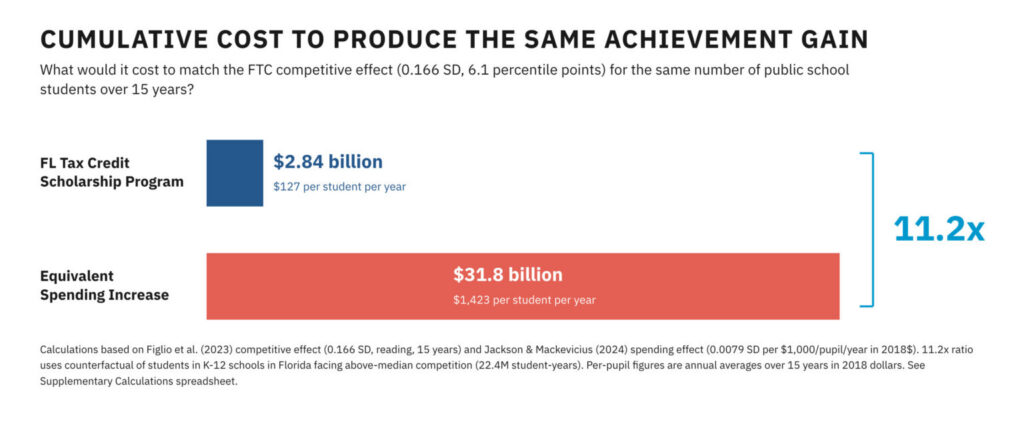
Not a zero-sum game: Florida’s experience shows that school choice can benefit students, no matter where they learn, families, and taxpayers at the same time. Florida now enrolls over half a million students in private school choice programs, and its public school students still outperform students in most states while spending less.
Read the full report here.
The time has come when we officially recognize National School Choice Week. However, we at Step Up For Students like to say that every week is National School Choice Week.
We are proud that Florida is the national leader in empowering parents to choose the best educational fit for their children. More than half of the state's K12 students used some form of education choice in the 2023-24 school year, according to the Florida Department of Education.

Parents’ ability to direct their children’s education has always been important, but even more so in the past 100 years, when the U.S. Supreme Court ruling in Pierce v. Society of Sisters (1925) gave parents the right to choose between public and private options.
“The child is not a mere creature of the state,” Justice James C. McReynolds wrote in the unanimous decision that the government cannot compel children to attend only public schools.
Catholic schools, which were the target of the law the high court struck down, cheered.
Fittingly, Catholic Schools Week, which we also recognize, is running concurrently this year with National School Choice Week. With its robust statewide choice scholarships, Florida is also a national leader in Catholic school enrollment growth.
National School Choice Week is a non-partisan celebration that encompasses all forms of choice: Traditional district schools, public magnet schools and charter schools, virtual schools, private schools, both religious and secular, microschools, home education and customized learning powered by education savings accounts that can include a mix of public and private programs.
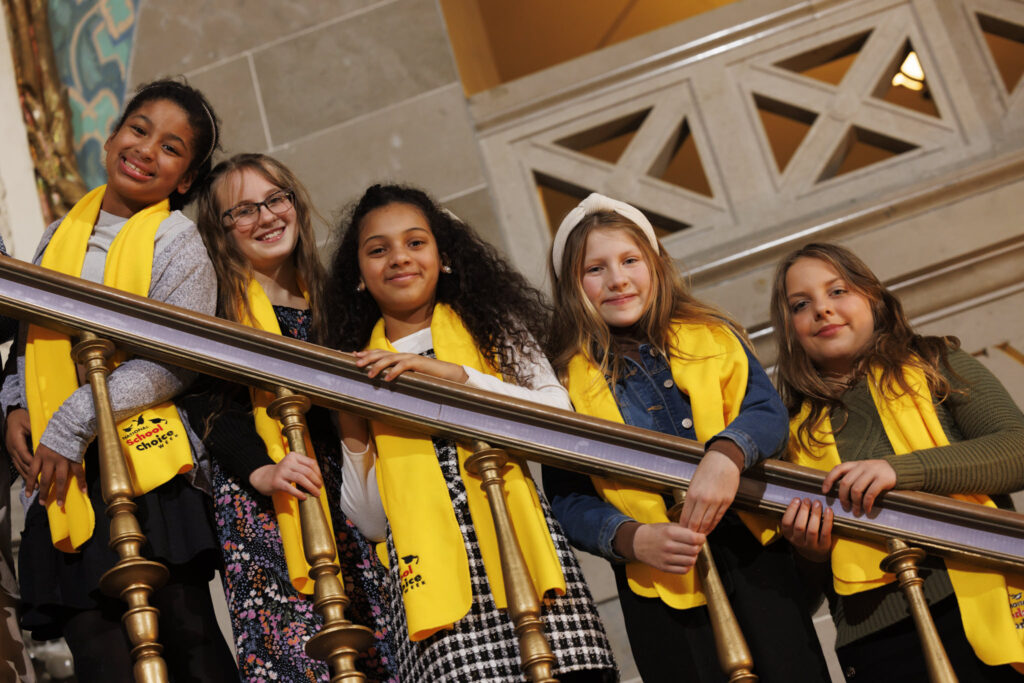
Events are happening across the nation, from capitol rallies to school choice fairs to students in signature yellow scarves performing the official National School Choice Week dance in their classrooms or homes.
Throughout the week, NextSteps will share stories of students and families who have benefited from Florida’s many educational options. You will meet a young hockey player whose Personalized Education Program scholarship has allowed him to travel with his team to compete in international tournaments while keeping up with his schoolwork and educational goals. Ron Matus, Step Up’s director of research & special projects, will share his memories of a former student who was among the state’s first recipients of Florida Opportunity Scholarships pioneered by former Gov. Jeb Bush. A couple of years in a Catholic school were enough to put him on a path to a better life.
We will also bring you a story by a Tampa Bay FOX affiliate of a single parent who was able to send her son, who struggled in other schools with his autism, to a school where he is thriving, with dreams of going to college.
We will cap off the week at the festivities Thursday in Tallahassee, where Step Up representatives will have information about the Feb. 1 season open for 2026-27 scholarship applications.
Even if you aren’t at the rally, you can still learn about the scholarships and apply at www.stepupforstudents.org.
We can’t wait until next week. And the week after. And the week after that.
Because we serve Florida, where choice is the norm for all public education.
CLEARWATER, Fla. — A check recently arrived in the mail for Landon Green, his compensation for the two hours he spent autographing baseball cards of himself one day last summer.
He signed 2,000 cards and was paid $1 for each signature.
That’s a nice payday for anyone, especially a 17-year-old high school junior who is among the top pitching prospects in the nation, one who is very much on the radar of top collegiate programs and Major League Baseball teams.
The landscape of amateur sports has shifted dramatically over the last few years, allowing athletes to benefit financially from their Name, Image, and Likeness (NIL) without jeopardizing their amateur status.
Likewise, the landscape of K-12 education in Florida has changed significantly with the expansion of education choice scholarship programs.

Landon, who is home-educated, receives a Personalized Education Program (PEP) scholarship available through the Florida Tax Credit Scholarship Program managed by Step Up For Students.
PEP, now in its third year, provides parents flexibility in how they spend their scholarship funds, allowing them to customize their children’s learning to meet their individual needs and interests.
“It allows us to select his academics based on his future, to study what we think will help him in his future,” Landon’s mom, Michele Donton said.
For Landon, that’s finance, business, and leadership – courses that will guide his financial potential. The scholarship also covers the cost of strength, conditioning, and mobility training – sessions that will help him improve athletically. Landon spends two to four hours a day either playing baseball or working on some aspect of his game.
“PEP gives us the flexibility to work around his schedule,” Michele said.
Morning workouts mean afternoon classes and vice versa. Also, Landon can still complete his schoolwork when he travels out of town for a tournament.
“I think (the PEP scholarship) is very beneficial for him, because he's not the typical go to school type of kid,” Landon’s father, Lamon Green, said.
Stacked among the textbooks on a table in the family’s Clearwater home is one published by the financial services firm Morgan Stanley titled “The Modern Athlete's Guide to Life, Money and NIL.”
Yellow sticky notes earmark chapters on “Smart Money Savings,” “The Business of You,” “Investing in Your Future,” and “Philanthropy & Legacy.”
It’s an important resource for someone like Landon, because the check he received for autographing baseball cards will be the first of many. He also has two NIL deals with athletic apparel companies. Opportunities for more deals can increase over the next two years as his career progresses.
“This kind of helps him and guides him through all of this,” Michele said. “It's the NIL bible, to be honest with you. It teaches you everything and anything you need to know.”

The days of teen-age baseball players being scouted during high school games by representatives from college and professional teams ended years ago. Now, top college and pro prospects like Landon attend showcase events around the country that draw scouts and evaluators from all 30 Major League Baseball teams as well as college coaches. Prospects play for travel teams, some of which draw from a nationwide talent pool.
Landon is also a regular at the USA National Baseball Training Complex in Cary, North Carolina. That’s where he autographed those baseball cards, and that’s where he attended financial seminars.
The National Collegiate Athletic Association (NCAA) changed its rules in 2021 by recognizing athletes as a brand and allowing them to profit from their identity. It wasn’t long before that trickled down to high school athletes.
So, not only is Landon a baseball prospect, but he is also a brand.
To that, he shrugged his shoulders.
Landon runs toward the quiet. He’s very businesslike on the pitcher's mound, retiring batters with not much fanfare.
“He’s very humble,” said his mom.
Landon’s answer when asked about his future was this: “Whatever happens, happens.”
Here’s what could happen:
If all goes according to plan, it will include either a scholarship to a Division I-A university with a top-flight baseball program or a contract with a Major League Baseball team after he is selected in the 2027 baseball draft. He has already had a workout with the Chicago Cubs.
Landon is already rated as one of the top pitchers eligible for the 2027 draft, which will be held after he graduates high school. A right-hander, his fastball has been timed at 98 mph, and it is expected to get faster as he adds bulk to his 6-foot-1, 174-pound frame.
The higher he is selected in the draft, the more money he will receive as a signing bonus.
If Landon chooses to play college baseball before turning pro, he stands to increase his NIL deals since he will be pitching for a prominent program. He is being recruited by a number of colleges, including blue bloods like the universities of Florida, Texas, and Miami, and Louisiana State University.
“I was one of his T-ball coaches back in the day. Watching him play on the grass, I would have never thought all this could happen. This is awesome,” said Lamon, who has been a Clearwater police officer for nearly 25 years.
“That’s why I tell him to stay out of trouble, do the right thing. I push him in his education to learn about money. Don’t blow it because you want a necklace. You have a future to think about.”
This is Landon’s third year of home education. Michele said the move was made to better control his learning environment. The fewer distractions made for a better student.
She was thrilled when she learned about the PEP scholarship and how it works. Many families who receive the scholarship are tailoring their children’s education based on their interests and needs, choosing options a la carte style. A growing number of parents are looking to the future when customizing their child’s education.
For Landon, that means his curriculum is evolving.
“We're always listening,” Michele said. “I'm constantly looking for material that can help him, that I think is going to help him in his future, whether it be financial literacy, learning how to invest. I really want him to learn how to invest. That's a big thing we're going to focus on this school year.”
MELBOURNE, Fla. – When it comes to her son’s education, Denice Santos always thinks about the big picture.
“What can we do to merge his goals?” she said. “Education, and then, of course, becoming a pilot.”
Her son, William, 12, has wanted to fly airplanes for half his life. He took control of a plane for the first time when he was 8. He’s nearly halfway to the required 51 hours of flight time needed to earn a pilot’s license.
A Florida education choice scholarship is helping him reach that goal.
William receives a Personalized Education Program (PEP) scholarship available through the Florida Tax Credit Scholarship Program managed by Step Up For Students. PEP provides parents with flexibility in how they spend their scholarship funds, allowing them to tailor their children’s learning to meet their needs and interests.

William Santos stands in front of a two-engine airplane that he has flown during his training flights.
For his needs, William attends Florida Virtual School, where he is a straight-A student.
For his interests, William heads to Melbourne Flight Training twice a month for flight lessons. Both are paid for with his PEP scholarship, with the flight lessons covered under enrichment courses.
“I’m not just thinking about right now, his education experience right now. I’m thinking long term,” Denice said. “What’s after school? What’s school building to?”
William said he is thinking about attending the United States Air Force Academy. Or maybe a career in law enforcement where he could put his flying skills to use. Border patrol? Possibly.
He’s recently developed an interest in flying helicopters, which could open another career avenue. The family lives in Melbourne Beach, located in Brevard County, and the Brevard County Sheriff's Office has an aviation unit with four helicopters.
He could also become a commercial pilot and fly for an airline or fly charters for a private company.
“The sky is the limit,” said Denice, who chuckled at her choice of words.
***
William was 6 when he attended the Cocoa Beach Air Show with his mother and father, Kevin. There were flying machines everywhere – F-22s and F-35s, F-16s and B-52s. They screamed overhead and rested majestically on the ground.
He was hooked.
When they were leaving, William said, “Mom, when I grow up, I’m going to be a pilot.”
“He’s always been super decisive,” Denice said. “I knew he wasn’t kidding.”
Denice checked for the minimum age requirement needed to begin flying lessons. Turns out, there is none. You do have to be between 8 and 17 to participate in the nationwide Young Eagles program, which offers free introductory rides for youngsters interested in flying. William was in the air as soon as he turned 8.
“They take kids up for 30 minutes with the pilot, and they get a little taste of it to see if they like it. Is this something? Are they afraid, or does it spark something? William did 10 of those, and we said, ‘OK, this is a thing.’”
Soon, Denice and Kevin were searching for a flight school. They settled on Melbourne Flight Training, which is 20 minutes from home.

William poses in front of the wall containing pictures of all the pilots who earned their license after training at Melbourne Flight Training.
“When I was a kid, I always liked planes,” William said. “Even when I would go on flights as a baby, I would never cry. I would love it, every minute. It was the best thing ever. And I was never really afraid of heights. It didn't bother me much.”
That’s good, because his first flight with Young Eagles was in a BushCat Light Sport Aircraft, a small plane that has non-traditional doors – they are clear plastic and can be removed. You can fly with or without them.
“It was kind of ever so slightly scary,” William said. “Since I was young, I was like, ‘Uh, am I sure about this?’ And many, many flights later, I'm here.”
He has flown 25 times with an instructor and has nearly 20 hours of flight time. He will need to turn 17 and have a minimum of 51 hours before he’s licensed. He will also need to be medically certified to fly and pass a written exam that covers weather, navigation, flight regulations, and aerodynamics.
Dr. Tracey Thompson, the student advisor at Melbourne Flight Training, said it’s not uncommon for someone as young as William to take lessons.
“But,” she added, “he’s been up 25 times, and for someone his age to be up that many times, that’s phenomenal. His consistency, his passion, he wants to do this all the time.”
Jonathan Gaume is William’s instructor. He said he’s never worked with a student this young and is impressed by William’s interest and enthusiasm.
While he’s on pace to reach his 51 hours when he’s 17, William would like to accelerate his training and reach those hours when he’s 16.
Why?
“Because I find this fun,” he said.
As for being one of the youngest pilots training at Melbourne Flight Training, “You know, it's been really the only thing I’ve done since I was 8. It’s been the thing I've always looked forward to.”
***
William has trained several times in a four-seat plane, and Denice has accompanied him during those flights. She said she’s noticed a level of peace when William is flying.
Gaume noticed it, too. He said William’s confidence spikes as they climb into the aircraft.
“He has key elements to being a good pilot: calm, confident and in control,” Gaume said.
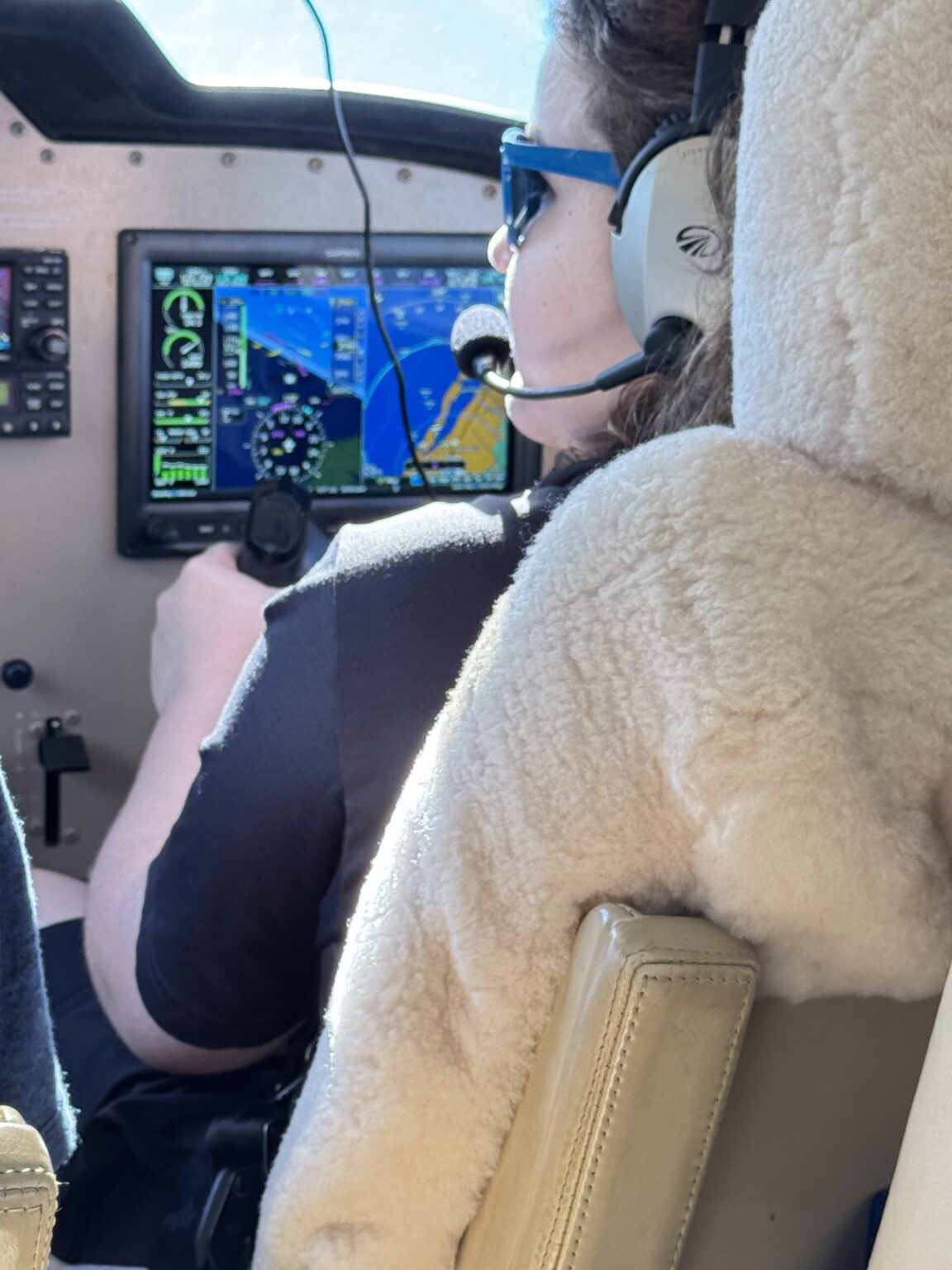
William at the controls. (Photo courtesy of Denice Santos)
The flight path takes William over the Atlantic Ocean, where they sometimes fly around thunderstorms. A recent lesson took place in a twin-engine plane. Gaume killed one of the engines, and William had to keep the plane flying. Confident and in control, William did just that.
“We’re just so thrilled, just so happy to plug him into his dream,” Danica said. “To be in the plane with him, seeing him flying, just seeing him totally locked in, that's all a parent can wish for.”
Flying lessons cost between $300 and $500 depending on airtime, and William averages about two lessons a month. That can strain the family budget for Denice, a teacher at Florida Virtual School, and Kevin, who is retired after 22 years in the U.S. Army.
“It’s not like we’re rolling in the dough,” Denice said. “The scholarship makes this possible. If we didn't have that scholarship, how many flights would he get? Probably not as many as he's getting now.
“I'm thrilled to be in Florida, because there's so much parental choice here. Not only do parents have choices, but then they can branch out and get some financial support from the state for those choices. Amazing. It's awesome.”
Every family in Florida that receives an education choice scholarship uses it in their own, unique way. Denice encourages parents to be as forward-thinking as possible, to merge education and interests and work toward a goal.
“I would like more people to think beyond where their kid is right now, but what are they good at. Really invest in that and tune in and give them the most experience as you can,” she said. “To me, that's what the scholarship money is for, branching out, tap into your kids’ interests because you never know what can happen.”
As Denice said, the sky is the limit.
This is what home education looks like to Vivian McCoy:
Feeding horses in the morning. Mucking stalls, too. Doing the same in the late afternoon, plus whatever else needs to be done at the horse farm where she works part time.
In between, Vivian, who is in the ninth grade, and her sister, Genevieve, second grade, complete their schoolwork on the 15-acre farm where they live with their mom, AnnaMarie, in the Florida Panhandle community of DeFuniak Springs
“I feel I have way more free time to do the things I enjoy,” Vivian said, when asked about the benefits of home education.
That free time includes caring for her own two horses – Blue, a quarter Mustang mix, and Froggy, a Tennessee Walker – and tending to the other animals that live on what AnnaMarie calls a “teaching farm.”

Vivian and Froggy get ready to participate in the Fourth of July parade. (Photo courtesy of AnnaMarie McCoy)
Genevieve looks after the chickens and works in the 2,000-square-foot garden.
There are the core courses, for sure, but there is plenty of hands-on learning for the McCoy sisters in the only educational setting they have known.
Florida education choice scholarships help make it affordable for AnnaMarie, a single mom who works from home part-time as a dietitian consultant.
Genevieve receives the Family Empowerment Scholarship for Students with Unique Abilities (FES-UA). Vivian receives the Personalized Education Program (PEP) scholarship available through the Florida Tax Credit Scholarship Program. Both scholarships are managed by Step Up For Students.
Like FES-UA, PEP is an education savings account (ESA) that gives parents the flexibility to customize their children’s learning to meet their needs. The scholarship, enacted by the Florida Legislature before the 2023-24 school year, has been a financial boon to AnnaMarie.
Until then, she paid out of pocket for the curriculum and supplies needed for Vivian’s home education.
“Pre-scholarship, it was a real struggle meeting all of her goals and being able to present her with things that were going to enhance her interests and her education,” AnnaMarie said. “Although we did it and we got through it, having the scholarship opens up an entire new world for us.
“I can use that money to really enhance what their interests are and what their weaknesses are, or their strengths.”
Like most students who are home educated, Vivian’s and Genevieve’s learning has evolved.
“I’ve gotten a lot more experience over the years to see what works for us,” AnnaMarie said. “These are two very different children, very different students, with very different interests and learning abilities. So, before the scholarship was an option, I definitely did things that were very budget-friendly and utilized anything that was a possible benefit to us that was low-cost, and I still do.”
Vivian is interested in agricultural science and animal husbandry. Hence, Blue and Froggy and her job at the horse farm.
“She's also very artistic,” AnnaMarie said. “She's super, super creative and super artistic.”

Genevieve displays the vegetables she grew in the family's 2000-square-foot garden. (Photo courtesy of AnnaMarie McCoy)
Genevieve, an excellent swimmer, is interested in anything that involves physical activity. She uses part of her ESA for speech-language pathology therapy and the educational tools needed to support that.
While Vivian was “born loving science,” AnnaMarie said, she finds herself trying to find something that will spark that interest in Genevieve. Toward that end, AnnaMarie has “melded” their home into a working farm.
“Everything here presents a teaching opportunity or learning opportunity, and they can see it from beginning to end,” AnnaMarie said.
Genevieve watches the chickens go from egg to chick to chicken – the entire lifecycle. In the garden, she follows the plants from seed to harvest.
“And all the struggles with that,” AnnaMarie said, “the positive outcomes and the negative outcomes and the environmental outcomes.”
AnnaMarie said there are “pros and cons” to every education setting.
“This lifestyle suits them best,” she said. “Having this environment and the flexibility in our schedule really suits their interests and their needs.”
Vivian, 14, is nearing driving age, yet she opted to spend the money she could have put toward a car to buy Froggy.
“She eats, lives, and breathes horse stuff,” AnnaMarie said.
“I’m fascinated by the equine species,” Vivian said. “The power and the majesty they hold. I find it very cool that you can do so many things with them and how they've evolved over the years.”
She was thrilled earlier this summer when she was allowed to ride Froggy in the local Fourth of July parade. It was a big step for both of them, Vivian said. She was able to do something away from the farm with Froggy, and he was able to be around a crowd with all the music and pageantry that comes with a parade.
“I was proud that he didn’t freak out,” she said.
Vivan said she plans to attend college and would like a career in marine biology or one that allows her to work with livestock.
For now, she’s content to work part-time at a local horse farm and care for Blue and Froggy.
And she’s grateful her home education setting allows for that.
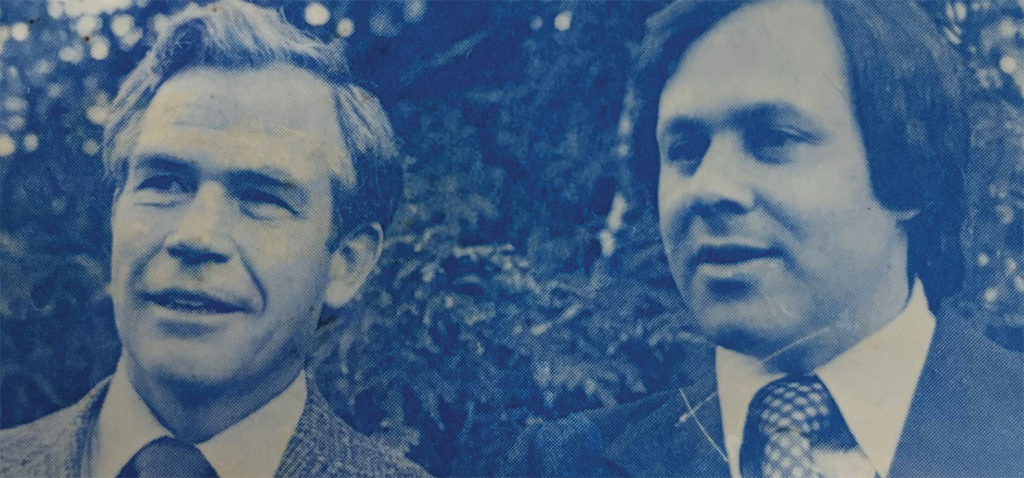
Berkeley law professors Jack Coons (left) and Stephen Sugarman described what we now call education savings accounts - and a system of à la carte learning - in their 1978 book, “Education by Choice.”
John E. Coons was ahead of his time.
Decades before the term “education savings account” became an integral part of the education choice movement, the law professor at the
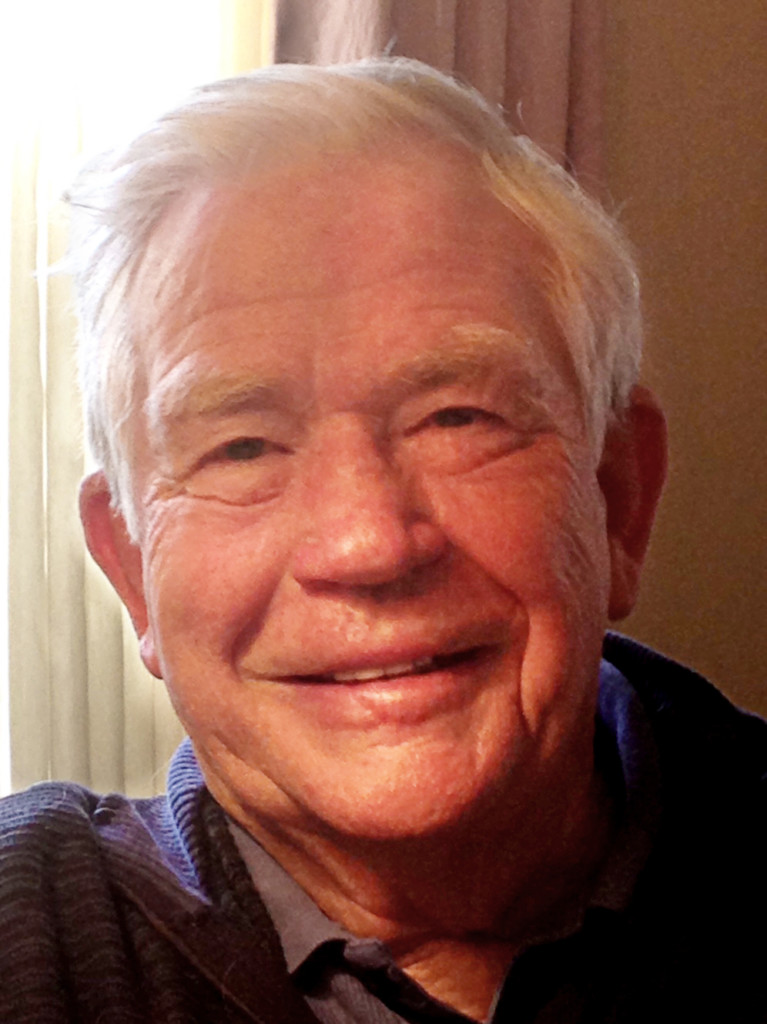
Jack Coons, pictured here, co-authored "Education by Choice" in 1978 with fellow Berkeley law professor Stephen Sugarman.
University of California, Berkeley, and his former student, Stephen Sugarman, were talking about the concept. In their 1978 book, “Education by Choice: The Case for Family Control,” the two civil rights icons envisioned a model drastically different from the traditional one-size-fits-all, ZIP code-based school system inspired by the industrial revolution:
“To us, a more attractive idea is matching up a child and a series of individual instructors who operate independently from one another. Studying reading in the morning at Ms. Kay’s house, spending two afternoons a week learning a foreign language in Mr. Buxbaum’s electronic laboratory, and going on nature walks and playing tennis the other afternoons under the direction of Mr. Phillips could be a rich package for a ten-year-old. Aside from the educational broker or clearing house which, for a small fee (payable out of the grant to the family), would link these teachers and children, Kay, Buxbaum, and Phillips need have no organizational ties with one another. Nor would all children studying with Kay need to spend time with Buxbaum and Phillips; instead, some would do math with Mr. Feller or animal care with Mr. Vetter.”
Coons and Sugarman also predicted charter schools, microschools, learning pods and education navigators, although they called them by different names.
Fast forward to Florida today, where the Personalized Education Program, or PEP, allows parents to direct education savings accounts of about $8,000 per student to customize their children’s learning. Parents can use the funds for part-time public or private school tuition, curriculum, a la carte providers, and other approved educational expenses. PEP, which the legislature passed in 2023 as part of House Bill 1, is the state’s second education savings account program; the first was the Gardiner Scholarship, now called the Florida Family Empowerment Scholarship for students with Unique Abilities, which was passed in 2014.
Coons, who turned 96 on Aug. 23, has been a regular contributor to Step Up For Students' policy blogs over the years. Shortly after the release of his 2021 book, “School Choice and Human Good,” he was featured in a podcastED interview hosted by Doug Tuthill, chief vision officer and past president of Step Up For Students.
 “It is wrong to fight against (choice) on the grounds that it is a right-wing conspiracy,” said Coons, a lifelong Catholic whom some education observers describe as “voucher left.” “It’s a conspiracy to help ordinary poor people to live their lives with respect.”
In 2018, Coons marked the 40th anniversary of “Education by Choice” by reflecting on it and his other writings for NextSteps blog.
He said he hopes his work will “broaden the conversation” about the nature and meaning of the authority of all parents to direct their children’s education, regardless of income.
“Steve (Sugarman) and I recognized all parents – not just the rich – as manifestly the most humane and efficient locus of power,” he wrote. “The state has long chosen to respect that reality for those who can afford to choose for their child. ‘Education by Choice’ provided practical models for recognizing that hallowed principle in practice for the education of all children. It has, I think, been a useful instrument for widening and informing the audience and the gladiators in the coming seasons of political combat.”

The Rev. H.K. Matthews, front row, second from left, and John Kirtley, front row, far left, joined more than 6,000 marchers at a 2010 Tallahassee rally to support expanding the income-based Florida Tax Credit Scholarship Program.
By John Kirtley
The Rev. H.K. Matthews passed away Monday at the age of 97. As I urge you to read in this obituary, he was one of the towering figures in the Florida civil rights movement.
He was arrested over 30 times fighting for equal rights in Northwest Florida. He was beaten, along with John Lewis and other brave activists, on the Edmund Pettus Bridge in their first attempt to march from Selma to Montgomery. There is now a park named in his honor in Pensacola. You can also read his autobiography, “Victory After The Fall.”.
On a 2010 visit to Pensacola to recruit schools for the Florida Tax Credit Scholarship program, former Step Up For Students grassroots organizer Michael Benjamin and I met the operator of a faith-based school in town. He urged us to meet with Rev. Matthews, who he thought might respond well to the social justice message of the scholarship program. At the time, the average household income of our students was less than $30,000, and 75% were minorities. Michael and I said we would love to meet him.
Rev. Matthews didn’t say much during our initial visit; Michael and I explained how the scholarship program empowered low-income families to choose a different school if the one they were assigned to wasn’t working for them. He seemed to just take it all in but offered neither affirmation nor disagreement.
Almost as an afterthought, I invited him to a march and rally we were having the next month in Tallahassee. We needed the legislature to pass a bill to expand the scholarship program to relieve our waitlist, and we asked scholarship families to come to the Capitol to show their support. To my surprise, he agreed to attend.
On that day, over 6,000 people marched from the convention center to the Capitol. I invited Rev. Matthews to walk in front of the crowd with other faith leaders. Normally I would never walk in the front row, but I wanted to make sure everything went smoothly for him. He was very quiet as the huge crowd marched.
When we had gathered for the rally in the Capitol, I placed him in a prominent seat on the stage. A few minutes into the event, he motioned me over and asked if he could speak to the crowd. I had no idea what he was going to say, but I wasn’t going to say no. I went to the minister running our show and asked him to introduce Rev. Matthews.
What would he say? Was he with us?
I soon had my answer.
“This reminds me of the old movement,” he said. “Seeing thousands walking in the streets, fighting for the right to determine their own future, to fight for what is best for their children. When I worked with Dr. King back in the day …”
When he said those words, there was a murmur in the crowd, both students and adults. These kids had read about Dr. King in their history books. Some of them knew that there were not one but two marches across the Pettus Bridge, and here was someone who was there at the first attempt, someone who took the blows.
He was indeed with us.
Immediately after the rally, Rev. Matthews was swarmed by students young and old, some asking questions about his time with Dr. King, some young ones who just wanted to touch him — I suppose just to make sure this hero was real. They did not let him go for at least 20 minutes.
I could tell at the time this moved him. He told me so later. After that day he would call me to ask if there was anything he could do to help the movement. We had him appear at events with donors, governors, and legislators.
He would lead another march for us in 2016, when over 10,000 people came to protest the lawsuit filed by the Florida teachers union demanding that the courts shut down the Tax Credit Scholarship, which would evict 80,000 poor kids from their schools. That day Rev. Matthews was joined at the front of the procession by Martin Luther King III, the son of the man Matthews marched with 50 years prior. You can watch a 60-second video of that march here.
I had the pleasure of joining him at his church in Brewton, Alabama, where he moved in later years. He was being honored for his years of service to that church. I was honored, though very surprised, when he called me up to speak that day. Luckily, the words to praise him came easily.
They come again easily today, but not without a few tears.
How fortunate I was to have my life intersect with his, however unlikely that would have been to me before this movement changed the course of my life.
How fortunate the education freedom movement was to have his blessing and his involvement.
How fortunate the state of Florida was to have his tireless efforts fighting for civil rights.
How fortunate, all.
Rest in peace, Rev. Matthews.
John Kirtley is founder and chairman of Step Up For Students.

Homeschool student William Alexander enjoys a book at The Homeschool Hive, a store in Tampa, Florida, that offers materials and services to families across the Sunshine State and nationally.
TAMPA, Fla. — When you think of homeschooling, what comes to mind? For many families, it’s a journey filled with creativity, flexibility, and personalized learning. Whether you're following a traditional curriculum, taking a hybrid approach, or crafting your own adventure with a Florida K-12 education savings account, parent-directed learning allows families to find the best fit for their children’s needs.
But no matter the style, every family needs support and reliable resources. That’s where The Homeschool Hive comes in. It’s more than just a store. It’s a community that helps families build confidence and find the tools they need to thrive.
A store with a heartbeat
The Homeschool Hive was founded by Kimberlee Tucker, a former classroom teacher and homeschool parent. Her journey began out of necessity. Years ago, Tucker was searching for the right materials and support to educate her daughter, who has unique learning needs. What she discovered was a gap in resources and understanding, especially for parents opting out of a traditional school system.
So, she created what she couldn’t find. Today, parents who visit The Homeschool Hive find a warm, welcoming place that offers curriculum, advice, enrichment tools, and a judgment-free space for families to learn and grow.
“Kimberlee Tucker truly understands how to find the right curriculum for each individual student,” said Lisa Mezzei, who has relied on Tucker, a certified educator, for the past 10 years to conduct annual evaluations for her son, Matthew. “The process has given Matthew a real sense of ownership in his education.”
A store that's truly for everyone
Step inside The Homeschool Hive and you’ll find a thoughtfully curated selection of materials for every subject and learning style. There are full curriculum kits, hands-on science activities, history unit studies, sensory-friendly items, reading support tools, and even educational games and fidgets.
Whether a child is a budding scientist, a reluctant reader, or needs a more tactile learning approach, the Hive has something for everyone. Parents say the best part is personalized support. Tucker and her team listen, guide, and recommend based on each family's needs.
“The Homeschool Hive is such a low pressure, welcoming place,” parent Anissa Stern said. You can visit several times to explore what works best for your child, and the staff, many of whom have children with unique abilities, are incredibly helpful. It’s a fantastic resource for any homeschooling family.”
Kelli Alexander agreed.
“The Homeschool Hive has truly guided our homeschooling journey. It is one of my children’s favorite places to go. Everything is educational, fun, and engaging. I have found so many helpful supplements and resources that reinforce what they have already learned, and I even do their yearly testing through the store.”
Alexander recommends families visit twice, once with their kids, so they can explore and find materials that excite them, and again solo to get one-on-one advice from the staff. “It really makes a difference,” she added

Parent Kelli Alexander, second from left, regularly volunteers at The Homeschool Hive with her family.
Alexander's children especially love the extras they’ve found there, including books, games, and fidgets that make learning more enjoyable. They also look forward to the store’s community events, like the Christmas party, where her kids enjoy volunteering and connecting with other homeschool families.
From frustration to inspiration
Many parents come to The Homeschool Hive unsure of where to begin. It can feel overwhelming trying to choose the right curriculum or learning tools, especially if you’re new to homeschooling or supporting a child with special learning needs. But what sets the Hive apart is its heart.
Tucker and her team meet families where they are. They provide encouragement, advice, and solutions that are realistic and effective. Parents leave feeling seen, heard, and empowered to take the next step in their child’s education.
Tucker’s daughter, the inspiration behind it all, has since graduated from high school and is now engaged to be married. That journey of learning and growth is something Tucker says she wants for every family that walks through her doors.
A store that goes beyond the basics

Kimberlee Tucker shows off Bernadette Bee, a therapy trained dog and the store's new mascot.
Tucker doesn’t just stock big brands. She travels to toy and education conferences across the country, sourcing creative and engaging tools from family-owned and independent companies. These unique items aren’t just educational; they’re fun, hands-on, and often perfect for gifts or seasonal enrichment.
For those not local to Florida, The Homeschool Hive ships nationwide and has become a go-to resource for families across the country. Families don’t have to be on a Florida education choice scholarship to purchase from the store. Everyone’s welcome. With growing demand, Tucker is considering opening a second location soon. She recently expanded the staff to include Bernadette Bee.
"She is my new shop dog," Tucker said. "She is therapy trained and training to be a service dog for me."
Perfectly timed for the educational shift
As school choice continues to expand in Florida and across the country, families are exploring new ways to educate their children. The Homeschool Hive is perfectly positioned to support that shift. Whether you're a brand new homeschool or scholarship parent or several years into the journey, this is the place where guidance, resources, and inspiration come together.
“If you are just starting your homeschooling journey, you have to visit the Homeschool Hive first," parent Lisa Mezzei said. "It is the perfect place to get support, explore options, and find what really works for your child.”
Markala was Marlena and John Roland’s first child, and there were more on the way – four more, in all. And Markala was 5, so the Roland children were going to reach school age in quick succession.
This presented a dilemma.
“We wanted our kids in private school, but we didn’t have the money,” Marlena said.
But there was hope.
The year was 2005, and Marlena, a teacher at a private school near their Coral Springs home at the time, learned about a private school scholarship that had been established a few years earlier and was managed by Step Up For Students.

For nearly 20 years, a member of the Roland family attended a private school with the help of a scholarship managed by Step Up For Students.
She applied and was accepted, and for nearly all of the next 20 years, at least one of the Roland children attended a private school with the help of a Step Up scholarship. The exception was the two years the family lived in Georgia.
“It was a blessing for us,” John said. “The best thing we did was give them that education foundation.”
“None of that would have been possible without the scholarship,” Markala said.
Marlena was a teacher at ALCA when the kids began school. Even with the employee discount, she said the cost of tuition would strain the family’s finances. Still, she wanted her children to benefit from ALCA’s educational setting just like the students she was teaching.
“We wanted to set the bar high, to create good study skills and habits. We wanted them to be well-rounded,” said Marlena, who also taught at The Randazzo School for nearly 10 years, including the time Marcia attended.

Marcia, who graduated last May from The Randazzo School, was the last of the Roland children to use a scholarship managed by Step Up For Students.
It was by design that the Roland children split their education between private and district schools. Some were sports-related, but mostly, John wanted their children to experience both educational settings.
“John said, ‘Let’s put them in public school for a little bit and see how it goes,’” Marlena said. “He said they need to have both, and that will build character and build them as individuals.”
And it worked.
The private school experience helped the children excel at their district schools.
“It laid a really good foundation for us,” Markala said. “Just getting us excited to be in the classroom, to learn new things, to collaborate with others.
“I had friends (in high school) ask me, ‘Where did you learn this? Why are you thinking that way?’ All I could say was, ‘Thanks to my teachers at ALCA and Westminster.’ They really set us apart and prepared us for what was coming next. We were leaps and bounds ahead of our peers.”
John credited the private school education his children received but also gave credit to the emphasis he and Marlena placed on education at home.
“When I dropped them off at school, I told them we’ll add to it when you get home,” he said.
“They didn’t play with that,” Markala said. “That was non-negotiable in our house.”
She remembers a time when John sold the family pickup truck to help meet the expenses of her attending Westminster that the scholarship didn’t cover.
“As a kid, you see them doing that, and I'm like, ‘Don't we need that car to get places?’ They really valued education. That was what was important,” she said. “I see that now as an adult, the things that they're willing to do to make sure that we had a good education, putting us into spaces where we could learn and grow have been tremendous to me, even now that I’m in the workforce.”
Last week, I had the opportunity to make a presentation about how lawmakers can support teachers who want to start their own schools. The four key features:
2. Formula funding/demand-driven funding: Whoever applies for a choice program should receive funding if eligible.
3. Avoidance of anti-competitive accreditation requirements: Don’t ask your startup schools to operate without funding from the choice program while incumbent/accredited schools receive choice funding.
4. Exempt private schools from municipal zoning: Old hat for charter schools, needed for private schools as well.
Florida is the only state your humble author is aware of that has taken all four of these steps. This makes Ron Matus’ new study "Going With Plan B” all the more important. Despite a statewide increase of 705 private schools, 41,000 Florida families applied for, received, and ultimately did not use an ESA. Matus surveyed thousands of these parents to learn why.

The lack of school space was the No. 1 reason Florida families found themselves as non-participants. Reasons two and three were related to costs, which can also be thought of as a supply issue.
The “Going with Plan B” study is very interesting and should be studied carefully by Florida policymakers. For now, however, let us focus on the other states with choice programs that lack the four critical elements listed above. If FLORIDA has a supply issue, your state, sitting at one out of four, or two out of four, should take note: It is likely to be even worse in a state near you.

