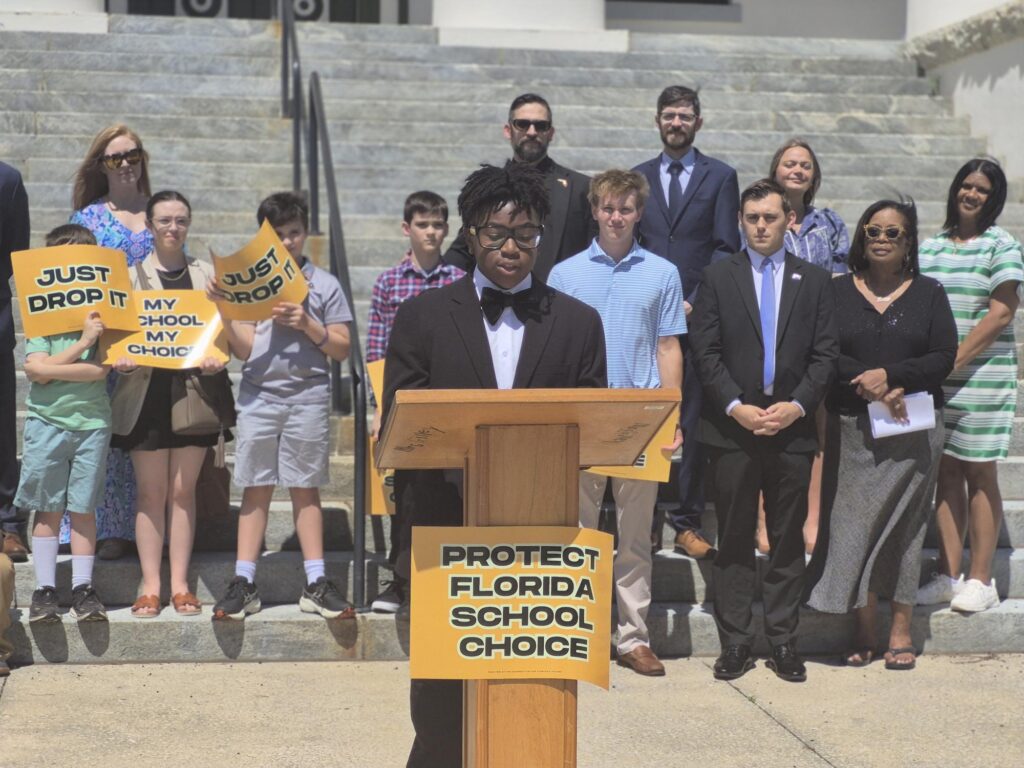
Nine days after the state teachers union sued to strip Florida families of the right to choose their children’s education, the pushback began when supporters of state K-12 scholarships and charter schools gathered in Tallahassee on the steps of Old State Capitol to protest.
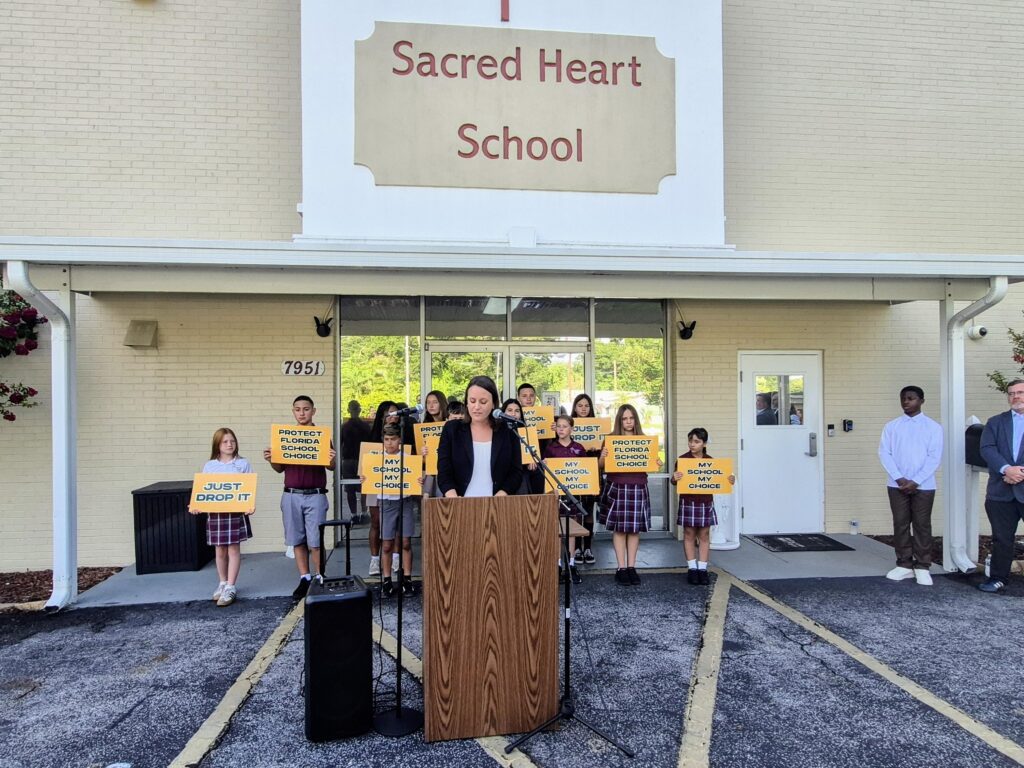
Two weeks later, choice supporters stood outside Sacred Heart Catholic School in the Tampa Bay area holding signs with the slogans, “My Child, My Choice” and “Just Drop It.”
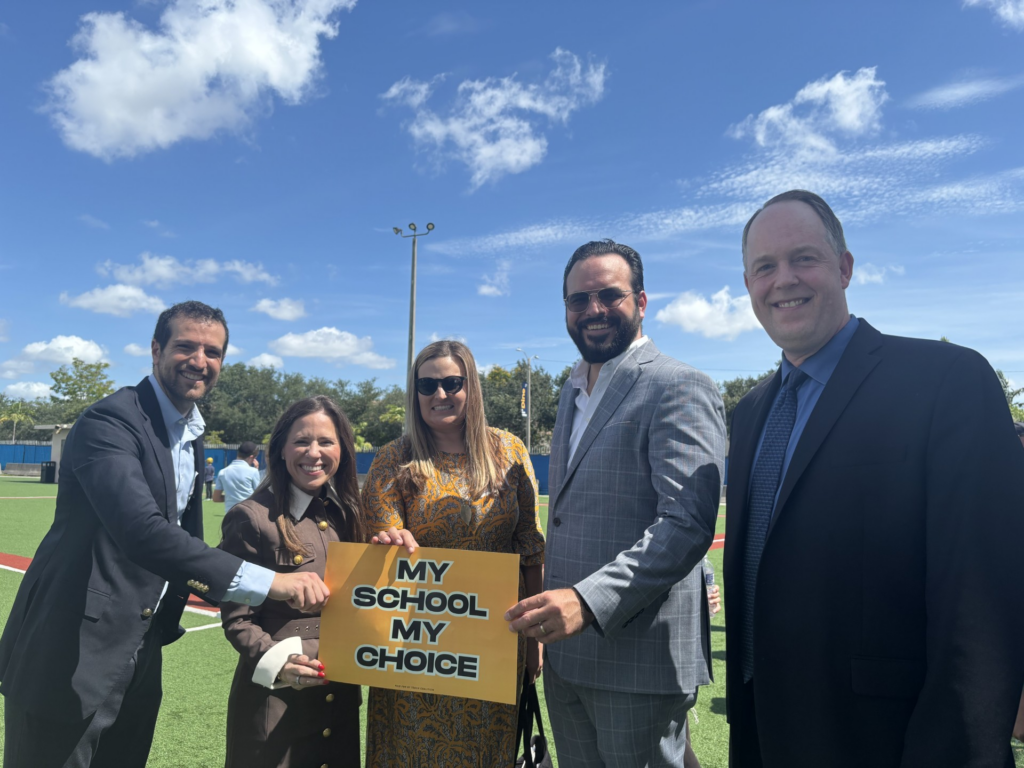
This week, the protests got louder. Students, parents, charter, and private school leaders stood outside Lubavitch Educational Center, the state’s largest Jewish day school, on Thursday and pledged to defend the decades-old policies and programs that have empowered families to choose the best educational fit for their children from a rapidly growing number of options.
“It’s not easy to pay private school tuition,” said Ailyn Weisleder, whose three sons are thriving at a Jewish day school. “But universal school choice has made that possible for our family. It gave us, and thousands of other families across Florida, the ability to choose the education that fits our children, not just the school assigned to us by a ZIP code.”
Audrey Maman Bensoussan said her family can’t afford to give her four children a Jewish education without the scholarships. She said the school feels like “a second home” to her children.

“If this lawsuit succeeds, it will not hurt politicians or special interests. It will hurt families like mine. It will hurt children like mine. It will take opportunities away from parents who simply want the freedom to choose the school that best meets their children's needs.”
Yonah Schwartz, 11, said at the news conference that if the lawsuit succeeds, then he won’t be able to afford to transfer to a school that better suits his learning needs.
“Not every kid learns the same way,” he said. “For me, changing schools means getting the chance to learn in a place that’s a better fit for me.”
The lawsuit, filed May 5, asks a judge to eliminate the state’s education choice scholarship programs based on the Florida Constitution, which says the state “shall make adequate provision for a uniform, efficient, safe, secure, and high-quality system of free public schools.” The lawsuit also seeks to end state funding of charter schools.
Faith leaders, charter school and private school leaders, as well as former Florida Gov. Jeb Bush’s Foundation for Florida’s Future, have supported the news conferences. Step Up For Students, the nation’s largest education choice scholarship funding organization, led the Tampa Bay area event. Teach Florida, a nonprofit school choice advocacy organization for Jewish education, organized and led the Miami event.
“The lawsuit brought by the Florida Education Association threatens everything these programs have made possible,” said Melissa Glaser, Teach Florida’s executive director. “This is about protecting families, protecting opportunity, and protecting a parent’s fundamental right to choose the best educational path for their child.”
She said more than $130 million annually in state scholarship funding helps ensure that Jewish children throughout Florida receive “the education they deserve — in schools that reflect their values and strengthen our communities.”
Their comments echo those made at the previous news conferences, where families described how scholarships had changed their lives. A charter school leader also spoke about how tuition-free charter schools ( which, like district schools, are public) have benefited students, including many from low-income households. Faith leaders also described how their schools uplift communities and welcome students with special needs.
Jim Rigg, superintendent of schools for the Archdiocese of Miami, said the lawsuit could damage “a thriving educational ecosystem in South Florida that attracts people from all over the world.” That includes the 37,000 students who attend Catholic schools in the diocese’s three counties. He said each school is accredited, gives standardized tests, complies with applicable state requirements, and employs highly qualified and certified teachers.
“But at its heart, the issue is not about institutions. It’s about children and families. Everyone wins with meaningful school choice, ultimately making our state the ideal place to raise and educate a child.”
ORLANDO, Fla. — As public education has evolved from a one-size-fits-all system to one where families are empowered to choose the environment that best fits their child, everyone has been a winner: Students, parents, educators, entrepreneurs, and even public school districts.
That was the message of John F. Kirtley, founder and chairman of Step Up For Students, to the roughly 1,000 people who attended the non-profit’s Navigating New Horizons conference this week.
In a closing speech that at the end brought the audience to its feet, Kirtley began by describing the state of education before the 1990s. Everyone paid taxes, and students were assigned to schools by their ZIP codes.
“It was, it could be said, a definition that emphasized ‘uniformity,’” he said, referencing but not naming the state teachers union’s recent lawsuit to eliminate Florida’s robust education choice programs, including all scholarship programs and charter schools.
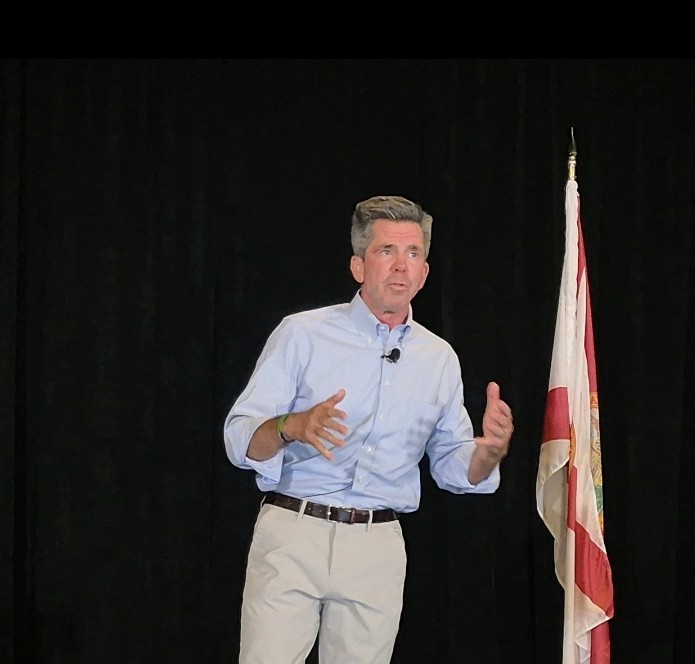
Kirtley said he didn’t realize it at the time, but since overall graduation rates in Florida were, until the mid-1990’s, around 60% overall and less than 40% for black males, it’s likely that many of his friends on the football team who crossed the stage did not get real diplomas. They likely received certificates of completion. The second group probably included a classmate who regularly got in trouble for dozing during early morning courses and was uninspired by classic literature. Yet he could take apart an entire car and rebuild it by himself, when Kirtley couldn’t change his car’s oil.
“But there was no specialized program for him…No, uniformity didn’t serve him well.”
Today, Kirtley said, his classmate could sleep in, take core classes online in his pajamas, then head over to the district automotive technology program in the afternoon, where he would be the star student.
“When he graduated, he’d be hired by the local Mercedes dealer and make over $100,000 two years out of school,” Kirtley said. “So, yeah, he’d be better off.”
Not only are students better off, but so are educators who can start their own schools, including microschools, and even school districts, including many that now offer specialized magnet schools and individual courses to education choice scholarship students who attend school part time.
“I close by saying don’t fear the New Definition. Embrace it. Thrive in it. You can thrive in it whether you are a microschool, an à la carte provider, or one of nation’s largest school districts,” he said. “And when you thrive in the New Definition, all students will thrive along with you. And shouldn’t that really be the ultimate goal?”
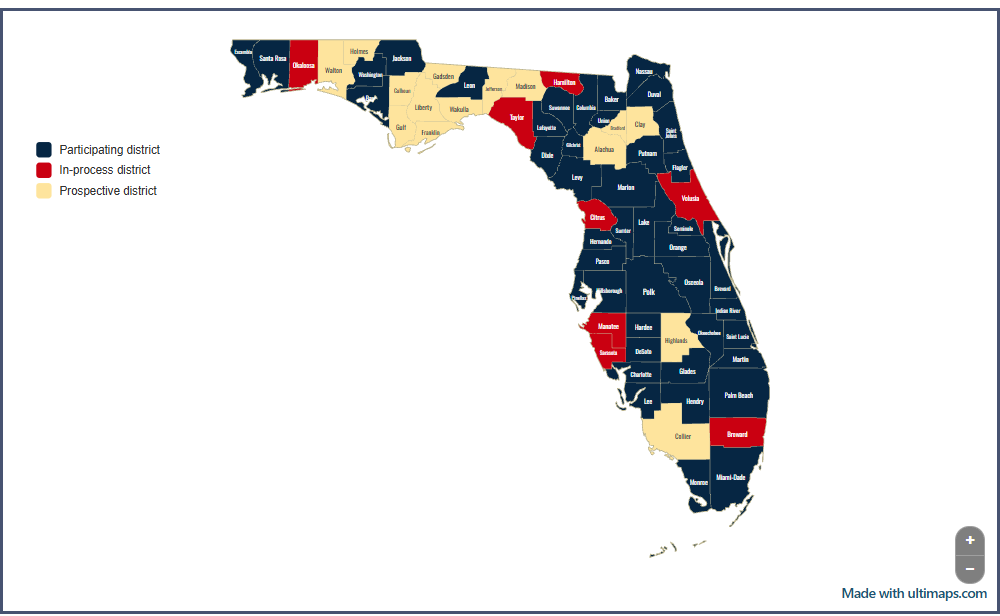
His remarks echoed the message given the day before by Gretchen Schoenhaar, Step Up’s chief executive officer, who gave the conference’s opening speech.
“Families today seek learning environments that reflect their children's unique strengths, needs and goals,” Schoenhaar said. “What's really inspiring is how this demand has sparked innovation across the education landscape.”
Schoenhaar said she hoped the two-day event would offer attendees a chance to be “inspired by the conversations you have, encouraged by the stories you hear, and energized by the collective passion in this room.”
Schoenhaar said Florida is home to the nation's largest parent-directed education marketplace today, with more than half of all K-12 students participating in some form of education choice, including many district schools, private schools, charter schools, homeschools, online schooling, or some combination of those.
“The spirit of innovation and possibility is exactly what this conference is all about,” she said.
The event, whose theme is Facing the Future Together, featured nearly 100 session speakers and 100 exhibitors displaying everything from a la carte learning to transportation options, tutoring, and curriculum.
Organizers said this year’s goal was to provide educators with information and resources based on best practices that also reflect the bigger picture. That included information about the rise of microschools and how to use AI efficiently and responsibly.
“Over the next two days, we hope you'll be inspired by new ideas, meaningful connections and innovative strategies that will help shape the future of education,” Paula Nelson, Step Up’s vice president of school and provider services, told the audience during her welcome.
Breakout session topics included school safety, a la carte education, navigating AI, the future of public education, the benefits of applying for the Yass Prize, how public schools are offering individual courses to scholarship students and how to create and sustain microschools. Four sessions on the upcoming federal Education Freedom Tax Credit program drew standing-room-only crowds.
The federal program, which launches in January 2027, allows individual donors to divert up to $1,700 of federal tax liability to support scholarships for students in public and private schools. The federal government is expected to announce rules that cover program specifics soon. Florida Gov. Ron DeSantis is among the governors who have opted their states into the program.
At the end of the conference, Schoenhaar broke some news: The conference will return June 14 and 15 of 2027.
TALLAHASSEE, Fla. — Parents, students, and education leaders who gathered at the Florida Capitol on Thursday had a message for the Florida Education Association, the teachers union that filed a lawsuit to end K-12 education choice scholarship programs used by nearly 540,000 children, as well as all charter schools.
Just drop it.
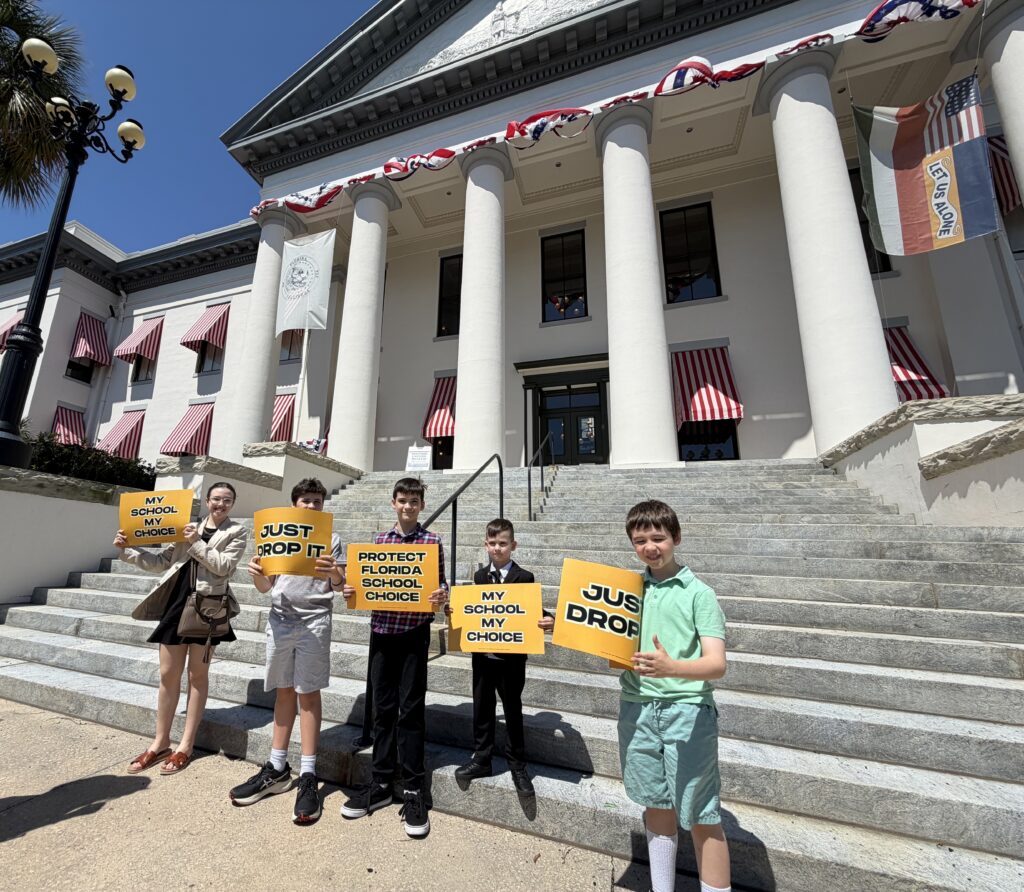
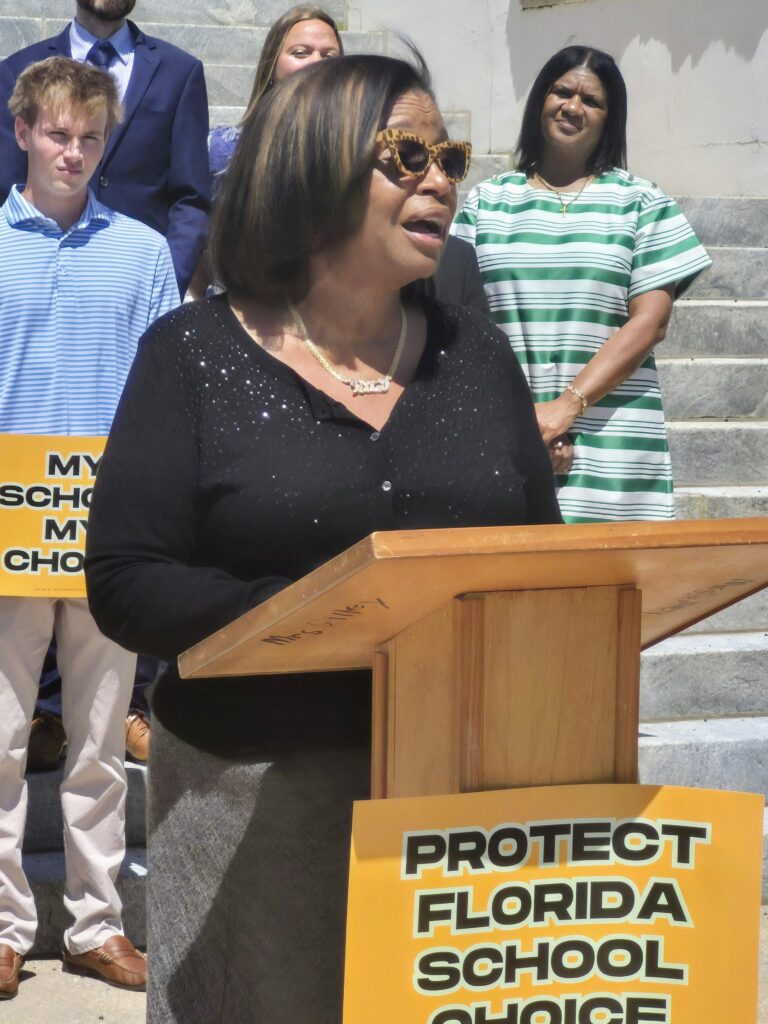
That was just one of the messages on the signs that supporters held up as they stood on the steps of the Old State Capitol building, as advocates proclaimed how education choice scholarships changed lives for the better. “My School My Choice” and “Protect Florida School Choice” could also be seen on the bright yellow signs. Former Gov. Jeb Bush’s Foundation for Florida’s Future organized the news conference. Bush launched the private school choice movement in 1999, right after he became governor.
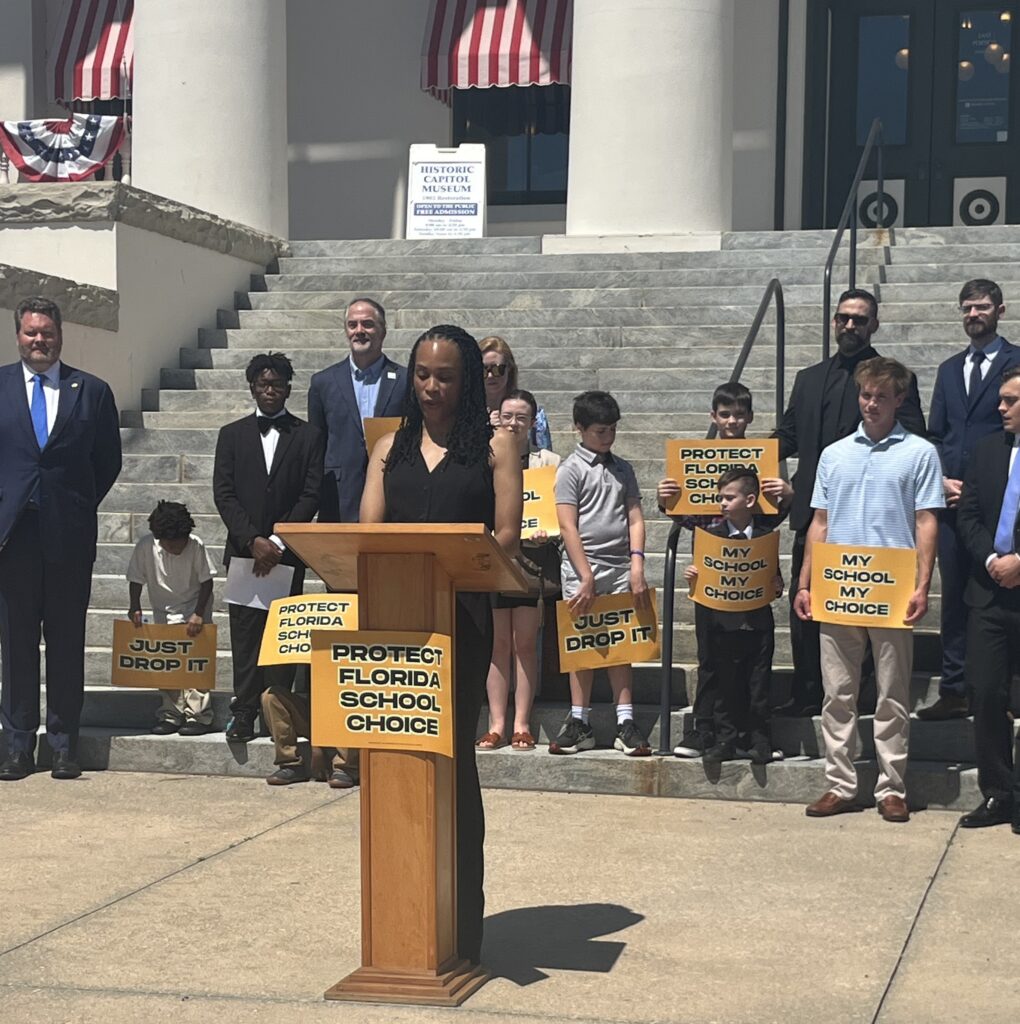
“The scholarships are VERY important to me,” said Kiteka Walker, whose son, Rashad, is in seventh grade at Dixon School for Arts & Sciences in Pensacola. After attending previous schools and homeschooling Rashad, he asked to return to school. She sent him to Dixon because it was the right fit, offering Rashad opportunities to participate in student government, the robotics team, and other enriching activities. The Florida Family Empowerment Scholarship he received made it affordable for him to attend the private school while his two younger brothers attended a private elementary school. If the lawsuit succeeds in eliminating the scholarships, Walker said she would have to homeschool him again because she could not afford private school for three children.
“Parents choose where we send our children to daycare, we choose where to go to college. Why can’t we do the same with K-12 schools?”
Rashad Walker, who traveled to the event with his family, shared how he is thriving at the school his mother chose for him.
“Dixon has been the perfect fit for me. It has a lot of culture and provides a bunch of opportunities in band, art, singing, technology, and media,” he said.
Rashad, who also participates in robotics and serves on the student council, said the school encourages him to try new things, like playing a piano that had been gathering dust at home for years.
“Dixon inspired me to teach myself to play the piano. I practice every day on that piano at home. No more dust,” he said.
Last fall, when he was hospitalized for three weeks following knee surgery, Rashad created craft kits called DUCK bags that help kids combat boredom. He sold the kits at business fairs and is making some to donate to children’s hospitals.
None of that would have happened if it weren’t for Dixon, he said. And Dixon wouldn’t have happened if it weren’t for the scholarship.
“That’s why I don’t understand this lawsuit,” Rashad said. “Why get rid of something that is life-changing for other people? That helps them achieve better things in life?”
Rita Brown can see proof that education choice changes lives every day at Brownsville Preparatory Institute in Tallahassee, a private school she founded more than 20 years ago.
The school began as a pre-kindergarten and now serves 95 students through third grade. Brownsville is in a low-income community. Most parents can’t afford private education after their 4-year-olds complete the state-subsidized pre-kindergarten program.
The scholarships, Brown said, changed that.
It allowed her to add grades. Today, Brownsville students typically learn to read at age 3 and are adding, subtracting, writing, and learning cursive.
“We are the best school in our neighborhood,” she said. “Florida’s education choice scholarships have been a vital part of that.”
If the teachers union wins in court, Brown said, the school would lose most of its school-age children.
“That K-3 program would probably die. It would be devastating for our parents. We have all these students doing amazing things, but they would be forced to go to schools that don’t meet their needs. “
She called the lawsuit “frivolous” and “an attempt to turn back the clock.” But Florida is too embedded in education choice to return to a bygone era.
“At the end of the day, we need to be collaborative in educating all students,” Brown said.
The event inspired a lawmaker to attend to voice his opposition to the lawsuit.
State Sen. Jonathan Martin, R-Fort Myers, said empowering parents to choose the best options for their children does not take away resources from other students and makes America “the light on the hill that Ronald Reagan talked about.”
Florida’s robust scholarship programs have led the way and “will continue to make sure our light stays the brightest, not just in this country but around the world.”
You may have read or seen a story this week about the Florida Education Association, the state's largest teachers union, filing a lawsuit challenging the state’s scholarship programs and its charter schools.
Basically, the union is claiming that because private and charter schools don’t have to follow the same rules as district schools, the funding of these programs violates the Florida state constitution. The state constitution has a provision that Florida must provide a "uniform, efficient, safe, secure, and high-quality system of free public schools".
The union wants the courts to interpret this provision to mean the state can fund nothing but district-run schools, or at least make all schools that receive state funding be “uniform.”
Of course, the whole purpose of education choice is to create alternatives to traditional district schools to meet the needs of Florida’s incredibly diverse students.
Today, over 50% of taxpayer-funded K-12 students in Florida do not attend their zoned district school. In Miami Dade, our largest district, that figure is over 70%. The largest category of choice is district-run choices: magnets, open enrollment, career academies. Districts have admirably responded to competition.
In a ruling from 20 years ago, the state Supreme Court cited this uniformity provision when ruling that a small scholarship program was unconstitutional. The Harvard Law Review called the ruling an “adventurous reading and strained application” of Florida’s constitution. In contrast, a legal challenge to the tax credit scholarship was defeated in 2017.
The justices on the state Supreme Court — and their legal philosophy — is very different than even a decade ago. It would be very difficult to imagine that this court would interpret the uniformity provision in the same way as 20 years ago.
However, it will be very important to demonstrate to everyone how important education choice is.
Step Up led the coalition that defeated the lawsuit the union brought in 2014. This effort was a wonderful opportunity to show the country what choice meant to Florida families. The culmination of this effort: over 10,000 people came to Tallahassee to show their support for choice:
There will be an even stronger coalition this time around.
Charter schools. The Pembroke Pines Charter Schools system, which recently cut teacher pay, is asking parents to pay $1,000 per student per year to restore the system's reserves. South Florida Sun Sentinel. Gov. Rick Scott signs the bill boosting accountability for charter schools. Orlando Sentinel.
 Common Core. FEA President Andy Ford says too much testing could sour the public on it. StateImpact Florida.
School grades. Tony Bennett meets with the school grades task force, which includes a number of superintendents, but says he won't make changes just to soften the blow of bad grades. Orlando Sentinel, Tampa Bay Times, StateImpact Florida, Palm Beach Post, News Service of Florida, Tallahassee Democrat.
Dual enrollment. Tony Bennett says districts and state colleges need to better collaborate in the wake of the Legislature's decision to shift costs to districts. Gradebook.
Parent power. The Pensacola News Journal writes up the new law that gives more power to parents of students with disabilities.
Superintendents. Duval's Nikolai Vitti: "Folks here know that public education can be better. And they’re willing to put their shoulder to the wheel to make it better." StateImpact Florida.
Teachers unions. The Broward union wins an arbitration case involving changes to the high school schedule. South Florida Sun Sentinel, Miami Herald.
Tardiness. Alachua looks for ways to crack down on chronic tardiness. Gainesville Sun.
School spending. Walton will consider upping the millage rate for capital improvements. Northwest Florida Daily News.
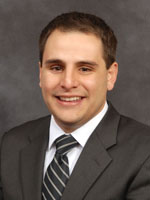
Rep. Trujillo is a co-sponsor of the House parent trigger bill
The parent trigger bill is back in the Florida Legislature this year and, judging by the spirited 8-5 party line vote it got in its first committee stop Thursday, perhaps as contentious as ever. But unlike last year, some Florida parents and child advocates not only voiced support, but drove to Tallahassee to tell lawmakers in person.
Former Marion County teacher Karen Francis-Winston trekked 200 miles from Ocala with her daughter to testify in favor of the bill sponsored by Republican Reps. Michael Bileca and Carlos Trujillo.
Pastor Alfred Johnson came from Tampa,where he said he serves a low-income community.
“I don’t understand what’s the matter with empowering parents to make a recommendation,’’ he told the Choice & Innovation Subcommittee. “We’re doing nothing but recognizing they have a voice, a say in the process.’’
House Bill 867, with an identical version filed by Sen. Kelli Stargel, R-Lakeland, allows parents with children in an F-rated school to petition the school district to consider a turnaround plan that could include bringing in a charter school operator. The petition would need signatures from a majority of parents. (more…)
Tutoring oversight. In the first part of a two-part series on a requirement initially mandated by No Child Left Behind, a Tampa Bay Times investigation finds at least 36 of 456 tutoring companies in Florida are headed by people with criminal records. In part two, the Times traces last year's last-minute legislative push to keep the mandate in place.
Educator oversight. Sarasota Herald Tribune: "As Bradenton police investigate allegations that a Manatee High School assistant football coach groped a female student, they are also trying to determine who knew about the girl's claims and why no one notified law enforcement as required by law."
Teacher bashing? A StateImpact Florida story headlined "Teachers Question Why Proposed Pay Raises Come Before Teacher Evaluations" quotes a single teacher who says, “For a while now we’ve been hearing how bad we are. [That] we need to weed out bad teachers, there’s so many bad teachers.” Ocala Star Banner editorial page editor Brad Rogers writes in this column: "There are so many wildly talented, caring and dedicated teachers in Marion County’s schools that unfairly take abuse and blame and criticism for what is wrong with our schools and our society, when in truth they represent what is most right and bright and promising about our schools and our society."
Teacher pay. Sen. Bill Galvano, chair of the Senate Education Appropriations Committee, suggests Gov. Rick Scott's proposal for across-the-board raises clashes with performance pay, reports the Florida Current. The South Florida Sun Sentinel also writes up the debate over proposals for higher teacher pay.
Strange bedfellows. The Florida Education Association plans to join the Florida Department of Education in fighting the Florida Times-Union's request for teacher evaluation data.
Tony Bennett. He talks to North Florida superintendents about teacher evals and notes he encouraged his daughter to become a teacher: "“I don’t want it written on my headstone: ‘Here lies the man that ruined the career his daughter chose.’ ” Tallahassee Democrat.
Teachers unions. The United Teachers of Dade will elect a new leader this week. Miami Herald. (more…)
Teaching to the test. The FEA is rallying members to a petition started by UFS Professor/blogger Sherman Dorn. Gradebook.
Charter schools. In a vote along party lines, the House Choice and Innovation Subcommittee approves a bill that would allow charter schools to move into unused district buildings. redefinED. Coverage also from the Palm Beach Post, Tallahassee Democrat, Gradebook, StateImpact Florida.
Poverty. South Florida Sun Sentinel: "More than half a million kids under 18 in Broward, Palm Beach and Miami-Dade counties live in low-income households that earn up to 200 percent of the Federal Poverty Guidelines, the National Center for Children in Poverty at Columbia University reports. For a single mom and child, that translates into an income of $30,260 a year or less."
School security. A jury orders the Palm Beach County School Board to pay $1.7 million in a case involving a mentally challenged, 3-year-old girl who was sexually attacked by a 15-year-old ninth grader on a school bus in 2007, reports the South Florida Sun Sentinel. More from the Palm Beach Post. A Hernando County middle school teacher on paid administrative leave since last April is on a keep-off-campus list generated by district officials after the Newtown tragedy, reports Hernando Today. Osceola will beef up police presence at elementary schools, reports SchoolZone. The video of a girl beating another girl on a Pasco school bus gets posted on Facebook; arrests ensue, reports the Tampa Bay Times. An 11-year-old, special needs student in Duval either falls or jumps out of a school bus and sustains life threatening injuries, reports the Florida Times Union.
Teacher evaluations. The Florida Times-Union files suit against the Department of Education to force the release of teacher evaluation data. (more…)
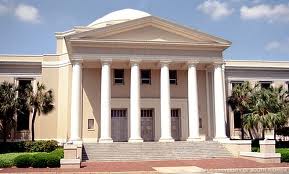 Pension ruling. In a case brought by the state teachers union, the Florida Supreme Court rules 4-3 that it is constitutional for the state to require teachers and other state workers to contribute 3 percent of their pay towards their pensions. Coverage from the Herald/Times Capital Bureau, Palm Beach Post, Lakeland Ledger, Orlando Sentinel, Daytona Beach News Journal, Tallahassee Democrat, Associated Press. StateImpact Florida considers potential impacts on the lawsuit against SB 736.
Teachers in Palm Beach and Broward are “devastated,” reports the South Florida Sun Sentinel. “Bitter disappointment,” writes the Tampa Tribune. “Dashed hopes,” writes the Gainesville Sun. The state should offer modest raises to “lessen the sting,” editorializes the Tampa Bay Times. Gov. Rick Scott should convert the savings into better teacher pay, editorializes the Palm Beach Post.
School safety. Gov. Scott will “listen to ideas” but not push for gun law changes, reports SchoolZone. Some Pinellas schools will consider “buzz-in access,” reports the Tampa Bay Times. Officials in the Hernando district are quietly dropping the issue, the Times also reports. The Palm Beach County district will spend $400,000 on school police aides, with more expenses on the way, reports the Palm Beach Post. Escambia Superintendent Malcolm Thomas wants armed, plainclothes marshals, reports the Pensacola News Journal.
Charter schools. The Clay County School Board shoots down an application for a performing arts academy. Florida Times Union.
Test score limbo followup. State Sen. John Legg says fix the problem with concordant scores, pronto. Tampa Bay Times.
Teacher evals. Pasco officials say in response to a query from Patricia Levesque at the Foundation for Florida’s Future that the district isn’t ready for the new requirements, given the need to develop hundreds of new tests, reports the Tampa Bay Times. (more…)

Image from schoolsecurity.org
School safety. Superintendents and lawmakers talk about more funding for more security. Coverage from Gradebook, St. Augustine Record, Sarasota Herald Tribune, Daytona Beach News Journal. Some are worried about “open campuses,” reports SchoolZone. A bill is filed that would require private schools to get safety alerts, just like public schools, from police departments and other emergency response agencies, reports redefinED.
The chairman of the Osceola County School Board, Jay Wheeler, writes in this Orlando Sentinel op-ed that the federal government should tax guns and bullets to pay for school guards: “When 26 students and school staff get killed by a crazed gunman in a public elementary school, it is a sad wake-up call for all of us that we have to do a better job protecting ourselves from our own freedoms.”
In Palm Beach County, mayors plead with the school board to install metal detectors in every school, reports the South Florida Sun Sentinel. More from the Palm Beach Post. In Lee County, deputies begin patrolling elementaries, reports the Fort Myers News Press. More from the Naples Daily News.
Test score limbo. If high school students fall short on the FCAT, he or she can still graduate if they get a high enough score on the ACT or SAT. But the state has yet to set new concordant scores for the other tests since upgrading the FCAT, leaving many students in limbo. Tampa Bay Times.
Charter school laws. SchoolZone notes the Center for Education Reform’s annual report card.
Why grading schools is good. EdFly Blog.
Vouchers and creationism. A Jacksonville school is among those highlighted in this MSNBC op-ed by student activist Zack Kopplin.
Privatization. The Bay County school district moves towards privatizing bus service. Panama City News Herald. (more…)

