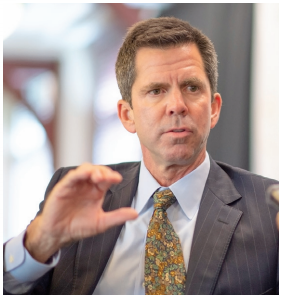
John Kirtley
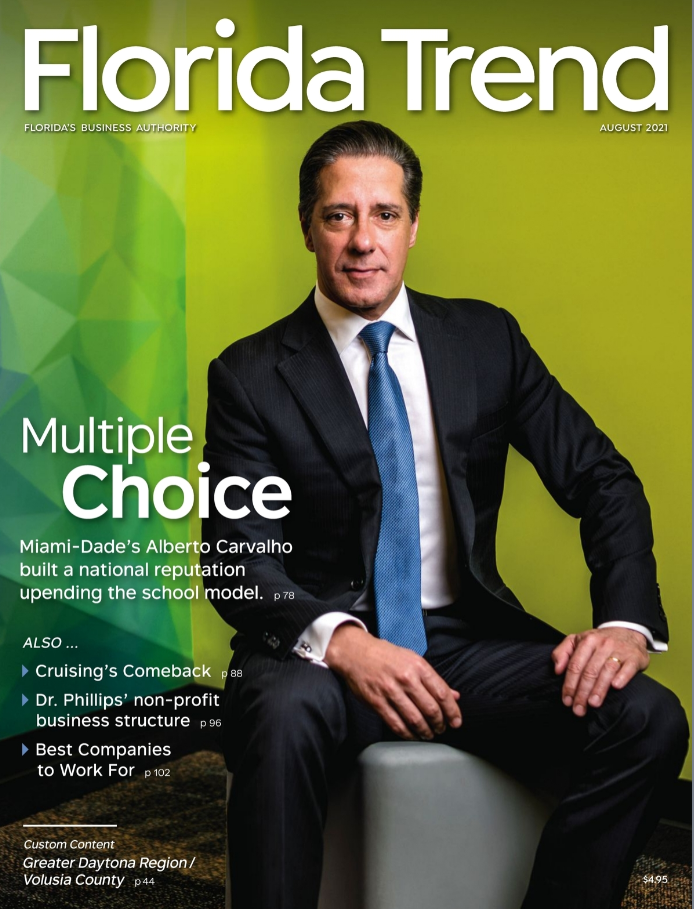
In the cover story for its latest issue, Florida Trend, the state’s leading business publication, shines a light on Alberto Carvalho, the innovative superintendent of the Miami-Dade school district. With nearly three-quarters of the students in that district exercising options beyond their zoned neighborhood schools, Miami-Dade is portrayed as head and shoulders above other districts in its efforts to pursue education choice as a pathway to equity.
A handful of insightful sidebars accompany the story, one of which features the voice and views of Step Up For Students founder and CEO John Kirtley, who has been deeply involved in education choice in Florida and across the nation from the start. Kirtley muses on Florida’s incredible success over the past quarter-century in moving toward a new definition of public education that empowers families to make decisions that are best for their children’s unique needs.
Perhaps more important, he looks ahead to see what’s likely to come next in the education choice world: a demand from families for more customization and how that will be accomplished.
“Many families will be ready to go back to the traditional brick-and-mortar school,” Kirtley writes. “But many families will discover that they like the flexibility and customization that the pandemic forced them to develop. Maybe they like having their child take some classes online and some in person. Maybe they like having their child move along at their own pace in math online, but they want in-person classes for other topics. Maybe they had a great experience supplementing their math classes with tutoring at Kumon or Mathnasium … These are all situations tailor-made for ESAs (education savings accounts).”
You can read the full essay here.
 Media coverage in Florida is often negative when it comes to how school choice and education choice have become mainstream – and how advantageous that transformation has been for millions of families.
How refreshing, then, to see the take from the state’s leading business publication.
For its latest cover story, widely respected Florida Trend features Alberto Carvalho, the innovative, independent-minded superintendent of the Miami-Dade school district.
Miami-Dade is the most choice-rich district in arguably the most choice-rich state. In Florida, nearly half the students in PreK-12 now attend something other than their zoned neighborhood schools. In Miami-Dade, that figure approaches 75%.
This is intentional. For years, Carvalho has been using a colorful tsunami metaphor (see here and here) to help folks understand why he and his gigantic district – the fourth biggest in the nation – decided to embrace choice rather than fight it.
Here’s how Carvalho describes it in the Florida Trend piece:
“Ability is evenly distributed. However, access and opportunity aren’t. So, we have rushed to create choice programs in areas and ZIP codes where they did not exist. I know we opted for a very different route than many school districts that fought parental choice. We recognized the tsunami of choice was upon us, and rather than be engulfed and annihilated by it, we chose to ride on top of it.”
Miami-Dade has the highest rate of private school enrollment of any big district in Florida, and now has at least 440 private schools participating in school choice scholarship programs. Until recently, it also ranked No. 1 in percentage of students enrolled in charter schools. (It’s now No. 2, after fast-growing Osceola County near Orlando.)
All that non-district choice spurred Miami-Dade to create the most diverse portfolio of district choice in Florida, including more than 100 often amazing magnet schools like this one. And all that choice may help explain why Miami-Dade is now one of America’s top performing urban districts.
Two years ago, in preparing a paper on Miami-Dade for an “Education Cities” conference at Harvard, I googled “elementary schools near me” outside a Catholic school in North Miami that’s educating hundreds of school choice scholarship students. Within 4 miles, there were six charter schools (not including a KIPP charter school 15 minutes away); seven private schools accepting choice scholarships (including another Catholic school); seven magnet schools; and three district K-8 schools (which are choice schools in Miami-Dade).
A generation ago, most of these options didn’t exist – and the ones that did would not have been accessible to lower-income parents.
The Florida Trend piece includes a couple of excellent side bars, including a must-read on Florida’s changing education landscape from Step Up For Students Chair John Kirtley. (Step Up hosts this blog.)
To hear more from Carvalho, check out these podcasts from redefinED and Education Next.
Mississippi: State lawmakers are expected to try again this year to pass charter school legislation, but some suburban Republicans continue to have concerns (Desoto Times Tribune). Lt. Gov. Tate Reeves says there's bipartisan support for charter schools (Associated Press). More from the Memphis Commercial Appeal. At least one lawmaker is talking about the possibility of tax credit scholarships (GulfLive.com)
 Florida: Jonathan Hage, CEO of Charter Schools USA, is named Florida Trend magazine's Floridian of the Year for 2012. A new state lawmaker works in public schools as an assistant principal, but supports publicly funded private school choice options (redefinED).
Arizona: The state's education savings accounts program expands to include students from the lowest-performing public schools (Arizona Republic.)
Oregon: The founders of a charter school chain are accused of racketeering and money laundering and charged with scamming $17 million from the state (The Oregonian).
Washington D.C.: Charter schools in the district expel students at far higher rates than traditional public schools (Washington Post).
Indiana: Lawmakers will look at expanding the state's voucher program during the upcoming legislative session (Associated Press).
Louisiana: The legal challenge against the state's voucher program heads to the state supreme court (New Orleans Times Picayune). (more…)
 Andy Ford, president of the Florida teachers union, has done his darnedest to kick out many of the Republicans who continue to run both the executive and legislative branches in this state, and they don’t usually take a shine to his approach. Just the other day, Ford bought a two-page ad in Florida Trend, a leading business magazine, to proclaim: “IT’S MIDNIGHT IN FLORIDA. Do You Know Where Your Public Education Dollars Are Going?” He added: “The foundation of public education in the Sunshine State is devious, unreliable and crumbling before our very eyes.”
Given all that, you’d think Ford would be in a better mood at the Democratic National Convention in Charlotte. And you’d think he’d especially appreciate the speech from U.S. Education Secretary Arne Duncan, who spent much of his time criticizing Mitt Romney for gutting education spending “to cut taxes for millionaires and billionaires.” Even American Federation of Teachers President Randi Weingarten found some reason for cheer, tweeting, “Duncan: "teachers matter" and "no teachers should have to teach to the test"-very different from Romney/Ryan/Rhee agenda.”
Was Ford moved, too? Not so much. As the secretary wrapped up, he tweeted six words: “Glad Duncan is off the stage!”

